Calorie Deficit Calculator
Calculate the exact calorie deficit needed to reach your goal weight. Choose from mild, moderate, or aggressive deficit plans, each showing your daily target, weekly fat loss, and a personalised timeline.
Quick answer
A deficit of about 300 to 500 kcal below maintenance loses roughly 0.25 to 0.5kg a week while protecting muscle. This calculator sets that target from your maintenance calories and how fast you want to go.
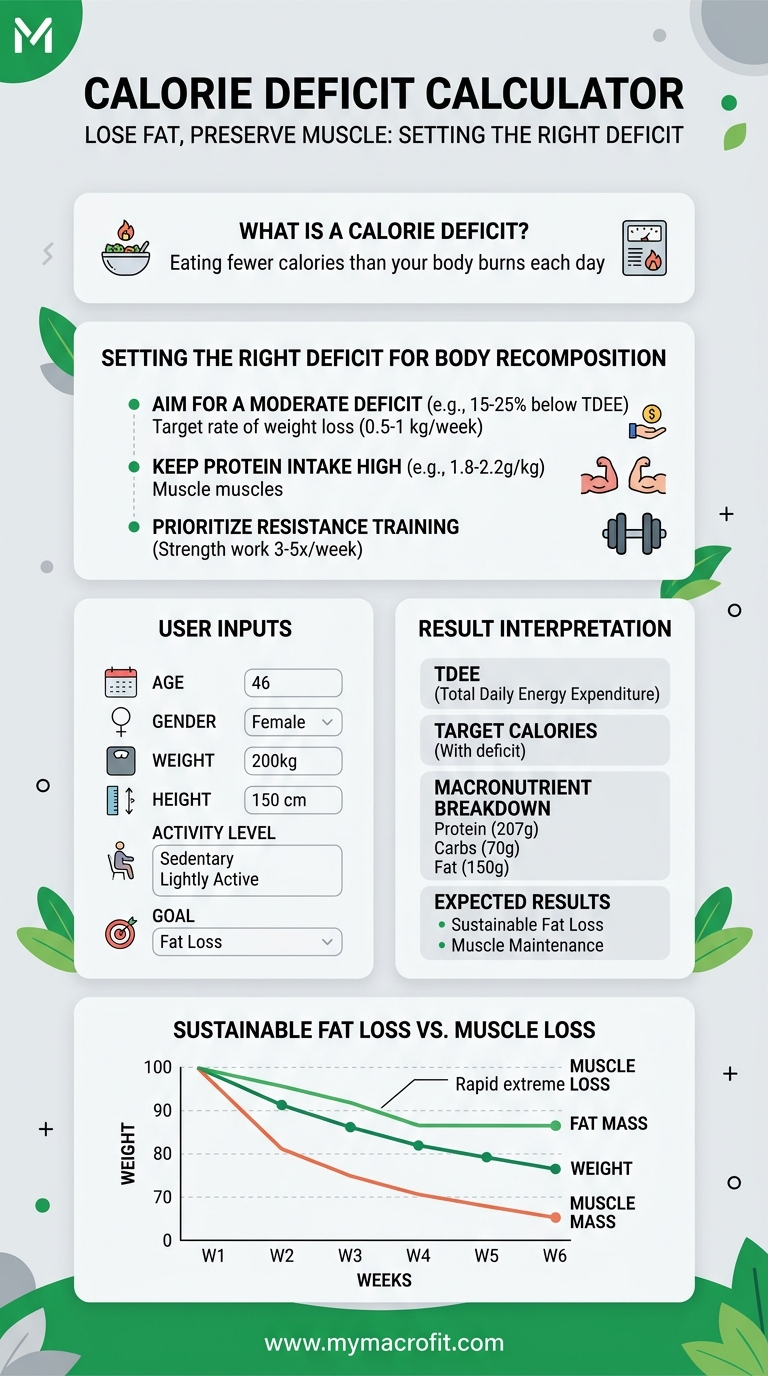
What Is a Calorie Deficit and How Does It Work?
A calorie deficit is the gap between how many calories you eat and how many your body burns. When you consistently eat less than your Total Daily Energy Expenditure (TDEE), your body must find energy elsewhere, and it turns to stored body fat.
One kilogram of body fat contains roughly 7,700 kcal of stored energy. A daily deficit of 500 kcal means 3,500 kcal of deficit per week, about half a kilogram of fat loss. It sounds simple because it is, at the macro level. The challenge is in the execution.
How to Choose the Right Deficit Size
The "right" deficit depends on your starting point, training volume, and how much time you have:
- Close to goal weight (5–10 kg to lose): Use a mild deficit (−250 kcal). You have less fat to burn and more muscle to protect.
- Moderate fat loss phase (10–25 kg): A moderate deficit (−500 kcal) with high protein is the gold standard.
- Significant fat loss needed (>25 kg): An aggressive deficit (−750 kcal) can accelerate progress but should be cycled with 1–2 week diet breaks every 6–8 weeks to manage hormonal adaptations.
Athletes and heavy lifters should generally stay at mild-to-moderate deficits to fuel performance and muscle protein synthesis. Sedentary individuals without training goals can tolerate larger deficits.
Protecting Muscle While in a Deficit
The biggest risk of aggressive dieting is losing muscle alongside fat, a process called lean tissue catabolism. Three strategies significantly reduce this risk:
- High protein intake: Aim for 1.8–2.2 g of protein per kg of body weight. This is the single most evidence-backed strategy for muscle preservation during a cut.
- Resistance training: Lifting weights signals your body to keep muscle even when calories are low. Aim for 3–4 sessions per week targeting major muscle groups.
- Moderate deficit: Very aggressive deficits (greater than 1,000 kcal/day) dramatically increase muscle loss rates regardless of protein intake.
Why Deficits Shrink Over Time
As you lose weight, your TDEE decreases, you're carrying less mass, which requires less energy to move. A deficit that produced 0.5 kg/week loss at 90 kg will produce less loss at 75 kg using the same calorie target.
This is why recalculating every 4–6 weeks (or after every 3–5 kg of loss) is essential. If fat loss stalls for 3 consecutive weeks, reduce calories by 100–150 kcal rather than making large cuts that impair training and recovery.
Refeed Days and Diet Breaks
Extended calorie deficits cause hormonal adaptations, leptin drops, cortisol rises, and metabolic rate can decrease by 10–15% beyond what weight loss alone predicts (adaptive thermogenesis). Planned refeed days (eating at TDEE for 1–2 days) and diet breaks (1–2 weeks at maintenance every 6–8 weeks) help manage these adaptations, improve adherence, and make long diets more sustainable.
Frequently Asked Questions
What is a calorie deficit?
How large should my calorie deficit be?
What is the difference between mild, moderate, and aggressive deficits?
Will I lose muscle on a calorie deficit?
How long will it take to reach my goal weight?
Should I eat back calories burned from exercise?
What is the minimum safe daily calorie intake?
How do I calculate my calorie deficit without a calculator?
How it's calculated: this tool uses established, published equations. See the full calculator methodology for the formulas and assumptions behind it.
Results are estimates for general guidance, not medical advice. See our disclaimer, and speak to a qualified healthcare professional before making medical or dietary changes.
Related Tools
Save & share on Pinterest
Click any card to pin it — or share with someone who needs it.
Calorie Deficit Calculator
Calculate the exact calorie deficit needed to reach your goal weight. Choose from mild, moderate, or…
Calculate the exact calorie deficit needed to reach your goal weight. Choose fro…
Read the full guide: Calorie Deficit Calculator
Try the free Calorie Deficit Calculator
Calorie Deficit Calculator — use our free calculators for instant personalised results. No signup re…
Pinterest opens in a new tab. You can edit the description before saving.
Get Your Free Macro Cheat Sheet
One-page PDF with all the key formulas. Free, no spam ever.
Get the Free Macro Guide