BMR vs TDEE: The Complete Explanation

CN · Metabolic Health Coach
BMR and TDEE are the two most confused acronyms in all of nutrition, and I find that genuinely frustrating, because once you see the relationship between them, it's almost beautifully simple. People plug numbers into apps, pick the wrong one, set their calories off a figure that was never meant for that job, and then wonder why the plan isn't working. The error is upstream of everything else.
So let's fix it at the source. I'll show you exactly what each number measures, the simple multiplier that connects them, and which one drives your actual calorie target (spoiler: it's almost never the one people default to). Want the number now? The TDEE Calculator gives you both and your targets for every goal, but the concept is worth two minutes of your time.
The Short Answer
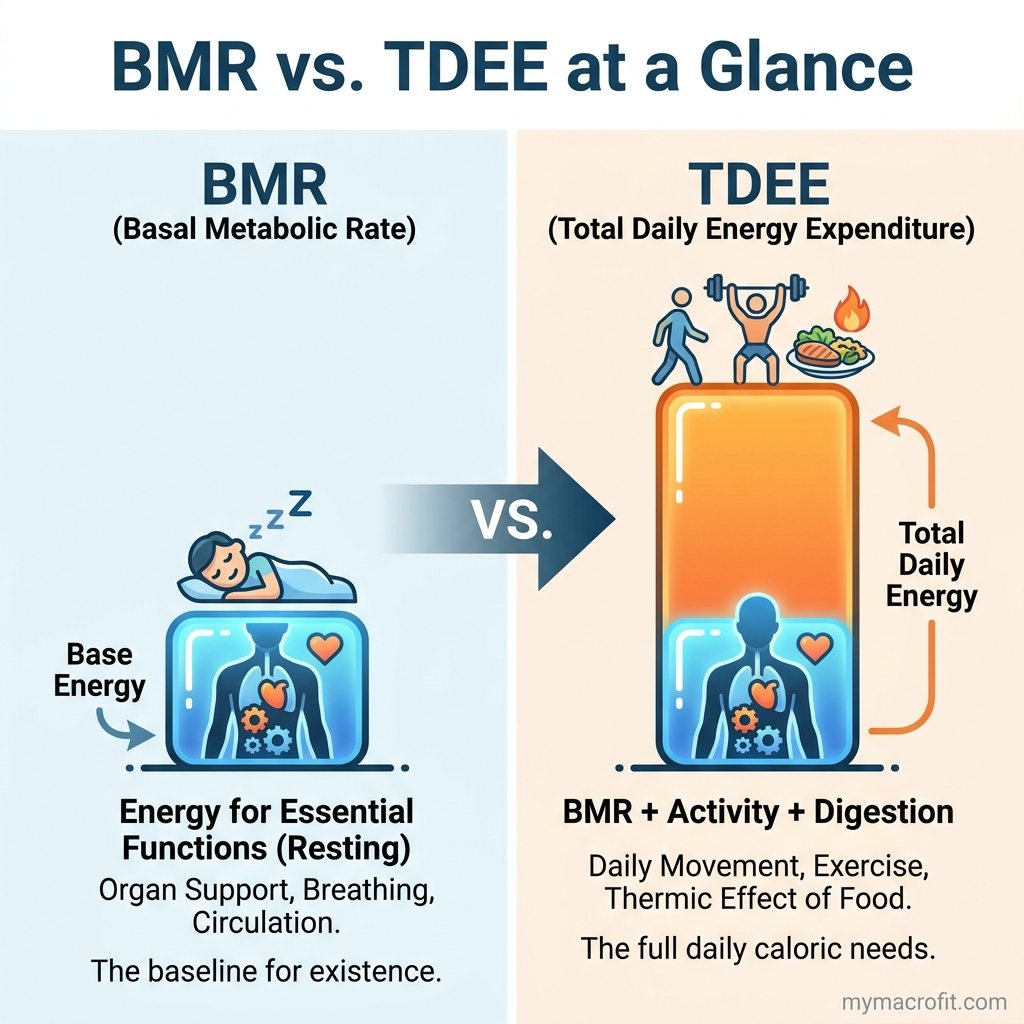
- BMR = calories your body burns doing absolutely nothing (at rest)
- TDEE = calories your body burns living your actual life (rest + all activity)
You should always base your calorie goal on your TDEE, not your BMR.
What Is BMR?
Basal Metabolic Rate (BMR) is the number of calories your body requires to maintain basic physiological functions at complete rest:
- Keeping your heart beating
- Breathing and lung function
- Maintaining body temperature
- Cell repair and regeneration
- Brain function
BMR is measured under specific conditions: lying completely still, in a thermally neutral environment, after at least 12 hours of fasting. In practice, it represents the absolute minimum calories your body needs to survive.
For most people, BMR falls somewhere between 1,200 and 2,200 kcal/day, depending on age, sex, height, and body composition.
What Is TDEE?
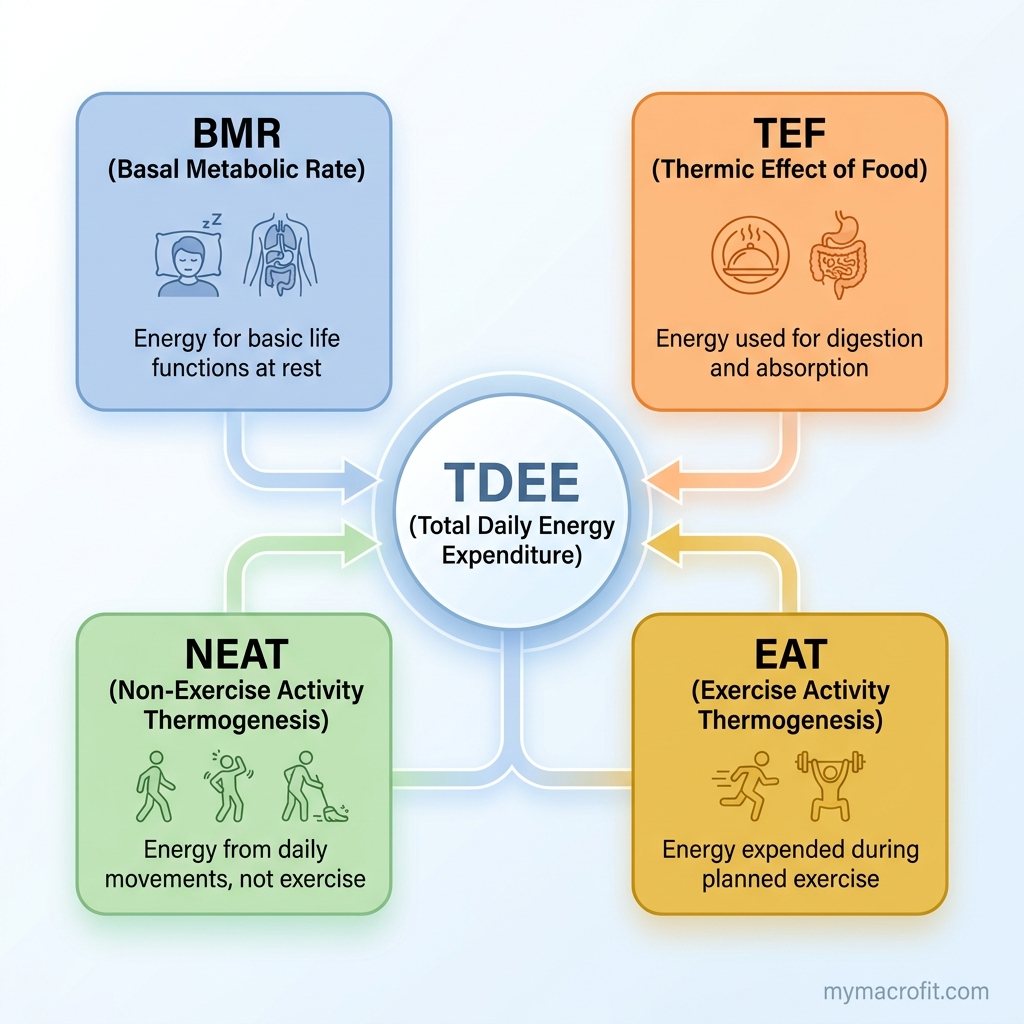
Total Daily Energy Expenditure (TDEE) is your complete daily calorie burn, BMR plus the energy cost of everything else you do:
| Component | What It Includes | % of TDEE |
|---|---|---|
| BMR | Resting metabolism | 60-70% |
| TEF | Digesting food | ~10% |
| EAT | Intentional exercise | 5-15% |
| NEAT | All other movement | 15-30% |
TDEE is the number that actually determines your body weight. Eat above it and you gain weight. Eat below it and you lose weight. Eat at it and you maintain.
The Key Difference: A Practical Example
Take a 35-year-old woman, 165 cm, 65 kg, who works in an office and goes to the gym three times a week:
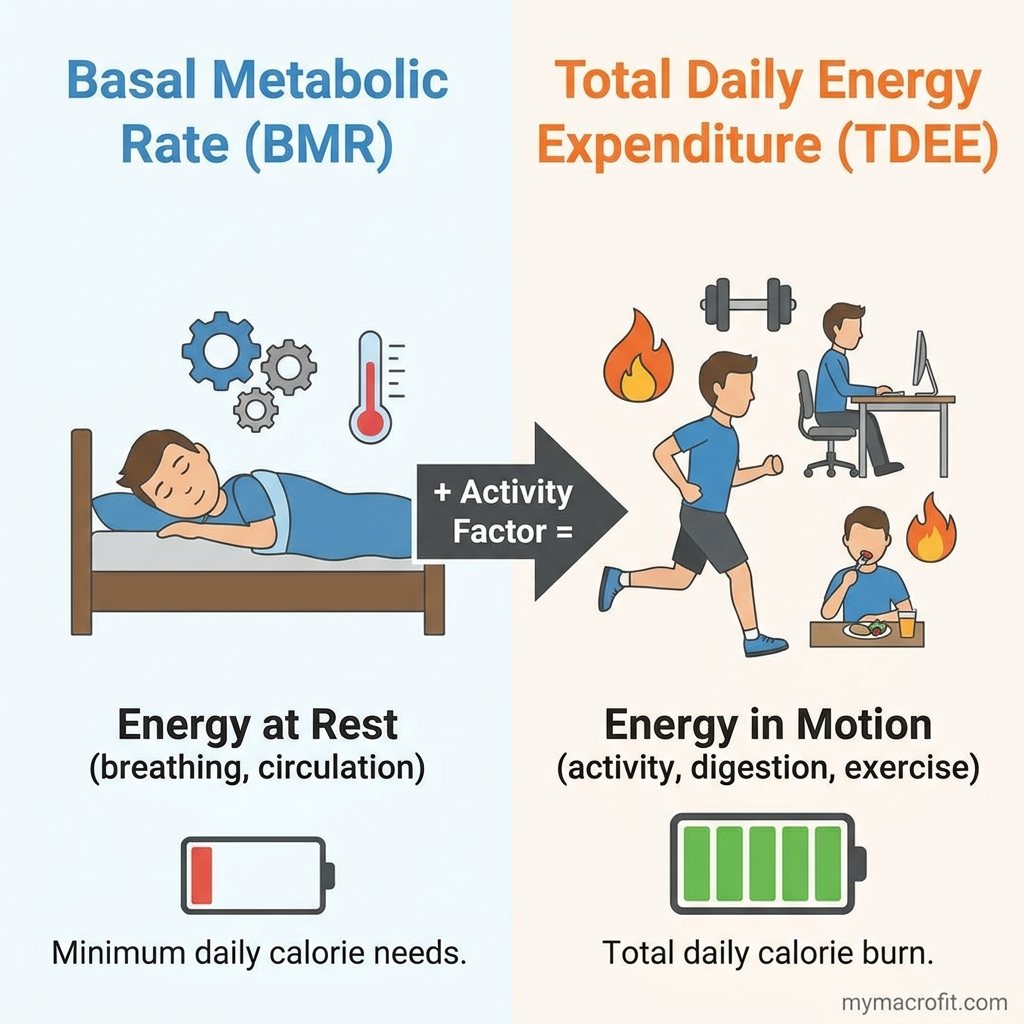
- BMR: ~1,380 kcal (calories burned doing nothing)
- TDEE: ~2,140 kcal (calories burned living her actual life)
The difference, 760 calories, represents all the energy she burns through movement, exercise, and digestion every day.
If she eats 1,380 calories (her BMR), she'd actually be in a 760-calorie deficit, much larger than intended, and likely to cause muscle loss and fatigue.
If she eats 1,640 calories (TDEE minus 500), she's in a sensible calorie deficit for ~0.5 kg/week of fat loss.

Which Formula Calculates Each?
Both BMR and TDEE start with the same base formula. The most accurate is the Mifflin-St Jeor equation (1990):
BMR formula:
- Men: (10 × kg) + (6.25 × cm) − (5 × age) + 5
- Women: (10 × kg) + (6.25 × cm) − (5 × age) − 161
TDEE formula:
- TDEE = BMR × Activity Multiplier (1.2 to 1.9)
The activity multiplier accounts for how much you move throughout the day.
When to Use BMR vs TDEE
Use BMR to:
- Understand your metabolic baseline
- Set a hard minimum calorie floor (don't eat below BMR long-term)
- Track changes in metabolism over time (e.g., after building muscle)
- Estimate the impact of body composition changes
Use TDEE to:
- Set your actual daily calorie target, run the TDEE Calculator to get yours
- Calculate your calorie deficit or surplus
- Plan your macros
- Understand why your weight is changing (or not)
In short: BMR is a diagnostic tool. TDEE is the planning tool.
Does BMR Ever Change?
Yes, and understanding why matters for long-term fat loss:
BMR decreases with:
- Age (muscle mass declines ~3-8% per decade after 30)
- Weight loss (less body mass to maintain)
- Prolonged calorie restriction (adaptive thermogenesis)
- Low protein intake (muscle breakdown)
BMR increases with:
- Resistance training and muscle gain
- Adequate protein intake
- Quality sleep
- Thyroid hormone optimisation
This is why the strategy of "eat less, do more cardio" often stops working after a few months. Losing weight reduces BMR, and excessive cardio without resistance training accelerates muscle loss, further lowering BMR.
The NEAT Problem
One reason TDEE is hard to predict accurately is NEAT (Non-Exercise Activity Thermogenesis), all movement that isn't structured exercise. Research shows that when people start a calorie-restricted diet, their NEAT drops spontaneously:
- Less fidgeting
- Taking elevators instead of stairs
- Moving more slowly
- Sitting for longer periods
This "energy conservation" response can reduce TDEE by 200-400 calories, essentially erasing the deficit you planned. It's one reason why the calculated deficit doesn't always match actual weight loss.
The fix: stay active throughout the day, not just during scheduled workouts. Aim for 8,000-10,000 steps daily regardless of gym sessions.

Practical Summary
| BMR | TDEE | |
|---|---|---|
| What it measures | Resting calorie burn | Total daily calorie burn |
| Includes activity? | No | Yes |
| Use for calorie goals? | No | Yes |
| Changes with activity? | No (only body comp) | Yes (daily) |
| Typical value (avg adult) | 1,400-1,800 | 2,000-2,800 |
Calculate both with the free BMR Calculator and TDEE Calculator, understand what each means, and always build your nutrition plan around your TDEE. The BMR is a useful reference, your TDEE is the number that actually drives results.
Sources
- Validation of the Mifflin-St Jeor equation, Frankenfield et al., Journal of the Academy of Nutrition and Dietetics, 2005
- Resting metabolic rate and body composition, Ravussin et al., American Journal of Clinical Nutrition, 1982
- Total energy expenditure and physical activity, NHS, 2023
Save & share on Pinterest
Click any card to pin it — or share with someone who needs it.
BMR vs TDEE: The Complete Explanation
Learn the exact difference between BMR and TDEE, which one to use for your calorie goal, and how the…
Learn the exact difference between BMR and TDEE, which one to use for your calor…
Read the full guide: BMR vs TDEE: The Complete Explanation
Try the free BMR Calculator
BMR vs TDEE: The Complete Explanation — use our free calculators for instant personalised results. N…
Pinterest opens in a new tab. You can edit the description before saving.
Ready to get your numbers?
Free calculator, instant results, no signup required.
Frequently Asked Questions
What is the difference between BMR and TDEE?+
How accurate are BMR calculators?+
Can I increase my BMR?+
How often should I recalculate my TDEE?+
Should I ever eat below my BMR?+
Is my BMR the same as my resting metabolic rate (RMR)?+
About the Author

I'm a certified nutritionist and metabolic health coach. I went deep on keto and metabolism after reversing my own insulin resistance, and I'd rather give you the actual numbers than a hand-wave.
View full profile →