TDEE Calculator: What It Is and Why It Matters

CN · Metabolic Health Coach
Okay, let me geek out for a second, because this is genuinely my favourite number in all of nutrition. If you've ever watched two people eat identical meals and get completely opposite results, one shredding fat, the other gaining, TDEE is the hidden variable explaining the whole thing. It's the single most important number in nutrition, and somehow most people have never heard of it.
I came to this stuff through necessity (insulin resistance at 26 will do that to you), and understanding TDEE was the moment the whole puzzle clicked. So let me break it down properly: what TDEE actually is, the equations behind it, and how to turn it into real gram-by-gram targets. When you want your number, the TDEE Calculator crunches it in seconds, but stick with me, because understanding the why is what makes it stick.
What Does TDEE Stand For?
TDEE stands for Total Daily Energy Expenditure. It's the total number of calories your body burns in a 24-hour period, not just at rest, but including everything: exercise, walking to the kitchen, digesting your food, even thinking.
Think of TDEE as your body's personal daily energy budget. It's the number that determines:
- Whether you gain, lose, or maintain your current weight
- How large a calorie deficit or surplus you need for your goal
- Why your diet stops working as your body changes
Why TDEE Is More Important Than Calories
"Eat less, move more" is technically correct but practically useless without a reference point. TDEE gives you that reference point.
Here's why it matters so much:
Without knowing your TDEE, any calorie target is a guess. 1,500 calories might be a sensible deficit for a sedentary woman who burns 2,000 calories a day, but a dangerous under-eat for an active man burning 3,500. TDEE personalises the math to your body.
The Four Components of TDEE
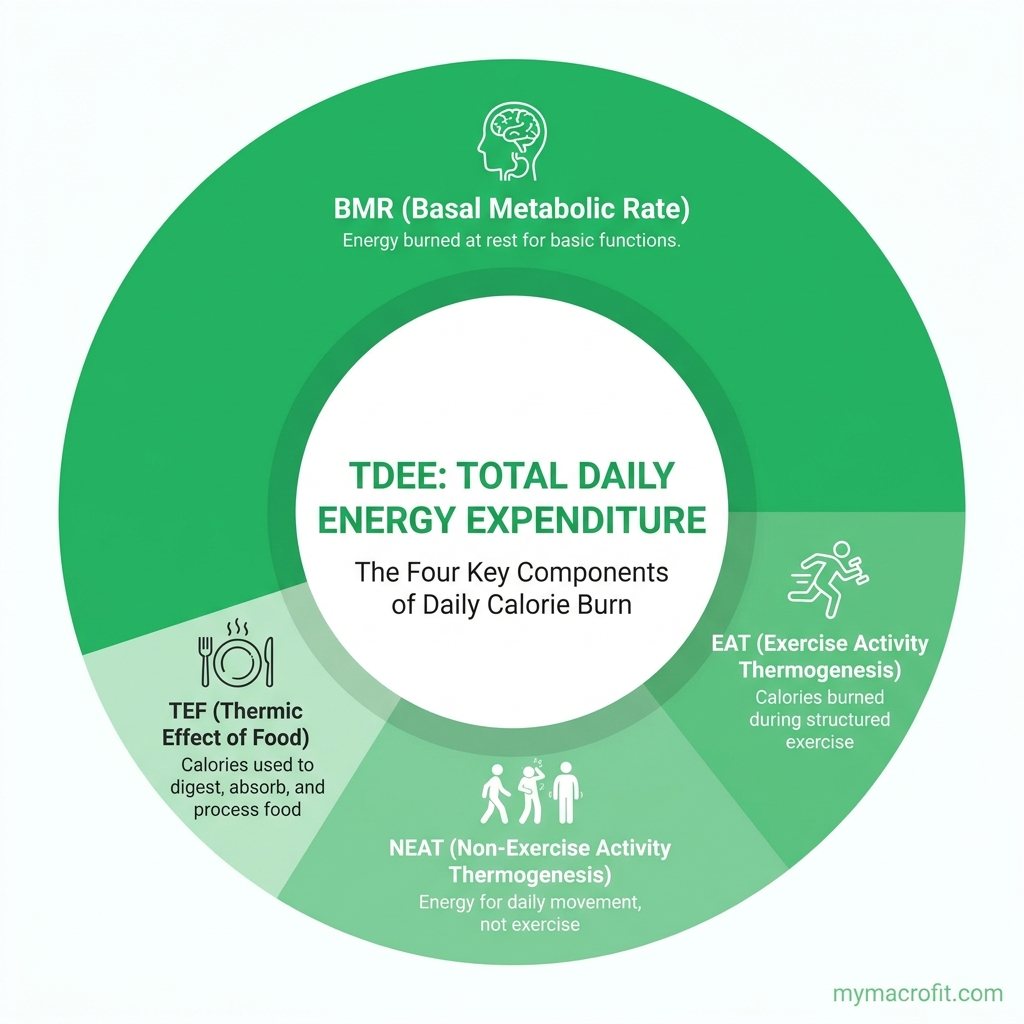
Your total daily calorie burn comes from four sources:
1. BMR (Basal Metabolic Rate), 60-70% of TDEE
The calories your body burns at complete rest to keep you alive: heart beating, lungs breathing, cells repairing. This is the largest component.
2. TEF (Thermic Effect of Food), ~10% of TDEE
Calories burned digesting and processing the food you eat. Protein has the highest TEF (20-30%), carbs are moderate (5-10%), and fat is lowest (0-3%). This is why high-protein diets have a slight metabolic advantage.
3. EAT (Exercise Activity Thermogenesis), 5-15% of TDEE
Calories burned during intentional exercise, gym sessions, runs, cycling. This is the component most people focus on, but it's often the smallest contributor for non-athletes.
4. NEAT (Non-Exercise Activity Thermogenesis), 15-30% of TDEE
All other movement: walking, fidgeting, taking stairs, household chores, gesturing while talking. This is the most variable component, two people with identical BMRs can differ by 500-1,000 kcal/day in TDEE purely based on NEAT.
This is why "I go to the gym but still can't lose weight" is so common. An hour of gym work can easily be cancelled out by 8 hours of sitting.
How Is TDEE Calculated?
TDEE is calculated in two steps:
Step 1: Calculate BMR using the Mifflin-St Jeor equation
- Men: BMR = (10 × weight kg) + (6.25 × height cm) − (5 × age) + 5
- Women: BMR = (10 × weight kg) + (6.25 × height cm) − (5 × age) − 161
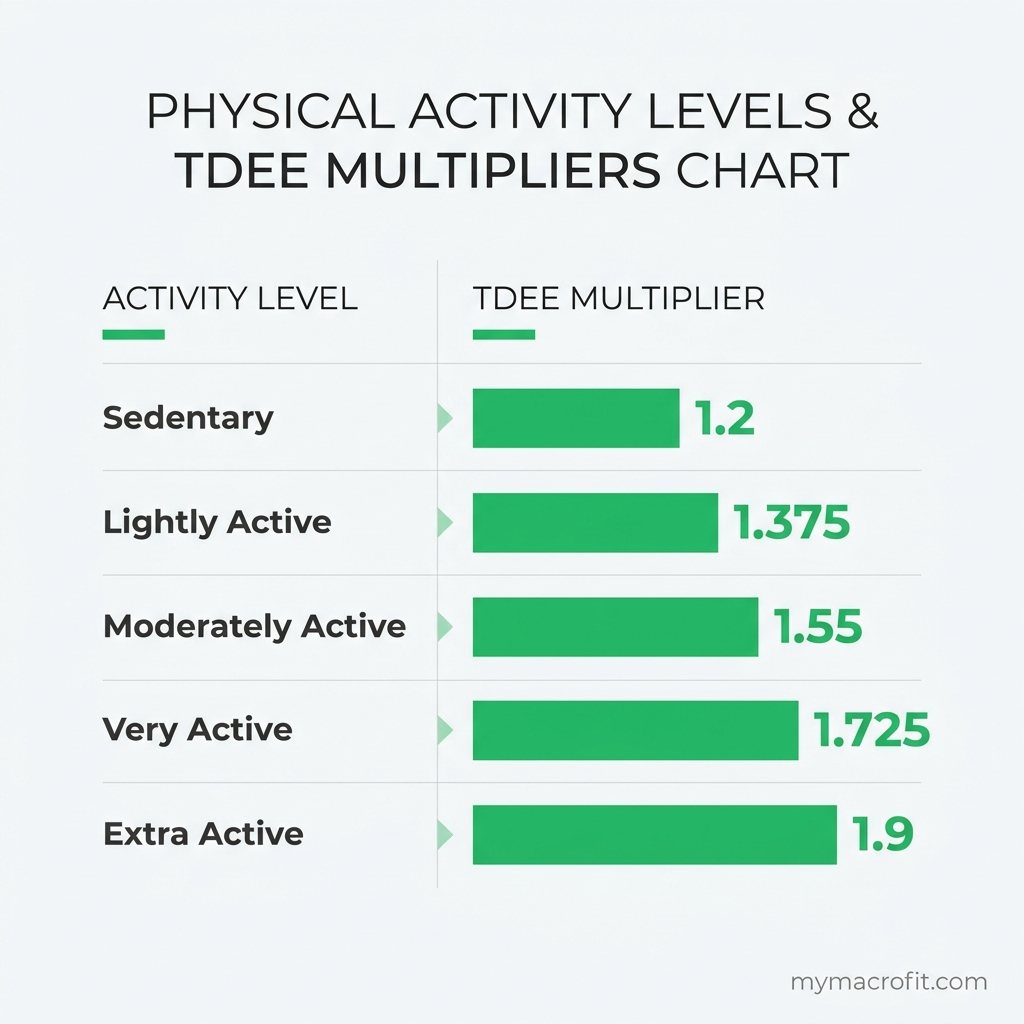
Step 2: Multiply BMR by your activity factor
| Activity Level | Description | Multiplier |
|---|---|---|
| Sedentary | Desk job, no exercise | × 1.2 |
| Lightly active | Exercise 1-3 days/week | × 1.375 |
| Moderately active | Exercise 3-5 days/week | × 1.55 |
| Very active | Exercise 6-7 days/week | × 1.725 |
| Extra active | Physical job + daily exercise | × 1.9 |
The result is your estimated TDEE. Skip the manual calculation and use the free TDEE Calculator, it runs the Mifflin-St Jeor equation for you and shows calorie targets for every goal in one table.
How to Use Your TDEE
Once you have your TDEE, applying it is straightforward:
For fat loss: Eat 250-500 calories below your TDEE. Use the Calorie Deficit Calculator to find your personalised target, this creates a deficit of 0.25-0.5 kg (0.5-1 lb) per week without excessive muscle loss.
For maintenance: Eat at your TDEE. Monitor weight weekly and adjust by 100-150 calories if you drift.
For muscle gain (lean bulk): Eat 200-300 calories above TDEE. Use the Lean Bulk Calculator to dial this in precisely, a small surplus gives your body the energy for muscle growth without excessive fat storage.
The golden rule: Never go below 1,200 kcal (women) or 1,500 kcal (men), regardless of what the math says.
Common TDEE Mistakes
Overestimating activity level, this is the #1 error. Most office workers with 3 gym sessions per week are "moderately active" at best. Choosing "very active" when you're not adds hundreds of phantom calories to your target.
Never recalculating, as you lose weight, your TDEE drops because there's less mass to maintain. Recalculate every 4-6 weeks or whenever you've changed by more than 5 kg.
Confusing BMR with TDEE, eating at your BMR means eating at your resting-only calorie burn, ignoring all activity. This creates an unintentional severe deficit and risks muscle loss.
Ignoring NEAT, if you start a diet and automatically become less active (fidgeting less, taking fewer stairs), your TDEE drops without you realising. This is called "adaptive thermogenesis", your body defending its weight.

How Often Should You Recalculate TDEE?
Recalculate whenever:
- Your weight changes by more than 3-5 kg
- Your activity level changes significantly
- Progress stalls for 3+ consecutive weeks
- You return from a vacation or period of disrupted routine
A good habit is to recalculate every 4-6 weeks during active fat loss or muscle gain phases.
TDEE vs BMR: Which Number Should You Use?
Always use TDEE as your reference point for calorie goals. BMR is a useful diagnostic, it tells you your baseline metabolism, but it doesn't account for the calories you burn living your actual life.
Use BMR to:
- Understand your metabolic baseline
- Compare changes over time (e.g., did building muscle raise your BMR?)
- Set your absolute minimum calorie floor (never eat below BMR long-term)
Use TDEE to:
- Set your daily calorie target
- Plan your deficit or surplus
- Understand why your progress is or isn't happening
The Bottom Line
TDEE is the foundation of every successful nutrition plan. Without it, you're guessing. With it, you have a personalised, science-based target to work from, one that actually reflects your body, your activity, and your goals.
Calculate yours with the TDEE Calculator, apply the appropriate adjustment for your goal, give it 3-4 weeks, and adjust based on real results. That's the entire system.
Save & share on Pinterest
Click any card to pin it — or share with someone who needs it.
TDEE Calculator: What It Is and Why It Matters
Everything you need to know about Total Daily Energy Expenditure, what it is, how it's calculated, a…
Everything you need to know about Total Daily Energy Expenditure, what it is, ho…
Read the full guide: TDEE Calculator: What It Is and Why It Matters
Try the free TDEE Calculator
TDEE Calculator: What It Is and Why It Matters — use our free calculators for instant personalised r…
Pinterest opens in a new tab. You can edit the description before saving.
Ready to get your numbers?
Free calculator, instant results, no signup required.
Frequently Asked Questions
What is TDEE and how is it calculated?+
What is a typical TDEE for women and men?+
Should I eat my TDEE to lose weight?+
Does TDEE change over time?+
About the Author

I'm a certified nutritionist and metabolic health coach. I went deep on keto and metabolism after reversing my own insulin resistance, and I'd rather give you the actual numbers than a hand-wave.
View full profile →