BMI Calculator
Calculate your Body Mass Index instantly. See your BMI category, where you fall on the scale, your ideal weight range, and exactly how much to gain or lose to reach a healthy BMI.
Quick answer
BMI is your weight in kg divided by your height in metres squared. Under 18.5 is underweight, 18.5 to 24.9 is healthy, 25 to 29.9 is overweight, and 30 or more is obese. It is a screening number, not a body-fat measure.
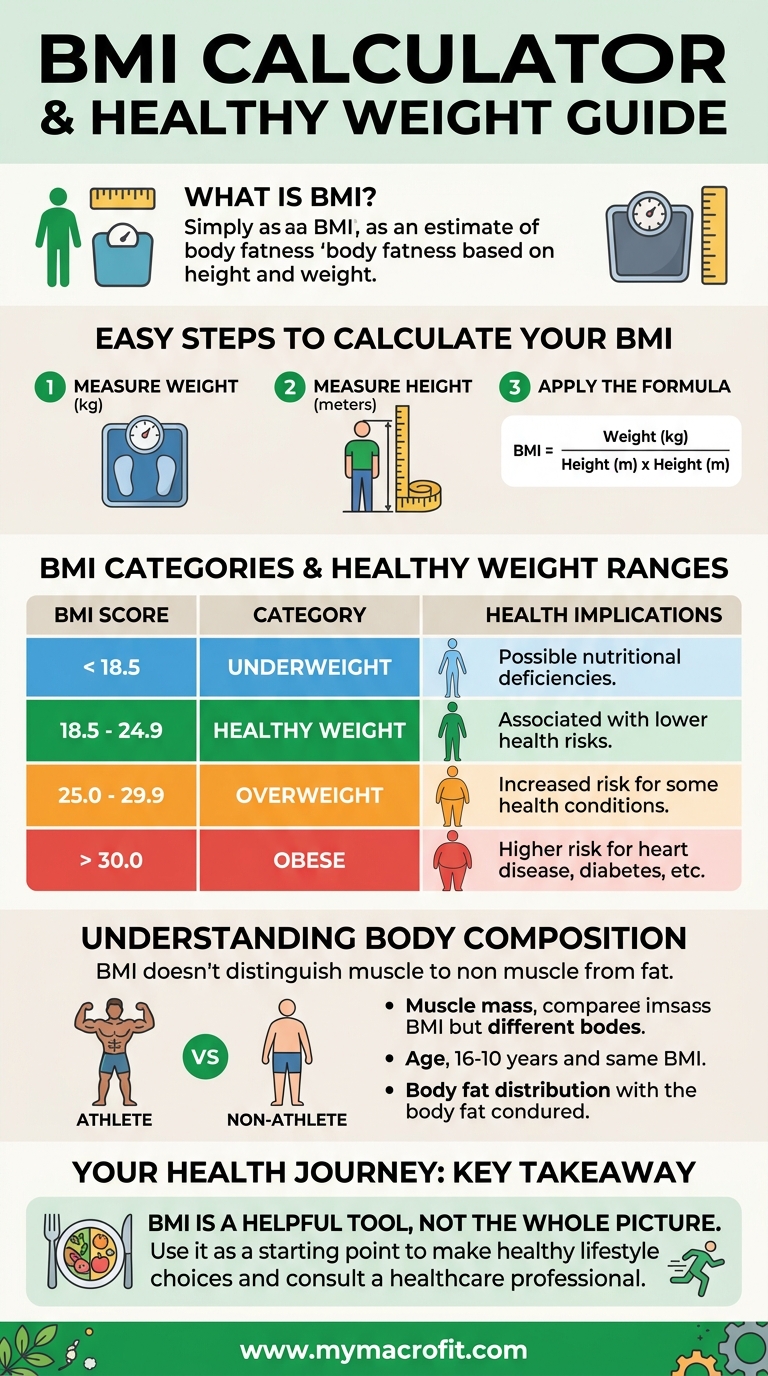
What Is BMI and Why Is It Used?
Body Mass Index (BMI) is one of the most widely used screening tools in medicine and fitness. Developed in the 1830s by Belgian mathematician Adolphe Quetelet, it provides a simple ratio of weight to height that correlates, at a population level, with body fatness and associated health risks.
BMI is used by healthcare providers as a quick first-pass assessment. It costs nothing, requires no equipment, and takes seconds to calculate. For population studies and clinical screenings, it remains the standard despite its well-known limitations.
The BMI Formula Explained
The formula is straightforward: divide your weight in kilograms by your height in metres, squared.
- Metric: BMI = weight (kg) ÷ height (m)²
- Imperial: BMI = [weight (lbs) ÷ height (in)²] × 703
For example, a person who is 175 cm (1.75 m) and weighs 70 kg has a BMI of 70 ÷ (1.75²) = 22.9, which falls in the Normal weight range. The result is a unitless number, the same whether you use metric or imperial inputs.
BMI Categories and What They Mean
The four standard adult BMI categories, as defined by the World Health Organization, are:
- Underweight, below 18.5: May indicate malnutrition, eating disorders, or other health issues. Can affect immune function, bone density, and reproductive health.
- Normal weight, 18.5 to 24.9: Associated with the lowest risk of weight-related disease in population studies. Not a guarantee of good health, but a positive indicator.
- Overweight, 25 to 29.9: Elevated risk of cardiovascular disease, hypertension, and type 2 diabetes. Many people in this range are otherwise healthy, particularly if they are muscular.
- Obese, 30 and above: Significantly elevated health risks. Further subdivided into Class I (30–34.9), Class II (35–39.9), and Class III (40+).
Limitations of BMI You Should Know
BMI is a screening tool, not a diagnosis. Its most significant limitations include:
- Muscle mass: Bodybuilders and athletes often have "overweight" or "obese" BMIs despite very low body fat. Muscle weighs more than fat per unit volume.
- Age: Older adults tend to have more body fat at the same BMI as younger adults, since muscle mass naturally decreases with age.
- Sex: Women naturally carry more body fat than men at the same BMI. The same BMI may represent different health profiles for men vs women.
- Ethnicity: Asian populations show increased cardiometabolic risk at BMI values below the standard overweight threshold (23 vs 25).
- Fat distribution: BMI tells you nothing about where fat is stored. Visceral fat (around the organs) carries higher health risk than subcutaneous fat.
How to Move Your BMI Into a Healthy Range
If your BMI falls outside the 18.5–24.9 range, the path to a healthier number is straightforward in principle, though the execution requires consistency.
For those with a BMI above 25, a moderate calorie deficit of 300–500 kcal/day combined with resistance training produces the best long-term results. This rate of loss (0.25–0.5 kg/week) preserves muscle while reducing fat, which improves body composition beyond what the BMI number alone captures.
For those with a BMI below 18.5, a gradual calorie surplus of 200–300 kcal/day, combined with strength training, can add healthy lean mass. Focus on protein-rich whole foods and progressive resistance exercise to ensure weight gained is mostly muscle rather than fat.
Frequently Asked Questions
What is BMI?
What is a healthy BMI range?
Is BMI an accurate measure of health?
What is the difference between BMI and body fat percentage?
Does BMI apply to children?
Can BMI be different for different ethnic groups?
How do I lower my BMI?
What BMI is considered obese?
How it's calculated: this tool uses established, published equations. See the full calculator methodology for the formulas and assumptions behind it.
Results are estimates for general guidance, not medical advice. See our disclaimer, and speak to a qualified healthcare professional before making medical or dietary changes.
Related Tools
Save & share on Pinterest
Click any card to pin it — or share with someone who needs it.
BMI Calculator
Calculate your Body Mass Index instantly. See your BMI category, where you fall on the scale, your i…
Calculate your Body Mass Index instantly. See your BMI category, where you fall …
Read the full guide: BMI Calculator
Try the free BMI Calculator
BMI Calculator — use our free calculators for instant personalised results. No signup required.
Pinterest opens in a new tab. You can edit the description before saving.
Get Your Free Macro Cheat Sheet
One-page PDF with all the key formulas. Free, no spam ever.
Get the Free Macro Guide