TDEE Calculator
Calculate your Total Daily Energy Expenditure, the exact number of calories your body burns each day. See calorie targets for every goal from aggressive fat loss to lean bulking.
Quick answer
Your TDEE is the total calories you burn in a day, also called your maintenance calories. It uses the Mifflin-St Jeor equation for your resting burn, then multiplies by an activity factor. Most adults land between 1,600 and 2,800 kcal depending on size and activity.
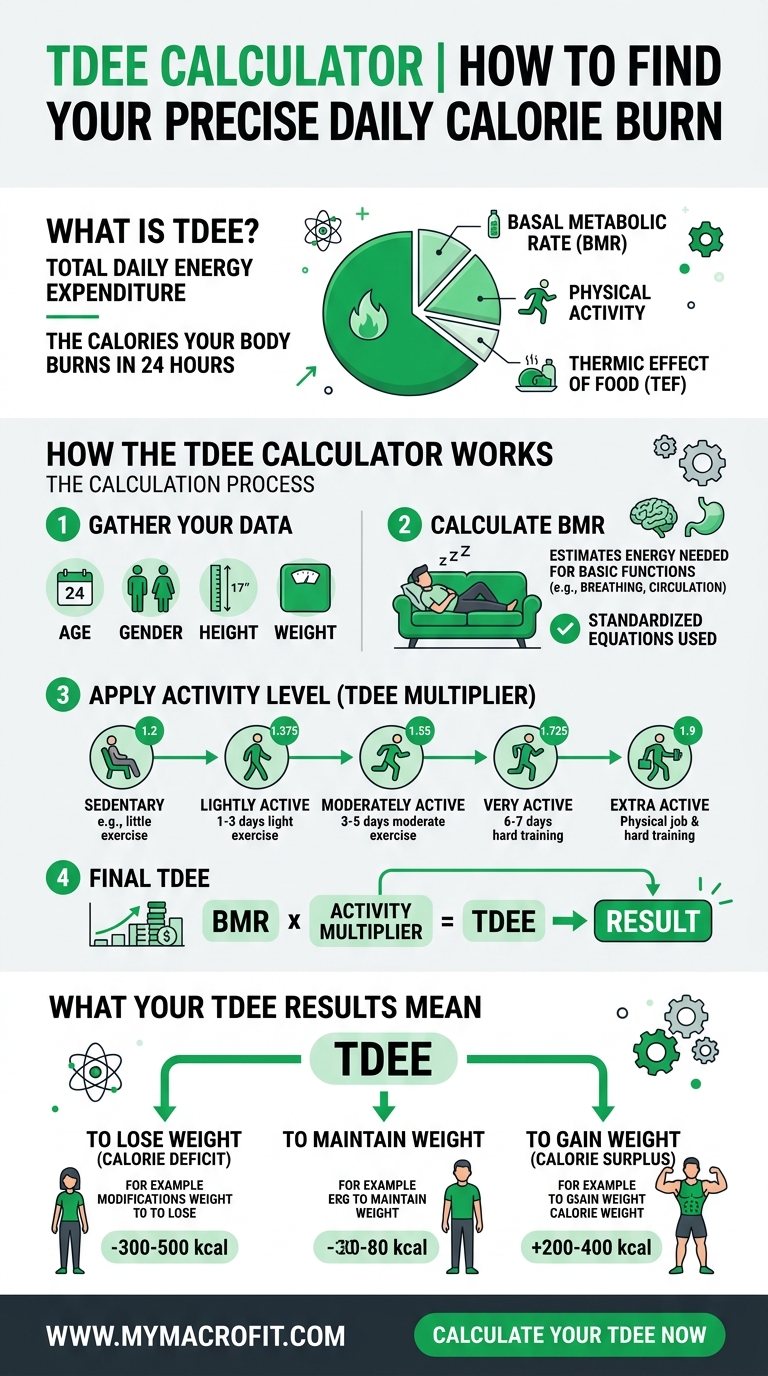
What Is TDEE and Why Does It Matter?
Your Total Daily Energy Expenditure (TDEE) is the single most important number in any fitness plan. It represents the total calories your body burns every 24 hours, not just at rest, but including every step you take, every workout you do, and even the energy used to digest your food.
Without knowing your TDEE, setting a calorie target is guesswork. Eat above it and you gain weight. Eat below it and you lose weight. Eat at it and you maintain. It's the foundation of every nutrition plan.
TDEE vs BMR: What's the Difference?
BMR (Basal Metabolic Rate) is the calories your body burns at complete rest, just to keep your heart beating, lungs breathing, and cells functioning. It accounts for roughly 60–70% of total daily calorie burn.
TDEE builds on BMR by adding three additional components:
- TEF (Thermic Effect of Food), ~10% of calories, burned digesting food
- EAT (Exercise Activity Thermogenesis), calories burned during intentional exercise
- NEAT (Non-Exercise Activity Thermogenesis), all other movement (walking, fidgeting, chores)
NEAT is the most variable component, two people with identical BMRs can have TDEEs that differ by 500–1,000 kcal/day based purely on how active they are outside the gym.
How to Use Your TDEE to Reach Your Goal
Once you have your TDEE, apply the appropriate calorie adjustment:
- Fat loss: TDEE − 250 to −500 kcal/day (lose 0.25–0.5 kg/week)
- Maintenance: Eat at TDEE, monitor weight weekly and adjust ±100 kcal
- Muscle gain (lean bulk): TDEE + 200 to +300 kcal/day for minimal fat gain
- Aggressive bulk: TDEE + 500 kcal/day, faster muscle gain but more fat too
For most people pursuing fat loss, a 300–500 kcal deficit is the sweet spot, large enough to drive consistent fat loss while preserving muscle and energy levels.
The Mifflin-St Jeor Formula
This calculator uses the Mifflin-St Jeor equation to calculate BMR, then multiplies by your activity factor to get TDEE. Developed in 1990 and validated across multiple studies, it's the most accurate formula for most adults.
- Men: BMR = (10 × kg) + (6.25 × cm) − (5 × age) + 5
- Women: BMR = (10 × kg) + (6.25 × cm) − (5 × age) − 161
The result is your BMR. Multiply by the appropriate activity factor (1.2–1.9) and you have your TDEE.
Why You Should Recalculate Regularly
TDEE is not a fixed number. As your body composition and weight change, so does your calorie burn. A common mistake is calculating TDEE once and never adjusting, leading to a stall after initial progress.
Recalculate every 4–6 weeks or whenever your weight changes by more than 3–5 kg. If fat loss stalls for 3+ weeks, reduce by 100–150 kcal/day rather than making dramatic cuts that hurt performance and muscle.
Frequently Asked Questions
What is TDEE?
What is the difference between BMR and TDEE?
How accurate is the TDEE calculator?
How do I use my TDEE for weight loss?
Should I use TDEE or BMR to set my calorie goal?
Which activity level should I choose?
Why does my TDEE change?
What activity multiplier does this calculator use?
How it's calculated: this tool uses established, published equations. See the full calculator methodology for the formulas and assumptions behind it.
Results are estimates for general guidance, not medical advice. See our disclaimer, and speak to a qualified healthcare professional before making medical or dietary changes.
Related Tools
Related Guides
Save & share on Pinterest
Click any card to pin it — or share with someone who needs it.
TDEE Calculator
Calculate your Total Daily Energy Expenditure, the exact number of calories your body burns each day…
Calculate your Total Daily Energy Expenditure, the exact number of calories your…
Read the full guide: TDEE Calculator
Try the free TDEE Calculator
TDEE Calculator — use our free calculators for instant personalised results. No signup required.
Pinterest opens in a new tab. You can edit the description before saving.
Get Your Free Macro Cheat Sheet
One-page PDF with all the key formulas. Free, no spam ever.
Get the Free Macro Guide