BMR Calculator
Calculate your Basal Metabolic Rate, the number of calories your body burns at complete rest. Uses the Mifflin-St Jeor formula with Harris-Benedict comparison.
Quick answer
Your BMR is the calories your body burns at complete rest just to stay alive. This calculator uses the Mifflin-St Jeor equation, the most accurate for most people. BMR is usually 60 to 70 percent of the calories you burn each day.
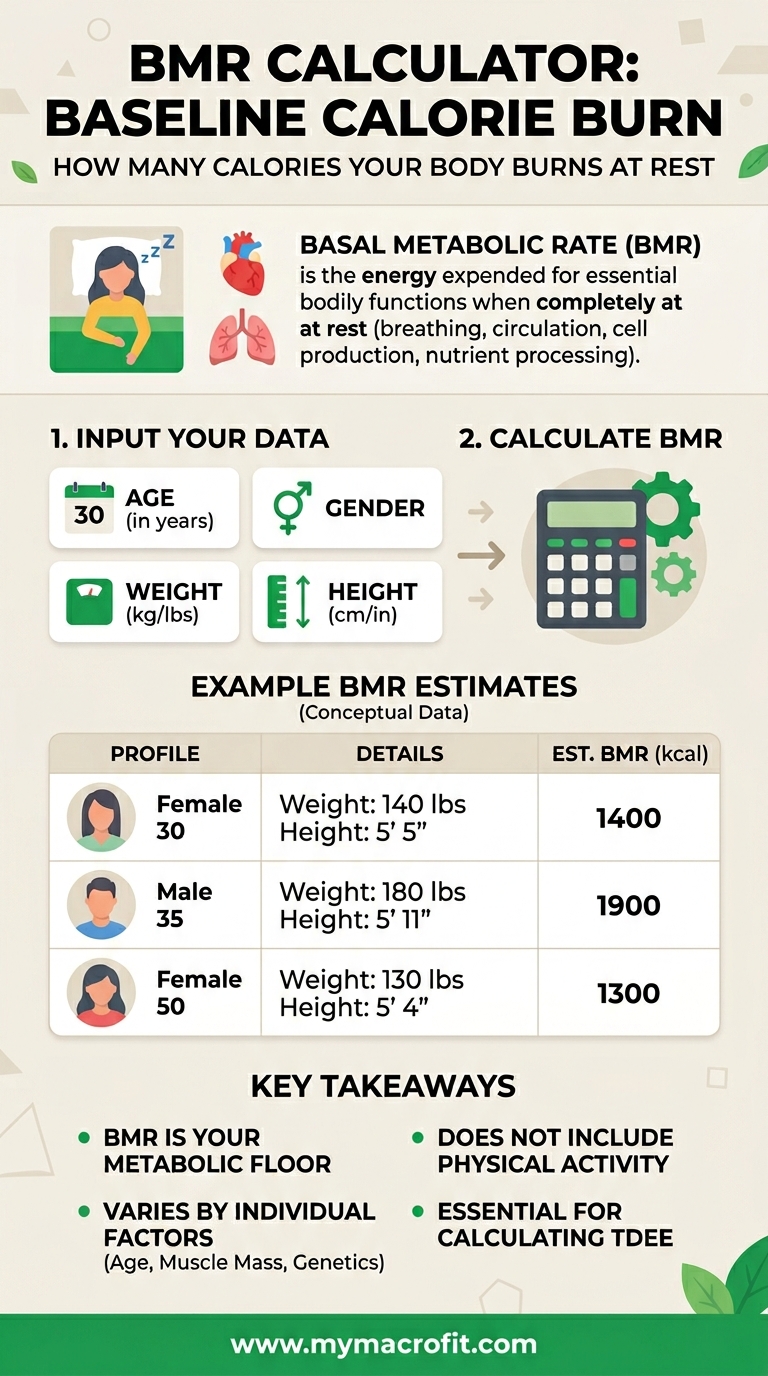
What Is Basal Metabolic Rate (BMR)?
Your Basal Metabolic Rate (BMR) is the number of calories your body burns every day at complete rest, just to keep you alive. Think of it as the energy cost of running your internal machinery: heart, lungs, kidneys, brain, and every cell in your body constantly consuming energy even when you're sleeping.
BMR typically accounts for 60–70% of total daily calorie burn for most people. The remaining calories come from physical activity, exercise, and digesting food (thermic effect of food).
The Mifflin-St Jeor Equation
Developed in 1990, the Mifflin-St Jeor equation is the gold standard for BMR estimation. Multiple independent studies have validated it as the most accurate formula for non-athletes, and it's the preferred equation of the Academy of Nutrition and Dietetics.
- Men: BMR = (10 × weight kg) + (6.25 × height cm) − (5 × age) + 5
- Women: BMR = (10 × weight kg) + (6.25 × height cm) − (5 × age) − 161
The difference between male and female equations (the constant +5 vs −161) reflects the average difference in lean body mass and hormonal factors between biological sexes.
BMR vs TDEE: Which Should You Use?
BMR alone is an incomplete picture. If you want to set a calorie target for weight loss, maintenance, or muscle gain, you need your TDEE (Total Daily Energy Expenditure).
TDEE = BMR × Activity Factor
Activity factors range from 1.2 (sedentary) to 1.9 (extremely active). Our TDEE Calculator does this automatically, enter the same stats and get your full daily calorie burn including activity.
Factors That Affect Your BMR
BMR is not fixed, it changes throughout your life based on several factors:
- Age: BMR decreases by approximately 2% per decade after age 20 due to muscle loss
- Body composition: More muscle = higher BMR (muscle burns ~3× more calories at rest than fat)
- Weight: Heavier people have higher BMRs, more mass requires more energy to sustain
- Hormones: Thyroid hormones regulate metabolic rate; imbalances can raise or lower BMR significantly
- Diet history: Prolonged severe restriction causes adaptive thermogenesis, the body reduces BMR to conserve energy
How to Boost Your BMR
The most effective evidence-based strategies for raising BMR are:
- Build and preserve muscle through resistance training (each kg of muscle adds ~13 kcal/day to BMR)
- Avoid extreme calorie restriction that causes muscle loss and metabolic adaptation
- Eat enough protein (1.6–2g/kg/day) to maintain muscle during any fat loss phase
- Prioritise sleep, sleep deprivation reduces BMR and increases hunger hormones
- Stay hydrated, mild dehydration can reduce metabolic rate by up to 3%
Frequently Asked Questions
What is BMR (Basal Metabolic Rate)?
What formula does this BMR calculator use?
What is the difference between BMR and TDEE?
Should I eat at my BMR?
Why is my BMR lower than expected?
How does muscle mass affect BMR?
How accurate is the Mifflin-St Jeor equation?
Can I increase my BMR?
How it's calculated: this tool uses established, published equations. See the full calculator methodology for the formulas and assumptions behind it.
Results are estimates for general guidance, not medical advice. See our disclaimer, and speak to a qualified healthcare professional before making medical or dietary changes.
Related Tools
Save & share on Pinterest
Click any card to pin it — or share with someone who needs it.
BMR Calculator
Calculate your Basal Metabolic Rate, the number of calories your body burns at complete rest. Uses t…
Calculate your Basal Metabolic Rate, the number of calories your body burns at c…
Read the full guide: BMR Calculator
Try the free BMR Calculator
BMR Calculator — use our free calculators for instant personalised results. No signup required.
Pinterest opens in a new tab. You can edit the description before saving.
Get Your Free Macro Cheat Sheet
One-page PDF with all the key formulas. Free, no spam ever.
Get the Free Macro Guide