Ideal Weight Calculator
Find your ideal body weight using four scientific formulas, Devine, Robinson, Miller, and Hamwi. See your ideal range averaged across all formulas, a BMI-based comparison, and how your current weight compares.
Quick answer
Your healthy weight is a range, not one number, based on your height and frame. This calculator gives that range using established formulas so you have a realistic target instead of a single fixed figure.
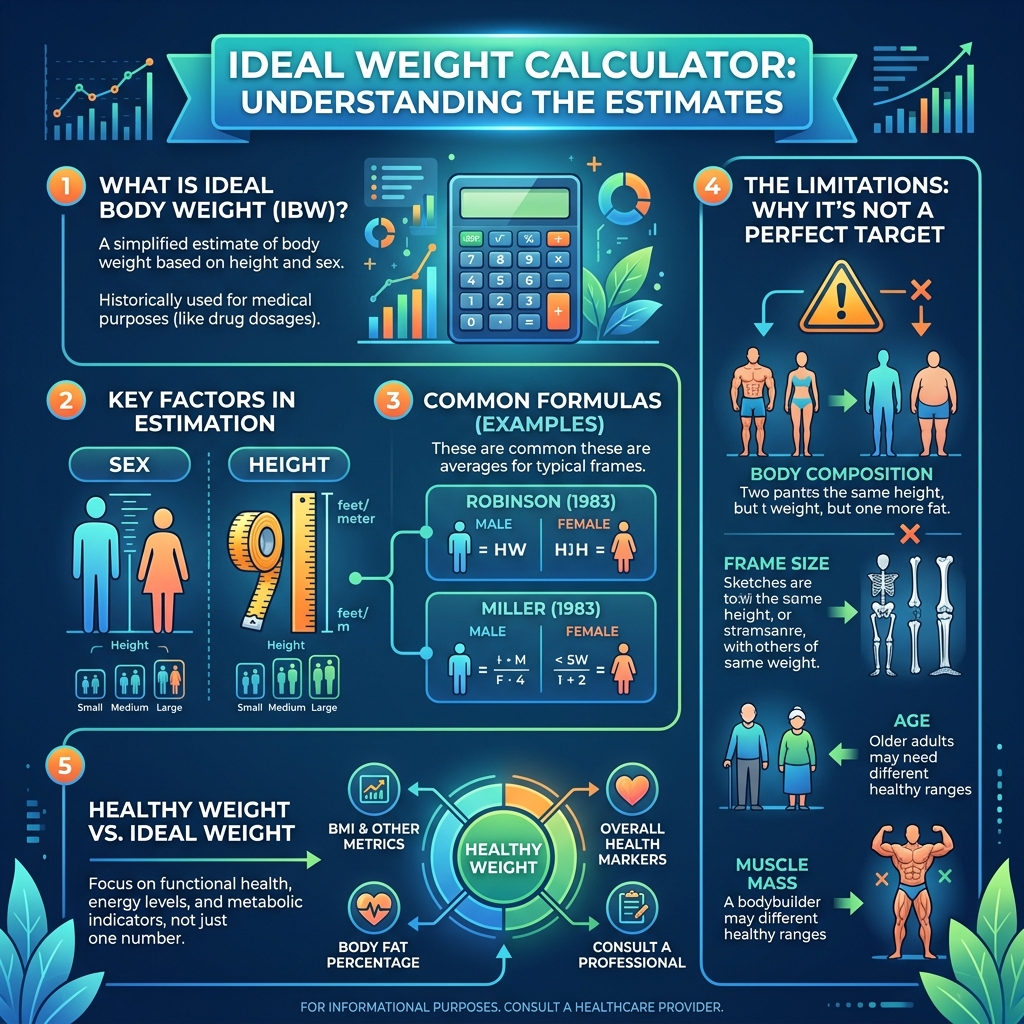
What Is "Ideal Body Weight" and Where Does It Come From?
The concept of ideal body weight (IBW) originated in the pharmaceutical industry in the mid-20th century. Clinicians needed a quick way to calculate drug dosages for patients without complex body composition data. Several formulas were developed, each using height above five feet as the primary input.
These formulas were never intended to define a single "perfect" weight for every individual. They are reference points, starting estimates that work reasonably well at a population level but have real limitations for individuals, particularly those with high or low muscle mass.
The Four Formulas Compared
This calculator uses all four major ideal weight formulas:
- Devine (1974): The original and most widely cited. Men: 50 kg + 2.3 kg per inch over 5 ft. Women: 45.5 kg + 2.3 kg per inch over 5 ft.
- Robinson (1983): A revision of Devine with slightly different increments. Men: 52 kg + 1.9 kg/inch. Women: 49 kg + 1.7 kg/inch.
- Miller (1983): Produces higher estimates for taller individuals. Men: 56.2 kg + 1.41 kg/inch. Women: 53.1 kg + 1.36 kg/inch.
- Hamwi (1964): The earliest, commonly used in nursing. Men: 48 kg + 2.7 kg/inch. Women: 45.5 kg + 2.2 kg/inch.
The spread between these formulas for a typical person is 3–8 kg. Averaging them and showing a ±10% range gives a realistic target zone rather than a falsely precise single number.
BMI vs Formula-Based Ideal Weight
The BMI-based range (weight that produces a BMI of 18.5–25) is the most commonly used clinical reference for "healthy weight." It has the advantage of being a continuous scale rather than a discrete formula, and it scales naturally with both height and the associated health risk data from large epidemiological studies.
Formula-based IBW and BMI ranges usually overlap substantially but not perfectly. For shorter individuals, the IBW formulas tend to give slightly lower targets than the BMI method. For taller individuals, the formulas may give slightly higher targets. Using both gives you a broader reference zone.
Setting a Realistic Goal Weight
The ideal weight range shown in this calculator is a useful starting point, not a mandate. A more meaningful personal target considers your individual build, athletic history, age, and how you feel at various weights.
For practical goal-setting: pick a target within the formula average range, then track body fat percentage and lean mass as you progress. A person who reaches the "ideal weight" but feels weak and has lost significant muscle should consider adjusting the target upward and focusing on body composition instead.
Frequently Asked Questions
What is my ideal weight?
Which ideal weight formula is most accurate?
What is the Devine formula?
What is the difference between the four formulas?
Does ideal weight change with age?
Should I use ideal weight or BMI as my target?
Can I be "ideal weight" but still unhealthy?
Is the ideal weight different for athletes?
How it's calculated: this tool uses established, published equations. See the full calculator methodology for the formulas and assumptions behind it.
Results are estimates for general guidance, not medical advice. See our disclaimer, and speak to a qualified healthcare professional before making medical or dietary changes.
Related Tools
Save & share on Pinterest
Click any card to pin it — or share with someone who needs it.
Ideal Weight Calculator
Find your ideal body weight using four scientific formulas, Devine, Robinson, Miller, and Hamwi. See…
Find your ideal body weight using four scientific formulas, Devine, Robinson, Mi…
Read the full guide: Ideal Weight Calculator
Try the free Ideal Weight Calculator
Ideal Weight Calculator — use our free calculators for instant personalised results. No signup requi…
Pinterest opens in a new tab. You can edit the description before saving.
Get Your Free Macro Cheat Sheet
One-page PDF with all the key formulas. Free, no spam ever.
Get the Free Macro Guide