Body Fat Calculator (Navy Method)
Estimate your body fat percentage using the U.S. Navy circumference method. Enter height, neck, and waist measurements (plus hip for women) to see your body fat %, fitness category, fat mass, lean mass, and FFMI.
Quick answer
This calculator uses the US Navy method, which estimates body fat from your height and a few tape measurements. Healthy ranges are roughly 10 to 20 percent for men and 18 to 28 percent for women.
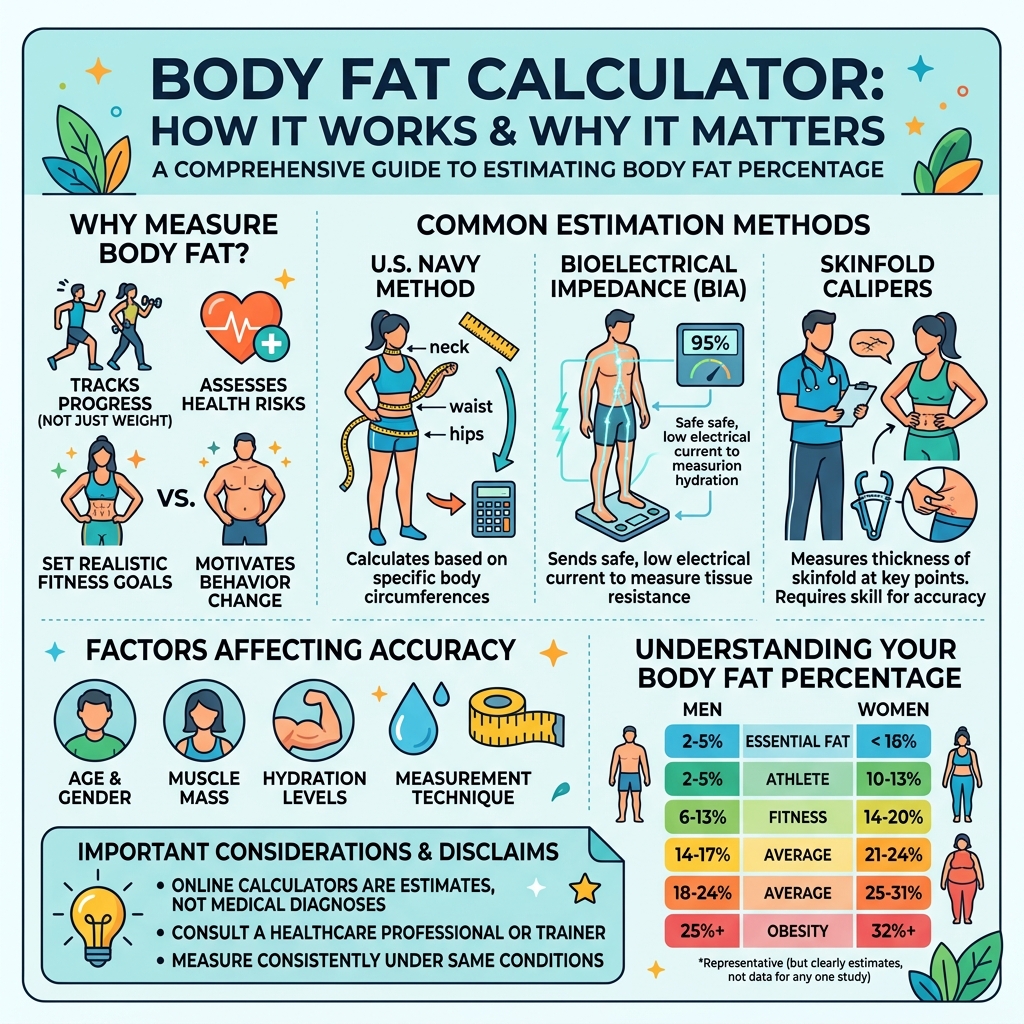
The U.S. Navy Body Fat Method Explained
The U.S. Navy circumference method was developed as a practical, equipment-free way to estimate body fat percentage for military fitness assessments. It uses only a tape measure and basic logarithmic equations validated against underwater weighing in large populations.
The formula works by measuring the circumference of body parts that reflect fat storage patterns: waist (primary fat depot in men), and waist plus hips (primary fat depots in women), relative to neck (which reflects lean tissue and correlates with overall muscularity).
Body Fat Categories and Health Implications
Body fat percentages are classified into five zones for both sexes:
- Essential fat, The minimum needed for physiological function. Going below this is dangerous and associated with hormonal disruption.
- Athletes, Typical range for competitive athletes. Requires deliberate nutrition and training to achieve and maintain.
- Fitness, Lean and defined appearance. Achievable and sustainable with consistent training and good nutrition.
- Average, The range most adults naturally fall into without structured exercise or dieting.
- Obese, Elevated metabolic health risk. Associated with increased risk of cardiovascular disease, insulin resistance, and other conditions.
Unlike BMI, body fat categories explicitly separate men and women, because women naturally and healthily carry substantially more essential fat than men, particularly around the hips and breasts.
What Is FFMI?
Fat-Free Mass Index (FFMI) measures your lean mass relative to height, effectively asking, "how much muscle do you have for your height?" It is calculated as:
- Lean mass (kg) ÷ height (m)²
Reference values for natural (drug-free) men: below 18 = below average, 18–20 = average, 20–22 = above average, 22–25 = exceptional, above 25 = extremely rare naturally. Women typically score 3–5 points lower due to lower testosterone and different muscle mass potential.
FFMI is particularly useful for tracking muscle-building progress over time, the scale may go up as you build muscle, but FFMI will show whether that gain is lean mass or fat.
Reducing Body Fat: What the Evidence Says
Fat loss comes down to a sustained calorie deficit combined with preserved or increased lean mass. The most effective strategies backed by research:
- Calorie deficit of 300–500 kcal/day: Produces consistent fat loss without the muscle loss, fatigue, and hunger that larger deficits cause.
- High protein intake (1.8–2.2 g/kg): The single most impactful nutrition variable for preserving lean mass during a cut.
- Resistance training 3–4×/week: Provides the anabolic signal that tells your body to keep muscle even when calories are restricted.
- Adequate sleep (7–9 hours): Sleep deprivation increases cortisol, reduces testosterone, impairs recovery, and increases fat storage even in a deficit.
Frequently Asked Questions
What is the U.S. Navy body fat method?
How accurate is the Navy body fat calculator?
Where exactly should I measure for the Navy method?
What is a healthy body fat percentage?
What is FFMI and why does it matter?
What is the most accurate way to measure body fat?
Can I reduce my body fat percentage without losing weight?
How often should I measure my body fat?
How it's calculated: this tool uses established, published equations. See the full calculator methodology for the formulas and assumptions behind it.
Results are estimates for general guidance, not medical advice. See our disclaimer, and speak to a qualified healthcare professional before making medical or dietary changes.
Related Tools
Save & share on Pinterest
Click any card to pin it — or share with someone who needs it.
Body Fat Calculator (Navy Method)
Estimate your body fat percentage using the U.S. Navy circumference method. Enter height, neck, and …
Estimate your body fat percentage using the U.S. Navy circumference method. Ente…
Read the full guide: Body Fat Calculator (Navy Method)
Try the free Body Fat Calculator (Navy Method)
Body Fat Calculator (Navy Method) — use our free calculators for instant personalised results. No si…
Pinterest opens in a new tab. You can edit the description before saving.
Get Your Free Macro Cheat Sheet
One-page PDF with all the key formulas. Free, no spam ever.
Get the Free Macro Guide