Calories Burned Calculator
Find out how many calories you burn during any exercise. Enter your weight, choose your activity, and set the duration to get an instant estimate based on validated MET values.
Quick answer
Calories burned depend on the activity, your weight, and how long you train. This calculator estimates the burn using MET values for each activity so you can plan your intake.
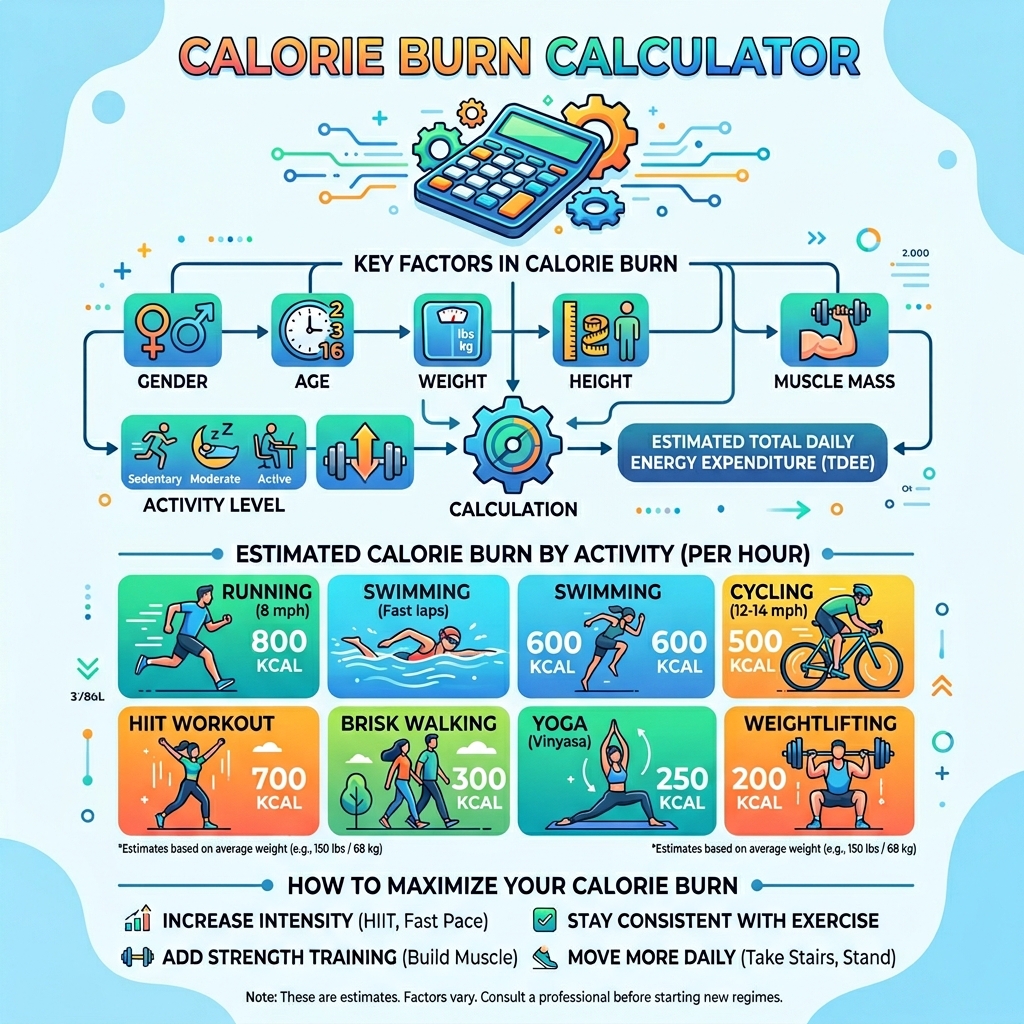
How MET Values Accurately Calculate Calories Burned
The Metabolic Equivalent of Task (MET) system is the gold standard for estimating exercise calorie expenditure. Developed by researchers at the American College of Sports Medicine and published in the Compendium of Physical Activities, MET values have been validated in thousands of laboratory and field studies.
A MET of 1.0 represents the energy cost of sitting quietly, roughly 1 kcal per kg of body weight per hour. Every other activity is expressed as a multiple of that baseline. Walking at 5 km/h (MET 3.5) burns 3.5× more calories than sitting. HIIT (MET 12) burns 12× more. The formula is simple but surprisingly accurate:
Calories = MET × Weight (kg) × Time (hours)
Calorie Burn by Activity: What the Numbers Really Mean
Here's a quick comparison for a 75 kg person exercising for 30 minutes:
- Yoga: ~113 kcal, excellent for recovery and mobility
- Walking 5 km/h: ~131 kcal, sustainable, low-impact base activity
- Weight training: ~188 kcal, plus after-burn effects (EPOC)
- Cycling moderate: ~300 kcal, great calorie/joint-stress ratio
- Running 8 km/h: ~300 kcal, efficient and accessible
- Swimming laps: ~368 kcal, full-body, joint-friendly
- HIIT / Jump rope: ~443 kcal, maximum calorie efficiency
Ready to put these numbers to work?
Use your calorie burn to set a precise daily target for fat loss or muscle gain.
Download the Free Macro Guide →Why Body Weight Is the Biggest Factor in Calorie Burn
The single biggest variable in calorie burn isn't the exercise you choose, it's your body weight. A 55 kg person burns roughly 40% fewer calories than a 90 kg person doing the exact same workout. This is why comparing calorie burns between people is misleading without accounting for body mass.
As you lose weight, you'll burn fewer calories doing the same workout. This is why calorie targets should be recalculated every 5–10 kg of body weight change, and why building muscle matters: more muscle mass raises your resting metabolism and calorie burn at every activity level.
Exercise Calorie Burn vs Diet: Which Matters More?
A common misconception is that exercise alone drives weight loss. In reality, diet has 3–4× more impact on total calorie balance than exercise for most people. A 45-minute run burns roughly 400–600 kcal, which a single large meal can easily replace. This doesn't mean exercise doesn't matter, it matters enormously for:
- Preserving muscle mass during a calorie deficit
- Improving insulin sensitivity and metabolic health
- Reducing stress, improving mood and sleep quality
- Increasing TDEE so you can eat more while still losing fat
The optimal strategy: create a 300–500 kcal/day deficit through diet, and add 3–5 exercise sessions per week for health, performance, and muscle retention.
5 Ways to Burn More Calories Without More Gym Time
- Increase NEAT: Non-exercise activity thermogenesis (standing, walking, fidgeting) can add 200–800 kcal/day, more than most gym sessions. Take stairs, walk calls, stand at your desk.
- Add intensity: Walking uphill or running faster burns significantly more calories than the same duration at lower intensity. Even 10% more speed means 25–35% more calorie burn.
- Build muscle: Each kilogram of muscle burns ~13 kcal/day at rest, and dramatically more during activity. Strength training is the best long-term calorie-burn investment.
- Train fasted: Morning exercise in a fasted state may increase fat oxidation. The total calorie burn is similar, but the fuel source shifts toward stored fat.
- Use HIIT strategically: High-intensity intervals create significant excess post-exercise oxygen consumption (EPOC), your metabolism stays elevated for hours after the session.
Frequently Asked Questions
How does the calorie burn calculator work?
What is a MET value?
How accurate is this calculator?
Does body weight really affect calorie burn that much?
What is the highest calorie-burning exercise?
Does exercise burn enough calories to matter for weight loss?
What does "fat grams burned" mean?
How many calories should I burn per week through exercise?
How it's calculated: this tool uses established, published equations. See the full calculator methodology for the formulas and assumptions behind it.
Results are estimates for general guidance, not medical advice. See our disclaimer, and speak to a qualified healthcare professional before making medical or dietary changes.
Related Tools
Save & share on Pinterest
Click any card to pin it — or share with someone who needs it.
Calories Burned Calculator
Find out how many calories you burn during any exercise. Enter your weight, choose your activity, an…
Find out how many calories you burn during any exercise. Enter your weight, choo…
Read the full guide: Calories Burned Calculator
Try the free Calories Burned Calculator
Calories Burned Calculator — use our free calculators for instant personalised results. No signup re…
Pinterest opens in a new tab. You can edit the description before saving.
Get Your Free Macro Cheat Sheet
One-page PDF with all the key formulas. Free, no spam ever.
Get the Free Macro Guide