Carb Cycling Calculator
Build a personalized carb cycling plan with science-based macro targets for high-carb training days, moderate carb days, and low-carb rest days. Choose fat loss, recomposition, or lean bulk protocol.
Quick answer
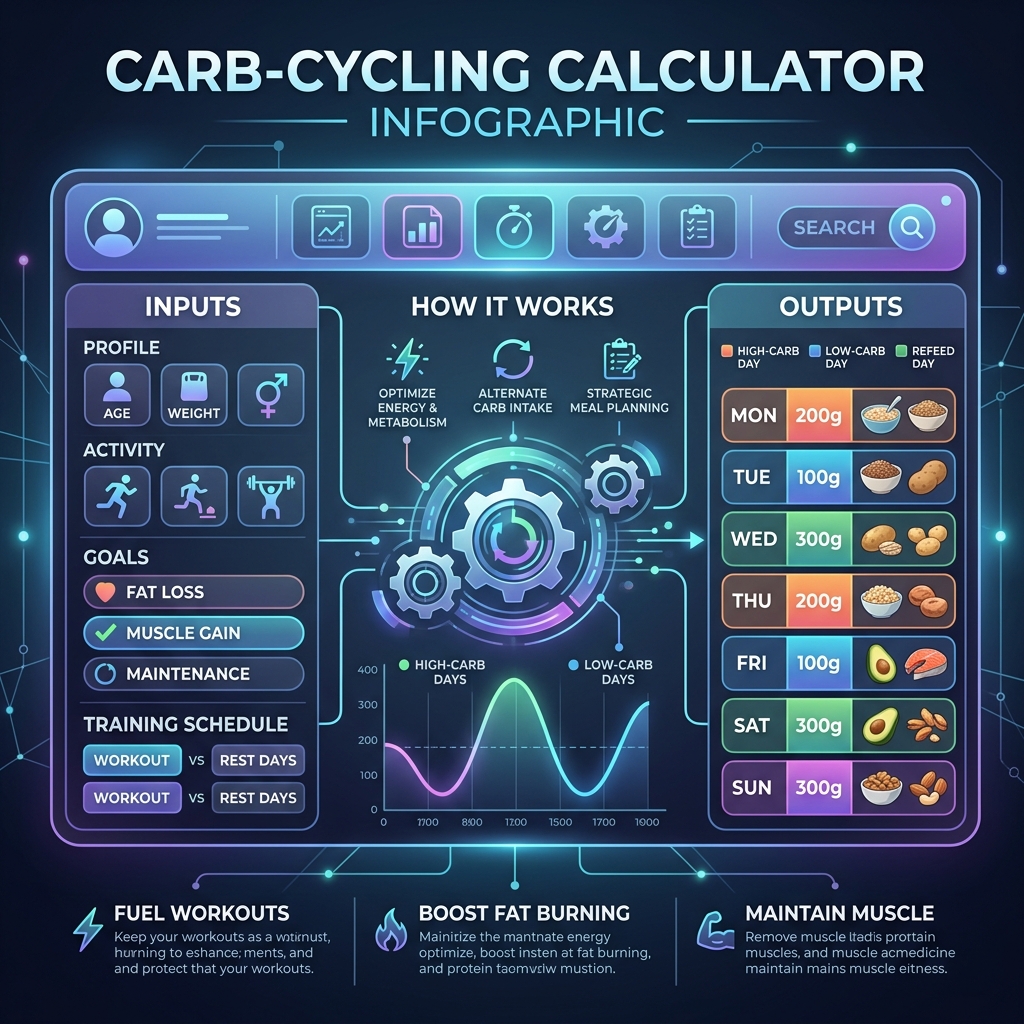
Carb cycling alternates higher-carb days around training with lower-carb days on rest days, while protein stays steady. This calculator sets your high, medium, and low carb targets from your calories and training week.
Ready to simplify carb cycling?
A done-for-you meal plan with macros already dialled in for your cycle days.
See the 30-Day Fat Loss Meal Plan →What Is Carb Cycling and Why Does It Work?
Carb cycling exploits a simple physiological truth: your body needs different amounts of fuel on different days. On training days, your muscles crave carbohydrates to replenish glycogen, power performance, and trigger an anabolic response. On rest days, you don't need those carbs, and eating them just creates a calorie surplus that gets stored as fat.
By matching carb intake to training demand, you can be in a weekly calorie deficit while never feeling depleted during workouts. This is why carb cycling is so popular among athletes, physique competitors, and fitness enthusiasts who want the best of both worlds: fat loss without performance sacrifice.
5 Signs You're Eating Too Few Carbs on Training Days
- Weights feel unusually heavy, Glycogen depletion reduces strength output by 5–10%. If a weight you could normally lift 10 times becomes a struggle at 6, your training-day carbs are too low.
- You feel lightheaded or "foggy" mid-workout, The brain and muscles both compete for glucose during high-intensity exercise. Low carbs reduce blood glucose and impair focus.
- You can't complete your planned sets, Carbohydrates are the primary fuel for anaerobic work. Without them, you simply can't train at the intensity needed for hypertrophy.
- Recovery feels slower, Post-workout carbs spike insulin, driving amino acids into muscle cells and speeding glycogen resynthesis. Skipping them delays recovery by 24–48 hours.
- You're losing strength over multiple weeks, Chronic glycogen depletion is catabolic. If strength is trending down over 3–4 weeks despite eating enough protein, add 50–100g carbs to training days.
Carb Cycling for Women: What's Different
Women metabolize carbohydrates differently than men due to hormonal fluctuations across the menstrual cycle. Research suggests women may benefit from adjusting carb intake based on cycle phase:
- Follicular phase (days 1–14), Estrogen promotes insulin sensitivity and glycogen storage. This is the ideal time for higher-carb training days and more aggressive workouts.
- Luteal phase (days 15–28), Progesterone blunts insulin sensitivity slightly. Moderate carb intake and prioritizing protein is often better tolerated.
If you notice energy crashes or poor recovery in the second half of your cycle, consider shifting some high-carb days earlier in the month.
How to Build a Weekly Carb Cycling Schedule
The best schedule maps high-carb days to your most demanding training sessions. A practical template:
- Monday (legs/heavy compound): High-carb day
- Tuesday (upper body/push): Medium-carb day
- Wednesday (cardio or active recovery): Low-carb day
- Thursday (pull/back): Medium-carb day
- Friday (legs or full body): High-carb day (for bulk) or medium (for fat loss)
- Saturday (light activity): Low-carb day
- Sunday (rest): Low-carb day
Adjust based on your actual training schedule. The key principle is always: train hard → eat more carbs, rest → eat fewer carbs.
Frequently Asked Questions
What is carb cycling?
Who benefits most from carb cycling?
What do I eat on a high carb day?
What do I eat on a low carb day?
Is carb cycling better than IIFYM?
How long should I do carb cycling before seeing results?
How it's calculated: this tool uses established, published equations. See the full calculator methodology for the formulas and assumptions behind it.
Results are estimates for general guidance, not medical advice. See our disclaimer, and speak to a qualified healthcare professional before making medical or dietary changes.
Related Tools
Save & share on Pinterest
Click any card to pin it — or share with someone who needs it.
Carb Cycling Calculator
Build a personalized carb cycling plan with science-based macro targets for high-carb training days,…
Build a personalized carb cycling plan with science-based macro targets for high…
Read the full guide: Carb Cycling Calculator
Try the free Carb Cycling Calculator
Carb Cycling Calculator — use our free calculators for instant personalised results. No signup requi…
Pinterest opens in a new tab. You can edit the description before saving.
Get Your Free Macro Cheat Sheet
One-page PDF with all the key formulas. Free, no spam ever.
Get the Free Macro Guide