Muscle Gain Calculator
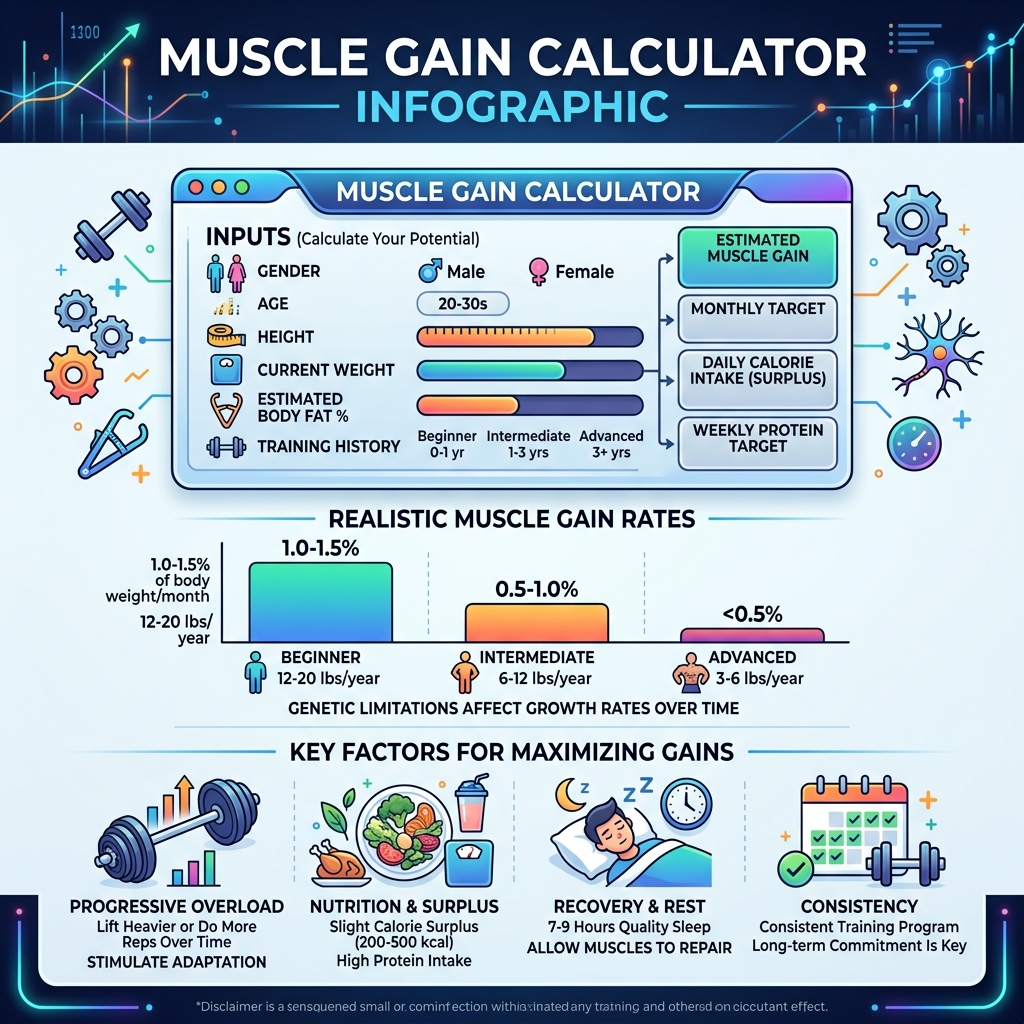
How much muscle can you realistically build? Calculate your monthly gain potential, lean bulk calorie target, protein/carbs/fat macros, and natural FFMI ceiling based on your training experience.
Quick answer
Building muscle needs a modest calorie surplus plus enough protein, about 1.6 to 2.2g per kg. Realistic gain is roughly 0.25kg a week for most people. This calculator sets your calorie and macro targets.
Turn these targets into a real plan.
A 7-day muscle-building meal plan with exact macros and a full grocery list.
Get the Muscle Building Meal Plan →The Truth About How Fast You Can Actually Build Muscle
Social media is full of dramatic 3-month transformations, but the science of muscle hypertrophy tells a different story. The body has hard physiological ceilings on how quickly it can synthesize new muscle tissue, and those limits are largely determined by your training history.
Understanding your realistic rate of gain is not discouraging, it's empowering. It tells you exactly what to expect, prevents frustration from unrealistic comparisons, and helps you recognize when you're making real progress vs. when your program needs to change.
5 Reasons Your Bulking Phase Isn't Building Muscle
- Not eating enough protein, Even in a surplus, muscle growth stalls below 1.6 g/kg. Protein is the rate-limiting factor. Track it consistently.
- Surplus too large, Eating 800+ kcal above maintenance doesn't build muscle faster; it builds fat faster. Keep surplus to 200–300 kcal.
- Not training with progressive overload, Calories provide the raw material; progressive overload provides the stimulus. Add weight or reps every 1–2 weeks.
- Not sleeping enough, 80% of growth hormone release happens during deep sleep. Below 7 hours significantly blunts muscle protein synthesis.
- Skipping deload weeks, Accumulated fatigue masks fitness. A deload every 6–8 weeks allows supercompensation and keeps gains coming.
How to Interpret Your Natural FFMI Ceiling
Your estimated natural lean mass ceiling is based on the Fat-Free Mass Index research. This represents the maximum lean body mass you can realistically build without performance-enhancing drugs, normalized for your height.
Think of it as a long-term horizon, not an immediate target. If you're 10+ kg away from your ceiling, you have years of productive growth ahead. If you're within 2–3 kg, you're approaching advanced territory where progress is measured in grams, not kilograms, per month.
Most natural lifters never reach their genetic ceiling because they don't train consistently for long enough, not because of genetics or supplements.
The Lean Bulk vs. Aggressive Bulk: Which Is Right for You?
A lean bulk (+200–300 kcal/day) minimizes fat gain and is ideal for anyone with 15%+ body fat (men) or 25%+ (women). The surplus is small but sufficient, muscle can only be built at a limited rate, and any extra calories beyond that rate go directly to fat.
An aggressive bulk (+500+ kcal/day) makes sense only for true beginners who are very lean and struggle to eat enough. The additional calories don't build extra muscle, they just add fat that then requires a cut phase to remove.
The most evidence-backed approach for most intermediate lifters: stay in a 200–300 kcal lean bulk for 4–6 months, then cut for 8–12 weeks if body fat creeps above 18% (men) / 28% (women), then repeat.
Frequently Asked Questions
How much muscle can a natural beginner gain per month?
What is FFMI and how does it measure natural potential?
How many calories above maintenance should I eat to build muscle?
How much protein do I need to build muscle?
Is it possible to lose fat and gain muscle at the same time?
How long will it take to see visible muscle gains?
How it's calculated: this tool uses established, published equations. See the full calculator methodology for the formulas and assumptions behind it.
Results are estimates for general guidance, not medical advice. See our disclaimer, and speak to a qualified healthcare professional before making medical or dietary changes.
Related Tools
Save & share on Pinterest
Click any card to pin it — or share with someone who needs it.
Muscle Gain Calculator
How much muscle can you realistically build? Calculate your monthly gain potential, lean bulk calori…
How much muscle can you realistically build? Calculate your monthly gain potenti…
Read the full guide: Muscle Gain Calculator
Try the free Muscle Gain Calculator
Muscle Gain Calculator — use our free calculators for instant personalised results. No signup requir…
Pinterest opens in a new tab. You can edit the description before saving.
Get Your Free Macro Cheat Sheet
One-page PDF with all the key formulas. Free, no spam ever.
Get the Free Macro Guide