One Rep Max (1RM) Calculator
Calculate your estimated one rep max from any weight and rep count. Uses four proven formulas and generates a complete training percentage table so you know exactly what to lift for every set.
Quick answer
Your one-rep max is the most weight you can lift once. This calculator estimates it from the weight and reps of a recent set using the Epley formula, then gives training percentages for your program.
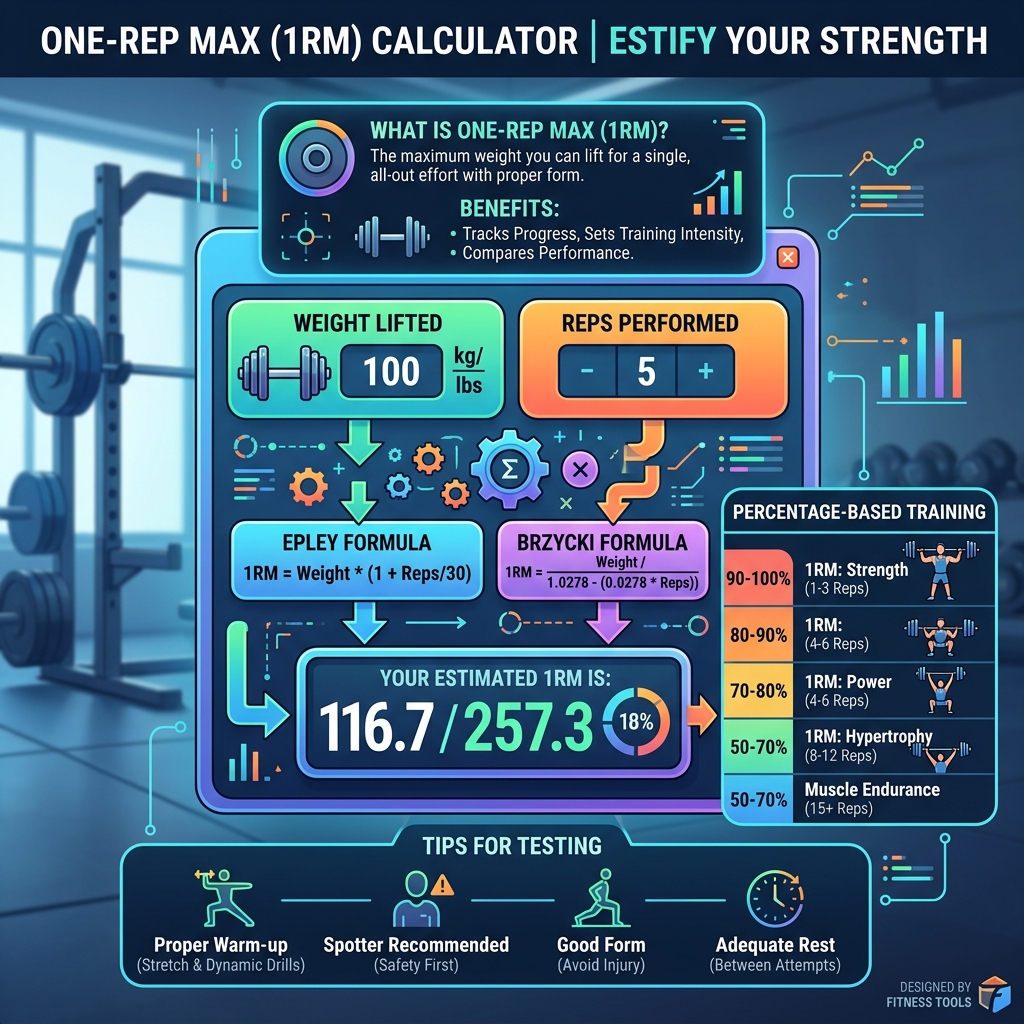
What Is a One Rep Max and Why Does It Matter?
Your one rep max (1RM) is the maximum weight you can lift for exactly one repetition with proper form. It's the universal benchmark of strength, used by powerlifters, Olympic weightlifters, CrossFitters, and anyone serious about structured strength training.
Knowing your 1RM allows you to autoregulate your training loads using percentages. Instead of guessing what weight to use for 5 sets of 3, you load 87% of your 1RM. This systematic approach is how elite athletes have programmed strength training for decades.
The 4 Formulas This Calculator Uses
No single formula is universally most accurate, so this calculator uses four and averages the results:
- Epley (1985): w × (1 + r/30), the most cited formula, performs well across all rep ranges
- Brzycki (1993): w × 36/(37−r), slightly more accurate for lower rep ranges (1–6 reps)
- Lander: (100 × w) / (101.3 − 2.67123 × r), biomechanics-derived, strong mid-range accuracy
- O'Conner (1989): w × (1 + r/40), more conservative estimate, useful for higher rep sets
The averaged result minimises the bias of any individual formula and provides a reliable estimate for programming purposes.
How to Use the Percentage Table for Better Programming
The percentage breakdown is the most actionable part of your 1RM result. Use it to select weights for different training goals:
- 50–65% (15–20+ reps): Muscular endurance, warm-up sets, recovery training
- 65–75% (10–15 reps): Hypertrophy (muscle growth), metabolic conditioning
- 75–85% (6–10 reps): Strength-hypertrophy crossover, most effective range for most lifters
- 85–95% (2–5 reps): Maximum strength development
- 95–100% (1–2 reps): Competition simulation, true 1RM testing
Safety: When to Estimate vs Actually Test Your 1RM
Estimating your 1RM from a 3–8 rep set is safer and sufficient for most training purposes. Actual 1RM testing requires:
- A thorough warm-up (15–20+ minutes, multiple escalating sets)
- A spotter or safety equipment in place
- Full physical readiness, no recent illness or significant fatigue
- Adequate recovery planned for the days after
Reserve true 1RM testing for competition preparation or periodic strength checks every 3–4 months. Use estimated 1RM for all day-to-day programming.
Fuel your strength gains correctly.
Protein and calorie targets built around your training — the nutrition side of getting stronger.
Get the Free Macro Guide →Progressive Overload: How to Keep Increasing Your 1RM
Your 1RM only grows if you consistently apply progressive overload, gradually increasing the demands placed on your muscles over time. Practical methods:
- Add weight: Increase load by 2.5–5 kg when you can complete all reps with good form
- Add reps: Increase rep count at the same weight before increasing load
- Add volume: More sets per week drives more total strength adaptation
- Reduce rest: Denser training sessions increase work capacity and metabolic stress
- Improve technique: Better technique alone can add 10–20% to your 1RM without adding any muscle
Frequently Asked Questions
What is a one rep max (1RM)?
Which 1RM formula is most accurate?
How accurate are estimated 1RMs?
Should I actually test my 1RM?
How do I use my 1RM to program training?
Why is my estimated 1RM different from what I can actually lift?
How often should I retest my 1RM?
Can I use this for any exercise?
How it's calculated: this tool uses established, published equations. See the full calculator methodology for the formulas and assumptions behind it.
Results are estimates for general guidance, not medical advice. See our disclaimer, and speak to a qualified healthcare professional before making medical or dietary changes.
Related Tools
Save & share on Pinterest
Click any card to pin it — or share with someone who needs it.
One Rep Max (1RM) Calculator
Calculate your estimated one rep max from any weight and rep count. Uses four proven formulas and ge…
Calculate your estimated one rep max from any weight and rep count. Uses four pr…
Read the full guide: One Rep Max (1RM) Calculator
Try the free One Rep Max (1RM) Calculator
One Rep Max (1RM) Calculator — use our free calculators for instant personalised results. No signup …
Pinterest opens in a new tab. You can edit the description before saving.
Get Your Free Macro Cheat Sheet
One-page PDF with all the key formulas. Free, no spam ever.
Get the Free Macro Guide