Running Pace Calculator
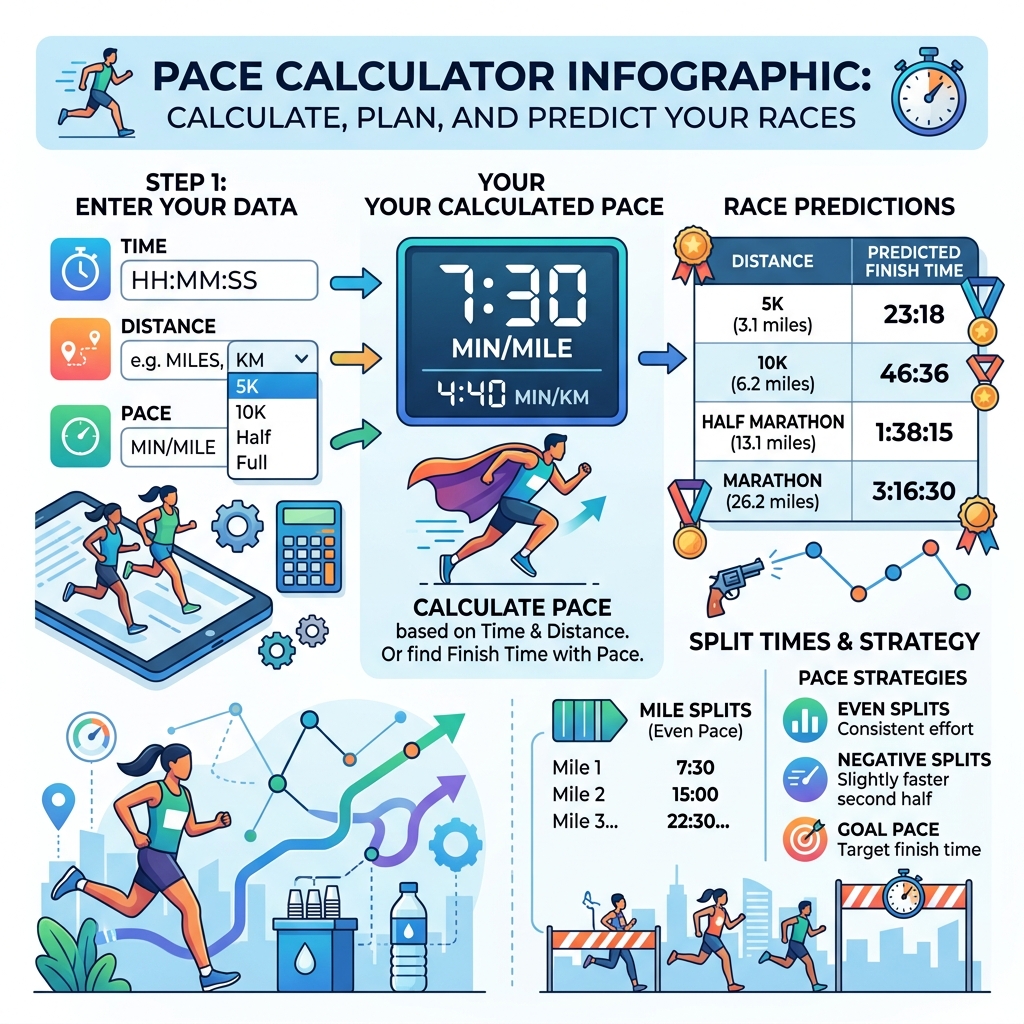
Calculate your running pace per km and per mile. See projected finish times for every major race distance, 5K, 10K, half marathon, and marathon.
Quick answer
Pace is your time per kilometre or mile. This calculator works out pace, speed, and finish time from any two of distance, time, and pace, which is useful for race planning.
Fuel your runs with the right macros.
Calorie and carb targets matched to your training volume — free guide, no signup needed.
Download the Free Macro Guide →How to Use Pace to Train Smarter (Not Just Faster)
Most runners make the same mistake: they run every session at the same medium effort, too hard to be easy, too easy to be hard. Training by pace fixes this. When you know your pace zones, each run has a purpose: easy runs build aerobic base, threshold runs lift your lactate ceiling, and interval runs push your VO2 max.
Use this calculator after every workout to track pace trends over weeks. A consistent 10–15 second drop in your easy-run pace over 8 weeks is a clear sign your aerobic base is growing.
5 Signs Your Pace Is Too Fast on Easy Days
- You can't hold a conversation, Easy runs should be fully conversational. If you're speaking in short bursts, slow down by 30–60 sec/km.
- Your heart rate is above 75% max HR, For most people that's above 140–150 bpm, which is too high for a recovery run.
- You feel sore the next day, True easy runs should leave you fresh, not fatigued.
- You can't maintain it for 60+ minutes, Your easy pace should feel sustainable for hours.
- Your pace drops significantly in the second half, A big positive split signals the effort was too high from the start.
How to Set a Realistic Race Time Goal
The best way to set a race goal is to use a recent time trial or race result as your reference point. Run a 5K time trial and plug that pace into the calculator, the projected marathon time will typically be within 5–10% of what you'd run with proper marathon-specific training.
Common race equivalency rules of thumb:
- Double your 5K time + ~10% to estimate 10K
- Multiply your 10K pace by 1.15 for half marathon pace
- Multiply your half marathon pace by 1.12–1.15 for marathon pace
Remember: these are ideal pacing strategies assuming proper training. Jumping from a 5K to a marathon without a base can lead to injury. Build gradually.
The 80/20 Running Rule: Why Easy Days Matter Most
Elite marathon runners spend roughly 80% of their training volume at easy pace (below 75% of max HR) and only 20% at moderate-to-hard effort. This distribution, known as polarized training, produces better long-term results than running every session at medium intensity.
The science is clear: low-intensity training maximizes mitochondrial density, improves fat oxidation, and allows full recovery between hard sessions. Hard sessions (threshold, intervals, tempo) are when you get fast , but only if the easy days allow you to show up fresh.
Use the pace calculator to define your zones: easy = 90 sec/km slower than 5K pace; threshold = 30 sec/km slower than 5K pace; intervals = 5K race pace or faster.
Pacing Strategy for Your First Marathon or Half Marathon
The golden rule of long-distance racing: go out slower than you think you need to. The most common first-marathon mistake is starting 15–20 seconds per km too fast, hitting the wall at mile 18, and suffering through the finish.
A proven strategy for beginners:
- Miles 1–3: Run 20–30 sec/km slower than goal pace, let the crowd thin, warm up gradually
- Miles 4–18: Lock into goal pace, run by feel and check in every 5K
- Miles 19–23: Maintain pace, focus on form, fuel on schedule
- Last 5K: If you have energy left, push, if not, hold and finish strong
Frequently Asked Questions
How do I calculate my running pace?
What is a good running pace for beginners?
What pace do I need for a sub-4 hour marathon?
How do I convert pace from min/km to min/mile?
What is a good 5K pace?
How do negative splits improve race performance?
How it's calculated: this tool uses established, published equations. See the full calculator methodology for the formulas and assumptions behind it.
Results are estimates for general guidance, not medical advice. See our disclaimer, and speak to a qualified healthcare professional before making medical or dietary changes.
Related Tools
Save & share on Pinterest
Click any card to pin it — or share with someone who needs it.
Running Pace Calculator
Calculate your running pace per km and per mile. See projected finish times for every major race dis…
Calculate your running pace per km and per mile. See projected finish times for …
Read the full guide: Running Pace Calculator
Try the free Running Pace Calculator
Running Pace Calculator — use our free calculators for instant personalised results. No signup requi…
Pinterest opens in a new tab. You can edit the description before saving.
Get Your Free Macro Cheat Sheet
One-page PDF with all the key formulas. Free, no spam ever.
Get the Free Macro Guide