How to Calculate Macros for Women (Step-by-Step Guide)

BSc Kinesiology · CPT
Here's something that genuinely frustrates me: most of the "macros for women" advice floating around is just a men's plan with the numbers shrunk down a bit. As if a woman is simply a smaller man. She isn't, our physiology, our hormones, the way our bodies handle carbohydrates across a monthly cycle, and the goals most of us are actually chasing are all meaningfully different. A scaled-down male template ignores all of it, and it's one of the most common reasons women feel like macro tracking "doesn't work for them."
So this guide does it the right way, built around female physiology from the start. I'll walk you through calculating your macros step by step, with a full worked example for a 65kg woman, and I'll explain why each number is what it is. Because understanding the reasoning is what lets you adjust with confidence later.
Why Women's Macros Are Different
Hormonal Fluctuations Affect Energy Needs
Men's hormone levels are relatively stable day to day. Women's are not. Your energy needs, carbohydrate metabolism, and recovery capacity change across your menstrual cycle:
- Follicular phase (days 1-14): Higher oestrogen improves insulin sensitivity. Your body handles carbohydrates more efficiently. Energy needs are slightly lower.
- Luteal phase (days 15-28): Progesterone rises, basal metabolic rate increases by approximately 100-200 kcal/day, insulin sensitivity decreases slightly, and protein breakdown increases.
A macro plan that ignores this cycling may result in energy crashes, poor workout recovery, or increased cravings in the luteal phase, not because of lacking willpower, but because the plan doesn't match your biology.
Women Have Higher Essential Fat Requirements
Body fat serves different functions in women. Reproductive hormones depend on adequate fat stores. The minimum healthy body fat percentage for women is approximately 10-13%, compared to 2-5% for men. This means women should not pursue the same extreme leanness that male bodybuilders target, and fat intake should never drop so low that it impairs oestrogen production.
Women Build Muscle Differently
Women have significantly lower testosterone levels than men, which means muscle growth is slower and requires more time. This is not a limitation, it means women can benefit from progressive resistance training without gaining bulk, and protein requirements during muscle-building phases are substantial but achievable.
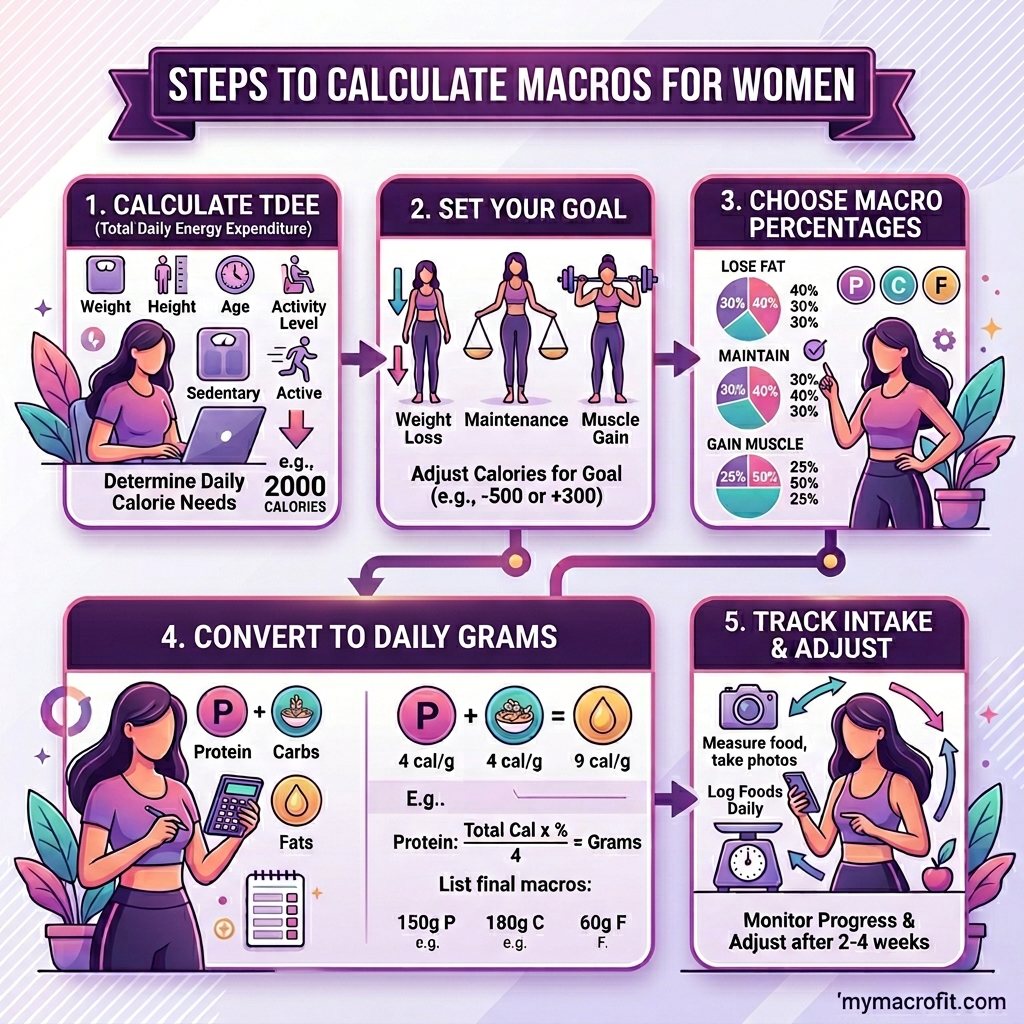
Step 1: Calculate Your TDEE
Your Total Daily Energy Expenditure (TDEE) is the starting point. This combines your Basal Metabolic Rate (BMR) with an activity multiplier.
Use the Mifflin-St Jeor equation for BMR:
BMR = 10 x weight(kg) + 6.25 x height(cm) − 5 x age(years) − 161
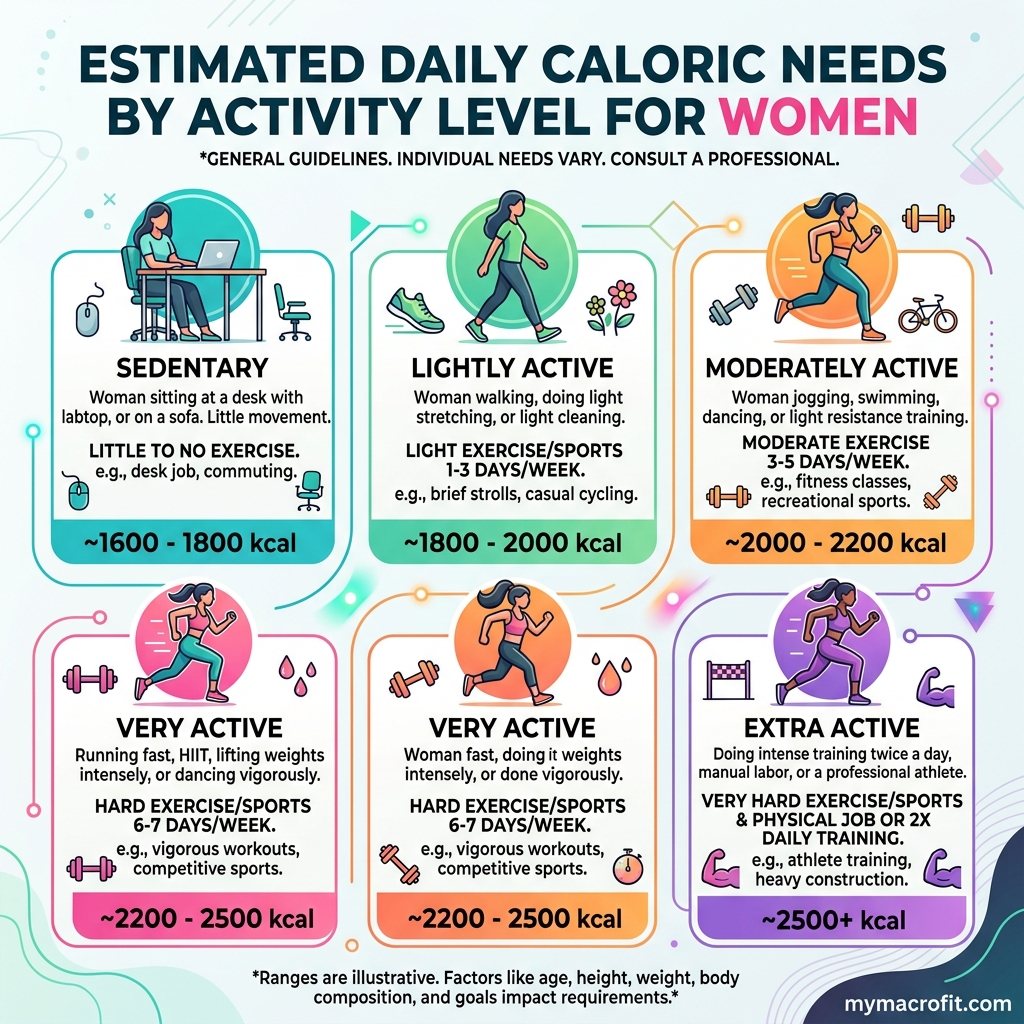
Activity multipliers:
- Sedentary (desk job, no exercise): BMR x 1.2
- Lightly active (1-3 days/week): BMR x 1.375
- Moderately active (3-5 days/week): BMR x 1.55
- Very active (6-7 days/week): BMR x 1.725
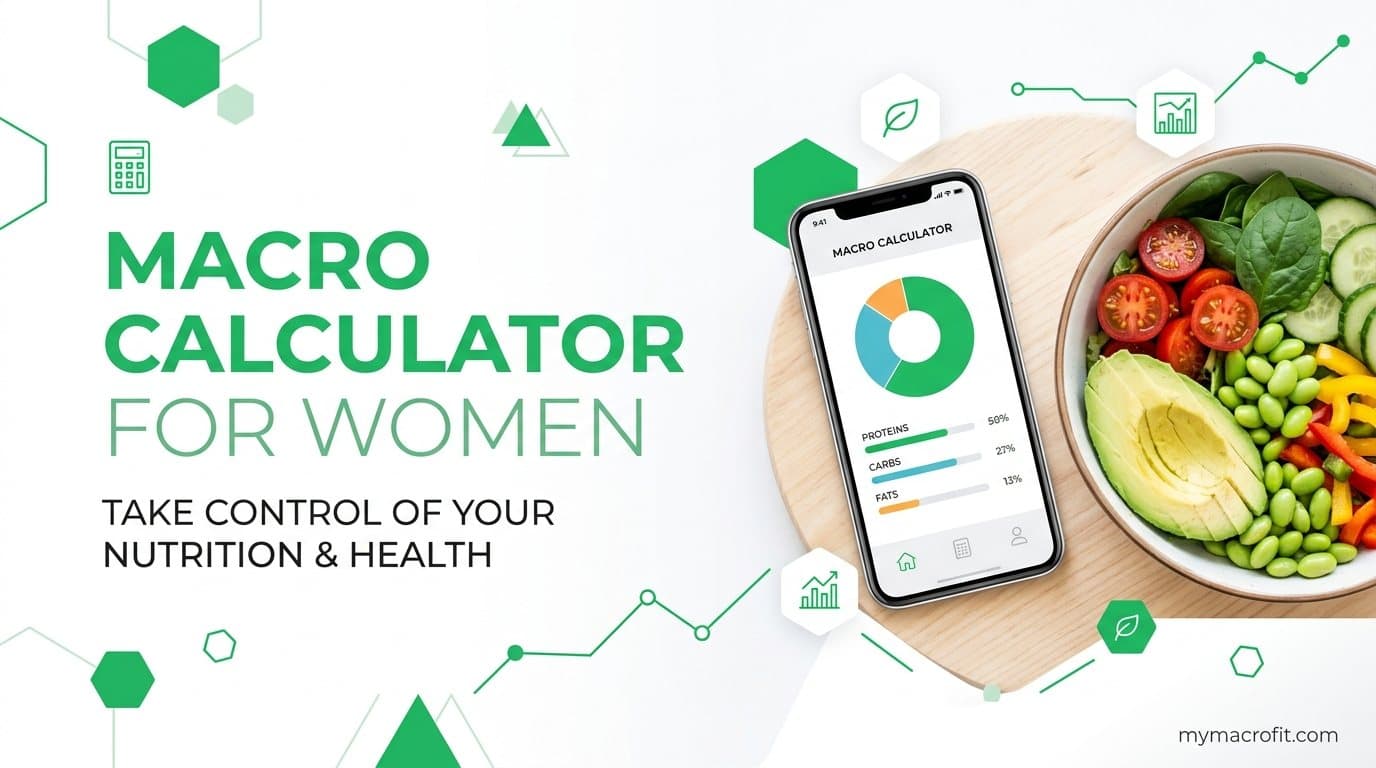
Or skip the maths entirely and use our Macro Calculator.
Step 2: Set Your Calorie Goal
Depending on your goal:
- Fat loss: TDEE minus 300-500 kcal (avoid going below 1200 kcal for most women)
- Maintenance: Match TDEE
- Muscle building: TDEE plus 150-250 kcal
Step 3: Set Protein
Protein is the most important macro to get right. For women, the evidence supports:
- Fat loss: 1.8-2.2g per kg body weight (preserves muscle during deficit)
- Muscle building: 1.6-2.0g per kg body weight
- Maintenance/general health: 1.2-1.5g per kg body weight
Each gram of protein provides 4 calories.
Step 4: Set Fat (Don't Go Too Low)
Women should not drop fat below approximately 0.8g per kg body weight. Lower than this can impair oestrogen production, disrupt the menstrual cycle, and affect skin, hair, and hormonal health.
A reasonable fat target for most women is 25-35% of total calories.
Each gram of fat provides 9 calories.
Step 5: Set Carbohydrates
Carbohydrates fill the remaining calories after protein and fat are accounted for.
Carbohydrates = (Total calories − protein calories − fat calories) ÷ 4
Each gram of carbohydrate provides 4 calories.
Worked Example: 65kg Woman, Fat Loss Goal
Profile:
- Weight: 65kg
- Height: 165cm
- Age: 32
- Activity: Moderately active (gym 4x/week)
- Goal: Fat loss
Step 1, BMR: 10 x 65 + 6.25 x 165 − 5 x 32 − 161 = 650 + 1031 − 160 − 161 = 1360 kcal
Step 2, TDEE: 1360 x 1.55 = 2108 kcal
Step 3, Calorie goal (deficit of 400): 2108 − 400 = 1708 kcal
Step 4, Protein: 65kg x 2.0g = 130g protein = 130 x 4 = 520 kcal from protein
Step 5, Fat: 65kg x 0.9g = 58g fat = 58 x 9 = 522 kcal from fat
Step 6, Carbohydrates: (1708 − 520 − 522) ÷ 4 = 666 ÷ 4 = 166g carbohydrates
Final macros for this 65kg woman:
| Macro | Grams | Calories | % of total |
|---|---|---|---|
| Protein | 130g | 520 kcal | 30% |
| Fat | 58g | 522 kcal | 31% |
| Carbohydrates | 166g | 664 kcal | 39% |
| Total | , | ~1708 kcal | 100% |
Adjusting Macros for Your Menstrual Cycle
Follicular Phase (Days 1-14): Higher Carb, Standard Calories
Your body is more insulin-sensitive and recovery from exercise is faster. This is a good time to prioritise carbohydrate-dense pre and post-workout nutrition. Keep to your standard calorie target.
Luteal Phase (Days 15-28): Higher Protein and Fat, Slightly More Calories
Basal metabolic rate increases by 100-200 kcal. Increase calories slightly (100-150 kcal) through protein and healthy fats rather than refined carbohydrates. This reduces the intense cravings that often occur in the late luteal phase.
A practical implementation:
- Days 1-14: Keep to calculated macros above
- Days 15-28: Add 30g of protein (+120 kcal) and reduce carbs by 30g (−120 kcal), keep total calories the same or increase by 100

Common Mistakes Women Make With Macros
Setting Calories Too Low
The most common mistake. Many women target 1200 calories because it sounds "safe." For a moderately active woman, this is likely 600-900 calories below TDEE, an extreme deficit that slows metabolism, promotes muscle loss, and is nearly impossible to sustain.
Ignoring Fat Minimums
Low-fat diets were popular for decades and the habit persists. Dropping fat below 40-45g per day consistently can impair hormonal health in women. Healthy fat is essential, not optional.
Eating the Same Every Day
Women's calorie needs genuinely vary across the week and across the month. Building in some flexibility, slightly more on training days, slightly less on rest days, reflects your actual biology better than a rigid flat daily target.
Not Adjusting After Weight Changes
Your TDEE changes as your weight changes. If you lose 5kg, your calorie needs drop by roughly 100-150 kcal. Recalculate every 4-6 weeks during an active fat loss phase.
Macro Ratio Quick Reference for Women
| Goal | Protein | Carbs | Fat |
|---|---|---|---|
| Fat loss | 30-35% | 35-40% | 25-30% |
| Muscle building | 25-30% | 40-45% | 25-30% |
| Maintenance | 20-25% | 45-50% | 25-30% |
| Low carb approach | 30-35% | 15-25% | 40-50% |
The Bottom Line
Calculating macros as a woman means accounting for your specific protein requirements, fat minimums, hormonal fluctuations, and realistic body composition goals. A macro plan built for a man's physiology and scaled down will underserve you.
The worked example above gives you a practical template. Use the Macro Calculator to generate personalised numbers for your body, and revisit them every 4-6 weeks as your weight and activity change.
Save & share on Pinterest
Click any card to pin it — or share with someone who needs it.
How to Calculate Macros for Women (Step-by-Step Guide)
A step-by-step guide to calculating macros for women, covering why women's macros differ, hormonal c…
A step-by-step guide to calculating macros for women, covering why women's macro…
Read the full guide: How to Calculate Macros for Women (Step-by-Step Guide)
Try the free Macro Calculator
How to Calculate Macros for Women (Step-by-Step Guide) — use our free calculators for instant person…
Pinterest opens in a new tab. You can edit the description before saving.
Ready to get your numbers?
Free calculator, instant results, no signup required.
Frequently Asked Questions
Are macros different for women than men?+
What should a woman's macros be for weight loss?+
Should women eat less than 1200 calories for weight loss?+
Do macros need to change during the menstrual cycle?+
About the Author

I'm a kinesiologist and personal trainer. I've spent eight years helping women lose fat and get stronger without handing their whole life over to a diet.
View full profile →