How Many Calories to Lose 1kg Per Week?

CN · Metabolic Health Coach
Here's a number you've probably seen quoted as gospel: 7,700 calories per kilogram of fat. It gets repeated everywhere, usually with the confident implication that fat loss is just simple arithmetic, subtract this, divide by that, done. As someone who works with the numbers daily, let me be straight with you: the 7,700 figure is a genuinely useful anchor, but the people who treat it as a precise law of physics are the ones who end up confused when the scale doesn't obey their spreadsheet.
The principle underneath is real, you lose fat by burning more energy than you take in. But the maths has nuance that matters, and understanding it is the difference between setting expectations you'll actually meet and chasing a number that was never going to behave the way you were told.
The 7,700 Calorie Rule
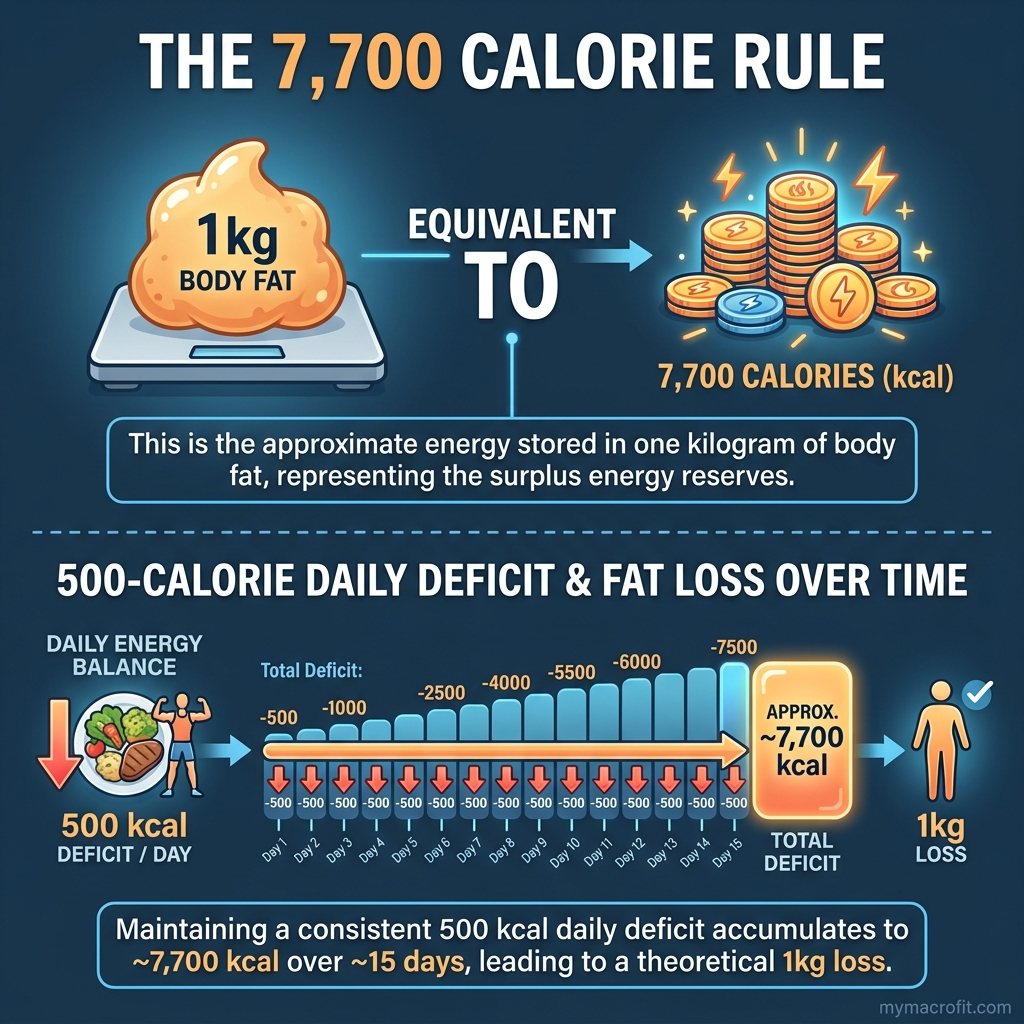
The most widely cited figure is that 1 kg of fat contains approximately 7,700 kilocalories. To lose 1 kg of fat per week, you'd therefore need a daily deficit of:
7,700 ÷ 7 = 1,100 kcal/day
That's a large deficit. For most people, it means eating significantly below maintenance while also accounting for exercise output.
In practice, most people should aim for 0.5 kg per week, which requires a 550 kcal/day deficit, far more sustainable and far less likely to cause muscle loss or metabolic adaptation.
Why 1kg Per Week Is Often Too Aggressive
Muscle Loss Risk
The larger your calorie deficit, the more your body turns to muscle tissue for energy in addition to fat. Studies consistently show that deficits beyond 700-800 kcal/day accelerate lean mass loss, especially without adequate protein intake and resistance training.
Losing muscle is counterproductive for long-term weight management because:
- Muscle is metabolically expensive (it burns calories at rest)
- Lower muscle mass means a lower Basal Metabolic Rate
- You become a lighter version of the same body composition rather than genuinely leaner
Metabolic Adaptation
When you eat in a large deficit, your body responds by reducing non-exercise energy expenditure (NEAT, fidgeting, incidental movement), reducing thyroid output, and lowering the energy cost of basic physiological processes. This is known as adaptive thermogenesis.
The result: the deficit you calculated at the start becomes smaller over time as your body "defends" its weight. This is why aggressive diets stall.
Hunger and Adherence
A 1,100 kcal/day deficit is genuinely uncomfortable for most people. Ghrelin (hunger hormone) rises significantly with large deficits, making adherence difficult. Most people who attempt aggressive cuts either overshoot their targets or abandon the diet entirely.
The Realistic Calorie Deficit for Different Goals
| Goal | Daily Deficit | Weekly Loss | Use Case |
|---|---|---|---|
| Very slow cut | 200-300 kcal | 0.2-0.3 kg | Athletes preserving performance |
| Standard cut | 300-500 kcal | 0.3-0.5 kg | Most people, sustainable, low muscle loss |
| Moderate cut | 500-700 kcal | 0.5-0.7 kg | Faster results, still manageable |
| Aggressive cut | 700-1,000 kcal | 0.7-1.0 kg | Short-term only, risk of muscle loss |
| Very aggressive | 1,000+ kcal | 1.0 kg+ | Not recommended except under medical supervision |
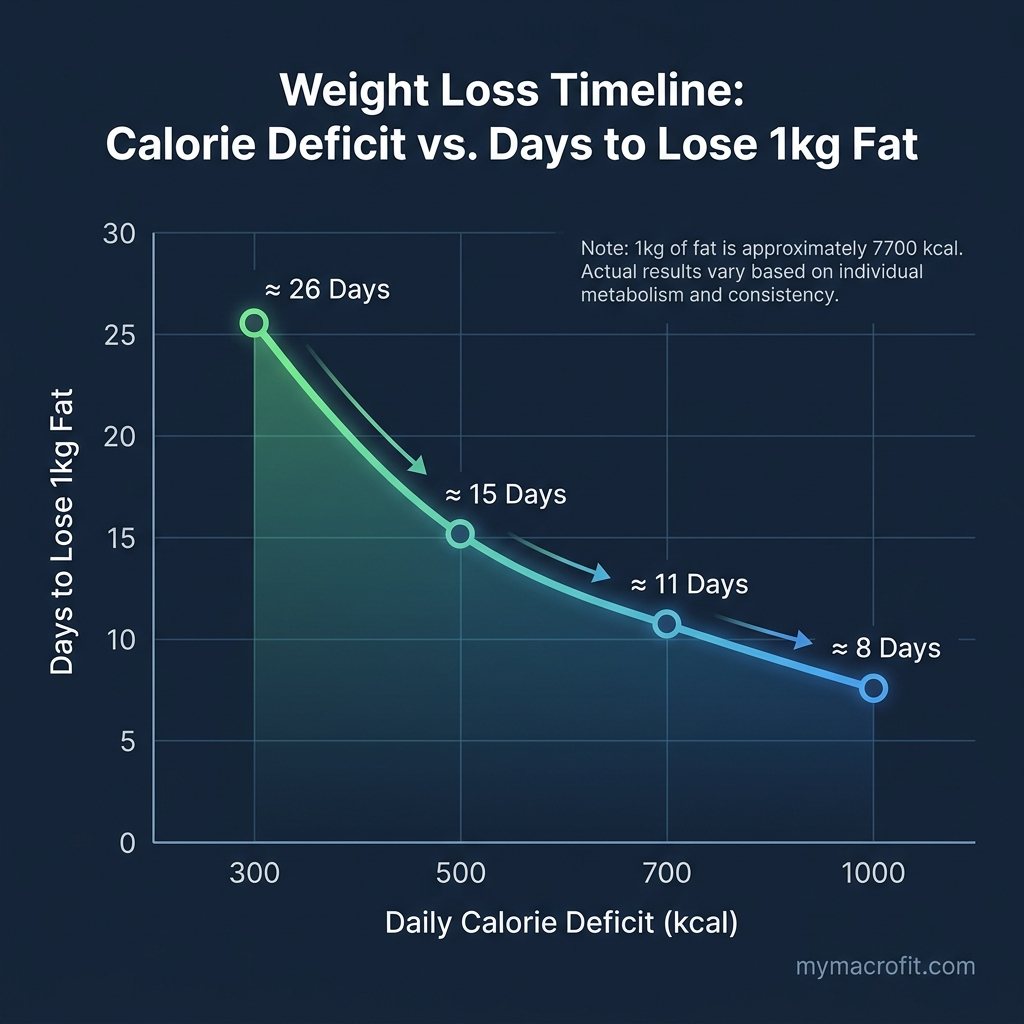
For most people, a 300-500 kcal daily deficit producing 0.3-0.5 kg of weight loss per week is the sweet spot: meaningful progress, sustainable hunger levels, and minimal lean mass loss.
How to Create a 500 kcal Deficit
From diet alone (500 kcal examples):
- Skip the evening dessert + reduce dinner portion, ~300 kcal
- Switch from full-fat to semi-skimmed dairy across the day, ~80 kcal
- One less slice of bread, ~100 kcal
- Replace a juice with water, ~120 kcal
These are small, stackable changes, not dramatic restriction.
From exercise (500 kcal examples):
- 6-7 km run at moderate pace (70 kg person), ~430-490 kcal
- 60 min cycling at moderate intensity, ~400-500 kcal
- 60 min strength training, ~250-350 kcal (less precise)
Combined approach (recommended):
A 250-300 kcal dietary reduction + 200-250 kcal from exercise creates a 500 kcal deficit more sustainably than either approach alone. You don't need to eat as little, and the exercise provides additional health benefits beyond calorie burn.
How Long to Lose Specific Amounts
Based on a 500 kcal/day deficit (0.5 kg/week realistic target):
| Weight to Lose | Time at 0.5 kg/week |
|---|---|
| 3 kg | 6 weeks |
| 5 kg | 10 weeks |
| 10 kg | 20 weeks (5 months) |
| 15 kg | 30 weeks (7 months) |
| 20 kg | 40 weeks (10 months) |
These are estimates. Progress slows as you lose weight (lower bodyweight = lower TDEE = smaller absolute deficit from the same food intake).

The 7,700 Rule Isn't Perfectly Accurate
The 7,700 kcal/kg figure comes from the energy density of pure fat (9 kcal/g × 1,000g = 9,000 kcal, minus the water content of adipose tissue). In practice, the calorie cost of losing 1 kg of body weight is lower than 7,700 in the early stages of a diet because:
- Water loss accounts for a significant portion of early weight loss (glycogen stored in muscle is bound to water; losing glycogen releases this water)
- Mixed tissue loss, you're losing both fat and lean tissue, and lean tissue has a lower energy density
In the first 1-2 weeks on a calorie deficit, weight loss is typically faster than predicted purely from the deficit because glycogen and water are being shed rapidly. After this initial phase, the rate slows to something closer to the expected deficit-based prediction.
Practical Example
Profile: 75 kg woman, 165 cm, 30 years old, moderately active
- TDEE: ~2,200 kcal/day
- Target deficit: 500 kcal
- Daily intake target: 1,700 kcal
- Expected weekly loss: ~0.5 kg
- Protein target: 130-150g/day (1.8-2.0g/kg)
At this intake, she'd reach her goal of losing 5 kg in approximately 10 weeks while maintaining muscle mass (assuming adequate protein and some resistance training).
When Is 1kg Per Week Appropriate?
A 1 kg/week deficit is sometimes appropriate for:
- Higher starting body fat, people with BMI 30+ can sustain more aggressive deficits while losing predominantly fat, because they have more fat stores to draw from
- Short-term, medically supervised, some clinical weight loss programmes use very low calorie diets (VLCDs) of 800-1,000 kcal with medical monitoring
- Pre-competition, bodybuilders in final weeks before a show sometimes accept muscle loss risk for short periods
For the general population trying to lose fat sustainably, 1 kg/week is usually too aggressive and 0.5 kg/week is the more practical target.
The Bottom Line
To lose 1 kg of fat requires a 7,700 kcal deficit, roughly 1,100 kcal/day over a week. That's aggressive for most people. A 500 kcal daily deficit producing 0.5 kg/week is a more realistic, sustainable, and muscle-preserving target.
Use the Calorie Deficit Calculator to find your precise targets based on your TDEE, and combine a moderate dietary reduction with regular exercise for the most sustainable results.
Save & share on Pinterest
Click any card to pin it — or share with someone who needs it.
How Many Calories to Lose 1kg Per Week?
The exact calorie deficit needed to lose 1kg per week, how long it realistically takes, and why the …
The exact calorie deficit needed to lose 1kg per week, how long it realistically…
Read the full guide: How Many Calories to Lose 1kg Per Week?
Try the free Calorie Deficit Calculator
How Many Calories to Lose 1kg Per Week? — use our free calculators for instant personalised results.…
Pinterest opens in a new tab. You can edit the description before saving.
Ready to get your numbers?
Free calculator, instant results, no signup required.
Frequently Asked Questions
How many calories do I need to cut to lose 1kg?+
Is it possible to lose 1kg per week safely?+
Why am I not losing weight in a calorie deficit?+
Does losing 1kg always mean losing 1kg of fat?+
About the Author

I'm a certified nutritionist and metabolic health coach. I went deep on keto and metabolism after reversing my own insulin resistance, and I'd rather give you the actual numbers than a hand-wave.
View full profile →