How to Lose 10kg: A Step-by-Step Plan That Actually Works
Founder, MyMacroFit
"I want to lose 10kg" is one of the most common goals I hear, and one of the most achievable, if you have an actual roadmap rather than just a wish and a vague plan to "eat less and move more." I lost 25kg myself, and I've since coached hundreds of people through losses of this size. The ones who succeed all have one thing in common: a clear, boring, repeatable plan they trust enough to stick with.
That's what this is. No extreme restriction. No 30-day miracle. A realistic timeline, the exact calorie and macro setup, a four-week action structure, and a weekly check-in system that keeps you honest without driving you mad over daily scale fluctuations.
The Realistic Timeline
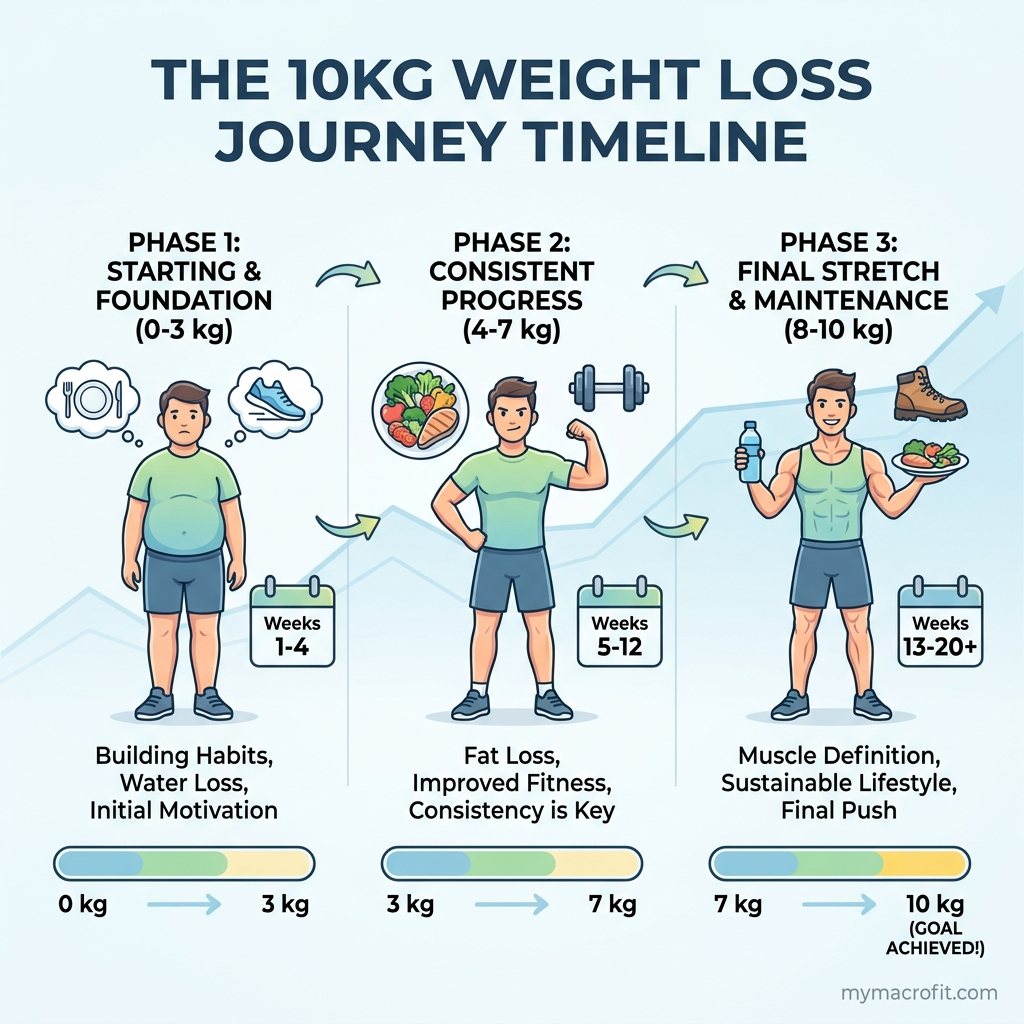
The most important thing to understand before starting: losing 10kg safely takes 10-20 weeks. That's 2.5 to 5 months, assuming:
- A daily calorie deficit of 500-750 kcal
- Rate of loss of 0.5-1kg per week
- Consistent effort throughout
Here's the breakdown:
| Weekly Fat Loss Rate | Time to Lose 10kg | Calorie Deficit Required |
|---|---|---|
| 0.5kg/week | ~20 weeks (5 months) | ~500 kcal/day |
| 0.75kg/week | ~13 weeks (3.25 months) | ~750 kcal/day |
| 1kg/week | ~10 weeks (2.5 months) | ~1000 kcal/day |
Note: 1kg/week requires a 1000 kcal daily deficit, which is aggressive for most people and risks significant muscle loss, metabolic adaptation, and energy crashes. Most people do better targeting 0.5, 0.75kg per week.
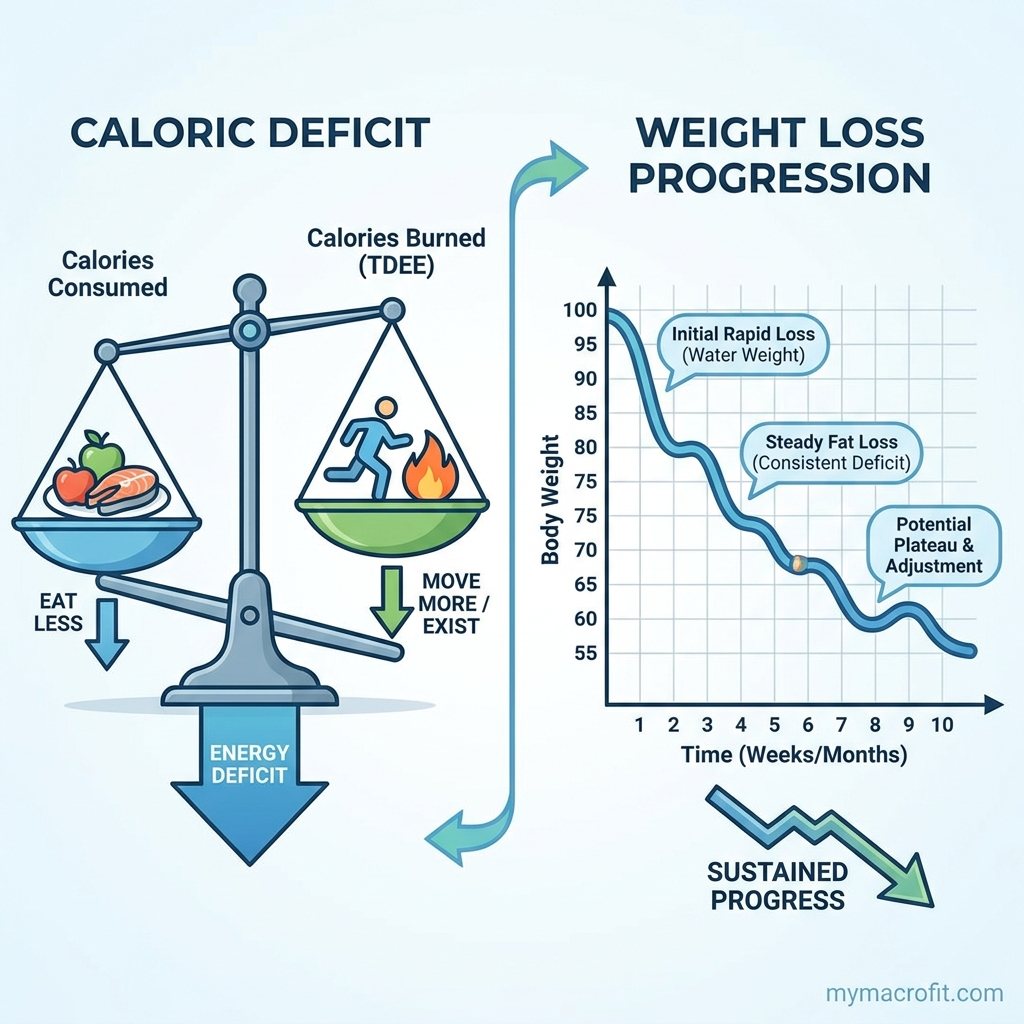
The scale will not move in a perfectly straight line. Water weight fluctuations of 1-2kg are normal and obscure actual fat loss in the short term. Judge your progress over 3-week periods, not day to day.
Step 1: Calculate Your Calorie Target
Your starting point is your Total Daily Energy Expenditure (TDEE), the number of calories you burn in a typical day.
Use our Calorie Deficit Calculator to get your personalised number. As a rough guide, the Mifflin-St Jeor equation estimates BMR:
Women: BMR = 10 x weight(kg) + 6.25 x height(cm) − 5 x age − 161 Men: BMR = 10 x weight(kg) + 6.25 x height(cm) − 5 x age + 5
Multiply BMR by your activity factor to get TDEE:
- Sedentary: x 1.2
- Lightly active: x 1.375
- Moderately active: x 1.55
- Very active: x 1.725
Subtract 500 kcal from your TDEE to set your daily calorie target.
Example: A 75kg moderately active woman, age 35, height 168cm
- BMR: 10 x 75 + 6.25 x 168 − 5 x 35 − 161 = 750 + 1050 − 175 − 161 = 1464
- TDEE: 1464 x 1.55 = 2269 kcal
- Target: 2269 − 500 = 1769 kcal/day
Step 2: Set Your Macro Targets
Within your calorie target, macro distribution determines whether you lose fat and muscle, or primarily fat. Protein is the most critical variable:
Protein: 1.8-2.2g per kg body weight
- Purpose: Preserves muscle during fat loss, suppresses hunger
- 75kg person: 135-165g protein = 540-660 kcal
Fat: 0.8-1.0g per kg body weight (minimum for hormonal health)
- 75kg person: 60-75g fat = 540-675 kcal
Carbohydrates: Fill remaining calories
- Remaining kcal after protein and fat ÷ 4
- Example: (1769 − 600 − 607) ÷ 4 = 562 ÷ 4 = ~140g carbs
Full macro example for the 75kg woman at 1769 kcal:
| Macro | Grams | Calories |
|---|---|---|
| Protein | 150g | 600 kcal |
| Fat | 67g | 603 kcal |
| Carbohydrates | 141g | 564 kcal |
| Total | , | ~1767 kcal |
Step 3: Build Your Weekly Structure
A week of fat loss eating and training looks like this:
Nutrition:
- Track calories and protein every day, even weekends
- Prep at least 3 days of food in advance (reduces decision fatigue)
- Aim for 3-4 meals per day, each with 35-50g protein
- Drink 2-2.5L of water daily
Exercise:
- 3-4 days of resistance training (preserves muscle during fat loss)
- 2-3 days of moderate cardio (brisk walking, cycling, swimming, 30-45 min)
- At least 7,500-10,000 steps per day from general movement
Weekly check-in:
- Weigh yourself every morning after using the bathroom, before eating
- Log results in a spreadsheet or app
- Calculate weekly average weight (average of all 7 days)
- Track progress by comparing weekly averages, not day-to-day readings
The 4-Week Action Plan
Week 1: Set the Foundation
Goal: Establish your baseline and start tracking
- Calculate TDEE and calorie target using our Calorie Deficit Calculator
- Choose and set up your tracking app (MyFitnessPal, Cronometer, or similar)
- Log everything you eat for 7 days, including weekends
- Aim for the calorie target but don't panic if you miss on days 1-3
- Start resistance training, 3 sessions this week, even if light
- Begin daily weigh-ins
Week 1 milestone: 7 days of tracked food logged, 3 training sessions completed, calorie target hit on at least 5/7 days
Week 2: Build Consistency
Goal: Hit your protein target consistently
- Protein is the priority this week, aim for your full target every day
- Prep at least 3 days of lunches on Sunday
- Identify your 2-3 "go-to" meals that make tracking easy
- Add 2 cardio sessions this week (30 min walks count)
- Review your Week 1 data, where did calories go over? Adjust accordingly
Week 2 milestone: Protein target hit on 6/7 days, 5 training/activity sessions completed, starting to see consistent calorie deficit in tracking data
Week 3: Optimise and Troubleshoot
Goal: Address any issues from weeks 1-2 and sharpen the process
- Compare Week 1 and Week 2 average weights, is the trend downward?
- If no downward trend: review tracking accuracy (weigh solid foods, account for cooking oils, check drink calories)
- If losing more than 1.25kg in 2 weeks: increase calories by 150-200 kcal, too aggressive
- Increase resistance training weight on at least 2 exercises this week
- Try meal prepping 5 days rather than 3
Week 3 milestone: Downward trend confirmed in weekly average weights, food logging is habitual, protein consistency improved
Week 4: Anchor the Habits
Goal: Make this feel automatic, not effortful
- Cook a batch of your favourite high-protein meal for the week
- Complete all planned training sessions, this week is about proving you can do it consistently
- Review your 4-week weight data, calculate total loss so far
- Plan your approach for the next 4-week block
- Identify and address the 1-2 most common situations where you exceed your calories
Week 4 milestone: Total weight loss of 2, 4kg since starting, eating routine feels manageable, training is consistent
Progress Tracking Beyond the Scale
The scale is one data point. These additional metrics give a more complete picture of your progress:
| Metric | How to Track | What It Shows |
|---|---|---|
| Weekly average weight | Daily weigh-in, 7-day average | True fat loss trend |
| Waist circumference | Weekly measurement at belly button | Visceral fat reduction |
| Strength levels | Log weights and reps | Muscle preservation |
| Energy levels | 1-10 daily score | Adequacy of calorie intake |
| Progress photos | Monthly, same lighting/position | Visual body composition |
When the Scale Stalls
Every fat loss journey hits a plateau at some point. Here's what to do:
First: check tracking accuracy. Most "plateaus" are actually tracking errors. Weigh solid foods on a kitchen scale rather than estimating. Log condiments, drinks, and cooking oils.
If tracking is accurate: You've likely experienced metabolic adaptation, your body has lowered its calorie expenditure in response to the deficit. Options:
- Take a 1-2 week diet break at maintenance calories (research shows this restores metabolic rate)
- Reduce calories by a further 100-150 kcal
- Increase activity by adding 20-30 minutes of daily walking
Don't panic and drop calories drastically. This worsens metabolic adaptation and accelerates muscle loss.
What to Do After 10kg
Once you've reached your 10kg goal, transitioning out of the deficit properly is critical. Jumping straight to eating at maintenance calories can cause rapid water and glycogen refilling that shows on the scale and discourages people unnecessarily.
Transition plan:
- Increase calories by 100-150 kcal per week over 3-4 weeks until you reach your new TDEE
- Recalculate TDEE at your new weight, it will be lower than before
- Maintain training volume, this preserves the metabolic benefits of the muscle you've preserved or built
The Bottom Line
Losing 10kg is a 10-20 week project, not a 4-week sprint. The plan above, a 500 kcal daily deficit, 150g+ protein, resistance training, and consistent weekly tracking, is the evidence-based path to getting there without losing muscle, destroying your metabolism, or rebounding the moment you reach your goal.
Start with your personalised calorie target from our Calorie Deficit Calculator, commit to the 4-week action plan, and track your weekly average weight. The numbers will move.
Save & share on Pinterest
Click any card to pin it — or share with someone who needs it.
How to Lose 10kg: A Step-by-Step Plan That Actually Works
A realistic step-by-step plan to lose 10kg, covering the timeline, calorie setup, macro breakdown, 4…
A realistic step-by-step plan to lose 10kg, covering the timeline, calorie setup…
Read the full guide: How to Lose 10kg: A Step-by-Step Plan That Actually Works
Try the free Calorie Deficit Calculator
How to Lose 10kg: A Step-by-Step Plan That Actually Works — use our free calculators for instant per…
Pinterest opens in a new tab. You can edit the description before saving.
Ready to get your numbers?
Free calculator, instant results, no signup required.
Frequently Asked Questions
How long does it take to lose 10kg?+
What is the fastest way to lose 10kg safely?+
Will I need to eat very little to lose 10kg?+
How much protein should I eat to lose 10kg without losing muscle?+
About the Author
I'm the founder of MyMacroFit. I'm not a coach or a dietitian. I'm someone who wanted to lose weight, worked it out the hard way, and built the tools I wish I'd had.
View full profile →