Sleep and Weight Loss: The Science You Need to Know

RHC · Pre/Postnatal Fitness Specialist
In my coaching work, sleep is the variable people are most willing to sacrifice and least willing to talk about. They'll weigh their oats to the gram and never miss a workout, then run on five hours of broken sleep and wonder why the scale won't move. I understand it; sleep feels like the one place we can borrow time from. But your body keeps the receipts.
Here's what I want you to sit with before we go further: sleep is not a passive thing that happens to you while the real work waits for morning. It is the work. It's an active physiological process that governs your hunger hormones, your fat loss, the muscle you keep, and your metabolic rate. You can eat impeccably and train hard, but if your sleep is in chaos, you are quietly working against yourself all day long.
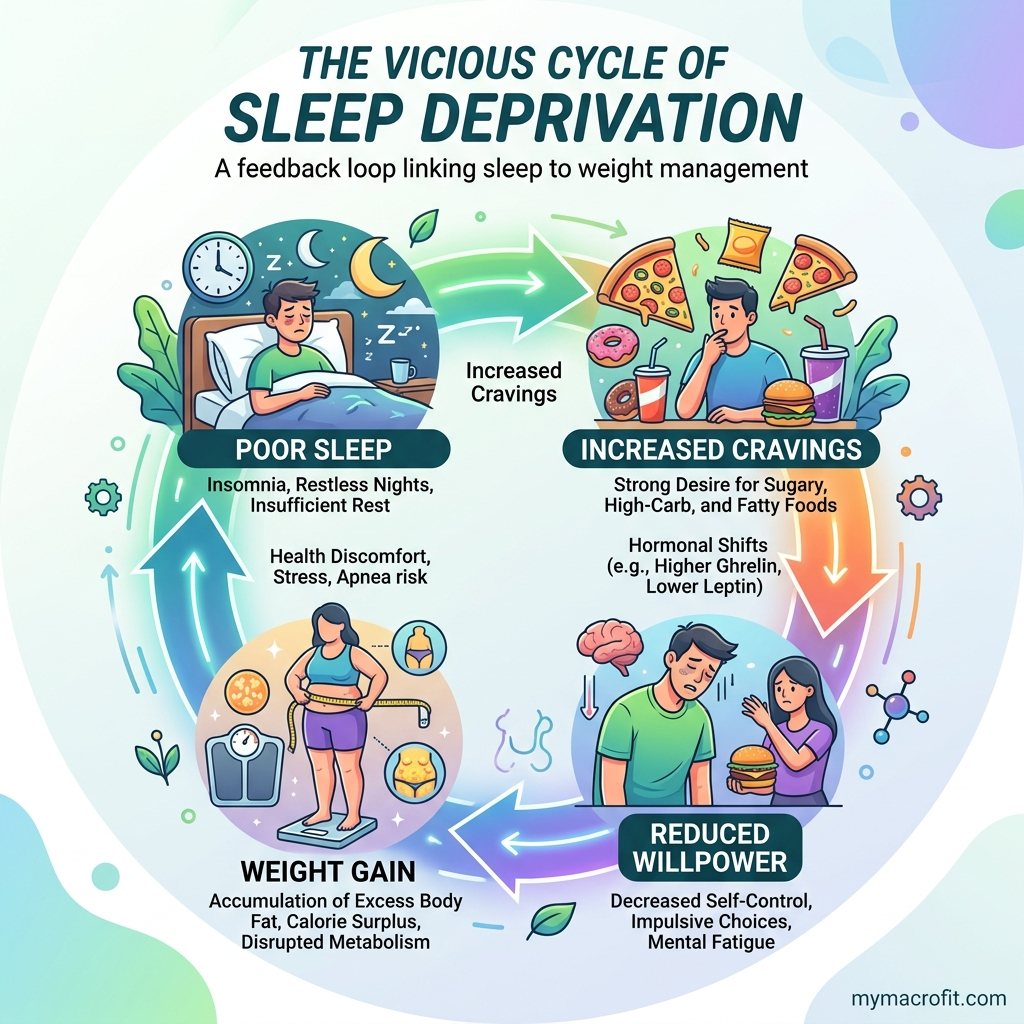
How Sleep Deprivation Causes Weight Gain
The research on sleep and body weight is striking. A landmark study from the University of Chicago found that when subjects ate the same calorie-restricted diet with 8.5 hours of sleep vs 5.5 hours of sleep, the well-rested group lost 55% more fat and the sleep-deprived group lost 60% more lean mass.
Same diet. Dramatically different results. Here's the mechanism:
1. Ghrelin and Leptin Disruption
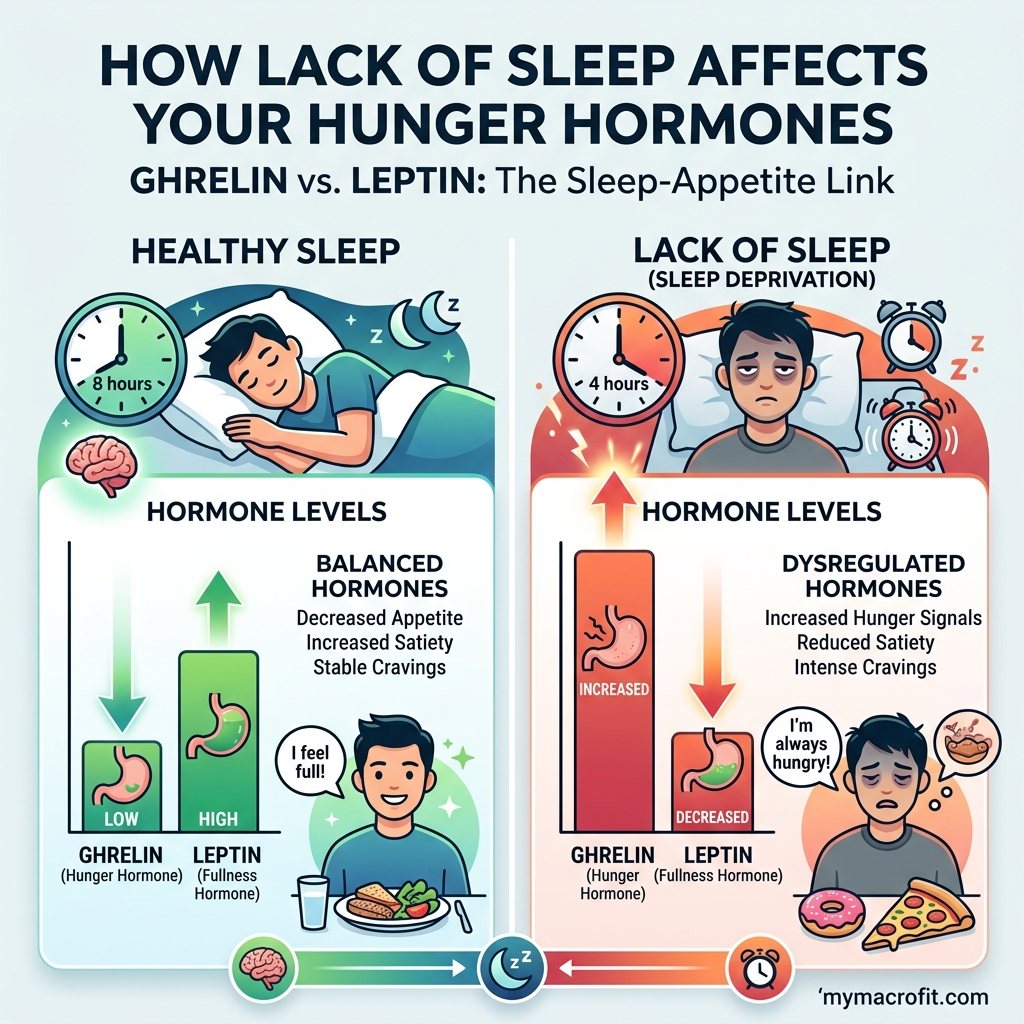
Sleep deprivation directly alters the two most important hunger-regulating hormones:
- Ghrelin (hunger hormone): Increases by ~15-20% after one night of poor sleep. You feel significantly hungrier.
- Leptin (satiety hormone): Decreases by ~15-20% after one night of poor sleep. You feel less full after eating.
This double effect means you're hungry more often, satisfied less easily, and biologically driven toward higher-calorie foods (studies show sleep-deprived people specifically crave sweet and fatty foods).
2. Cortisol Elevation
Poor sleep raises cortisol, the primary stress hormone. Chronically elevated cortisol:
- Promotes fat storage, especially visceral (abdominal) fat
- Breaks down muscle tissue (catabolism)
- Causes insulin resistance, making carbohydrates more likely to be stored as fat
- Increases appetite further through the hypothalamus
3. Reduced Insulin Sensitivity
After just four nights of sleeping five hours per night, otherwise healthy young adults show insulin sensitivity reductions comparable to early-stage type 2 diabetes. This means glucose is handled less efficiently and more likely to be stored as fat.
4. Impaired Growth Hormone Release
The majority of daily growth hormone secretion, critical for muscle repair, fat metabolism, and tissue regeneration, occurs during deep sleep. Reducing sleep quality or duration significantly reduces growth hormone output, slowing muscle recovery and fat utilisation.
How Much Sleep Do You Actually Need?
The NHS and sleep researchers consistently recommend 7-9 hours for most adults. Here's how to think about your personal requirement:
- 7 hours: Minimum for most people to avoid cognitive and metabolic impairment
- 8 hours: Optimal for most people
- 9 hours: Beneficial for athletes, those in high-stress periods, or those recovering from sleep debt
Genetics plays a role, approximately 3% of people genuinely function well on 6 hours (this is a verified genetic variant, not just self-reported tolerance). The remaining 97% who claim to "be fine on 6 hours" are experiencing the cognitive adaptation to sleep deprivation, feeling normal while performing measurably below their rested baseline.
Sleep Cycles and Why They Matter
Sleep isn't uniform, it occurs in 90-minute cycles, each comprising light sleep, deep sleep (slow-wave), and REM sleep:
Deep sleep (slow-wave): Most common in early cycles. Critical for physical recovery, growth hormone release, and immune function. Prioritised by the brain, if you only get 4 hours, you still get most of your deep sleep.
REM sleep: More prevalent in later cycles. Critical for memory consolidation, emotional regulation, and cognitive performance. Cutting sleep short significantly reduces REM sleep.
This is why wake time matters as much as bedtime. Going to bed at midnight and waking at 6am means you're cutting off the final REM-rich sleep cycles.
Use the Sleep Cycle Calculator to find the best wake-up times based on your bedtime.
Practical Sleep Optimisation Strategies
Prioritise sleep consistency over duration
Going to bed and waking up at the same time every day, including weekends, is the most powerful single change for sleep quality. Your circadian rhythm is an actual biological clock; inconsistency disrupts it.
Manage light exposure
- Morning: Get bright light (ideally sunlight) within 30-60 minutes of waking. This anchors your circadian rhythm and improves alertness.
- Evening: Dim artificial lights 1-2 hours before bed. Blue light from screens suppresses melatonin production. Use night mode on devices or blue-light blocking glasses if screens are unavoidable.
Optimise your sleep environment
- Temperature: 65-68°F (18-20°C) is optimal for most people, cooler than most people keep their bedrooms
- Darkness: Use blackout curtains. Even small amounts of light affect sleep quality
- Noise: White noise or earplugs if needed
Strategic caffeine management
Caffeine has a half-life of 5-6 hours. A 200mg coffee at 2pm still has 100mg active in your system at 8pm. For optimal sleep:
- Set a caffeine cutoff time of 1-2pm
- Switch to decaf, herbal tea, or sparkling water in the afternoon
Exercise timing
Regular exercise significantly improves sleep quality. However, vigorous training within 2 hours of bedtime can delay sleep onset for some people due to elevated heart rate and cortisol. Morning or early afternoon training is generally optimal for sleep.
Pre-sleep nutrition
- Don't go to bed hungry, hunger disrupts sleep onset
- Avoid large meals within 2-3 hours of bed, digestion increases core body temperature, impairing sleep
- Casein protein before bed (cottage cheese, Greek yogurt, casein shake) supports overnight muscle protein synthesis without disrupting sleep
Sleep Debt: Can You Catch Up?
You can partially recover from sleep debt by sleeping longer over the following nights, but the process isn't instant or complete. Research shows that some cognitive impairments from sleep debt persist even after "recovery sleep."
For practical purposes:
- Weekend lie-ins help but don't fully compensate for a week of poor sleep
- The most effective approach is preventing debt accumulation in the first place
- If you've been chronically sleep-deprived, expect 2-3 weeks of consistent good sleep before you feel fully recovered

Sleep and Muscle Building
The relationship between sleep and muscle gain is equally important:
- Growth hormone (released during deep sleep) directly stimulates muscle protein synthesis
- IGF-1 (insulin-like growth factor 1), another anabolic hormone, also peaks during sleep
- Cortisol from poor sleep actively breaks down muscle tissue
- Reduced sleep impairs gym performance the next day, strength, power output, and endurance all decline measurably with sleep deprivation
The Bottom Line
Sleep is not a lifestyle bonus, it's a foundational pillar of body composition. Seven to nine hours of quality sleep significantly improves fat loss, muscle retention, hunger control, and metabolic health. No supplement, diet strategy, or training protocol fully compensates for inadequate sleep.
If you're doing everything right with your nutrition and training but not seeing results, sleep is often the missing variable. And unlike most things in health, improving it doesn't ask you to do more, it asks you to protect something you're already meant to be doing. Start with one change: a consistent wake time, every day. Build from there, gently. Your hormones, your hunger, and your patience with yourself will all thank you.
Sources
- Sleep restriction and adipose tissue in humans, Nedeltcheva et al., Annals of Internal Medicine, 2010
- Sleep and human leptin and ghrelin levels, Spiegel et al., PLOS Medicine, 2004
- Sleep and obesity: a systematic review, Patel & Hu, Obesity, 2008
- Why sleep matters, NHS guidance, NHS, 2023
Save & share on Pinterest
Click any card to pin it — or share with someone who needs it.
Sleep and Weight Loss: The Science You Need to Know
How sleep affects weight loss, hunger hormones, metabolism, and muscle retention, and practical stra…
How sleep affects weight loss, hunger hormones, metabolism, and muscle retention…
Read the full guide: Sleep and Weight Loss: The Science You Need to Know
Try the free Sleep Cycle Calculator
Sleep and Weight Loss: The Science You Need to Know — use our free calculators for instant personali…
Pinterest opens in a new tab. You can edit the description before saving.
Ready to get your numbers?
Free calculator, instant results, no signup required.
Frequently Asked Questions
How many hours of sleep do I need to lose weight?+
Why do I gain weight when I'm sleep deprived?+
Does sleeping more help you lose weight?+
What should I eat before bed to support fat loss?+
About the Author

I'm a registered health coach and pre/postnatal specialist. I look at the whole person, your sleep, your stress, your hormones, because the number on the scale is only ever part of the story.
View full profile →