
Reverse Dieting: What It Is and Why You Need It After a Cut

BSc Kinesiology · CPT
Ending a diet is not as simple as "stopping." After weeks or months of calorie restriction, the body's metabolic rate is partially suppressed, hormones that regulate appetite and fat storage are altered, and psychological habits around food have shifted. Going straight from a large deficit back to full maintenance eating often produces rapid fat regain, not because of willpower failure, but because the body is in a state that predisposes it to regain.
Reverse dieting addresses this systematically.
Why You Can't Just "Stop Dieting"
After 10+ weeks of calorie restriction, several changes have occurred:
Metabolic adaptation: Basal metabolic rate is suppressed beyond simple weight-loss effects. The body's resting calorie burn is lower than expected for its current size, by 100-300+ kcal/day depending on the deficit's severity and duration.
Hormonal changes: Leptin is significantly reduced (appetite signal suppressed). Ghrelin is elevated (hunger signal elevated). These changes persist for weeks to months after dieting ends.
Psychological "rebound" pressure: After sustained restriction, the food environment feels like it did before dieting, but physiological hunger and reward signals are amplified. People commonly eat "normally" post-diet and are consuming significantly more than their suppressed maintenance needs.
The result: Rapid fat regain, often to or beyond the starting weight.
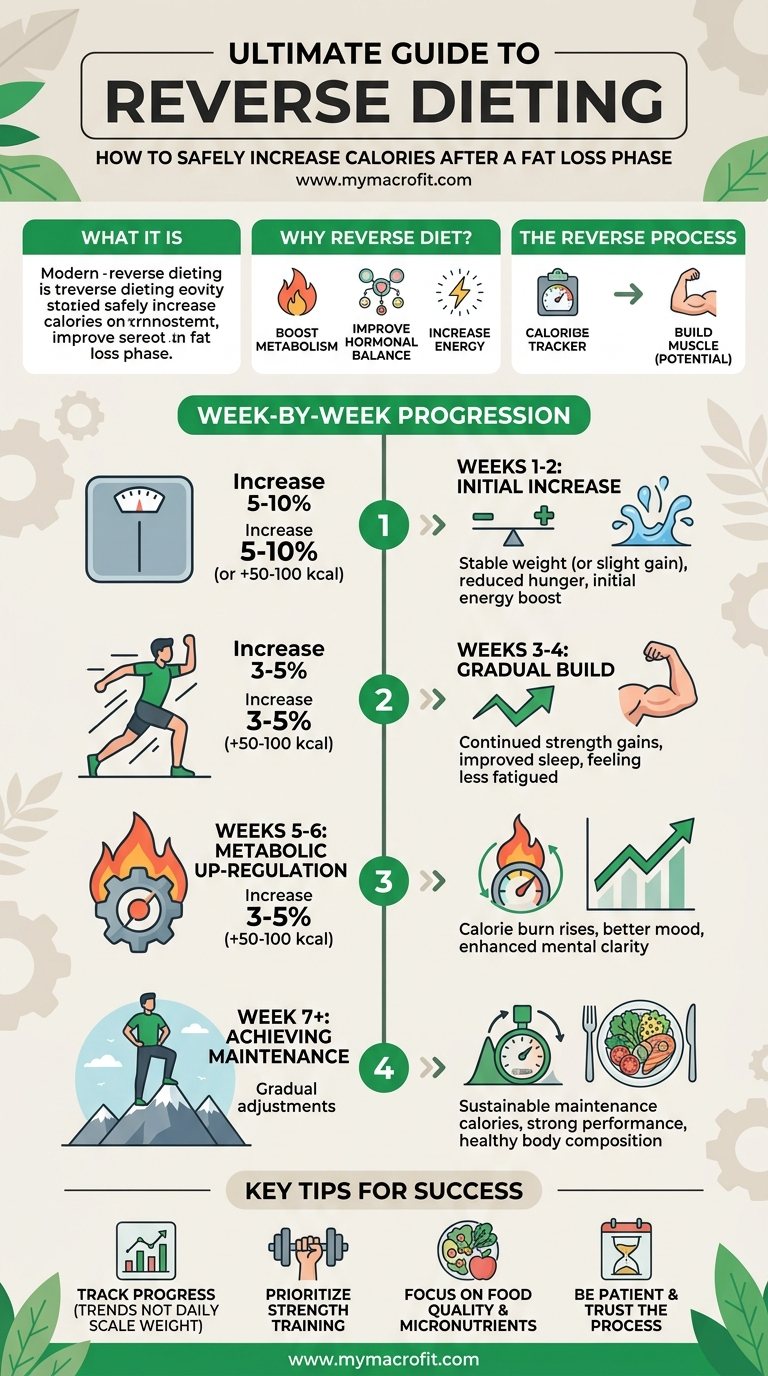
Reverse dieting addresses the metabolic adaptation component by gradually increasing calories, giving the body time to upregulate metabolism before a full surplus is reached.
How Reverse Dieting Works
Step 1: Calculate Your Current and Target Calories
Current: Your end-of-diet calorie intake (the level you were eating at the end of your cut)
Target: Your new maintenance calories at your current weight, calculated using our TDEE Calculator at current bodyweight and current activity level
The gap: Target − Current = Total calories to add. Divided by weekly increment = number of weeks.
Step 2: Choose Your Weekly Increment
Conservative (50 kcal/week): Slowest weight change, most metabolic recovery time, recommended for those who've dieted for 16+ weeks
Standard (75 kcal/week): Balanced approach, 8-12 week reverse diet for most people
Aggressive (100 kcal/week): Faster transition, higher chance of small fat gain, acceptable for shorter cuts
Step 3: Where to Add Calories
First priority: Carbohydrates. Increasing carbohydrate intake:
- Refills muscle glycogen (improves training performance)
- Boosts thyroid hormone conversion (T4 → T3)
- Raises leptin more effectively than fat increases
Second priority: Fat. If dietary fat was reduced very low during the cut, restore it to at least 0.5g/kg bodyweight.
Protein: Maintain at 1.8-2g/kg throughout, don't reduce protein as calories increase.
Step 4: Monitor Weekly
Weigh daily and calculate weekly averages. Expect:
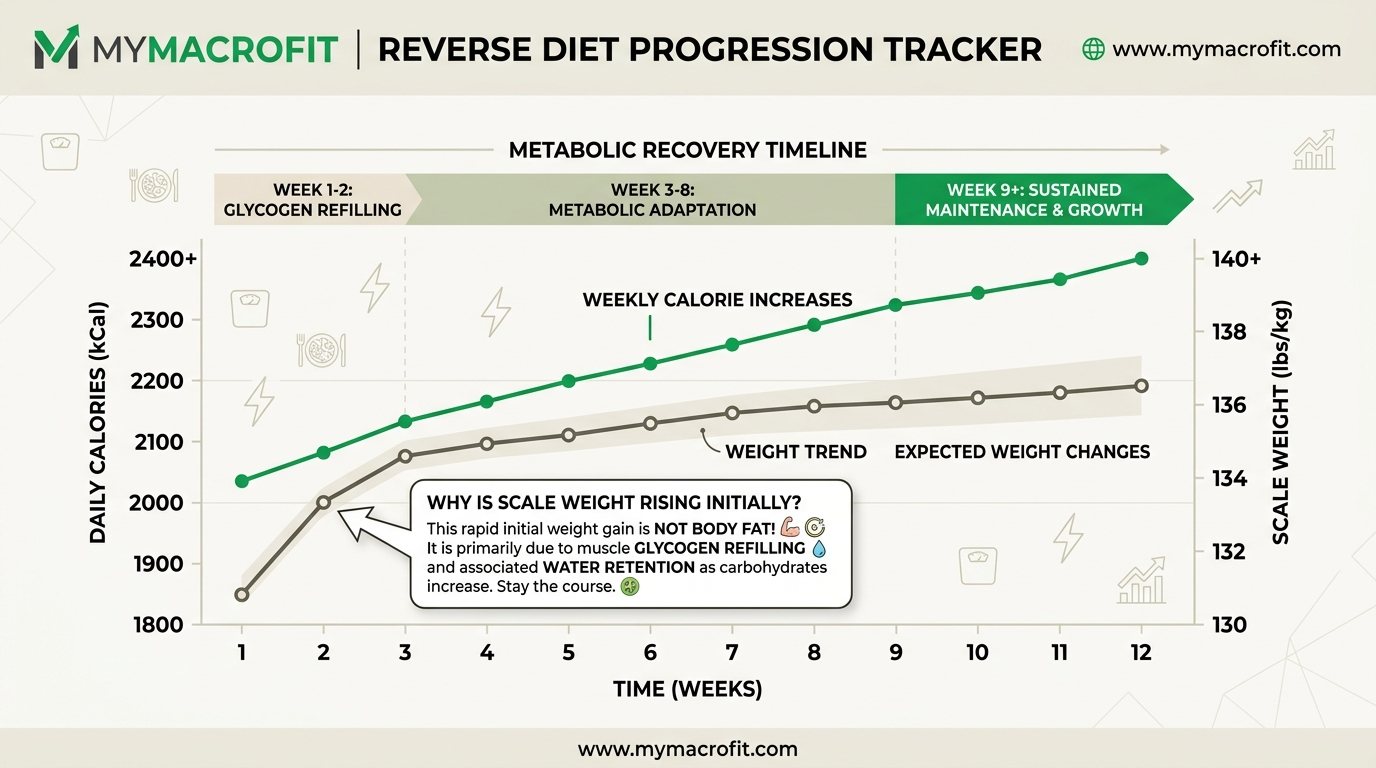
Weeks 1-3: Small scale increase (0.3-0.8kg) from glycogen replenishment and water retention as carbohydrates increase. This is not fat gain.
Ongoing: Scale should remain largely stable as calories approach maintenance. If scale rising more than 0.2kg/week consistently, increment pace is too fast, hold current calories for 1-2 more weeks before the next increase.
A Sample Reverse Diet (8-Week Example)
Starting point: 1,500 kcal/day after 12-week cut. Weight: 63kg. Goal maintenance: 2,000 kcal.
Gap to close: 500 kcal over 8 weeks = ~63 kcal/week increment (use 50-75 kcal clean increments)
| Week | Calories | Notes |
|---|---|---|
| 1-2 | 1,575 kcal | +75 kcal as extra carbs (small bowl oats, or banana) |
| 3-4 | 1,650 kcal | +75 kcal (additional rice at dinner, or fruit) |
| 5-6 | 1,725 kcal | +75 kcal (extra serving of complex carbs) |
| 7-8 | 1,800 kcal | +75 kcal |
| 9-10 | 1,900 kcal | +100 kcal |
| 11-12 | 2,000 kcal | Maintenance reached |
During this period: Protein stays at 126g/day (2g × 63kg). Training continues as normal or increases slightly as energy improves.
Benefits Beyond Preventing Rebound
Improved training performance: Glycogen restoration and increased calorie availability improves strength and endurance. Many people find their best lifts come during the early reverse diet phase as energy increases but weight is still low.
Hormonal recovery: Leptin, thyroid hormone, and sex hormones gradually normalise as calorie intake increases. Women may see menstrual regularity improve. Energy levels, libido, and mood often improve markedly.
Psychological reset: The gradual, structured increase allows new habits to form around food rather than immediate return to pre-diet patterns.
Better maintenance outcomes: People who reverse diet properly have significantly lower rates of significant fat regain compared to those who stop dieting abruptly.
Who Benefits Most From Reverse Dieting
Most beneficial:
- Anyone who has dieted for 10+ weeks continuously
- People experiencing significant diet fatigue, low energy, or hormonal disruption at end of cut
- Athletes transitioning from a cut back to training for performance
- Anyone who has regained rapidly after previous diet attempts
Less necessary:
- Short diet phases (6-8 weeks)
- Very modest deficits (200-300 kcal/day)
- Transition to a second, different diet approach
The Bottom Line
Reverse dieting is the structured process of gradually increasing calories after a deficit, giving your metabolism time to upregulate, hormones time to normalise, and your psychology time to adapt to eating more before full maintenance is reached.
The alternative, stopping a diet abruptly and returning to full maintenance or above, frequently triggers fat rebound, hormonal chaos, and the "yoyo" pattern that characterises most failed long-term weight management.
Save & share on Pinterest
Click any card to pin it — or share with someone who needs it.
Reverse Dieting: What It Is and Why You Need It After a Cut
How reverse dieting works after a prolonged calorie deficit, gradually increasing calories to restor…
How reverse dieting works after a prolonged calorie deficit, gradually increasin…
Read the full guide: Reverse Dieting: What It Is and Why You Need It After a Cut
Try the free TDEE Calculator
Reverse Dieting: What It Is and Why You Need It After a Cut — use our free calculators for instant p…
Pinterest opens in a new tab. You can edit the description before saving.
Ready to get your numbers?
Free calculator, instant results, no signup required.
Frequently Asked Questions
What is reverse dieting?+
Does reverse dieting actually increase metabolism?+
How long does a reverse diet take?+
Will I gain fat when I reverse diet?+
Do I have to reverse diet, or can I just go straight to maintenance?+
About the Author

I'm a kinesiologist and personal trainer. I've spent eight years helping women lose fat and get stronger without handing their whole life over to a diet.
View full profile →