Why Your Weight Loss Has Stalled (And 7 Ways to Fix It)
Founder, MyMacroFit
You were losing consistently, and then, nothing. The scale stopped moving. The diet feels harder than ever. This is a fat loss plateau, and it happens to virtually everyone who loses meaningful amounts of weight.
The good news: plateaus have identifiable causes, and each cause has a specific fix. Here's how to diagnose what's actually happening and restart your progress.
First: Is It Actually a Plateau?
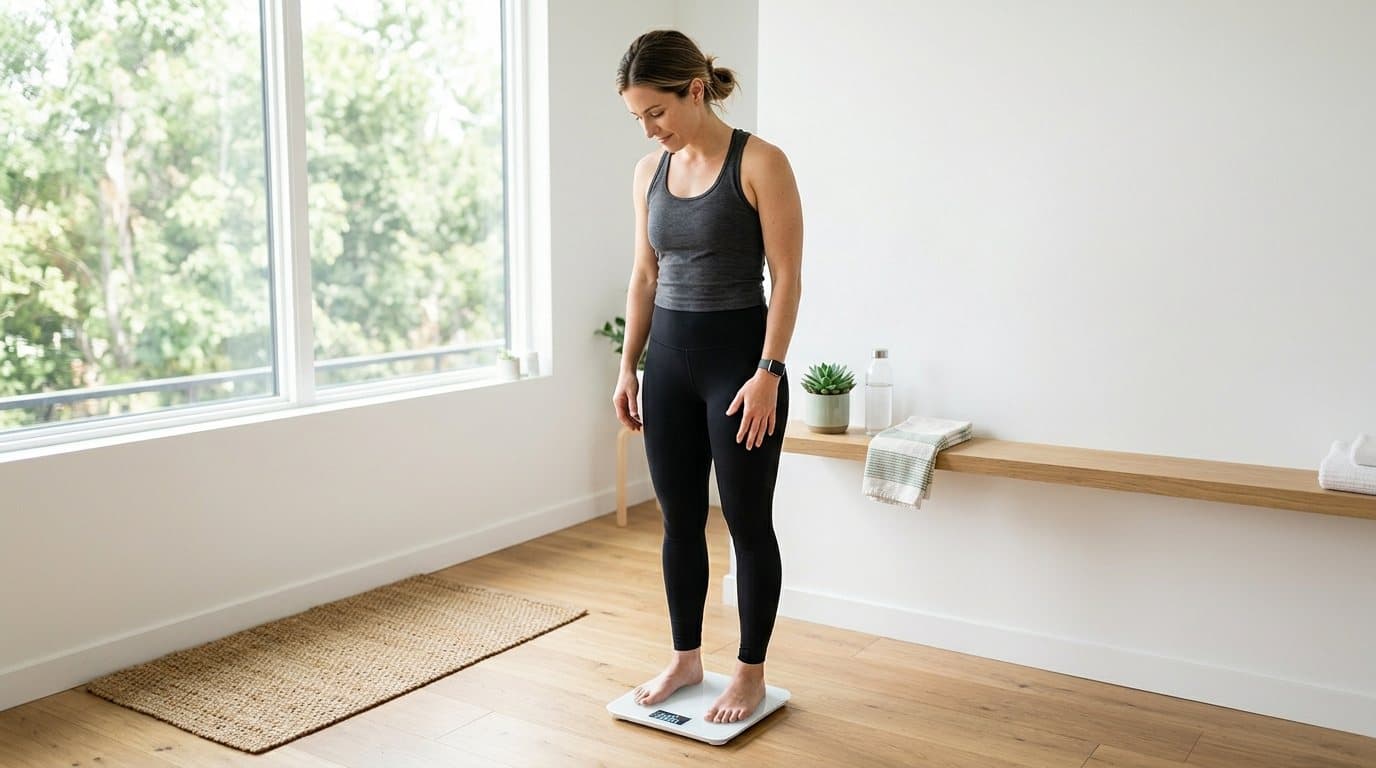
Before diagnosing causes, confirm you have a genuine stall:
A real plateau: Weekly average weight (weigh daily, calculate the average) has been unchanged for 3+ weeks, and you're tracking your food accurately.
Not a plateau:
- One or two flat weeks (normal variation)
- Scale up after a salty meal or during the luteal phase of your cycle
- You started resistance training recently (muscle gain masking fat loss on the scale)
- You haven't checked your weekly average, individual days vary 1-3kg normally
If your waist measurement is still decreasing while the scale is flat, you're experiencing body recomposition, not a plateau. This is progress.
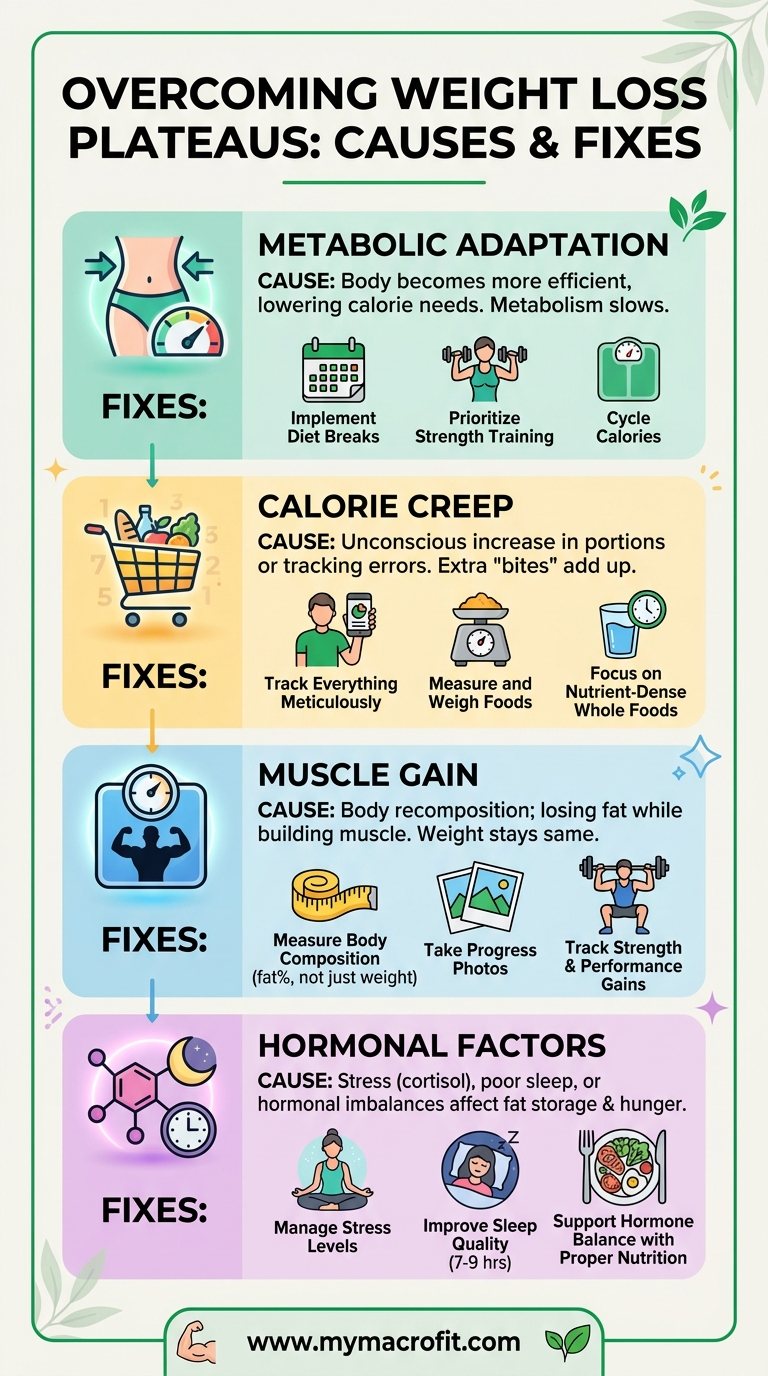
The 7 Causes of Weight Loss Stalls (and Their Fixes)
1. Calorie Creep, The Most Common Cause
What it is: Over time, portion sizes slowly grow. Oils, sauces, and cooking fats are underestimated. Snacks are added without logging. The deficit that was 500 kcal/day becomes 150 kcal/day without any conscious decision.
Studies consistently show people underestimate calorie intake by 20-30%, this gap widens over time as diet fatigue sets in.
The fix: Restart honest tracking for 2 weeks. Weigh everything. Use a food scale, not visual estimates. Pay particular attention to oils (120 kcal/tbsp), nuts, cheese, alcohol, and sauces.
2. Your TDEE Dropped as You Lost Weight
What it is: A body that weighs 75kg burns fewer calories than the same body at 90kg. If you set up your deficit when you weighed 90kg and haven't recalculated, your original 500 kcal deficit may now be 100-200 kcal.
The fix: Recalculate your TDEE at your current weight using our TDEE Calculator. Adjust your calorie target to restore the 400-500 kcal deficit from your new, lower TDEE.
3. Metabolic Adaptation
What it is: After 8-12+ weeks of sustained calorie restriction, the body reduces metabolic rate beyond simple weight-loss effects, downregulating hormones (particularly leptin and T3 thyroid hormone) and increasing metabolic efficiency. This is sometimes called "adaptive thermogenesis."
The body is resisting further fat loss, an evolutionary survival response.
The fix: A diet break, 1-2 weeks eating at your new TDEE maintenance. This allows leptin levels to recover and metabolic rate to partially normalise. After the break, restart the deficit.
Evidence shows diet breaks produce equivalent or better fat loss over 16 weeks compared to continuous restriction, with better muscle preservation.
4. Reduced NEAT Without Realising
What it is: NEAT (Non-Exercise Activity Thermogenesis), all the movement outside formal exercise, drops significantly during prolonged calorie restriction. People walk more slowly, fidget less, sit more. This can account for 200-400 kcal/day of reduced burn, wiping out a deficit without any change in diet.
The fix: Track daily steps. Set a minimum target of 8,000-10,000 steps/day. Use our walking guide to understand how much step count affects calorie burn.
5. Insufficient Protein Causing Muscle Loss
What it is: If protein intake drops below 1.6-2g/kg during a deficit, muscle is broken down alongside fat. Less muscle means lower resting metabolic rate, accelerating the slowdown.
The fix: Hit 2-2.2g/kg bodyweight of protein every day. This is the most important dietary variable for both preserving muscle and maintaining metabolic rate during a cut. See our guide to losing fat without losing muscle.
6. Sleep and Stress
What it is: Poor sleep raises cortisol and ghrelin (hunger hormone), reduces leptin (satiety hormone), and increases cravings for high-calorie food. Chronic high cortisol directly promotes fat retention, particularly around the abdomen.
You may be in a calorie deficit on paper but experiencing hormonal conditions that make weight loss very difficult.
The fix: Prioritise 7-9 hours of sleep. This isn't optional, inadequate sleep physically changes the hormone environment required for fat loss. See our sleep quality guide.
7. You're Close to Your Goal Weight
What it is: The closer you are to a healthy weight, the harder the body fights fat loss. The body's evolutionary preference is to maintain fat reserves. At lower body fat percentages, the metabolic and hormonal resistance to further loss intensifies.
The fix: Slow down. Reduce the deficit to 200-300 kcal/day (gentler but sustained). Accept that the final 5-10% of fat loss takes proportionally longer than the first 80%.
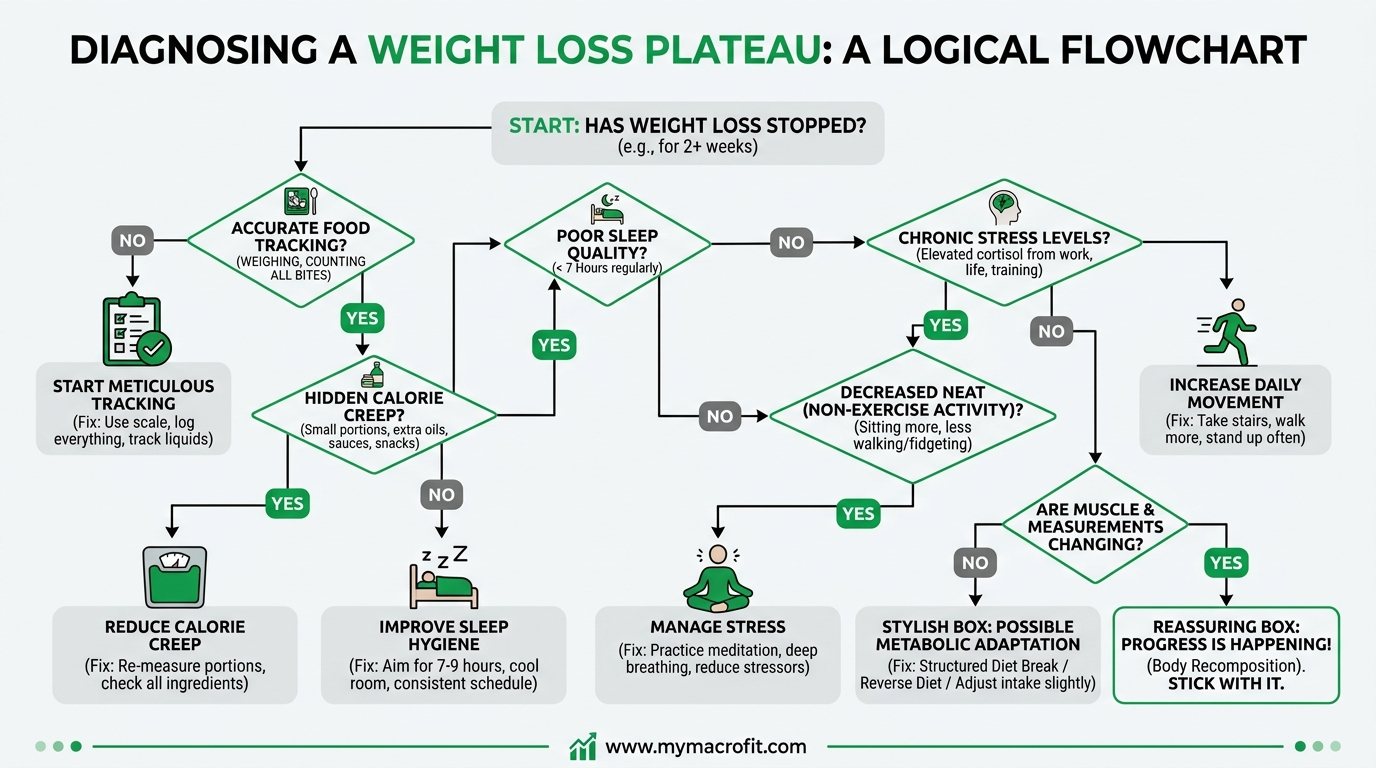
The Diet Break Protocol
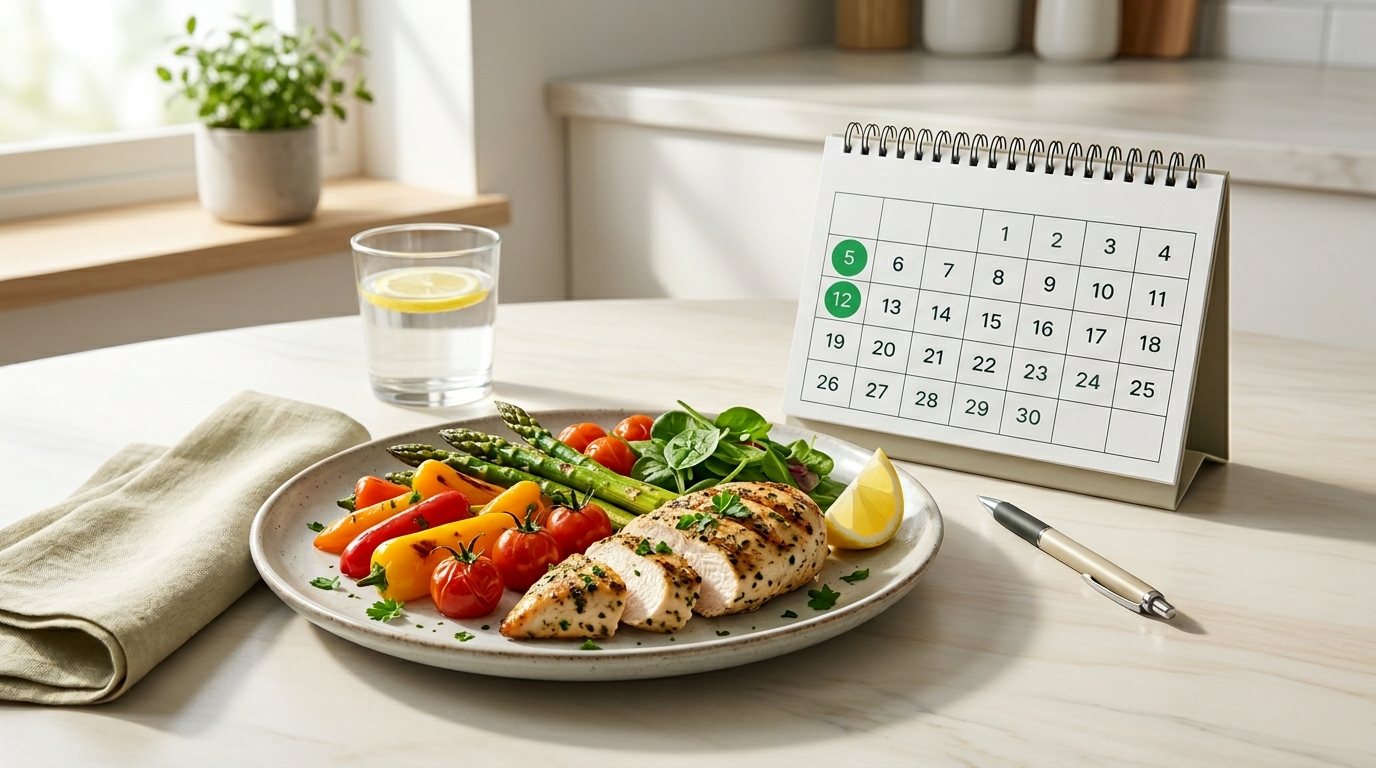
If you've been in a deficit for 8+ weeks and suspect metabolic adaptation, a structured diet break is the evidence-based approach:
Week 1-2: Increase calories to your current TDEE (maintenance). Continue resistance training. Don't use this as a "binge", it's a precise increase to maintenance, not above it.
After the break: Restart the deficit at the new, recalculated TDEE for your current weight. The break should have partially reset leptin and metabolic rate, making the subsequent deficit more effective.
What to expect: You may gain 0.5-1kg of water weight during the break as glycogen refills. This is normal and expected, it's not fat gain. It drops off quickly when the deficit resumes.
The Systematic Fix Protocol
If you're unsure which cause applies, work through these in order:
- Restart accurate tracking for 2 weeks, eliminates calorie creep as a cause
- Recalculate TDEE at current weight, adjusts for weight loss impact on calorie needs
- Check protein is hitting target, 2-2.2g/kg daily
- Audit step count, minimum 7,500-10,000 steps/day
- Address sleep, 7+ hours/night consistently
- Consider a 2-week diet break, if everything above is in place and plateau persists
Most plateaus are broken at step 1 or 2. A genuine metabolic adaptation plateau requiring a diet break is less common than most people assume.
The Bottom Line
Weight loss plateaus are nearly always caused by a combination of TDEE reduction and calorie creep, and both are fixed by recalculating and tightening your tracking. Metabolic adaptation exists but is often blamed before simpler causes are ruled out.
Work through the causes systematically. Be honest about adherence. Use our TDEE Calculator to recalculate your numbers at your current weight.
Save & share on Pinterest
Click any card to pin it — or share with someone who needs it.
Why Your Weight Loss Has Stalled (And 7 Ways to Fix It)
The real reasons fat loss plateaus happen and seven evidence-based strategies to break through them …
The real reasons fat loss plateaus happen and seven evidence-based strategies to…
Read the full guide: Why Your Weight Loss Has Stalled (And 7 Ways to Fix It)
Try the free TDEE Calculator
Why Your Weight Loss Has Stalled (And 7 Ways to Fix It) — use our free calculators for instant perso…
Pinterest opens in a new tab. You can edit the description before saving.
Ready to get your numbers?
Free calculator, instant results, no signup required.
Frequently Asked Questions
How long is a true weight loss plateau?+
Why does weight loss slow down after the first few weeks?+
Should I eat more or less to break a plateau?+
Can more steps or cardio break a stall instead of cutting food?+
Is a stall ever a sign I should stop dieting for a while?+
How do I know if my stall is real or just water weight?+
About the Author
I'm the founder of MyMacroFit. I'm not a coach or a dietitian. I'm someone who wanted to lose weight, worked it out the hard way, and built the tools I wish I'd had.
View full profile →