Why Am I Not Losing Weight in a Calorie Deficit?

CN · Metabolic Health Coach
Few things are more frustrating: you've done the maths, you're tracking your food, you're in a deficit, and the scale isn't moving. This experience is common enough that there's a well-worn explanation for it on every fitness forum: "a calorie is not just a calorie" or "you must be in starvation mode."
The reality is more straightforward. Here's the systematic diagnosis of why the scale isn't moving, and what to actually do about each cause.
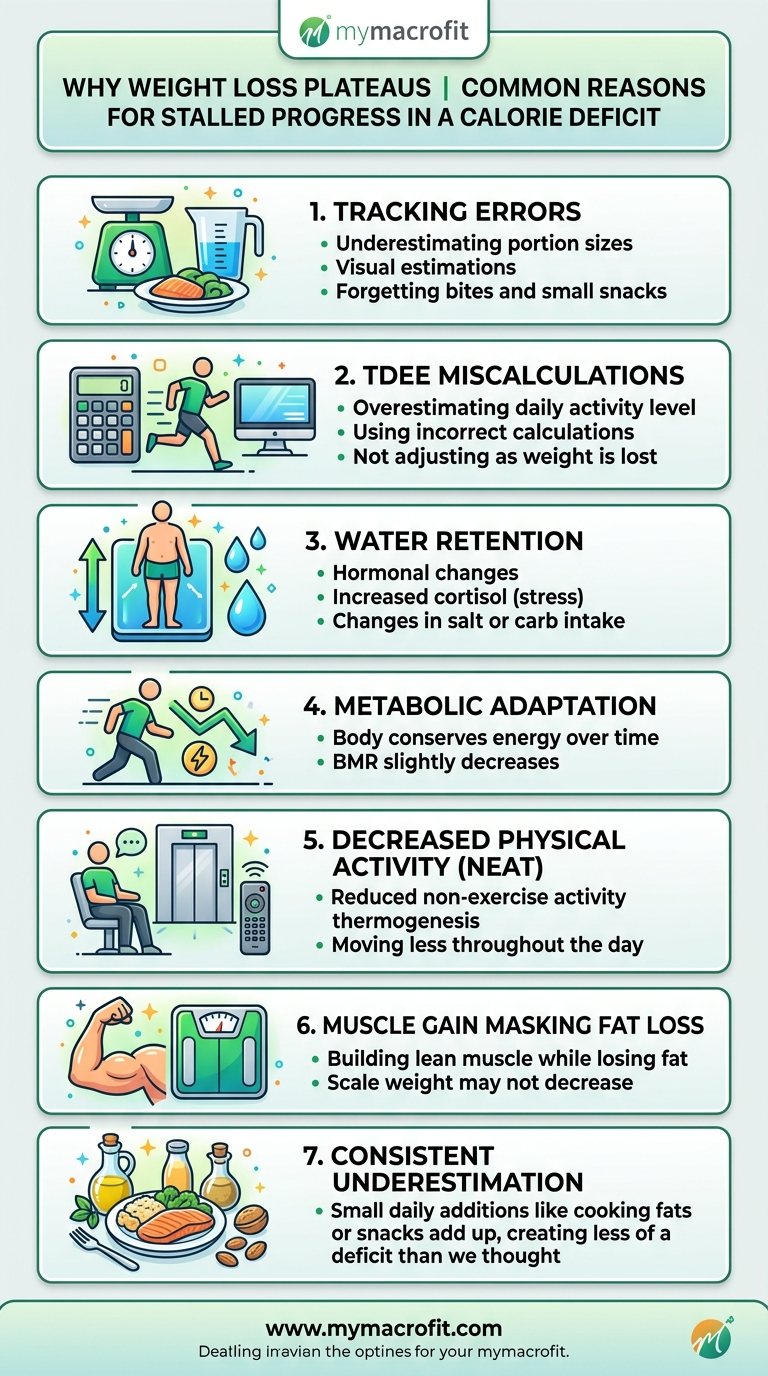
The Fundamental Truth: If You're in a Deficit, Fat Loss Is Happening
Before diagnosing problems, it's worth being clear on the physiology: if you are genuinely consuming fewer calories than your body burns over a sustained period, fat tissue will be mobilised. This is not disputed by any credible research.
The question is whether the scale accurately reflects that fat loss in any given week, and the answer is often no, for specific reasons.
Reason 1: Your Tracking Is Less Accurate Than You Think
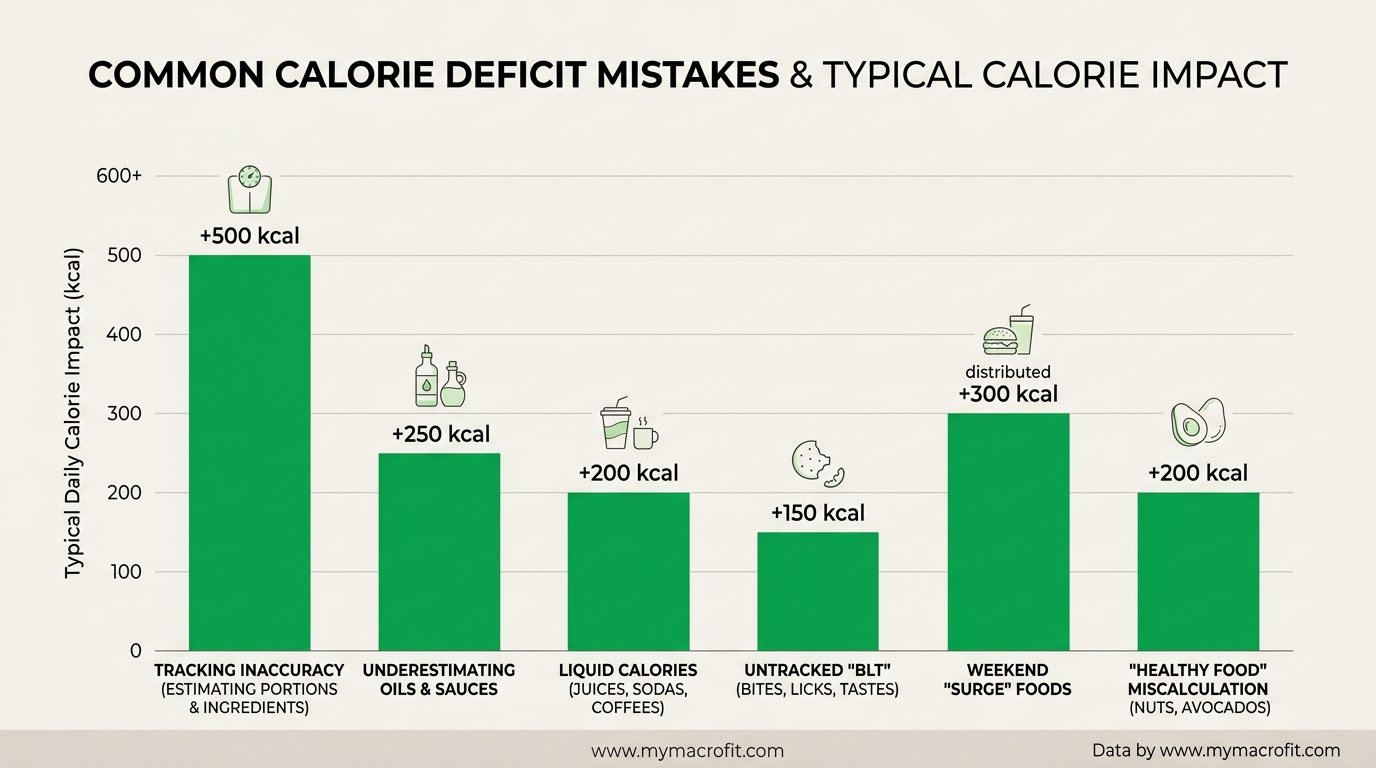
This is the most common cause by far. Research consistently shows that people underestimate their calorie intake by an average of 20-30%, including careful, experienced dieters.
Where the hidden calories hide:
Cooking oils and fats: A single tablespoon of olive oil is 120 kcal. Pour it "a little" vs. measure it, most people pour 1.5-2 tablespoons without realising. That's 60-120 extra kcal per meal.
Sauces and condiments: Peanut butter (95 kcal/tbsp), mayonnaise (100 kcal/tbsp), cream in coffee (50 kcal/splash). Easy to overlook. Significant when accumulated.
Food scale vs. visual estimates: A "medium" chicken breast varies from 120g to 250g. Visual estimation of rice, pasta, and nuts consistently underestimates by 30-50%.
Eating out: Restaurant portions are significantly larger than home cooking, often 30-60% more calories than equivalent dishes at home.
Tasting while cooking: Small tastes during cooking add up to 100-200 kcal in a session that never gets logged.
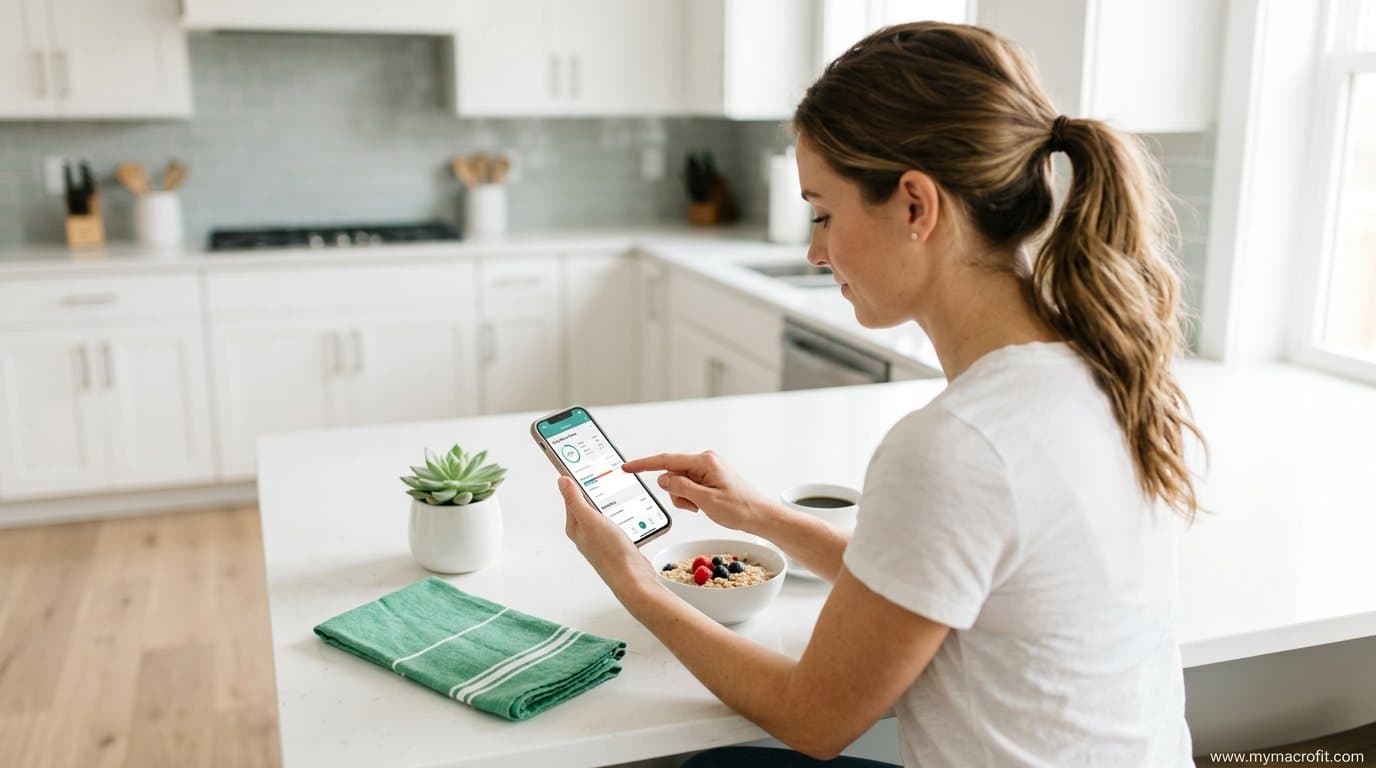
The fix: Use a food scale for 2 weeks. Weigh everything. Log oils, sauces, and drinks. This exercise almost always reveals the gap.
Reason 2: Your TDEE Is Lower Than Calculated
TDEE calculators give an estimate, they can be off by 200-400 kcal in either direction.
Why your TDEE might be lower than calculated:
Overestimated activity level: Most people select "moderately active" when their actual day is desk work + one gym session. True TDEE for this profile is closer to "lightly active."
Significant weight loss history: After losing meaningful weight, metabolic rate is suppressed 100-300 kcal below what a fresh TDEE calculation at the new weight would suggest (metabolic adaptation).
Sedentary job: If your NEAT is very low, desk work, car commute, limited daily walking, your actual TDEE could be 200-300 kcal lower than a standard calculator predicts.
The fix: Recalculate your TDEE using our TDEE Calculator with the most honest activity level input. If in doubt, select one level lower than you'd normally choose.
Reason 3: Water Retention Is Masking Fat Loss
Fat loss may be happening exactly as expected while water retention is keeping scale weight elevated.
Common sources of water retention that mask fat loss:
Starting resistance training or increasing training volume: Micro-tears in muscle tissue cause inflammation and water retention, often 0.5-1.5kg. This is temporary (1-4 weeks with a new stimulus) and resolves while fat loss continues.
Menstrual cycle: The luteal phase (roughly days 14-28 of the cycle) causes 1-3kg of water retention for many people. Scale weight can look flat for 2 weeks then drop 2kg in 3 days at the start of menstruation, all while fat loss was consistent throughout.
High sodium intake: Significantly elevated dietary sodium causes temporary water retention.
High stress / poor sleep: Cortisol causes fluid retention. A high-stress week can mask 0.5-1.5kg of fat loss on the scale.
The fix: Track body measurements (waist, hips) alongside scale weight. If measurements are declining while scale weight holds steady, fat loss is occurring. The scale will catch up when water retention resolves.
Reason 4: Muscle Gain Is Offsetting Fat Loss on the Scale
If you recently started resistance training, beginners can gain muscle and lose fat simultaneously, keeping scale weight constant while body composition improves dramatically.
This is body recomposition, and it's a very good outcome that looks like "no progress" on the scale.
How to confirm: Progress photos, waist measurements, and strength progression are the indicators. A body with less fat and more muscle at the same weight looks entirely different.
For more on this: see our non-scale victories guide.
Reason 5: You're Eating Back Too Many Exercise Calories
Fitness trackers notoriously overestimate calorie burn, often by 40-80% for activities like cycling, gym sessions, and aerobics classes.
If your app is telling you that a 45-minute gym session burned 600 kcal and you're eating back most of those calories, you may be significantly overestimating how much extra you can eat.
The fix: Either ignore exercise calorie burn entirely in your tracking (set TDEE at "active" without adding individual sessions) or eat back only 50% of tracked exercise calories as a conservative correction.
Reason 6: Genuine Metabolic Adaptation After Prolonged Dieting
If you've been in a continuous deficit for 12+ weeks and believe your tracking is accurate, genuine metabolic adaptation is possible.
The body reduces metabolic rate in response to prolonged energy restriction, typically by 5-15% beyond simple weight-loss effects. This can mean your once-500 kcal deficit is now 200 kcal.
The fix: A 1-2 week diet break at maintenance calories allows leptin and metabolic hormones to partially normalise. After the break, restart the deficit. See our weight loss plateau guide for the full protocol.
The Diagnostic Checklist
Work through this in order before assuming something unusual is happening:
- Switch to food scale tracking for 2 weeks. Weigh everything. Compare to previous tracking.
- Recalculate TDEE at current weight with honest activity level.
- Reduce deficit by the gap. If TDEE was 500 kcal higher than reality, adjust target.
- Check for water retention signals. Cycle phase, recent training increase, stress, sodium.
- Track measurements, not just scale. Is your waist decreasing?
- Review exercise calorie tracking. Are you eating back inflated exercise burn estimates?
- If all above checked and still no progress after 3+ weeks: Consider diet break for metabolic reset.
The Bottom Line
If the scale isn't moving despite a reported calorie deficit, the most likely explanation is that the deficit is smaller than believed, due to tracking inaccuracy or TDEE overestimation. This is not a personal failure; it's a common and fixable measurement problem.
Temporary water retention is the second most common cause. True metabolic adaptation requiring a diet break is real but less common than these two primary causes.
Start with the food scale. The answer is almost always found there.
Save & share on Pinterest
Click any card to pin it — or share with someone who needs it.
Why Am I Not Losing Weight in a Calorie Deficit?
The real reasons the scale doesn't move despite being in a calorie deficit, from inaccurate tracking…
The real reasons the scale doesn't move despite being in a calorie deficit, from…
Read the full guide: Why Am I Not Losing Weight in a Calorie Deficit?
Try the free TDEE Calculator
Why Am I Not Losing Weight in a Calorie Deficit? — use our free calculators for instant personalised…
Pinterest opens in a new tab. You can edit the description before saving.
Ready to get your numbers?
Free calculator, instant results, no signup required.
Frequently Asked Questions
Can you be in a calorie deficit and not lose weight?+
How do I know if I'm actually in a calorie deficit?+
Does stress stop weight loss?+
About the Author

I'm a certified nutritionist and metabolic health coach. I went deep on keto and metabolism after reversing my own insulin resistance, and I'd rather give you the actual numbers than a hand-wave.
View full profile →