GLP-1 Weight Loss Projection Calculator
An educational look at what published clinical trials report for GLP-1 medications (semaglutide, tirzepatide) versus lifestyle-only programmes — scaled to your weight and timeframe. Not medical advice; talk to your doctor.
Quick answer
In clinical trials, GLP-1 medications produced average loss of roughly 15 to 21 percent of bodyweight over about a year, more than lifestyle change alone. This calculator shows a trial-average projection for your starting weight. It is educational, not medical advice.
Educational tool only. These ranges are population averages from published clinical trials — they are not a prediction for you, and not medical advice. GLP-1 medications are prescription-only, have side effects and contraindications, and require medical supervision. Always talk to your doctor.
What the Trials Actually Show
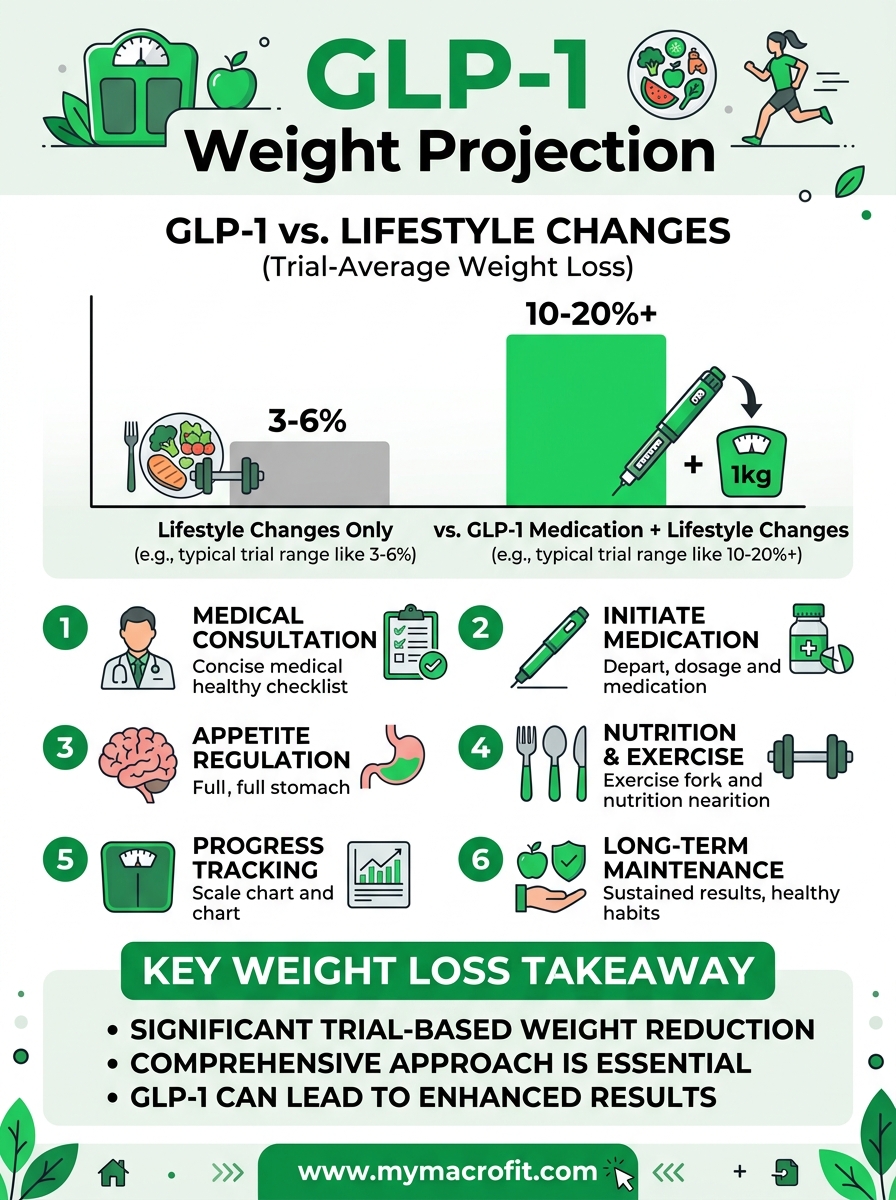
GLP-1 receptor agonists are the biggest shift in obesity medicine in decades, and the trial data is genuinely striking: ~15% average body weight loss for semaglutide (STEP 1, 68 weeks) and ~20% for tirzepatide (SURMOUNT-1, 72 weeks). For comparison, structured lifestyle-only programmes average 3–9% at one year.
Two caveats matter as much as the headline numbers. First, every trial paired medication with a calorie deficit and activity programme — the averages already include lifestyle change. Second, the spread is wide: some participants lost 30%+, while roughly one in seven lost under 5%.
The Part Nobody Markets: Muscle
Rapid weight loss takes muscle with it unless you actively defend it. Analyses of GLP-1 trials suggest 25–40% of weight lost can be lean mass in people who don't strength train or eat enough protein. Losing 15% of your body weight but a third of it as muscle leaves you lighter, weaker, and with a slower metabolism — the classic setup for regain.
- Protein: 1.6–2.2g per kg of bodyweight, every day — harder than it sounds when your appetite is suppressed, which is exactly why it needs planning.
- Resistance training: 2–3 sessions per week is the single strongest signal telling your body to keep muscle.
- Habits for the off-ramp: the STEP extension data shows ~two-thirds regain within a year of stopping. The medication window is when you build the routines that survive it.
On a GLP-1 or considering one?
Read our full evidence review — what GLP-1s do, the natural ways to stimulate the same hormone, and how to protect muscle.
Read the GLP-1 Guide →Medication or Not, the Physics Don't Change
GLP-1s work primarily by reducing appetite, which makes a calorie deficit dramatically easier to sustain. They don't burn fat directly. That means the playbook is the same with or without a prescription: know your maintenance calories, hold a moderate deficit, hit your protein, lift, and sleep. Use the Calorie Deficit Calculator and Protein Calculator to set those numbers.
Frequently Asked Questions
How much weight do people lose on GLP-1 medications?
Is this calculator medical advice?
What happens when people stop taking GLP-1 medication?
Do you lose muscle on GLP-1 medications?
Can I get similar results without medication?
How it's calculated: this tool uses established, published equations. See the full calculator methodology for the formulas and assumptions behind it.
Results are estimates for general guidance, not medical advice. See our disclaimer, and speak to a qualified healthcare professional before making medical or dietary changes.
Related Tools
Save & share on Pinterest
Click any card to pin it — or share with someone who needs it.
GLP-1 Weight Loss Projection Calculator
An educational look at what published clinical trials report for GLP-1 medications (semaglutide, tir…
An educational look at what published clinical trials report for GLP-1 medicatio…
Read the full guide: GLP-1 Weight Loss Projection Calculator
Try the free GLP-1 Weight Loss Projection Calculator
GLP-1 Weight Loss Projection Calculator — use our free calculators for instant personalised results.…
Pinterest opens in a new tab. You can edit the description before saving.
Get Your Free Macro Cheat Sheet
One-page PDF with all the key formulas. Free, no spam ever.
Get the Free Macro Guide