The Truth About Your Metabolism (And How to Actually Speed It Up)

CN · Metabolic Health Coach
"Slow metabolism" is one of the most common reasons people give for why they struggle to lose weight. Sometimes it's true, but more often, the problem is elsewhere. Understanding what metabolism actually is helps you focus on what genuinely works.
What "Metabolism" Actually Means
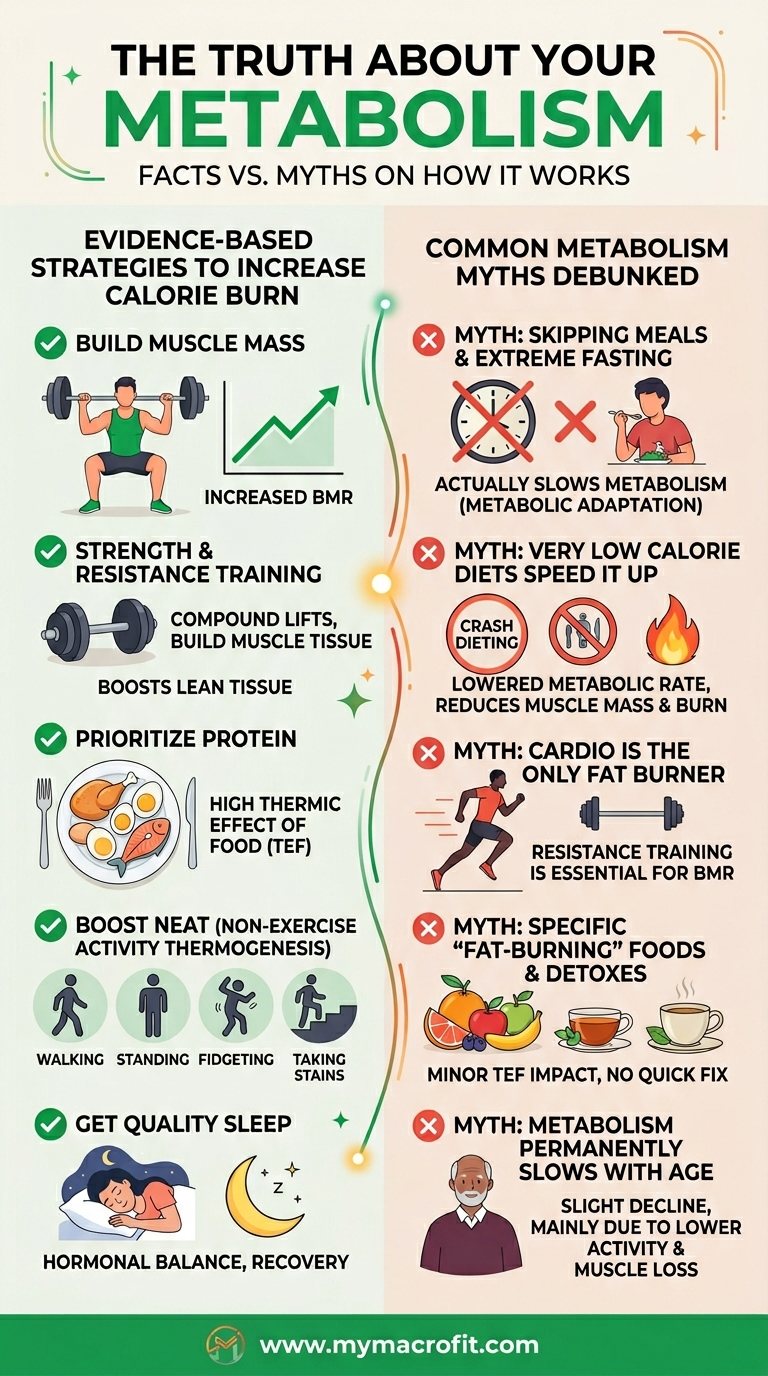
Your total daily energy expenditure (TDEE) has four components:
1. Basal Metabolic Rate (BMR), 60-75% of TDEE The calories burned at rest just to maintain bodily function (breathing, circulation, organ function, cell maintenance). The dominant factor in TDEE. Largely determined by lean body mass.
2. Thermic Effect of Food (TEF), 8-15% of TDEE Calories burned digesting and processing food. Protein has the highest TEF (20-30% of calories consumed). A 2,000 kcal diet with 30% protein burns approximately 50-80 kcal more in digestion than the same diet with 15% protein.
3. Exercise Activity Thermogenesis (EAT), 5-25% of TDEE Deliberate exercise. Highly variable by frequency, intensity, and duration.
4. Non-Exercise Activity Thermogenesis (NEAT), 10-35% of TDEE All movement that isn't deliberate exercise, walking, standing, fidgeting, household tasks. NEAT varies by up to 2,000 kcal/day between individuals. This is where the biggest leverage lies.
When people say "slow metabolism," they usually mean low BMR or low NEAT.
What Genuinely Affects Your Metabolic Rate
1. Muscle Mass, The Dominant Factor
Skeletal muscle burns approximately 13 kcal/kg/day at rest. Fat tissue burns approximately 4.5 kcal/kg/day. A person with 10kg more muscle burns roughly 85 kcal/day more at rest, around 600 kcal/week, or 30,000+ kcal/year from this factor alone.
This is why building and preserving muscle is the most effective long-term metabolic strategy. Every kilogram of muscle gained permanently increases resting metabolic rate.
Practical impact: Adding 3-5kg of lean muscle (achievable in 6-12 months of strength training) raises BMR by approximately 40-65 kcal/day permanently.
2. NEAT, The Biggest Variable
NEAT is the most underappreciated component of metabolism. Research shows sedentary people with desk jobs burn 1,200-1,500 kcal/day in NEAT. Active, fidgety people in physical jobs can burn 2,500-3,500 kcal/day in NEAT. This represents a 1,000-2,000 kcal/day difference between extreme sedentary and extreme active individuals.
Practical impact: Increasing from 3,000 to 10,000 steps/day adds approximately 300-400 kcal/day. Standing at a standing desk for 4 hours instead of sitting adds 50-100 kcal/day. Using our TDEE Calculator with accurate activity level captures this difference.
3. Protein Intake, TEF Lever
Protein has a thermic effect of 20-30%. Eating 150g protein/day vs 50g protein/day increases calories burned in digestion by approximately 100-150 kcal/day. Not dramatic, but meaningful over weeks and months, and protein's satiety effects on calorie intake are far more significant than its direct TEF contribution.
4. Sleep Quality
Sleep deprivation measurably reduces metabolic efficiency. Studies show that reducing sleep from 8.5 hours to 5.5 hours over two weeks reduces resting energy expenditure by approximately 5-10%. It also increases ghrelin (hunger hormone) and decreases leptin (satiety hormone), driving higher calorie intake.
The sleep-metabolism loop: Poor sleep → higher hunger, lower metabolic rate → weight gain → worsening sleep quality.
Metabolic Adaptation: Why Your Diet Stops Working
When you reduce calorie intake, your body adapts:
- BMR drops slightly (you're lighter, and adaptive thermogenesis reduces metabolic rate beyond what weight loss alone would predict)
- NEAT drops spontaneously (the body unconsciously reduces fidgeting and incidental movement)
- Thyroid output decreases slightly
- Muscle protein synthesis reduces
This is why an aggressive deficit that worked for 8 weeks may produce no loss at week 12. The total daily adaptation can be 200-400 kcal/day after several months of dieting.
Strategies to limit metabolic adaptation:
- Lose weight slowly (0.5-1% bodyweight/week maximum)
- Include diet breaks or refeed days every 4-6 weeks
- Maintain or increase protein and strength training throughout
- Use reverse dieting after a cut to restore metabolic rate before the next cut
What Doesn't Work
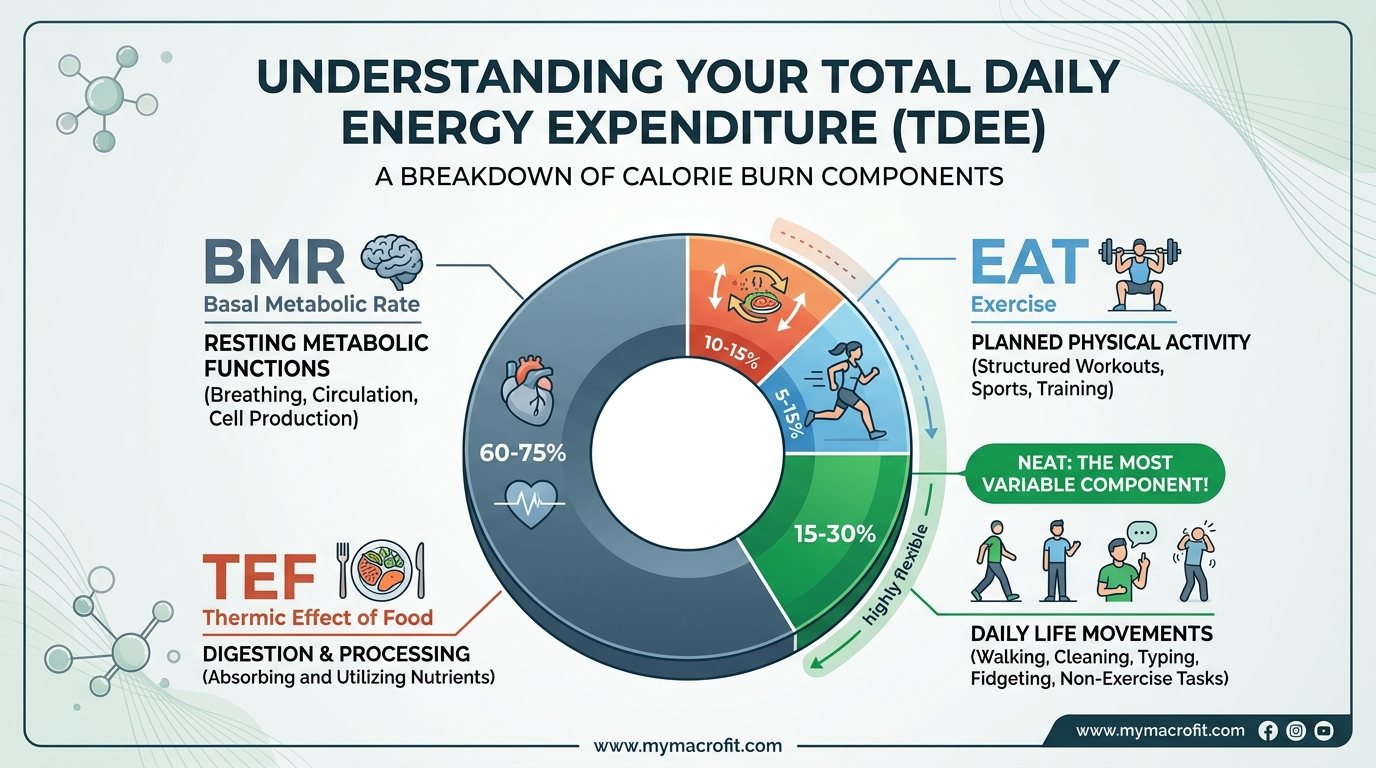
Eating 6 small meals a day to "keep metabolism firing." Disproven. The thermic effect of food is proportional to total calories consumed, not meal frequency. Five 400 kcal meals produce the same TEF as two 1,000 kcal meals.
"Metabolism-boosting" supplements. Green tea extract, cayenne, and most marketed thermogenics have tiny effects (50-100 kcal/day at best, usually less) that are negligible for weight loss.
Skipping meals "to save calories." Usually backfires through larger compensatory meals later, while also slightly reducing NEAT.
Chronic cardio without strength training. Cardio burns calories acutely but doesn't meaningfully increase resting metabolic rate. Without strength training, it often produces muscle loss that decreases BMR.
The Evidence-Based Metabolism Action Plan
Week 1-4: Start resistance training 2-3×/week (builds the muscle mass that raises BMR permanently). Increase daily steps to at least 7,000-10,000 (raises NEAT significantly). Track protein intake and target 1.6-2g/kg bodyweight.
Month 2-3: Increase training volume and intensity progressively. Add a second daily walk or standing time. Prioritise sleep quality, 7-9 hours consistently.
Long-term: Body recomposition (losing fat while building muscle) produces a gradually increasing metabolic rate even as body weight may remain stable. Each kg of muscle gained is a permanent metabolic upgrade.
What actually works, ranked by leverage
If you only act on a few things, act on the top of this list. Here's every lever in this article sorted by how much it genuinely moves your daily burn:
| Lever | Realistic effect | Timeframe |
|---|---|---|
| Increase NEAT (steps, standing) | +200-500 kcal/day | Immediate |
| Build muscle (resistance training) | +40-65 kcal/day per 3-5kg | 6-12 months, permanent |
| Raise protein to 1.6-2g/kg | +100-150 kcal/day (TEF) | Immediate |
| Fix sleep (7-9 hours) | Restores 5-10% lost to deprivation | Days to weeks |
| Supplements / "boosting" foods | ~0-50 kcal/day | Negligible |
Notice the gap between the top and bottom rows. The free, unglamorous stuff, walking more and lifting, dwarfs anything you can buy in a bottle. People spend money on the last row while ignoring the first two, which is exactly backwards.
The Bottom Line
Your metabolism isn't fixed, but the effective ways to increase it are different from what's usually marketed. Building muscle mass raises BMR permanently. Increasing NEAT (daily steps, standing, incidental movement) is the highest-leverage short-term tool. Adequate protein raises TEF modestly but reliably. Most supplements and "metabolism-boosting foods" have negligible real-world impact. Calculate your true TDEE with our TDEE Calculator, then focus on the strategies that genuinely move the needle.
Save & share on Pinterest
Click any card to pin it — or share with someone who needs it.
The Truth About Your Metabolism (And How to Actually Speed It Up)
The science of metabolism, what actually affects your metabolic rate, and the evidence-based strateg…
The science of metabolism, what actually affects your metabolic rate, and the ev…
Read the full guide: The Truth About Your Metabolism (And How to Actually Speed It Up)
Try the free TDEE Calculator
The Truth About Your Metabolism (And How to Actually Speed It Up) — use our free calculators for ins…
Pinterest opens in a new tab. You can edit the description before saving.
Ready to get your numbers?
Free calculator, instant results, no signup required.
Frequently Asked Questions
Can you actually speed up your metabolism?+
What causes a slow metabolism?+
Do certain foods speed up metabolism?+
Does eating more often keep my metabolism running?+
Will my metabolism stay slow after years of dieting?+
Is a slow metabolism really why I can't lose weight?+
About the Author

I'm a certified nutritionist and metabolic health coach. I went deep on keto and metabolism after reversing my own insulin resistance, and I'd rather give you the actual numbers than a hand-wave.
View full profile →