Menopause Calorie Calculator
Get accurate calorie targets during perimenopause and postmenopause. Standard TDEE calculators overestimate calories for menopausal women, this one accounts for the hormonal impact on metabolic rate.
Quick answer
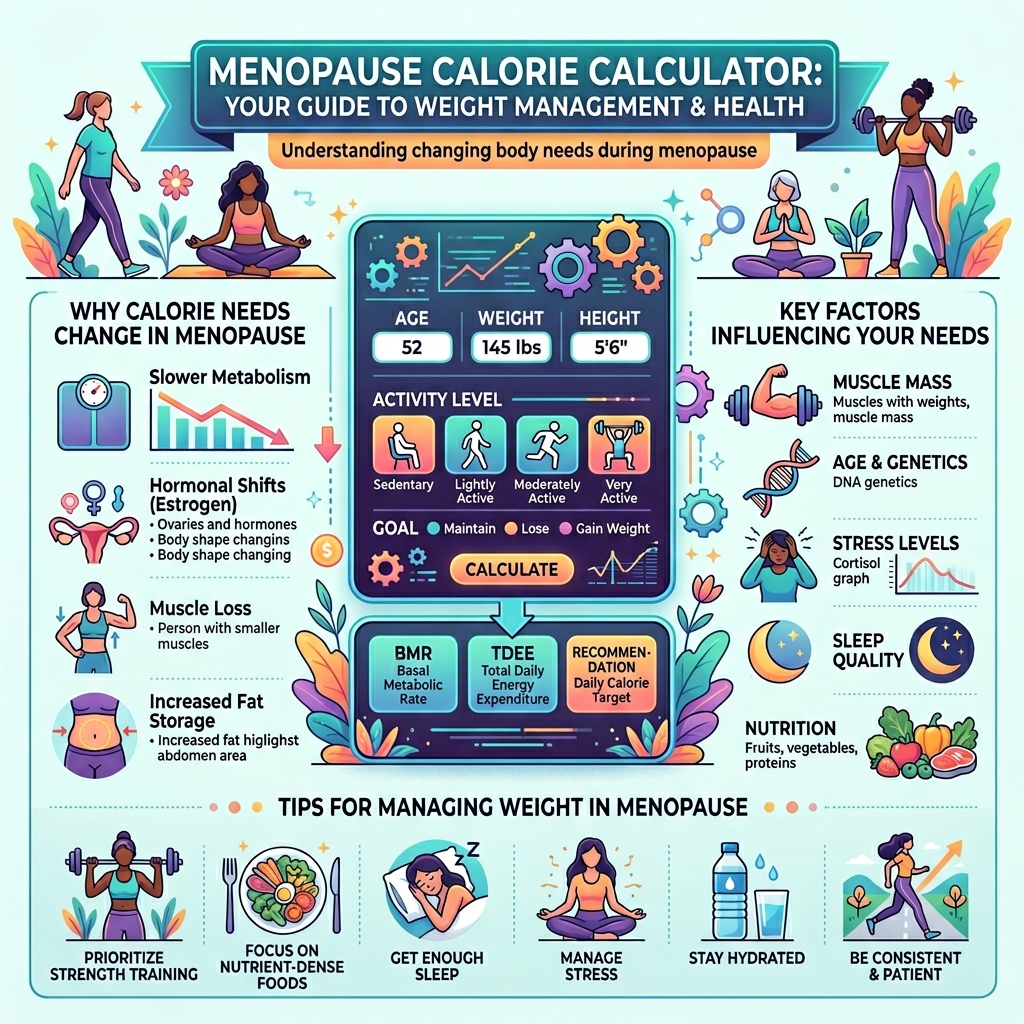
After menopause most women need about 200 to 400 fewer calories a day than in their 30s, due to muscle loss and lower oestrogen. This calculator adjusts your maintenance calories for this stage.
Why Standard Calorie Calculators Are Wrong for Menopausal Women
The Mifflin-St Jeor equation, used in most TDEE calculators, was developed and validated in mixed population studies. It consistently overestimates energy expenditure in postmenopausal women by 100–200 kcal/day. Research shows postmenopausal women have RMR approximately 7–10% lower than premenopausal women of the same body weight and composition.
The Hormonal Mechanism
Oestrogen directly influences metabolic rate through multiple pathways:
- Oestrogen receptor activation promotes mitochondrial function and fat oxidation
- Oestrogen supports muscle protein synthesis, decline accelerates muscle loss and reduces metabolically active tissue
- Oestrogen regulates appetite hormones (leptin, ghrelin), declining levels disrupt satiety signalling
- Body fat redistribution from subcutaneous (hips/thighs) to visceral (abdominal) is associated with metabolic changes
The Evidence-Based Menopause Nutrition Strategy
The three most impactful interventions for metabolic health during menopause, supported by clinical evidence:
- Higher protein intake (1.8–2g/kg): Preserves muscle mass as oestrogen declines. Muscle is the primary driver of metabolic rate.
- Resistance training 3×/week: The most potent intervention for preserving muscle mass, bone density, and metabolic rate during menopause.
- Accurate calorie tracking: Standard calculators overestimate needs. Using the adjusted targets in this calculator prevents unintentional surpluses.
Frequently Asked Questions
How does menopause affect calorie needs?
Why do women gain weight during menopause?
How much protein do women need during menopause?
What foods are most important during menopause?
How it's calculated: this tool uses established, published equations. See the full calculator methodology for the formulas and assumptions behind it.
Results are estimates for general guidance, not medical advice. See our disclaimer, and speak to a qualified healthcare professional before making medical or dietary changes.
Related Tools
Save & share on Pinterest
Click any card to pin it — or share with someone who needs it.
Menopause Calorie Calculator
Get accurate calorie targets during perimenopause and postmenopause. Standard TDEE calculators overe…
Get accurate calorie targets during perimenopause and postmenopause. Standard TD…
Read the full guide: Menopause Calorie Calculator
Try the free Menopause Calorie Calculator
Menopause Calorie Calculator — use our free calculators for instant personalised results. No signup …
Pinterest opens in a new tab. You can edit the description before saving.
Get Your Free Macro Cheat Sheet
One-page PDF with all the key formulas. Free, no spam ever.
Get the Free Macro Guide