The 5:2 Diet: What It Is, Does It Work, and Who It Suits

RHC · Pre/Postnatal Fitness Specialist
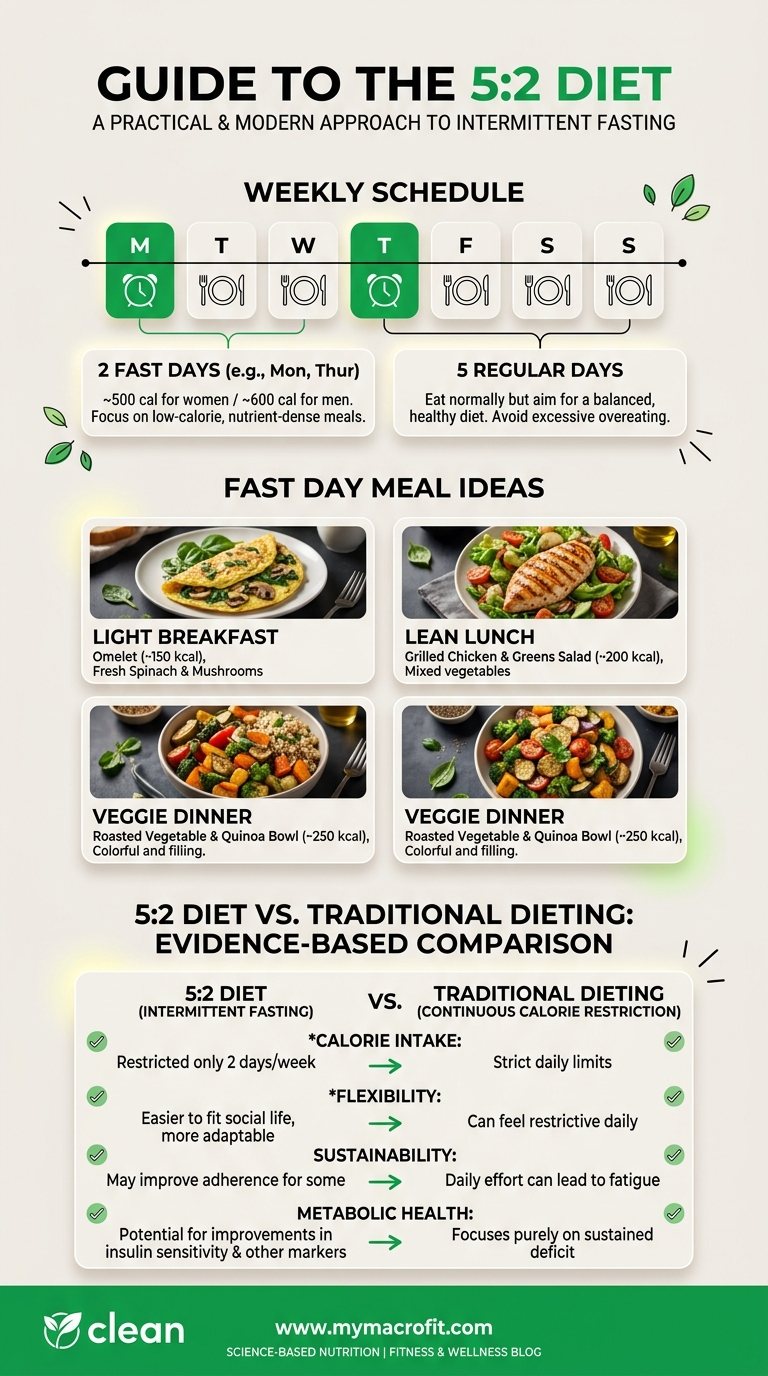
The 5:2 diet, eating normally 5 days per week and severely restricting calories (500-600 kcal) on 2 days, became one of the most popular dietary approaches globally after Dr Michael Mosley's 2012 book and subsequent research. A decade later, the evidence is more nuanced than its enthusiasts claim.
How the 5:2 Works
Regular days (5/7): Eat normally, at or near your TDEE. No restriction.
Fast days (2/7): Restrict calories to 500-600 kcal. These two days should not be consecutive (e.g., Monday and Thursday).
Total weekly calorie impact: If TDEE is 2,000 kcal/day:
- Normal days (5): 2,000 × 5 = 10,000 kcal
- Fast days (2): 500 × 2 = 1,000 kcal
- Weekly total: 11,000 kcal
- vs. no dieting: 14,000 kcal/week
- Weekly deficit: ~3,000 kcal → ~0.4kg/week fat loss
Compared to continuous restriction at the same weekly total: an equivalent result would be eating 1,571 kcal/day (equivalent weekly calorie total). This is within the range of a continuous 400-500 kcal daily deficit.
The Evidence: How 5:2 Compares to Continuous Restriction
The headline finding from most comparative research: at equivalent weekly calorie totals, 5:2 and continuous restriction produce equivalent weight loss.
Key studies:
- Harvie et al. (2011): 5:2 vs. 25% daily restriction, both groups lost similar weight at 6 months, but 5:2 showed greater improvements in insulin sensitivity
- Trepanowski et al. (2017): Alternate day fasting vs. daily restriction, equivalent weight loss, no significant difference in metabolic outcomes
- Lowe et al. (2020): Time-restricted eating (related approach), no additional metabolic benefit vs. continuous restriction when calories equated
The honest conclusion: The 5:2 is not metabolically magical. Its advantage, where it exists, is adherence, some people find 2 days of restriction easier than daily restriction.
Who Benefits From the 5:2
Best suited to:
- People who find daily restriction mentally exhausting
- Those with irregular schedules (can choose fast days around social events)
- People who do better with an "off/on" approach than gradual reduction
- Those who have failed continuous restriction diets repeatedly
Less suitable:
- People with history of binge eating (fast-day deprivation can trigger overeating on non-fast days)
- Very active individuals (performance significantly impaired on fast days)
- People with type 1 diabetes or medication-affected blood sugar
- Pregnant or breastfeeding women
- Those with eating disorders or disordered eating history
Structuring Fast Days
The goal on fast days: Maximise satiety from 500-600 kcal by prioritising protein and volume.
Sample fast day:
Option A: Two meals
- Late morning: 2-egg omelette with spinach and mushrooms (200 kcal, 18g protein)
- Evening: Grilled chicken breast (120g) + large mixed salad + broth (280 kcal, 28g protein)
- Total: ~480 kcal, 46g protein
Option B: One meal (simpler)
- Evening: Large grilled fish portion (150g) + steamed broccoli + cucumber salad (380 kcal, 35g protein)
- Plus 2 boiled eggs at lunch (140 kcal, 12g protein)
- Total: ~520 kcal, 47g protein
What helps on fast days:
- Black coffee or tea (essentially calorie-free, appetite-suppressing)
- Bone broth (~30-50 kcal per cup, surprisingly satisfying)
- Sparkling water
- Staying busy and away from food environments
Non-Fast Day Eating: The Critical Variable
The 5:2 fails when people significantly overeat on non-fast days, either compensating for fast-day hunger or psychologically "rewarding" themselves.
The 5:2 works when non-fast days are at or slightly below TDEE. It fails when non-fast days are at TDEE + 500-700 kcal "reward" eating.
Use our TDEE Calculator to understand your normal-day target.
Is the 5:2 Better for Metabolic Health?
Some proponents claim fasting-specific benefits (autophagy, IGF-1 reduction) beyond what calorie restriction alone provides. The evidence is real but modest:
- Some studies show greater improvements in insulin sensitivity with 5:2 than equivalent continuous restriction
- IGF-1 reduction (associated with longevity research) appears with fasting, even without overall calorie restriction
- Autophagy evidence in humans is largely indirect and preliminary
Whether these metabolic effects translate to meaningful clinical differences compared to equivalent continuous restriction is not yet established in long-term human trials.
The Bottom Line
The 5:2 diet works, because a calorie deficit works. It's neither better nor worse than continuous restriction when total calories are equivalent. Its value is adherence: for people who find 2 extreme days easier than 7 moderate days, it's a legitimate tool.
Choose it for psychological fit, not metabolic superiority.
Save & share on Pinterest
Click any card to pin it — or share with someone who needs it.
The 5:2 Diet: What It Is, Does It Work, and Who It Suits
A balanced evidence review of the 5:2 diet, comparing it to continuous calorie restriction, who it b…
A balanced evidence review of the 5:2 diet, comparing it to continuous calorie r…
Read the full guide: The 5:2 Diet: What It Is, Does It Work, and Who It Suits
Try the free TDEE Calculator
The 5:2 Diet: What It Is, Does It Work, and Who It Suits — use our free calculators for instant pers…
Pinterest opens in a new tab. You can edit the description before saving.
Ready to get your numbers?
Free calculator, instant results, no signup required.
Frequently Asked Questions
Does the 5:2 diet work for weight loss?+
How many calories on a 5:2 fast day?+
What should you eat on a 5:2 fast day?+
Are there health benefits to 5:2 beyond weight loss?+
Who should not do the 5:2 diet?+
Can I exercise on a 5:2 fast day?+
About the Author

I'm a registered health coach and pre/postnatal specialist. I look at the whole person, your sleep, your stress, your hormones, because the number on the scale is only ever part of the story.
View full profile →