HIIT for Weight Loss: How to Structure It for Maximum Fat Burn

BSc Kinesiology · CPT
HIIT (High-Intensity Interval Training) has become one of the most popular fat loss tools, marketed as a metabolism-boosting, fat-burning shortcut that delivers results in less time. Much of this reputation is deserved, but the mechanism and reality of HIIT fat loss are more nuanced than most fitness content suggests.
Here's what the evidence shows and how to programme HIIT effectively for maximum fat loss.
How HIIT Actually Burns Fat
The HIIT fat loss mechanism operates through two pathways:
Direct calorie burn: During the session itself, high-intensity intervals burn more calories per minute than low-intensity exercise (3-4x more). A 20-minute HIIT session can burn 200-350 kcal depending on intensity and bodyweight.
EPOC (Excess Post-Exercise Oxygen Consumption): After high-intensity exercise, the body continues burning elevated calories during recovery, returning oxygen debt, clearing metabolic byproducts, and repairing stressed muscle tissue. This "afterburn" effect adds approximately 6-15% to the session's total calorie cost, persisting for 2-24 hours.
The EPOC effect is often overstated in fitness marketing, it typically adds 30-80 extra kcal per session for a 20-minute HIIT workout, not the "hundreds of extra calories burned for days" sometimes claimed. It's a real but modest bonus.
HIIT vs Steady-State: What the Research Shows
Per unit of time: HIIT wins. 20 minutes of HIIT burns more calories than 20 minutes of moderate walking.
Per unit of calorie expenditure (when equated): The difference in fat loss between HIIT and steady-state cardio is small. A 2019 meta-analysis (Viana et al.) found HIIT produced slightly greater fat loss than moderate-intensity continuous training at equivalent total calorie expenditure, with greater improvement in cardiorespiratory fitness.
For time-constrained individuals: HIIT is the clear choice, 20-25 minutes achieves what 40-50 minutes of steady-state does.
For beginners or those with joint issues: Steady-state is more appropriate, lower injury risk, easier to sustain, and forms a better fitness foundation before introducing HIIT loads.
The Best HIIT Protocols for Fat Loss
Tabata (Original Protocol)
- Structure: 20 seconds maximum effort, 10 seconds rest × 8 rounds = 4 minutes
- Total time: 4 minutes per exercise
- Best for: Experienced exercisers with a solid fitness base
- Exercises: Cycling, rowing, sprinting, kettlebell swings, burpees
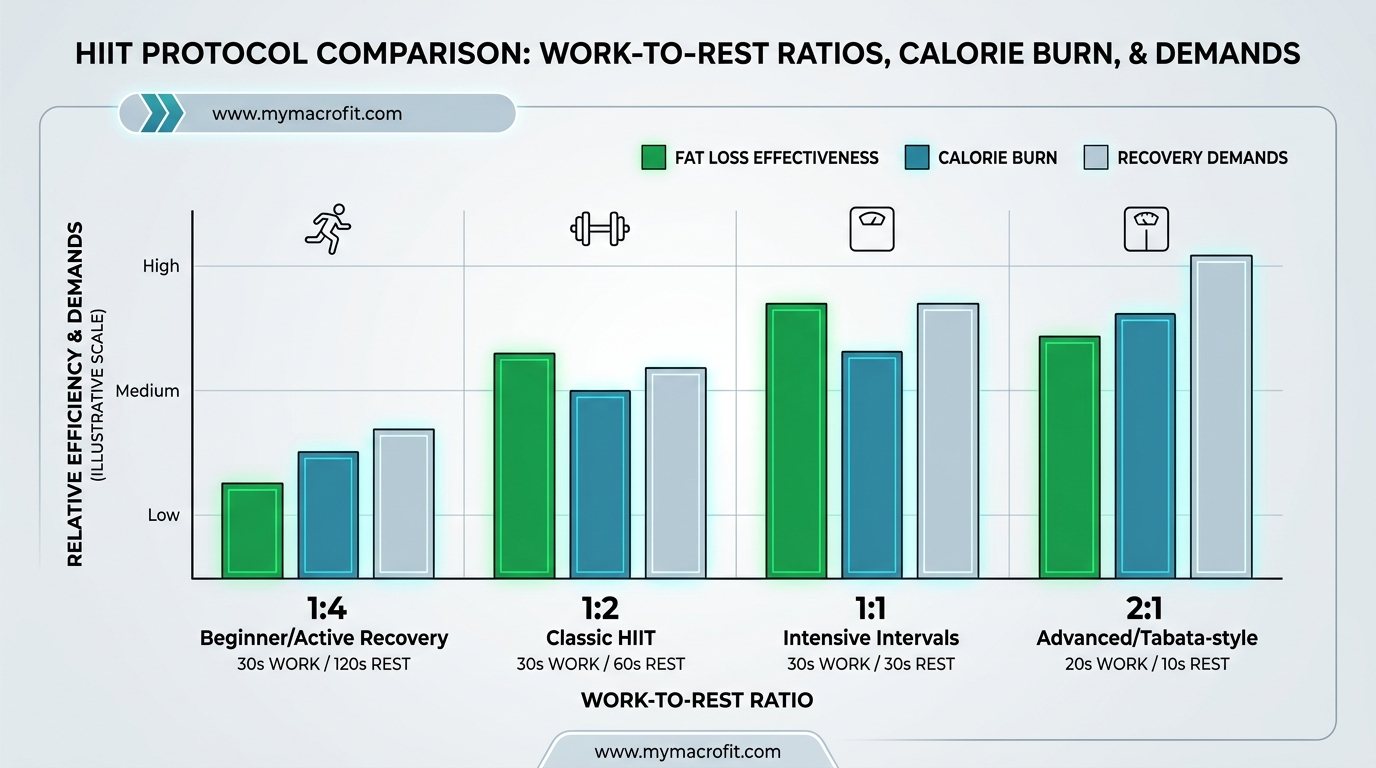
Work:Rest Ratio Protocols
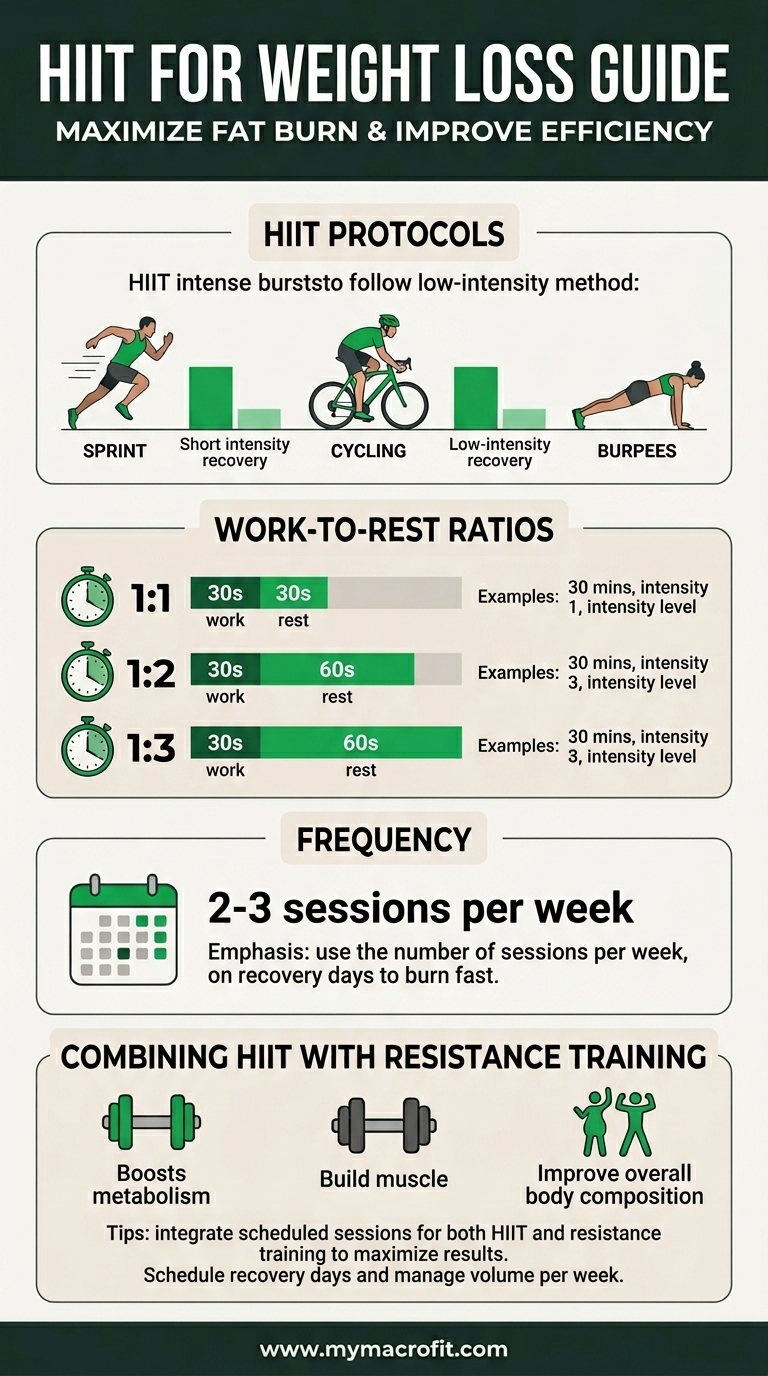
- 1:2 ratio (30 sec work, 60 sec rest), good for moderately fit individuals
- 1:1 ratio (40 sec work, 40 sec rest), higher intensity, better fitness required
- 2:1 ratio (40 sec work, 20 sec rest), advanced, demanding
Beginners: Start with 1:3 or 1:4 ratios (20 sec work, 60-80 sec rest)
Circuit HIIT
- 5-6 exercises, 40 seconds work, 20 seconds transition
- 3-4 rounds
- Total time: 20-25 minutes
- Good for: Combining strength and cardio stimulus
EMOM (Every Minute on the Minute)
- Complete a set number of reps of an exercise at the start of each minute
- Rest for the remaining seconds
- Progresses naturally as fitness improves
Sprint Interval Training (SIT)
- 6-10 second maximum sprints, 1-2 minutes full recovery
- Highest intensity protocol, excellent for EPOC
- Requires good sprint mechanics, risk of hamstring strain if form breaks down
Programming HIIT With Resistance Training
The most common mistake: adding too much HIIT to an existing resistance training programme and experiencing poor recovery, reduced strength, and injury.
Recommended weekly structure:
- 3 resistance training sessions (priority, muscle preservation and metabolic rate)
- 2 HIIT sessions on non-adjacent days
- 1-2 low-intensity cardio sessions (walking, cycling) for additional calorie burn without recovery cost
Same-day pairing (when scheduling requires it): Do resistance training first, HIIT second. The resistance training stimulus is most important for body composition, don't compromise it by fatiguing the muscles with HIIT beforehand.
Recovery signals to watch:
- Resting heart rate elevated by 5+ bpm above normal = under-recovered
- Motivation to train is significantly reduced
- Strength performance declining week-over-week
If any of these occur, reduce HIIT frequency before cutting resistance training volume.
Exercise Selection for HIIT
The intensity of HIIT, not the specific exercise, is what makes it effective. Choose exercises you can execute at genuinely high intensity:
High intensity with low injury risk:
- Cycling (stationary or outdoor)
- Rowing machine
- Swimming
- Battle ropes
Effective but higher injury risk with poor form:
- Running sprints (requires good running mechanics)
- Burpees (spinal load under fatigue)
- Kettlebell swings (requires technique)
- Box jumps (landing mechanics)
Bodyweight circuits (accessible, good starting point):
- High knees
- Mountain climbers
- Jump squats (avoid if joint issues)
- Speed skaters
A Practical HIIT Programme for Beginners
Weeks 1-2:
- 1 session per week
- 15 minutes total
- 20 sec work / 60 sec rest × 8-10 rounds
- Low-impact exercises only (cycling, rowing)
Weeks 3-4:
- 2 sessions per week
- 18 minutes total
- 25 sec work / 55 sec rest × 10 rounds
Weeks 5-8:
- 2 sessions per week
- 20-25 minutes total
- 30 sec work / 45-60 sec rest × 10-12 rounds
- Can introduce higher-impact options
The Honest Expectation
2 HIIT sessions per week burns approximately 400-700 kcal extra weekly. Over 4 weeks: 1,600-2,800 kcal, contributing 0.2-0.4kg of additional fat loss on top of your dietary deficit.
This is meaningful but not dramatic. HIIT is a tool to enhance a calorie deficit, not create one independently. Its greatest value is cardiovascular fitness, efficiency, and the metabolic improvements from high-intensity work (insulin sensitivity, VO2max) that reduce chronic disease risk beyond simple fat loss.
The Bottom Line
HIIT is an efficient, effective fat loss tool, best used 2 sessions per week alongside resistance training, not as a replacement for it. Start with beginner-appropriate work:rest ratios and build intensity over 6-8 weeks. The session's effort level matters more than the specific protocol.
For most people, the fat loss benefit of HIIT is best realised as part of a broader programme: calorie deficit + protein target + resistance training + 2 HIIT sessions + high daily step count.
Save & share on Pinterest
Click any card to pin it — or share with someone who needs it.
HIIT for Weight Loss: How to Structure It for Maximum Fat Burn
The evidence on HIIT for fat loss, how it compares to steady-state cardio, the best protocols, and h…
The evidence on HIIT for fat loss, how it compares to steady-state cardio, the b…
Read the full guide: HIIT for Weight Loss: How to Structure It for Maximum Fat Burn
Free fitness tools
HIIT for Weight Loss: How to Structure It for Maximum Fat Burn — use our free calculators for instan…
Pinterest opens in a new tab. You can edit the description before saving.
Frequently Asked Questions
Is HIIT better than steady-state cardio for fat loss?+
How many times per week should I do HIIT?+
Can beginners do HIIT?+
Does HIIT burn fat after the workout (the afterburn effect)?+
Will HIIT alone help me lose weight without dieting?+
Is HIIT or weight training better for fat loss?+
About the Author

I'm a kinesiologist and personal trainer. I've spent eight years helping women lose fat and get stronger without handing their whole life over to a diet.
View full profile →