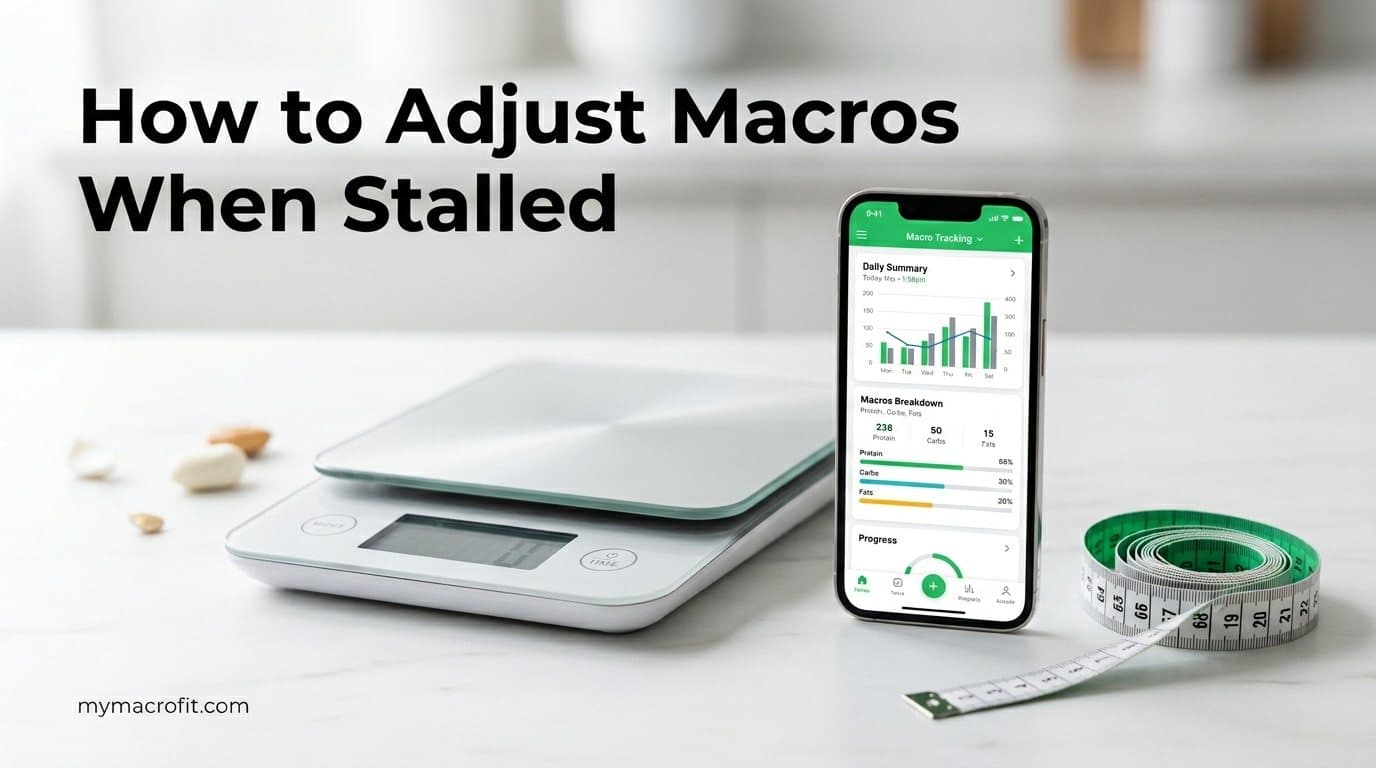
How to Adjust Your Macros When Weight Loss Stalls

BSc Kinesiology · CPT
You've been doing everything right, and the scale won't budge. Before you slash your calories in frustration, understand this: most "plateaus" are either not real yet, or they're a predictable signal that your numbers simply need a small recalibration. Here's how to diagnose what's actually happening and adjust your macros the smart way, so you start losing again without starving.
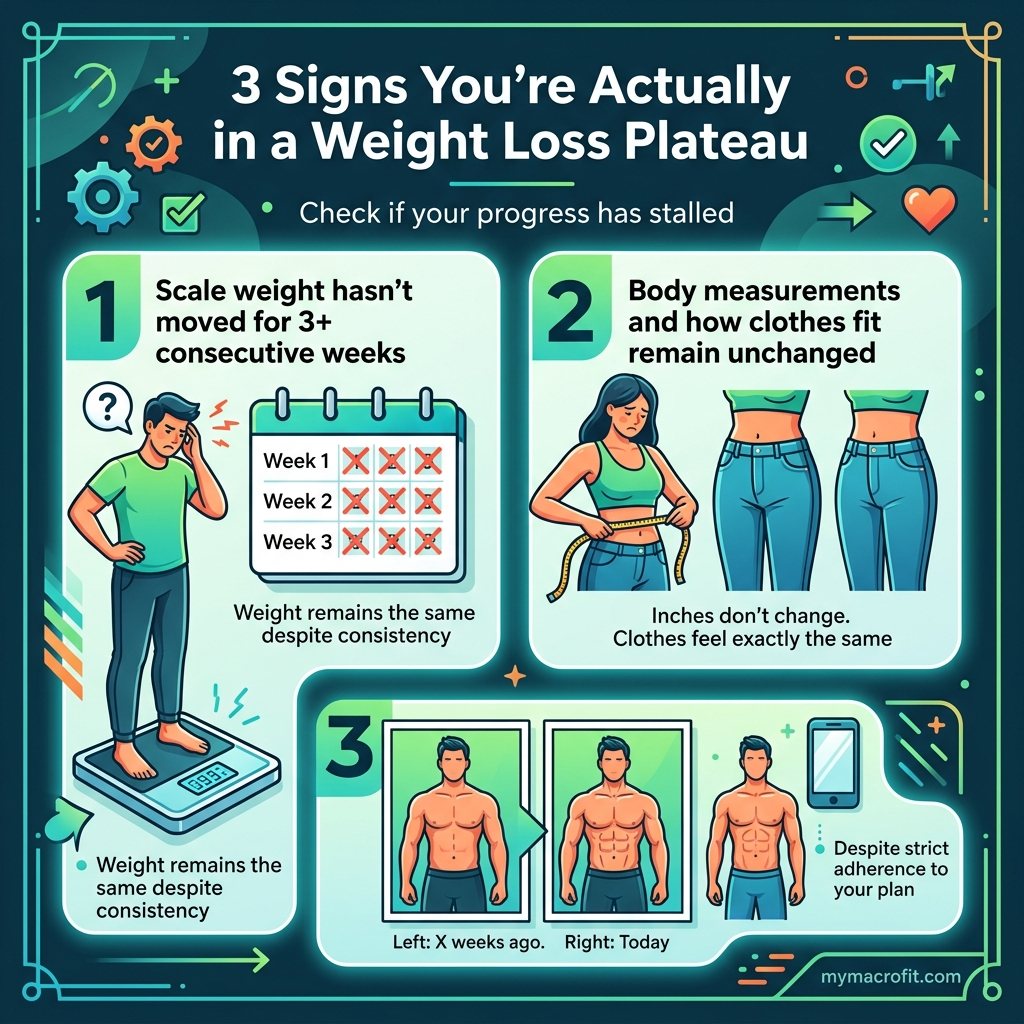
Step 1: Confirm it's actually a stall
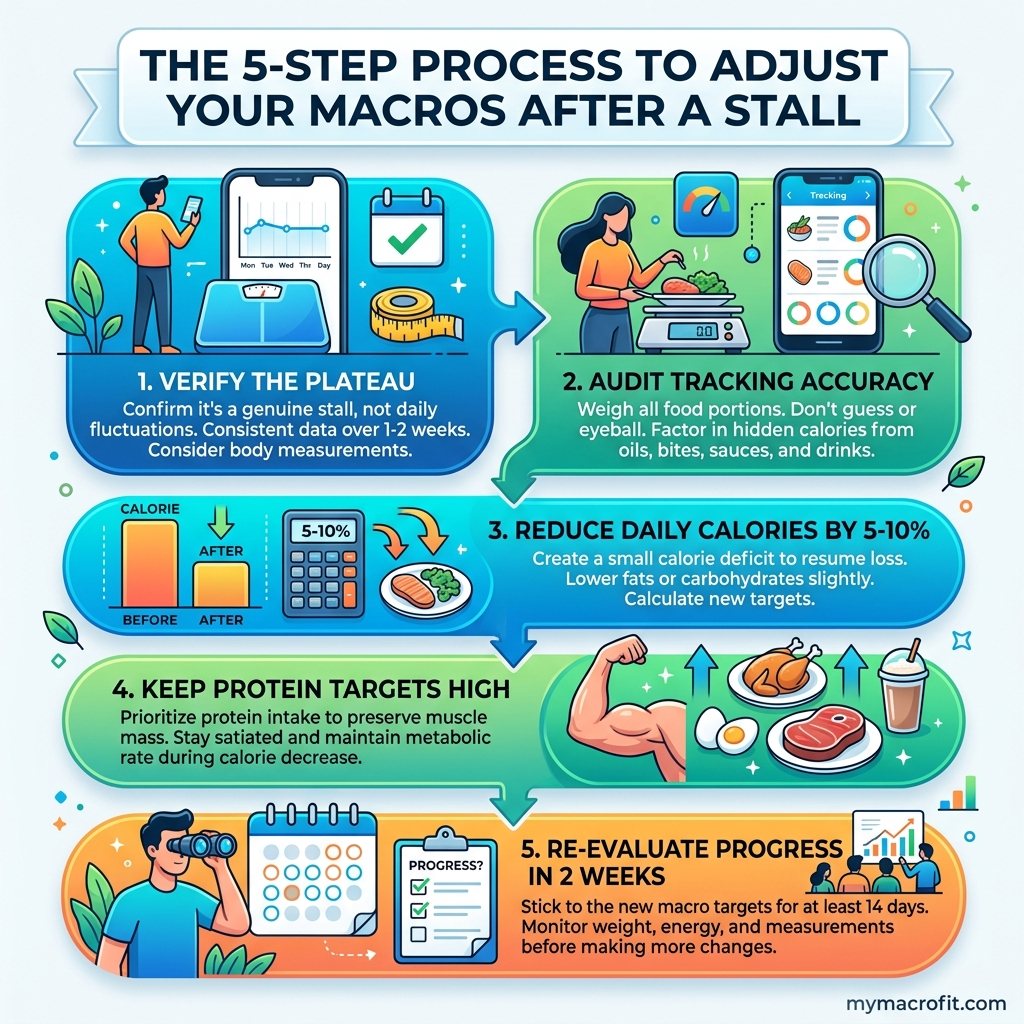
A few days of no movement is not a plateau, it's normal. Bodyweight swings daily from water, sodium, carbs, food volume, and hormones. A real stall is no change in your average weekly weight for 2-3 weeks.
Track a weekly average (weigh most mornings, average the week) rather than reacting to single readings. Half the time, what felt like a plateau resolves itself once you look at the trend instead of the noise.
Step 2: Check the usual suspects before cutting
If it's a genuine 2-3 week stall, run this checklist before changing anything:
| Likely cause | Quick check | Fix |
|---|---|---|
| Deficit shrank as you got lighter | Did you recalculate after losing weight? | Recompute targets for current weight |
| Portion/calorie creep | Weigh food strictly for 5-7 days | Tighten measuring; log honestly |
| Hidden calories | Oils, sauces, drinks, "bites"? | Count them, they add up fast |
| Water masking fat loss | High sodium, new training, poor sleep? | Wait it out; trend will show |
Often the fix isn't eating less, it's measuring accurately again, since portions quietly drift upward over weeks.
Step 3: Recalculate for your new bodyweight
This is the most common real cause. When you started, your deficit was (say) 500 calories below maintenance. After losing 6kg, your smaller body burns fewer calories, so that same intake is now only 250 below maintenance, and loss slows.
The fix is simple: recalculate your targets for your current weight. Run your new numbers through the Macro Calculator (and maintenance via the TDEE Calculator). Often this alone restores your deficit without any willpower required.
Recalculate for your current weight.
The free Macro Calculator resets your deficit and macros to your new, lighter body in seconds.
Recalculate My Macros →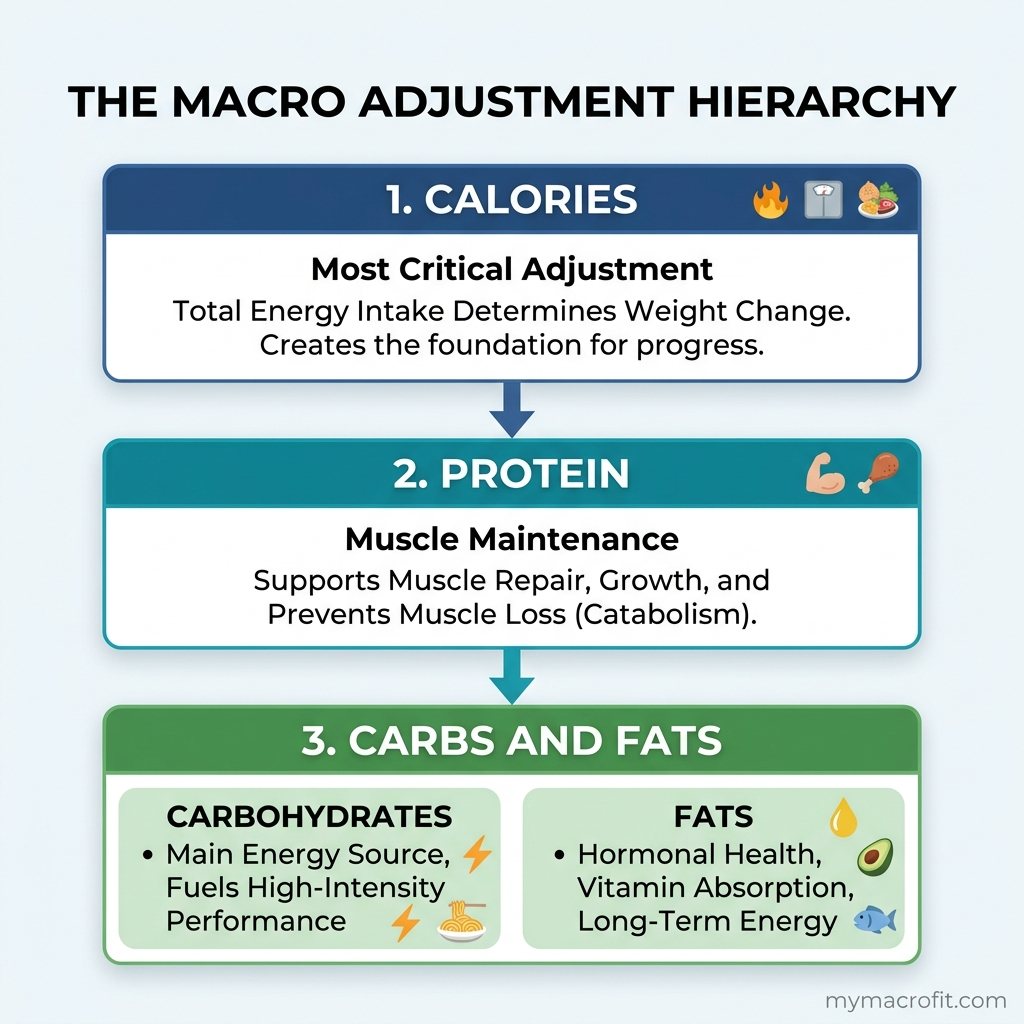
Step 4: Make a small, targeted cut
If you've recalculated and tightened measuring and the scale is still flat after two more weeks, then make a deliberate reduction:
- Cut 100-150 calories per day, small, not drastic. Bigger cuts just trigger more hunger and fatigue without faster results.
- Take it from carbs or fat, never protein. Keep protein at 1.8-2.2g/kg to protect muscle and appetite.
- Hold the new numbers for two weeks before judging. Repeat the cycle if needed.
Aggressively crashing calories backfires, it tanks energy, training, and adherence, and you lose more muscle. Small adjustments win.
Step 5: Consider a diet break
If you've been dieting for many weeks, sometimes the best move isn't eating less, it's a short, deliberate break at maintenance. A week or two at maintenance can restore adherence, energy, and hormones, setting up a more effective deficit afterward. It won't speed fat loss directly, but sustainability usually beats grinding an ever-deeper deficit.
A worked example of the whole process
Let me walk a real-feeling case through the steps, because seeing the numbers makes it click. Say you started at 90kg eating 2,000 calories, losing steadily for two months. Now you're 82kg and the scale hasn't moved in three weeks.
- Step 1, confirm: three weeks of flat weekly average. That's a genuine stall, not noise.
- Step 2, check: you weigh food strictly for a week and find your "tablespoon" of oil was nearer two, plus a couple of untracked weekend drinks. Worth ~150 calories a day.
- Step 3, recalculate: at 82kg your maintenance is lower than at 90kg, so your old 2,000 is now much closer to maintenance than it was. Your recalculated deficit target comes out around 1,800.
- Step 4, small cut if needed: you tighten the measuring and move to 1,800. If two more weeks are still flat, you trim another 100-150 from carbs or fat, never protein.
Notice you didn't crash to 1,400. Two honest fixes, accurate measuring and an updated target, did the work, with a tiny trim held in reserve. That's almost always how a real stall resolves.
What not to do
When the scale sticks, the temptation is to overreact, and that's what turns a minor recalibration into a miserable few weeks. Avoid these:
- Slashing calories by 500+. It triggers hunger, fatigue, and muscle loss without faster fat loss.
- Cutting protein. It's the one macro to protect; the reduction comes from carbs or fat.
- Adding hours of cardio overnight. A huge jump in training plus a big food cut is how people burn out and binge.
- Reacting to a few days. If it hasn't been a flat 2-3 week average, there's nothing to fix yet.
Small, evidence-led adjustments beat dramatic ones every time. The goal is to nudge the deficit back open, not to punish yourself for a number on a screen.
The takeaway
A stalled scale is rarely a mystery: it's usually an out-of-date target, drifting portions, or a stall that isn't real yet. Confirm the trend over 2-3 weeks, tighten your measuring, recalculate for your current weight, and only then make a small 100-150 calorie cut from carbs or fat. Start by getting your current numbers from the Macro Calculator, and see why you're not losing weight in a deficit for the deeper causes.
Save & share on Pinterest
Click any card to pin it — or share with someone who needs it.
How to Adjust Your Macros When Weight Loss Stalls
Stuck at the same weight for weeks? Here's exactly how to diagnose a real plateau and adjust your ma…
Stuck at the same weight for weeks? Here's exactly how to diagnose a real platea…
Read the full guide: How to Adjust Your Macros When Weight Loss Stalls
Try the free Macro Calculator
How to Adjust Your Macros When Weight Loss Stalls — use our free calculators for instant personalise…
Pinterest opens in a new tab. You can edit the description before saving.
Ready to get your numbers?
Free calculator, instant results, no signup required.
Frequently Asked Questions
How do I adjust my macros to break a weight loss plateau?+
Why have I stopped losing weight even though I'm in a deficit?+
Should I cut protein when adjusting macros in a stall?+
How long should I wait before changing my macros?+
Is a diet break or eating more ever the answer to a plateau?+
Can more steps or cardio break a stall instead of cutting calories?+
Could my plateau be a sign I should stop dieting for a while?+
About the Author

I'm a kinesiologist and personal trainer. I've spent eight years helping women lose fat and get stronger without handing their whole life over to a diet.
View full profile →