
How to Lose Weight With Hypothyroidism

RHC · Pre/Postnatal Fitness Specialist
Hypothyroidism affects approximately 2% of the UK population, with women significantly more likely to be diagnosed than men. The condition reduces metabolic rate, causes fluid retention, impairs fat mobilisation, and creates fatigue that reduces physical activity, all contributing to weight gain.
Weight loss with hypothyroidism is achievable, but requires addressing the medical component first and then applying specific dietary and exercise adjustments to the reduced metabolic baseline.
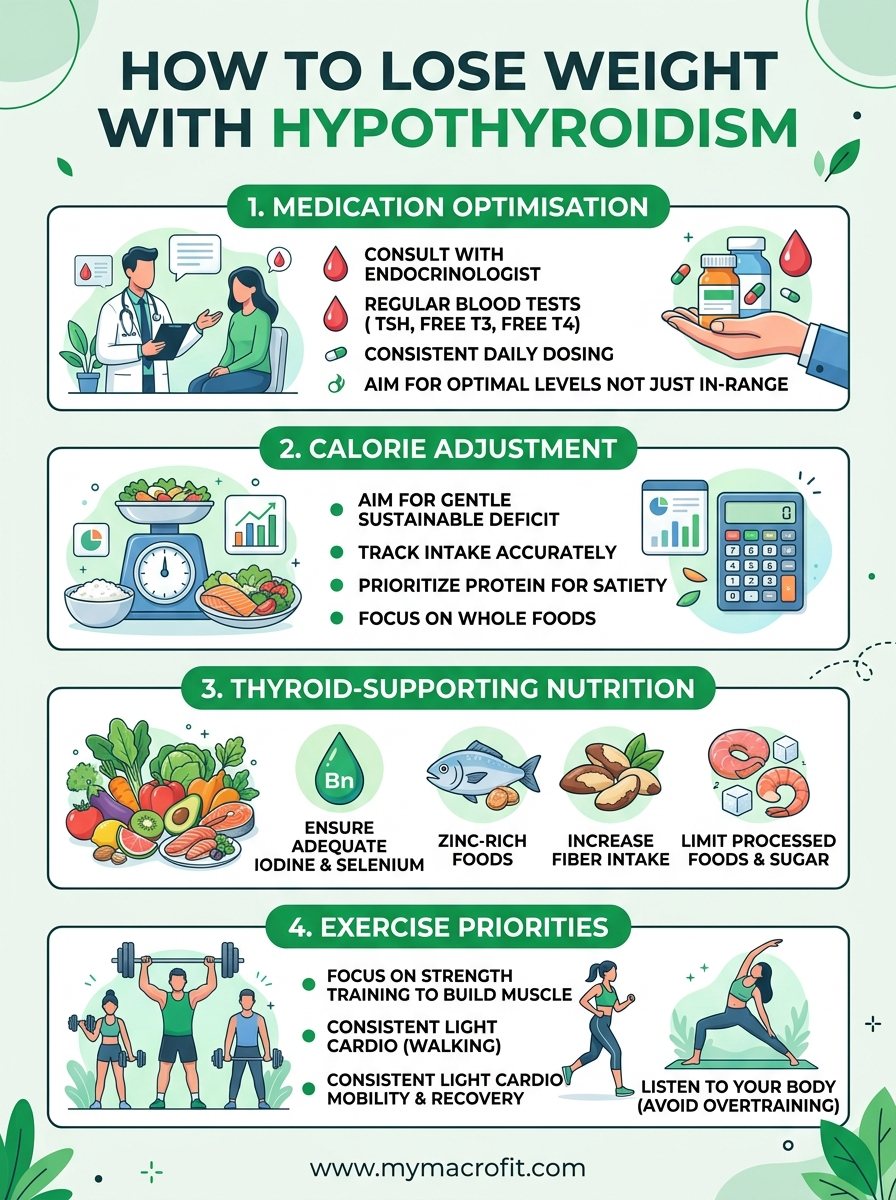
Step 1: Medication Comes First
No dietary approach will fully compensate for undertreated hypothyroidism. Before focusing on weight loss, ensure your thyroid medication is optimised.
Standard treatment: Levothyroxine (LT4, synthetic T4). The dose is adjusted to achieve a TSH within normal range.
Why "normal TSH" may not be sufficient for everyone: Some individuals don't convert T4 to T3 (the active hormone) efficiently due to genetic variation in deiodinase enzymes. These people may have TSH in normal range with low free T3, explaining persistent symptoms including fatigue, weight difficulty, and cold intolerance despite "normal" test results.
What to discuss with your GP:
- Request free T3 and free T4 testing alongside TSH
- If T3 is consistently low-normal despite adequate T4, combination therapy (levothyroxine + liothyronine) may be appropriate
- Optimal TSH for symptom resolution is often in the lower half of the reference range (1-2 mU/L rather than 4 mU/L)
Getting medication right is the single most impactful step for metabolic normalisation and weight loss ability.
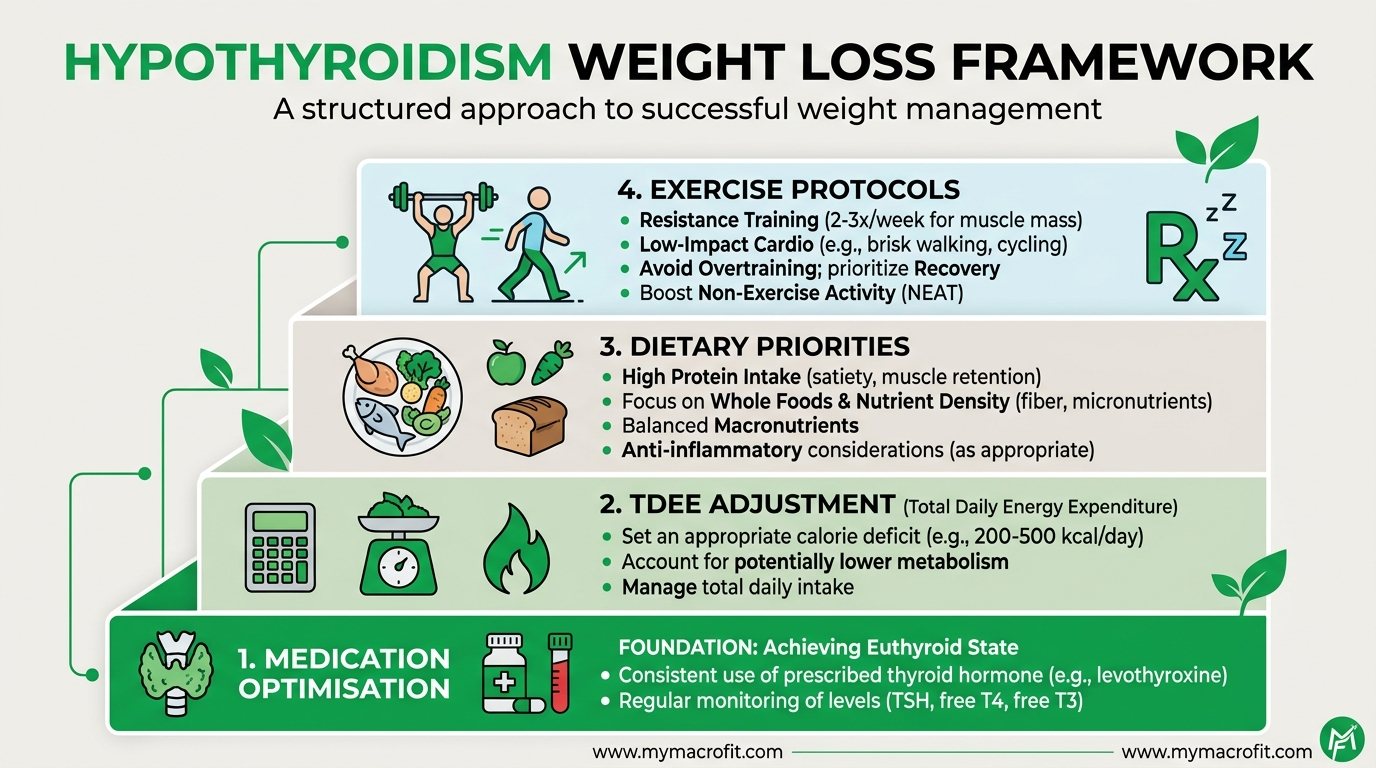
Step 2: Recalculate Your TDEE With a Hypothyroid Adjustment
Standard TDEE calculators don't account for reduced metabolic rate from hypothyroidism. Start with the standard calculation from our TDEE Calculator and then apply a correction:
With well-managed hypothyroidism (TSH in normal range): Standard TDEE × 0.90 (approximately 10% reduction)
With suboptimal management or persistent symptoms: Standard TDEE × 0.80-0.85
Validate against your actual weekly weight trend and adjust accordingly.
Step 3: Dietary Priorities for Hypothyroidism
Protein: 2-2.2g/kg
Hypothyroidism accelerates muscle loss (thyroid hormones support muscle protein synthesis). Higher protein counteracts this and preserves the muscle mass that maintains metabolic rate.
Selenium: Essential for Thyroid Function
Selenium is required for thyroid peroxidase (synthesises thyroid hormones) and for T4 to T3 conversion. Deficiency impairs thyroid function independently of iodine.
Best sources: 2 Brazil nuts/day provides approximately 200mcg selenium. Alternatively, selenomethionine supplement 200mcg/day.
Note: Excessive selenium (over 400mcg/day) causes toxicity, don't over-supplement.
Iodine: Adequate But Not Excessive
Iodine is required for thyroid hormone synthesis, but excess iodine can worsen autoimmune thyroid conditions (Hashimoto's). Aim for dietary adequacy from food rather than high-dose supplementation.
Adequate dietary sources: Dairy (150-200mcg per 500ml milk), fish, eggs, iodised salt. Avoid kelp and seaweed supplements (contain extremely variable and sometimes excessive iodine).
Zinc: Supports T4 to T3 Conversion
Zinc is a cofactor for deiodinase enzymes that convert T4 to T3. Deficiency impairs this conversion.
Sources: Pumpkin seeds (7mg/30g), beef, chickpeas, cashews.
Avoid Very Low Carbohydrate Diets
Strict low-carbohydrate diets reduce T3 levels and increase reverse T3, potentially worsening thyroid hormone action. A moderate-carbohydrate approach (100-150g/day from quality whole food sources) is preferable for those with hypothyroidism.
Selenium-Rich Foods Daily
| Food | Selenium per serving |
|---|---|
| Brazil nuts (2) | 200mcg |
| Tuna (85g) | 63mcg |
| Turkey breast (85g) | 31mcg |
| Eggs (1) | 15mcg |
| Oats (40g) | 10mcg |
Step 4: Exercise for Hypothyroidism
Resistance Training: Priority
Resistance training is particularly important with hypothyroidism because it:
- Counters the muscle loss associated with reduced thyroid hormone
- Improves insulin sensitivity (impaired in hypothyroidism)
- Increases metabolic rate through muscle maintenance
Minimum: 3 full-body sessions per week with progressive overload.
Moderate Cardio: Beneficial
Moderate cardiovascular exercise (walking, cycling, swimming at moderate intensity) improves thyroid hormone utilisation and supports fat loss. Excessive high-intensity cardio increases cortisol, which further reduces T3, keep high-intensity work to 2 sessions/week maximum.
Managing Fatigue
Hypothyroidism causes fatigue that can significantly reduce exercise capacity. Strategies:
- Exercise in the morning when energy is typically best
- Ensure medication is taken consistently and at the optimal time (levothyroxine is best absorbed on an empty stomach, 30-60 minutes before food)
- Don't overtrain, the fatigue of hypothyroidism recovers poorly from excessive volume
Goitrogens: The Practical Position
Goitrogens (compounds in cruciferous vegetables, soy, and some other foods) can interfere with iodine uptake in the thyroid. This has led to advice to avoid these foods with hypothyroidism.
The realistic risk: Cooked cruciferous vegetables and moderate soy intake do not pose meaningful goitrogen risk for iodine-sufficient people. Cooking deactivates most goitrogen activity in cruciferous vegetables. Very large raw amounts or excessive kelp supplementation could be an issue, moderate dietary quantities are fine.
Don't avoid broccoli, kale, or soy products based on goitrogen concerns. Their nutritional benefits (anti-inflammatory, fibre, protein) outweigh the theoretical goitrogen risk at normal dietary amounts.
Supplements Worth Considering
| Supplement | Benefit | Dose |
|---|---|---|
| Selenomethionine | T4 to T3 conversion support, reduces antibodies in Hashimoto's | 200mcg/day |
| Vitamin D | Thyroid function support, reduces autoimmune activity | 25 mcg/day |
| Magnesium | T4 to T3 conversion cofactor, sleep, cortisol management | 200-400mg (glycinate) |
| Zinc | Deiodinase enzyme support | 15-30mg/day |
The Bottom Line
Weight loss with hypothyroidism begins with medication optimisation, ensuring TSH, free T3, and free T4 are all in appropriate ranges. Once medication is optimised, weight loss follows standard principles but with a downward-adjusted TDEE estimate (10-15% reduction from standard calculation).
Dietary priorities: adequate selenium and zinc for thyroid hormone conversion, avoiding very low-carbohydrate diets (which impair T3), and maintaining adequate protein (2-2.2g/kg) to preserve muscle. Resistance training 3x/week plus moderate cardio is the appropriate exercise approach.
Save & share on Pinterest
Click any card to pin it — or share with someone who needs it.
How to Lose Weight With Hypothyroidism
Why hypothyroidism makes weight loss harder and the evidence-based strategies that work, from medica…
Why hypothyroidism makes weight loss harder and the evidence-based strategies th…
Read the full guide: How to Lose Weight With Hypothyroidism
Try the free TDEE Calculator
How to Lose Weight With Hypothyroidism — use our free calculators for instant personalised results. …
Pinterest opens in a new tab. You can edit the description before saving.
Ready to get your numbers?
Free calculator, instant results, no signup required.
Frequently Asked Questions
How much does hypothyroidism affect your metabolism?+
Should I eat low carb with hypothyroidism?+
How long does it take to lose weight with hypothyroidism once on medication?+
Can I lose weight with hypothyroidism, or is it impossible?+
Do certain foods or supplements interfere with thyroid medication?+
About the Author

I'm a registered health coach and pre/postnatal specialist. I look at the whole person, your sleep, your stress, your hormones, because the number on the scale is only ever part of the story.
View full profile →