Visceral Fat: What It Is, Why It's Dangerous, and How to Lose It

RHC · Pre/Postnatal Fitness Specialist
Not all fat is the same. The fat that accumulates around the abdomen, particularly the deep visceral fat that surrounds internal organs, is fundamentally different from the fat that sits under the skin. It's metabolically active, hormonally disruptive, and independently linked to the most serious chronic diseases.
This guide covers what visceral fat actually is, why it matters more than total weight, and the evidence-based approaches that reduce it most effectively.
What Makes Visceral Fat Different
Visceral fat isn't passive storage, it's active tissue. Unlike subcutaneous fat (the fat you can pinch), visceral adipose tissue:
Secretes inflammatory cytokines: TNF-alpha and IL-6 are pro-inflammatory compounds released by visceral fat that trigger chronic low-grade inflammation throughout the body. This inflammation is directly implicated in insulin resistance, atherosclerosis, and metabolic syndrome.
Disrupts insulin signalling: Visceral fat releases free fatty acids directly into the portal vein, which leads straight to the liver. This portal fatty acid flux impairs hepatic insulin processing, contributing to insulin resistance even before blood glucose becomes elevated.
Produces hormones: Visceral fat produces adipokines including resistin (which worsens insulin resistance) and reduced adiponectin (which normally has anti-inflammatory and insulin-sensitising effects).
Compresses abdominal organs: High visceral fat volume exerts physical pressure on surrounding organs, contributing to issues including non-alcoholic fatty liver disease (NAFLD).
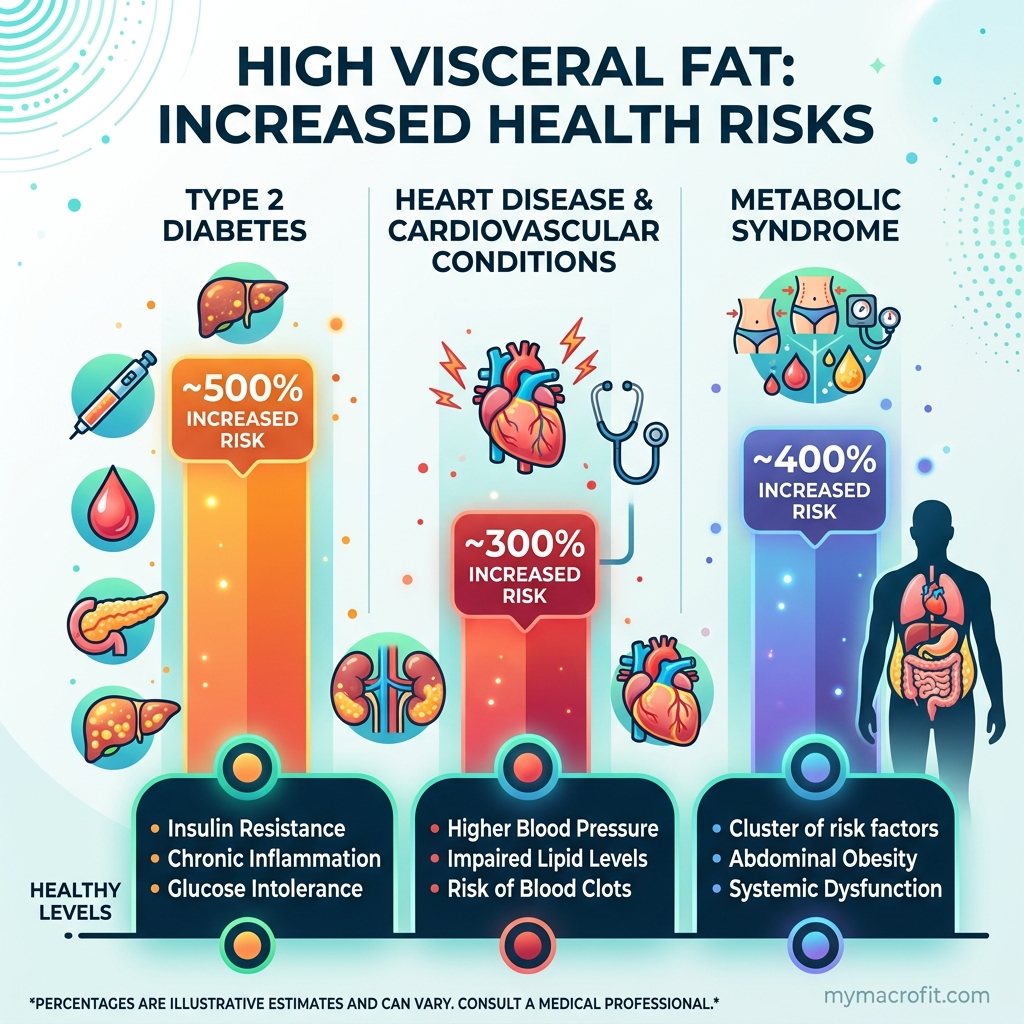
The result: people with high visceral fat are at significantly elevated risk for type 2 diabetes, cardiovascular disease, certain cancers, metabolic syndrome, and all-cause mortality, independently of their total body weight.
Who Gets Visceral Fat (and Why)
Visceral fat accumulation is influenced by:
Sex hormones: Men tend to accumulate more visceral fat than premenopausal women. After menopause, oestrogen decline causes women's fat distribution to shift toward the abdominal pattern, visceral fat increases substantially.
Cortisol: Chronic stress elevates cortisol, which specifically promotes visceral fat deposition. The abdomen has a higher density of cortisol receptors than other fat depots.
Alcohol: Alcohol metabolism in the liver directly promotes visceral fat accumulation. Abdominal fat gain from regular alcohol consumption is disproportionate to the calories consumed.
Sleep deprivation: Short sleep duration (under 6 hours) is independently associated with greater visceral fat accumulation, likely through cortisol and metabolic disruption.
Genetics and ethnicity: Some populations accumulate visceral fat at lower total body weights, South Asian, East Asian, and Middle Eastern individuals tend to develop metabolically dangerous visceral fat at BMIs where European populations typically would not.
How to Assess Visceral Fat
Waist Circumference
The simplest practical measurement. Measure at the level of the navel (or midway between the bottom of the rib cage and the top of the hip bone).
Risk thresholds:
- Men: >94cm (37in) = elevated risk; >102cm (40in) = high risk
- Women: >80cm (31.5in) = elevated risk; >88cm (34.5in) = high risk
Waist-to-Height Ratio
Divide your waist circumference by your height (in the same units). A ratio under 0.5 is associated with low visceral fat risk across genders and ethnicities.
Example: 80cm waist ÷ 168cm height = 0.476 (under 0.5, healthy range)
Body Fat Calculator
Use our Body Fat Calculator to assess overall body fat percentage. High total body fat almost always correlates with high visceral fat in people with an apple-shaped fat distribution.
DEXA Scan
The most accurate method, distinguishing visceral from subcutaneous fat precisely. Available at many UK gyms and health clinics for £50-150. Worth doing as a baseline measurement if you're focused on visceral fat reduction.
How to Lose Visceral Fat
The good news: visceral fat is metabolically active and responsive to lifestyle intervention. It tends to be mobilised earlier in weight loss than subcutaneous fat.
1. Calorie Deficit, The Foundation
A calorie deficit is required for fat loss of any kind. However, visceral fat responds preferentially to a deficit compared to subcutaneous fat, meaning early weight loss disproportionately reduces visceral tissue.
Even modest weight loss (5-10% of bodyweight) produces measurable visceral fat reduction and improvements in metabolic markers.
Set a 400-500 kcal/day deficit. See our calorie deficit guide.
2. Aerobic Exercise, More Effective for Visceral Fat Than Any Other Fat Depot
Multiple meta-analyses confirm that aerobic exercise (walking, running, cycling, swimming) reduces visceral fat significantly, even independent of body weight changes.
Effective protocol:
- 150-300 minutes moderate-intensity aerobic exercise per week
- Or 75-150 minutes vigorous-intensity aerobic exercise
- Consistency over months is more important than any single session's intensity
A 2011 study (Slentz et al.) demonstrated that exercise at equivalent calorie expenditure to diet-only restriction reduced visceral fat more than diet alone.
3. Resistance Training, Independently Effective
Resistance training reduces visceral fat even without significant weight loss. Muscle tissue is metabolically active and improves insulin sensitivity, directly countering the mechanisms by which visceral fat causes harm.
Protocol: 3 full-body strength sessions per week. Compound movements (squats, deadlifts, rows, presses) maximise muscle recruitment and metabolic benefit.
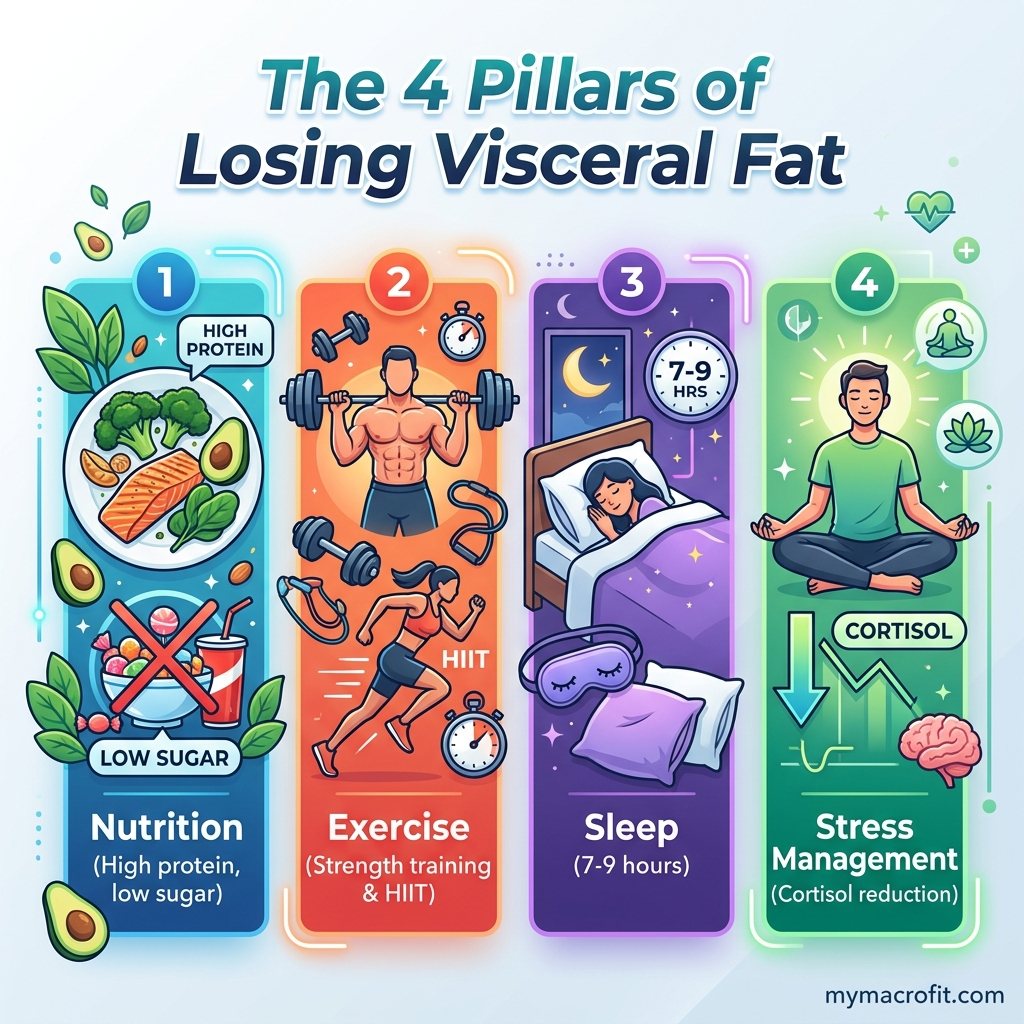
4. Sleep: 7-9 Hours Consistently
Sleep deprivation is a direct cause of visceral fat accumulation. Prioritising sleep to 7-9 hours/night is not a peripheral recommendation, it's a primary intervention for visceral fat reduction.
5. Stress Management
Cortisol is a visceral fat deposition signal. Chronic high cortisol from psychological stress, excessive calorie restriction, or overtraining directly promotes abdominal fat retention.
Managing stress through adequate sleep, moderate (not excessive) exercise, and avoiding prolonged extreme deficits all reduce cortisol and visceral fat retention.
6. Reduce Alcohol
Alcohol has a unique relationship with visceral fat beyond its calorie contribution. Reducing alcohol consumption, or eliminating it during an active fat loss phase, is particularly effective for reducing waist circumference.
Tracking Visceral Fat Progress
Primary measure: Monthly waist circumference in the morning under consistent conditions. Even 1-2cm reduction represents meaningful visceral fat loss.
Secondary: Waist-to-height ratio trajectory.
Tertiary: Body fat percentage from consistent measurement method.
Do not use body weight as the primary visceral fat indicator. Two people can have identical scale weight with dramatically different visceral fat levels based on exercise history, alcohol intake, and fat distribution patterns.
The Bottom Line
Visceral fat, not total body weight, is the primary metabolic health risk. The good news: visceral fat responds well to lifestyle intervention. A combination of moderate calorie deficit, regular aerobic exercise, resistance training, adequate sleep, and reduced alcohol produces measurable visceral fat reduction within 8-12 weeks.
Waist circumference is your primary progress indicator. Track it monthly alongside scale weight for a complete picture of what your fat loss programme is actually achieving.
Save & share on Pinterest
Click any card to pin it — or share with someone who needs it.
Visceral Fat: What It Is, Why It's Dangerous, and How to Lose It
The science of visceral fat, why abdominal fat is metabolically dangerous, how to measure it, and th…
The science of visceral fat, why abdominal fat is metabolically dangerous, how t…
Read the full guide: Visceral Fat: What It Is, Why It's Dangerous, and How to Lose It
Try the free Body Fat Calculator
Visceral Fat: What It Is, Why It's Dangerous, and How to Lose It — use our free calculators for inst…
Pinterest opens in a new tab. You can edit the description before saving.
Ready to get your numbers?
Free calculator, instant results, no signup required.
Frequently Asked Questions
What is the difference between visceral fat and subcutaneous fat?+
How do I know if I have too much visceral fat?+
Does exercise reduce visceral fat specifically?+
Can you spot-reduce belly fat with ab exercises?+
How quickly does visceral fat go down?+
Can you be a healthy weight and still have too much visceral fat?+
About the Author

I'm a registered health coach and pre/postnatal specialist. I look at the whole person, your sleep, your stress, your hormones, because the number on the scale is only ever part of the story.
View full profile →