Walking for Weight Loss: How Many Steps, How Far, How Fast
Founder, MyMacroFit
Walking is the most underrated thing in fitness, and I will happily die on that hill. It is free, you need no equipment, and you can fit it into a normal day without booking gym time you will probably skip anyway. It will not replace lifting weights for changing your shape, but as a daily contribution to fat loss, especially through all that incidental movement, it does a lot more than people give it credit for. It is also the one habit I have never managed to quit, which is exactly why it works for me.
Here is how walking actually affects your weight, and how to get the most out of it.
How many calories does walking actually burn?
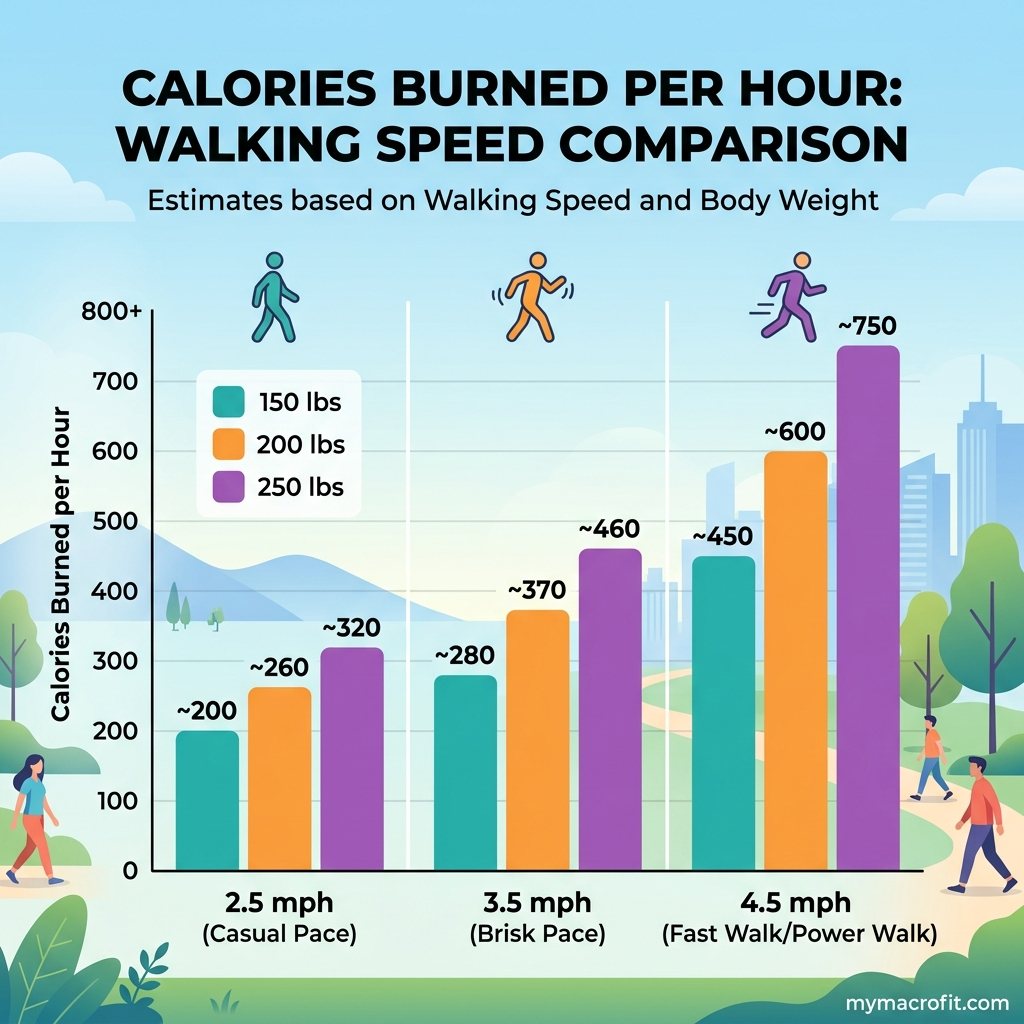
It depends on your weight, your pace, and the ground you are covering. Here are rough numbers for a 75kg person on flat ground:
| Pace | km/h | Calories per 10 min | Calories per 10,000 steps (~8km) |
|---|---|---|---|
| Slow stroll | 3 km/h | 28 kcal | ~340 kcal |
| Moderate walk | 4.5 km/h | 38 kcal | ~400 kcal |
| Brisk walk | 6 km/h | 52 kcal | ~450 kcal |
| Power walk | 7.5 km/h | 68 kcal | ~500 kcal |
Use our Steps-to-Calories Calculator to get a number based on your own weight and steps. When I started, seeing that number was weirdly motivating on the lazy days.
So a 75kg person walking 10,000 steps at a moderate pace burns around 400 calories. That is roughly a meal's worth, turning up reliably every day, without you having to schedule a thing.
Why walking matters beyond your workouts
A lot of what walking does for you sits outside of "exercise" entirely. It is part of the movement you do all day long, and that quiet, all-day movement varies enormously from person to person. Two people can do the exact same gym sessions, and the one who walks more burns hundreds more calories a day without anything else changing.
That is the bit I wish I had understood sooner. It is not just the workout. It is everything you do between the workouts. Bumping your daily steps up by 3,000, say from 5,000 to 8,000, adds something like 120 to 180 calories a day, which is most of a thousand calories a week from doing nothing more than moving a bit more.
So how many steps should you aim for?
A rough map, based on where you are now:
- Under 5,000 a day: this is where I started, and it does very little for fat loss. The first job is simply to move more.
- Around 7,500: real health benefits kick in here, even before we talk about weight.
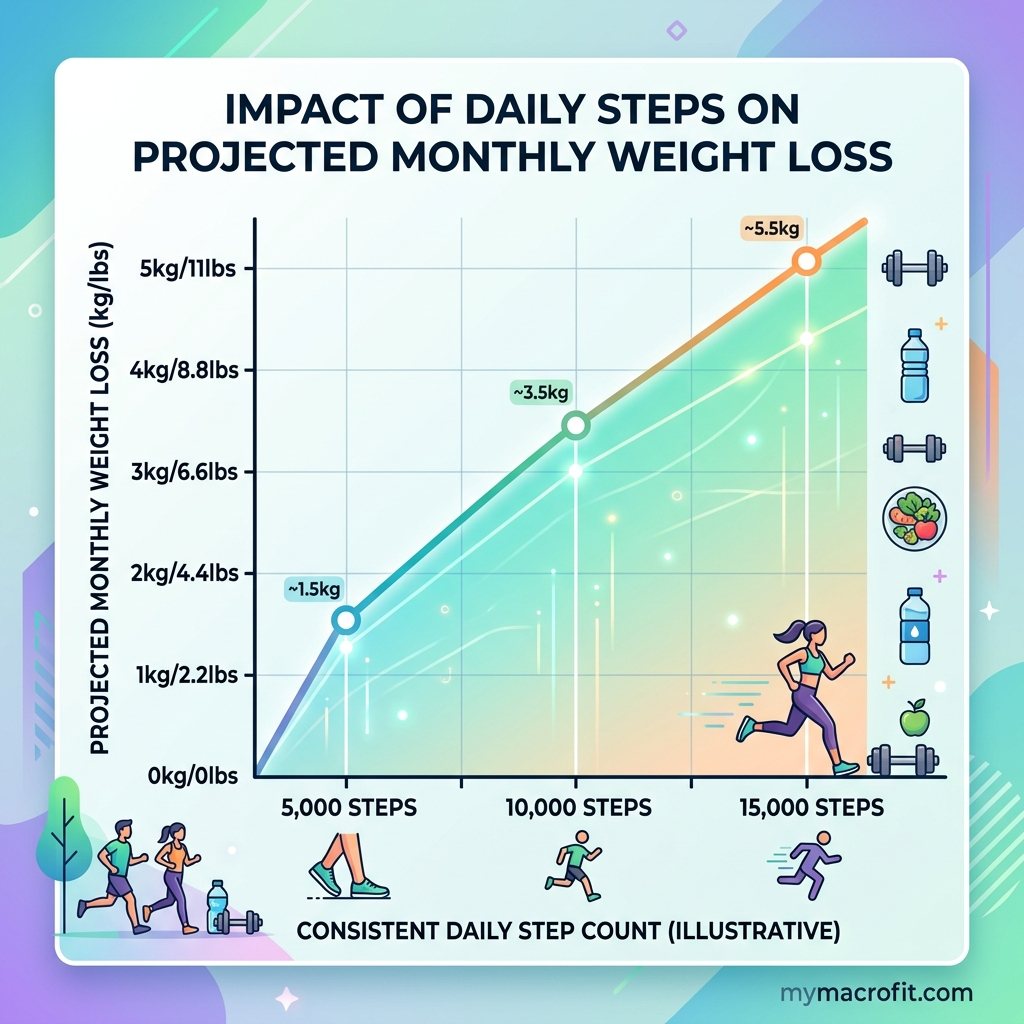
- 8,000 to 10,000: a solid fat-loss zone, burning roughly 320 to 450 calories a day for a 75kg person.
- 10,000 to 12,000: a genuinely meaningful daily contribution to your deficit.
The famous 10,000 target is not a magic number, but it is a decent one. Most of the benefit comes from getting off the sofa and up to 8,000. Pushing on to 10,000 adds a bit more on top.
How to get the steps without "going for a walk"
The trick that worked for me was not scheduling big walks. It was hiding steps inside the day I was already living:
- On the way somewhere: get off a stop early, park at the far end of the car park, walk the first ten minutes before you catch anything.
- At work: take the stairs, walk over to talk to someone instead of messaging them, stand up every hour.
- At lunch: a 20-minute walk adds around 2,000 steps and a bit of burn, and it breaks up the day nicely.
- After dinner: a 10-minute walk adds a thousand-odd steps, helps your body handle the meal, and became my favourite part of the evening.
- Doing chores: cleaning, gardening, lugging the shopping home. A proper tidy-up can add a couple of thousand steps without feeling like exercise.
Getting a bit more out of each walk
Once walking is a habit, you can make it work harder if you want to:
- Find some hills. Walking uphill burns noticeably more than flat ground at the same pace. Even a small treadmill incline does the job.
- Carry a bit of weight. A backpack with a few kilos in it bumps up the burn and adds a little load.
- Change the pace. Alternating brisk and easy stretches burns a bit more than plodding along at one speed.
- Walk before breakfast. The fat-burning difference is small and a bit overhyped, but I like getting it done before the day has a chance to get in the way.
Walking and lifting work together
This is not walking versus the gym. They do different jobs and they team up well. Lifting keeps your muscle, which keeps your metabolism ticking over. Walking adds the steady daily burn and is kind to your heart. Together they beat either one on its own.
A week might look like:
- A few resistance sessions, which do the heavy lifting for your shape.
- A daily step target around 8,000 to 10,000.
- Maybe one or two longer walks of 45 minutes to an hour.
The nice thing about the step target is that it is easier to keep than gym sessions. There is nothing to recover from, so you can do it every day, including your rest days.
Setting a goal you will actually keep
- Under 5,000 now? Add 2,000 to your daily average, then another 1,000 every couple of weeks. Small steps, literally.
- Between 5,000 and 8,000? Aim for 10,000, adding around 1,000 to 1,500 a week.
- Already over 10,000? Play with pace and hills instead of chasing a bigger number.
Track it with whatever you have, a watch, your phone, a cheap pedometer. Seeing the number is what kept me honest, especially early on.
Where I land on it
Walking will not transform you on its own, and anyone selling it that way is fibbing. But as a daily habit sitting on top of sensible eating, it is one of the best things you can do, with no schedule, no kit, and no recovery cost. Around 400 to 450 calories a day from 10,000 steps, turning up every single day, quietly does its work.
Start by hiding steps in the day you already have. Add proper walks later if you fancy it. And track it, because watching that number tick up is half the fun. If you want more of the honest, unglamorous version of all this, I share it on my TikTok.
Save & share on Pinterest
Click any card to pin it — or share with someone who needs it.
Walking for Weight Loss: How Many Steps, How Far, How Fast
How many calories walking burns, how many steps you need for weight loss, and how to maximise fat lo…
How many calories walking burns, how many steps you need for weight loss, and ho…
Read the full guide: Walking for Weight Loss: How Many Steps, How Far, How Fast
Try the free Steps-to-Calories Calculator
Walking for Weight Loss: How Many Steps, How Far, How Fast — use our free calculators for instant pe…
Pinterest opens in a new tab. You can edit the description before saving.
Ready to get your numbers?
Free calculator, instant results, no signup required.
Frequently Asked Questions
How many steps per day do you need to lose weight?+
Does walking pace affect weight loss?+
Can walking alone cause weight loss without dieting?+
About the Author
I'm the founder of MyMacroFit. I'm not a coach or a dietitian. I'm someone who wanted to lose weight, worked it out the hard way, and built the tools I wish I'd had.
View full profile →