Creatine Calculator
Calculate your exact creatine dose based on bodyweight. Get personalised loading phase and maintenance targets, plus timing guidance based on the latest evidence.
Quick answer
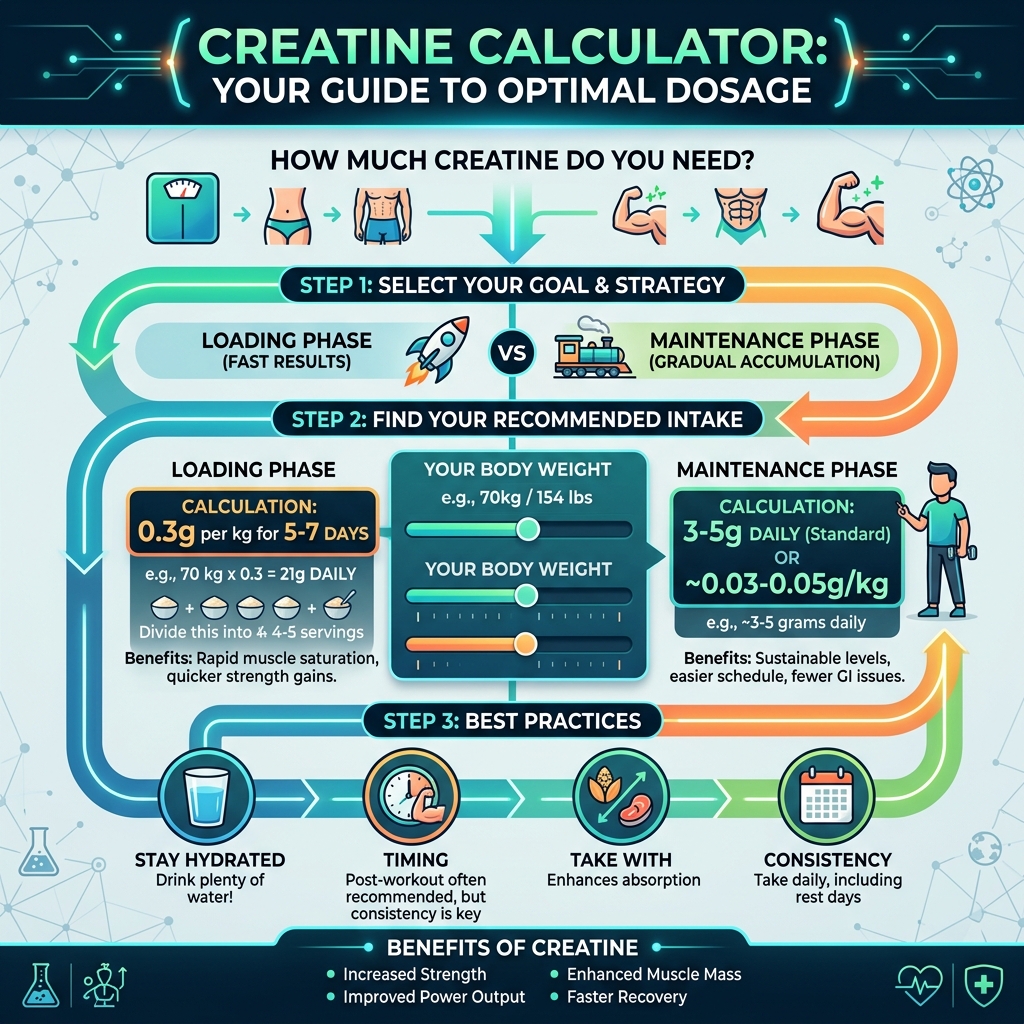
The standard dose is 3 to 5g of creatine monohydrate a day, taken at any time. An optional loading phase is about 20g a day for 5 to 7 days to saturate faster. This calculator sets your loading and maintenance doses by bodyweight.
Why Creatine Is the Best-Evidenced Supplement
Creatine monohydrate has more research behind it than virtually any other sports supplement. Over 500 peer-reviewed studies demonstrate consistent, meaningful improvements in strength, power output, and muscle mass, across age groups, training levels, and both sexes.
Unlike most supplements marketed to gym-goers, creatine's mechanism is well understood and the performance effect is reproducible and clinically significant.
How Creatine Works: The Phosphocreatine System
During maximal-intensity exercise (heavy lifts, sprints, jumps), your muscles use the phosphocreatine (PCr) system as their primary energy source. PCr stores are depleted in approximately 8–10 seconds of maximal effort.
Supplementing creatine increases the phosphocreatine stores in muscle cells by 15–40%. This means:
- More ATP available for the first set of heavy lifting
- Faster PCr resynthesis between sets
- More total reps, more total volume, more progressive overload over time
- More muscle building stimulus per training session
Creatine for Women: Underused but Equally Effective
Despite creatine being equally effective in women, female supplementation rates are significantly lower. Research shows women experience the same strength and muscle gains as men from creatine supplementation, and emerging evidence suggests additional benefits for women including improved mood, cognitive function, and bone health, particularly relevant during perimenopause.
Women typically have lower muscle creatine stores than men, which means the relative benefit of supplementation may actually be greater.
Loading vs Maintenance: Which Protocol to Use
Both approaches reach the same endpoint, fully saturated muscle creatine stores. The difference is speed:
- Loading (0.3g/kg/day for 5–7 days): Full saturation in one week. Mild GI discomfort possible with large single doses, taking 4 smaller doses across the day minimises this.
- Maintenance only (0.03g/kg/day): Full saturation in 3–4 weeks. No GI concerns. Preferred for long-term supplementation.
Frequently Asked Questions
How much creatine should I take per day?
Do I need to do a creatine loading phase?
When is the best time to take creatine?
What type of creatine is best?
Is creatine safe?
Does creatine cause water retention?
How it's calculated: this tool uses established, published equations. See the full calculator methodology for the formulas and assumptions behind it.
Results are estimates for general guidance, not medical advice. See our disclaimer, and speak to a qualified healthcare professional before making medical or dietary changes.
Related Tools
Save & share on Pinterest
Click any card to pin it — or share with someone who needs it.
Creatine Calculator
Calculate your exact creatine dose based on bodyweight. Get personalised loading phase and maintenan…
Calculate your exact creatine dose based on bodyweight. Get personalised loading…
Read the full guide: Creatine Calculator
Try the free Creatine Calculator
Creatine Calculator — use our free calculators for instant personalised results. No signup required.
Pinterest opens in a new tab. You can edit the description before saving.
Get Your Free Macro Cheat Sheet
One-page PDF with all the key formulas. Free, no spam ever.
Get the Free Macro Guide