
Calorie Cycling: What It Is and How to Do It

CN · Metabolic Health Coach
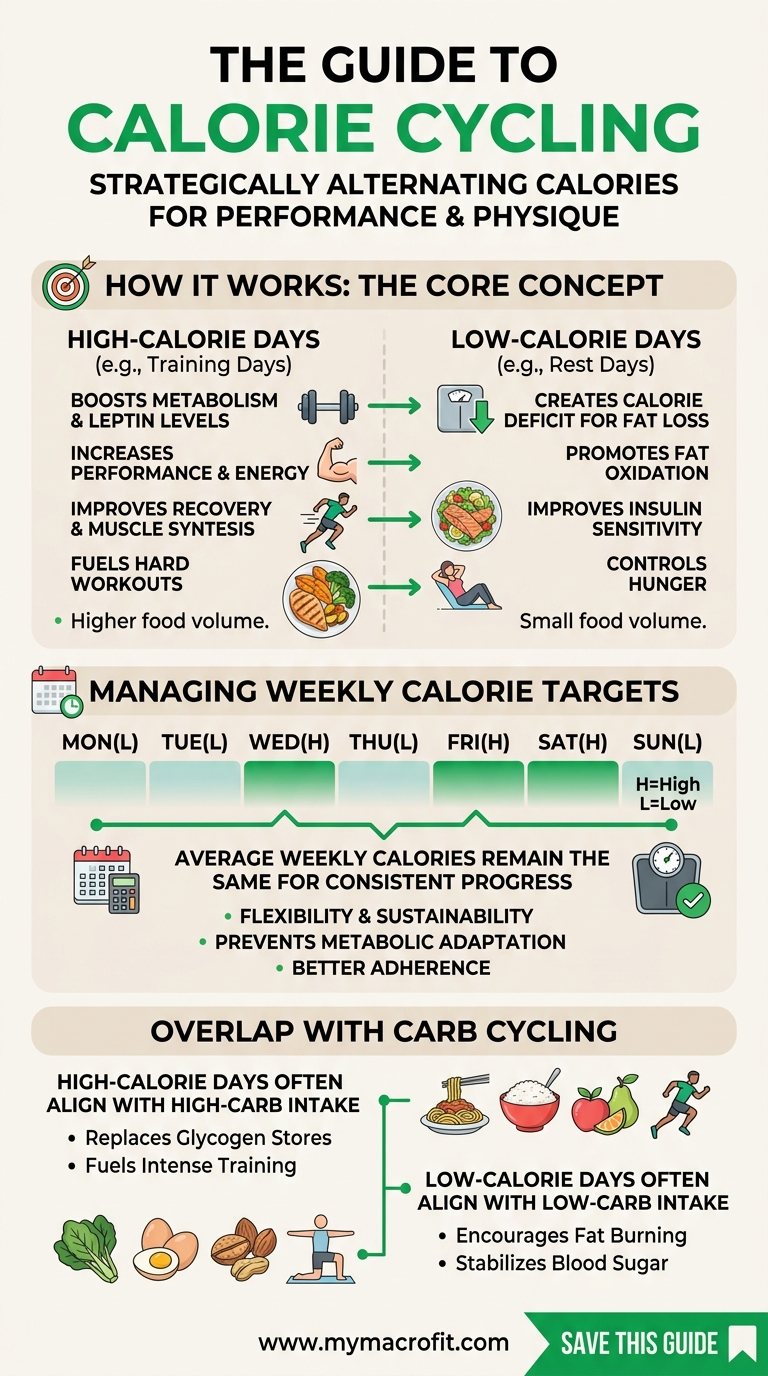
Calorie cycling, adjusting daily calorie intake rather than eating the same amount every day, is a practical approach for people who train regularly and want to align their nutrition with their activity level. It's neither magic nor gimmick: the fat loss mechanism remains the same (weekly calorie deficit), but the distribution strategy may improve adherence, training performance, and body composition outcomes.
The Core Principle
Calorie cycling maintains the same weekly calorie target as a steady deficit, it just distributes those calories unevenly across days:
Example: 1,600 kcal/day steady deficit vs. calorie cycling at same weekly total
Steady deficit: 1,600 × 7 = 11,200 kcal/week
Calorie cycling (training days higher, rest days lower):
- 3 training days: 1,900 kcal × 3 = 5,700 kcal
- 4 rest days: 1,375 kcal × 4 = 5,500 kcal
- Weekly total: 11,200 kcal ← identical
Both approaches produce the same expected fat loss, the difference is in how the calories are distributed relative to training.
Why Calorie Cycling May Have Advantages
Training performance: Higher calories on training days means more glycogen available for intense sessions. This supports higher training intensity and volume, the stimulus for muscle preservation and building during a fat loss phase.
Hormonal considerations: Higher calorie days (particularly with more carbohydrates) temporarily restore leptin, testosterone, and growth hormone, creating a more anabolic environment on training days. Lower calories on rest days create the overall deficit without impairing training quality.
Psychological sustainability: Knowing you have higher-calorie training days prevents the feeling of constant restriction. Many people find strict daily deficits mentally exhausting; cycling gives "scheduled" flexibility.
Better muscle preservation: Some research suggests aligning higher protein and calorie intake with training stimulus (on training days) produces better lean mass retention during a cut than a steady deficit.
How to Set Up Calorie Cycling
Step 1: Calculate Your Weekly Calorie Target
Start with your TDEE from our TDEE Calculator and determine your desired weekly deficit:
- 0.5kg/week fat loss = 3,850 kcal weekly deficit (550 kcal/day)
- 0.4kg/week fat loss = 3,000 kcal weekly deficit (430 kcal/day)
Weekly calorie budget = (TDEE × 7) − weekly deficit
Example: TDEE 2,000 kcal. Weekly budget = (2,000 × 7) − 3,500 = 14,000 − 3,500 = 10,500 kcal
Step 2: Classify Your Days
Training days (typically 3-4 per week): Higher calorie, align with the most intense training sessions
Rest or light activity days (3-4 per week): Lower calorie
Step 3: Set Day Targets
Training days: TDEE − 100 to +100 kcal (near maintenance or slight surplus for heavy training days)
Rest days: Lower calorie target to create the needed weekly deficit
Example (TDEE 2,000, training 3x/week):
- 3 training days at 1,900 kcal = 5,700 kcal
- 4 rest days at 1,200 kcal = 4,800 kcal
- Weekly total: 10,500 kcal ✓ (vs. 14,000 at maintenance = 3,500 weekly deficit)
Step 4: Macro Distribution
Training days (higher calories, where to add):
- Increase carbohydrates to fuel training and restore glycogen
- Maintain protein at 2g/kg
- Fat at moderate level
Rest days (lower calories, where to reduce):
- Reduce carbohydrates (less needed without training glycogen demand)
- Maintain protein at 2g/kg (never reduce protein)
- Fat may also be slightly reduced
A Sample Week
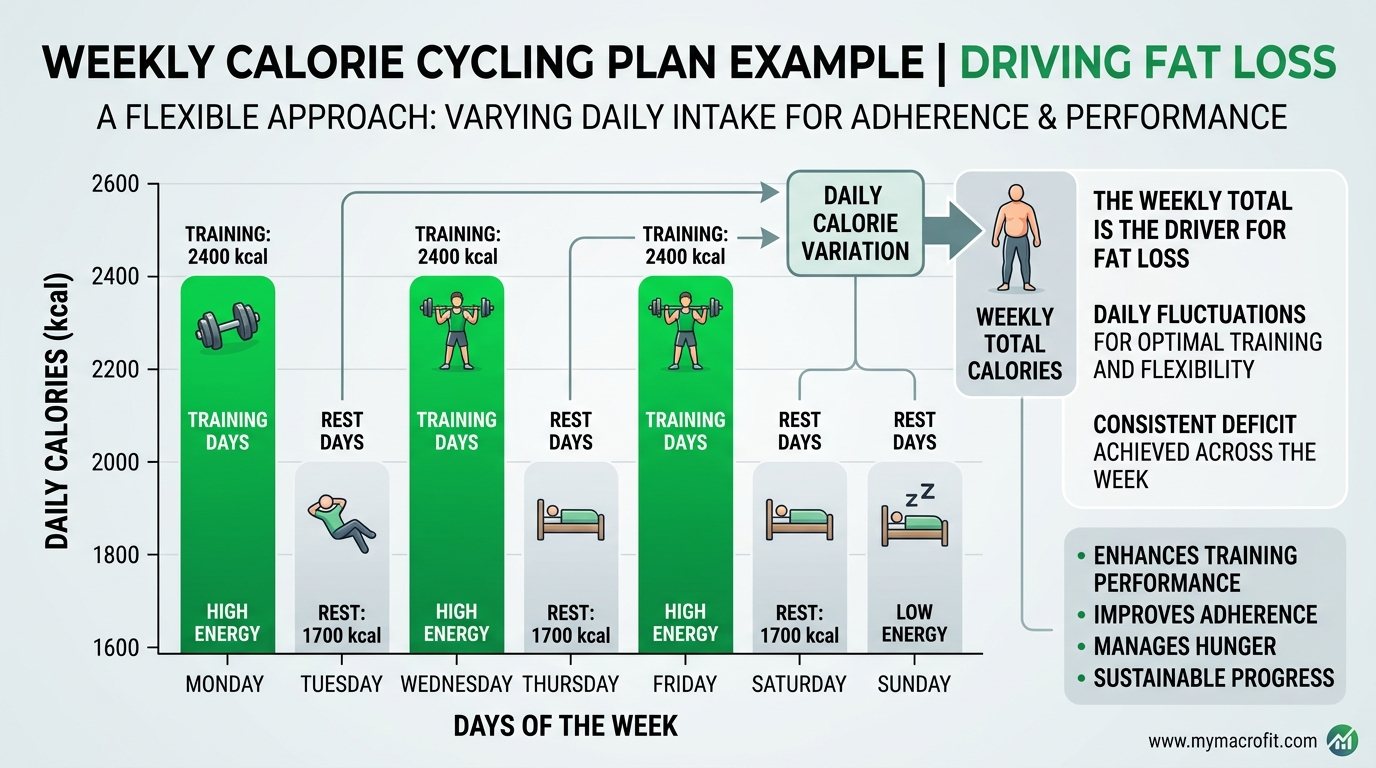
For a 70kg woman, TDEE 1,950 kcal, aiming for 0.5kg/week fat loss:
- Weekly budget: (1,950 × 7) − 3,500 = 13,650 − 3,500 = 10,150 kcal
| Day | Training | Calories | Protein | Carbs | Fat |
|---|---|---|---|---|---|
| Mon | Strength | 1,850 | 140g | 170g | 55g |
| Tue | Rest | 1,300 | 140g | 80g | 50g |
| Wed | Strength | 1,850 | 140g | 170g | 55g |
| Thu | Rest | 1,300 | 140g | 80g | 50g |
| Fri | Strength | 1,850 | 140g | 170g | 55g |
| Sat | Light walk | 1,500 | 140g | 100g | 55g |
| Sun | Rest | 1,300 | 140g | 80g | 50g |
| Total | 10,950 kcal | 140g/day |
Note: protein stays constant throughout. Carbohydrates and calories flex.
When Calorie Cycling Is Most Beneficial
Best suited to:
- People with structured training schedules (3+ sessions/week)
- Those who find constant daily restriction psychologically difficult
- Anyone prioritising strength performance alongside fat loss
- People who want to eat more on active days and less on lazy days (natural alignment)
Less necessary for:
- Beginners (establishing consistent basics first is more important)
- Very low training frequency (1-2 times/week)
- People who find tracking multiple day types too complex
The Bottom Line
Calorie cycling is a valid approach to fat loss that aligns calorie intake with training demand. It doesn't produce more fat loss than an equivalent steady deficit, but it may improve training performance, muscle preservation, hormonal environment on training days, and psychological sustainability.
Start with weekly calorie target, classify training vs. rest days, and distribute calories with higher amounts on training days and lower on rest days, while keeping protein constant throughout.
Save & share on Pinterest
Click any card to pin it — or share with someone who needs it.
Calorie Cycling: What It Is and How to Do It
How calorie cycling works, alternating higher and lower calorie days to support fat loss, muscle bui…
How calorie cycling works, alternating higher and lower calorie days to support …
Read the full guide: Calorie Cycling: What It Is and How to Do It
Try the free TDEE Calculator
Calorie Cycling: What It Is and How to Do It — use our free calculators for instant personalised res…
Pinterest opens in a new tab. You can edit the description before saving.
Ready to get your numbers?
Free calculator, instant results, no signup required.
Frequently Asked Questions
Does calorie cycling work better than a steady deficit?+
What is the difference between calorie cycling and carb cycling?+
How much of a difference should there be between high and low calorie days?+
How do I set up calorie cycling for my week?+
Is calorie cycling worth the extra effort for a beginner?+
Can I have my higher-calorie days on weekends instead of training days?+
About the Author

I'm a certified nutritionist and metabolic health coach. I went deep on keto and metabolism after reversing my own insulin resistance, and I'd rather give you the actual numbers than a hand-wave.
View full profile →