
Cheat Meals: The Science Behind Them and How to Use Them
Founder, MyMacroFit
Cheat meals are deeply embedded in diet culture, the "reward" for a week of good eating. The science behind them is more nuanced than the fitness community often portrays: the benefits are real but limited, and the common execution (uncontrolled eating) often does more harm than good.
Here's an evidence-based look at what cheat meals actually do and how to use them effectively.
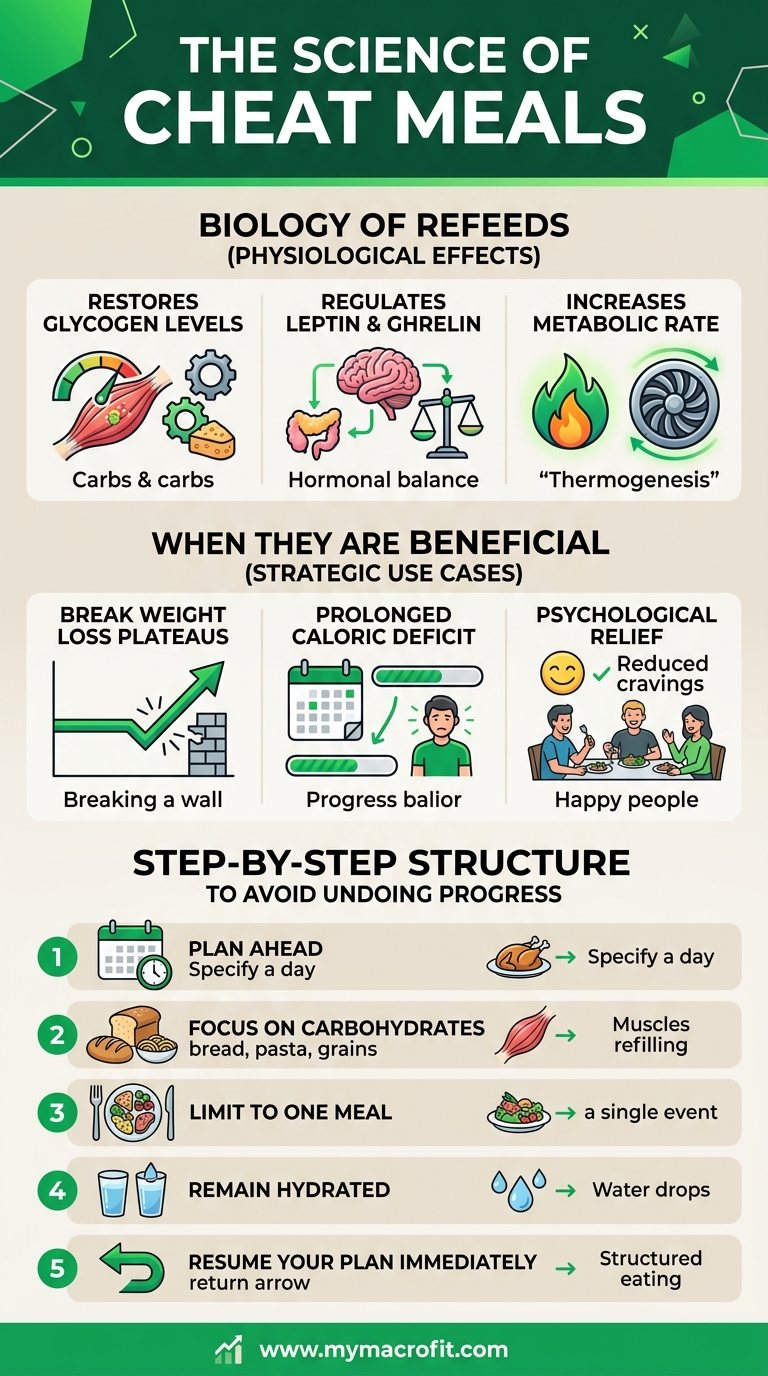
The Biology Behind the Claim
The metabolic case for cheat meals centres on leptin, the satiety hormone produced by fat cells that signals to the brain to reduce appetite and increase metabolic rate.
When in a calorie deficit:
- Fat cells shrink
- Leptin production falls
- The brain interprets low leptin as a signal of potential starvation
- Appetite increases, metabolic rate decreases (adaptive thermogenesis)
The idea: eating at or above maintenance temporarily restores leptin, interrupting this metabolic adaptation.
What the evidence actually shows:
- Leptin rises meaningfully after prolonged overeating (days to weeks), not a single meal
- A single higher-calorie day produces transient leptin changes that return to baseline within 12-24 hours
- The metabolic benefit of a single cheat day is minimal to negligible
- A 1-2 week diet break at maintenance (not a cheat meal) has genuine evidence for partial restoration of leptin and attenuation of metabolic adaptation
The cheat meal myth conflates the real science of diet breaks with the convenient fiction of a single indulgent meal fixing metabolic slowdown.
The Legitimate Benefits of Planned Flexibility
Despite the overblown metabolism claims, there are real reasons planned dietary flexibility helps:
Psychological sustainability: Knowing you have a planned higher-calorie meal or day reduces the deprivation feeling of dieting. Research on dietary restraint consistently shows that "all-or-nothing" approaches to dieting have worse long-term outcomes than flexible, planned flexibility.
Social function: Food is deeply social. The ability to participate in meals out, celebrations, and social occasions without guilt is practically important for long-term adherence.
Glycogen replenishment: For athletes or those doing significant training volume, a higher-carbohydrate day restores glycogen stores, improving subsequent training performance.
Mental reset: Breaking a monotonous diet pattern reduces "diet fatigue", the accumulation of small decisions that erode willpower over time.
Cheat Meal vs. Refeed: The Important Distinction
| Cheat Meal/Day | Structured Refeed | |
|---|---|---|
| Duration | 1 meal or 1 day | 1-2 days (or longer breaks) |
| Calorie target | Often uncontrolled | Maintenance calories |
| Food choices | Typically high-calorie favourites | Moderate, higher carbohydrate focus |
| Psychological state | Permission to eat freely | Planned and intentional |
| Evidence for metabolic benefit | Minimal | Modest but real |
| Risk of erasing deficit | High (common to consume 1,500-3,000+ kcal) | Low (maintenance, not surplus) |
A structured refeed, eating at your maintenance calorie level for 1-2 days, with slightly higher carbohydrates, is a more evidence-based approach than an uncontrolled cheat day.
How to Structure a Planned Higher-Calorie Day
Calculate your maintenance intake: Your current deficit target + your daily deficit amount. If you eat 1,600 kcal/day in a 500 kcal deficit, your maintenance is ~2,100 kcal.
Plan the day: Eat your normal protein target. Increase carbohydrates (prioritise whole food sources, rice, potatoes, fruit, oats). Fat stays moderate.
Choose your higher-calorie meal intentionally: Don't restrict all day to "save up" for an evening binge, this creates unhealthy eating patterns. Have normal meals plus a planned slightly larger dinner or dessert.
Don't compensate the next day: The following day, return to your normal intake. Extreme restriction post-refeed creates the binge-restrict cycle.
The Weekly Calorie Maths
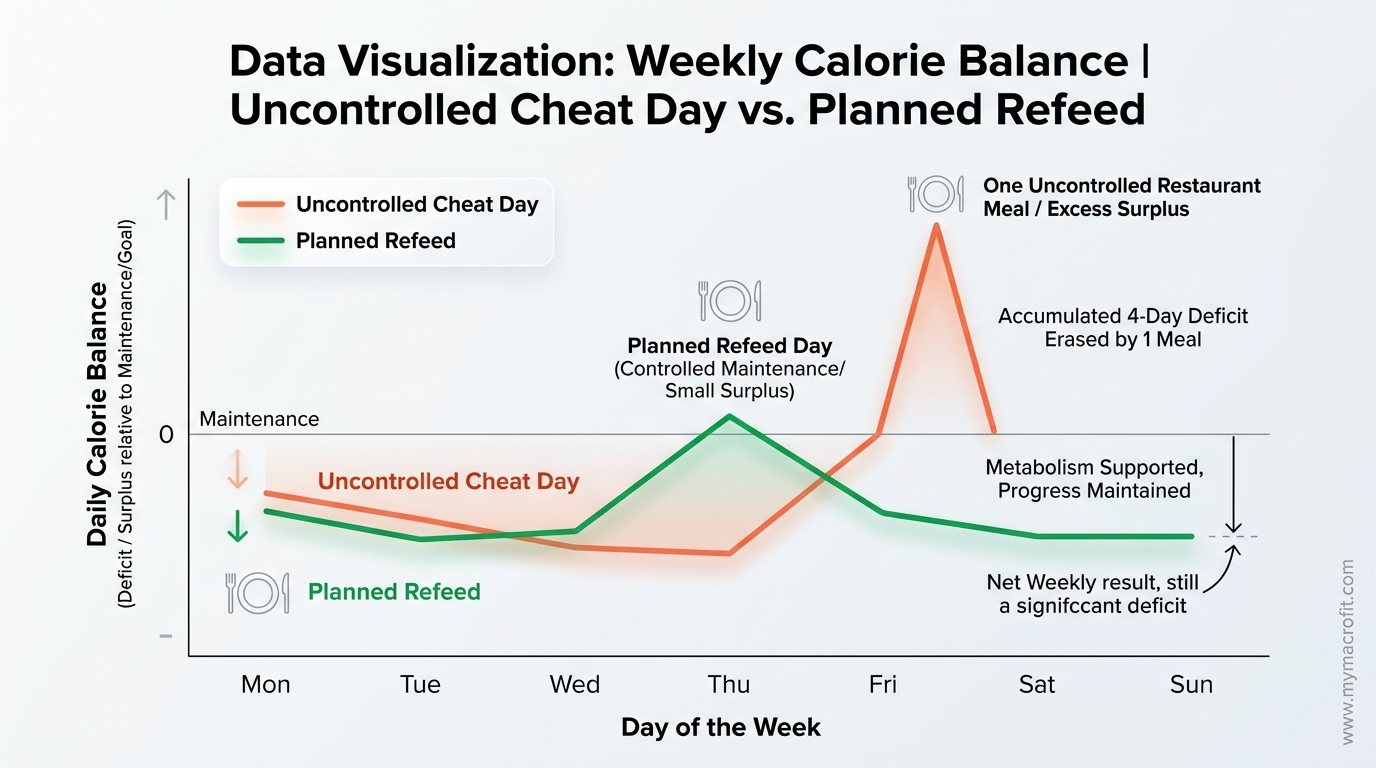
Why uncontrolled cheat days damage progress:
If your weekly deficit is 3,500 kcal (500 kcal/day × 7 days) = 0.5kg fat loss/week:
A cheat day consuming 2,500 kcal above maintenance eliminates the entire week's deficit. Seven days of effort, zero net result.
What this means practically:
You can absolutely have social meals, restaurant dinners, and special occasion food. But being honest about the calorie content, rather than treating the experience as "freeing" yourself from counting, protects your weekly progress.
Use our Calorie Deficit Calculator to understand your weekly deficit and how much flexibility you actually have.
Diet Breaks: The More Evidence-Based Alternative
For anyone who has been dieting for 8+ weeks:
A 2-week diet break (eating at maintenance) has real evidence for:
- Partial restoration of leptin levels
- Reduction in adaptive thermogenesis (metabolic rate recovers partially)
- Improved hormonal environment for subsequent fat loss
- Significant psychological refresh
The research (including the MATADOR trial) suggests that repeated 2-week deficit / 2-week maintenance cycling produces superior fat loss over time compared to continuous restriction, even though total dieting weeks are the same.
The Bottom Line
Cheat meals have minimal metabolic benefit as commonly practised. Their real value is psychological, reducing deprivation, enabling social function, and improving long-term dietary adherence.
Structured refeeds (one day at maintenance, not significantly above) preserve weekly progress while providing psychological flexibility. Diet breaks (2 weeks at maintenance after 8+ weeks of dieting) have genuine evidence for metabolic and hormonal benefits.
Plan flexibility intentionally rather than treating it as an uncontrolled reward. The difference between these approaches determines whether the week's deficit is preserved or erased.
Save & share on Pinterest
Click any card to pin it — or share with someone who needs it.
Cheat Meals: The Science Behind Them and How to Use Them
The evidence on cheat meals and refeed days, do they boost metabolism, when they help adherence, and…
The evidence on cheat meals and refeed days, do they boost metabolism, when they…
Read the full guide: Cheat Meals: The Science Behind Them and How to Use Them
Try the free Calorie Deficit Calculator
Cheat Meals: The Science Behind Them and How to Use Them — use our free calculators for instant pers…
Pinterest opens in a new tab. You can edit the description before saving.
Ready to get your numbers?
Free calculator, instant results, no signup required.
Frequently Asked Questions
Do cheat meals boost your metabolism?+
How many calories should a cheat meal be?+
How often should you have a cheat meal?+
What's the difference between a cheat meal and a refeed?+
Will one cheat meal undo my whole week of dieting?+
Should I exercise extra to make up for a cheat meal?+
About the Author
I'm the founder of MyMacroFit. I'm not a coach or a dietitian. I'm someone who wanted to lose weight, worked it out the hard way, and built the tools I wish I'd had.
View full profile →