
Does Eating Late at Night Cause Weight Gain?

RHC · Pre/Postnatal Fitness Specialist
The idea that eating at night causes weight gain is one of the most persistent pieces of dietary advice, repeated by parents, doctors, and fitness influencers alike. The reality, as with most nutrition myths, is more nuanced than a simple rule.
Here's what the evidence actually shows about meal timing, late-night eating, and body weight.
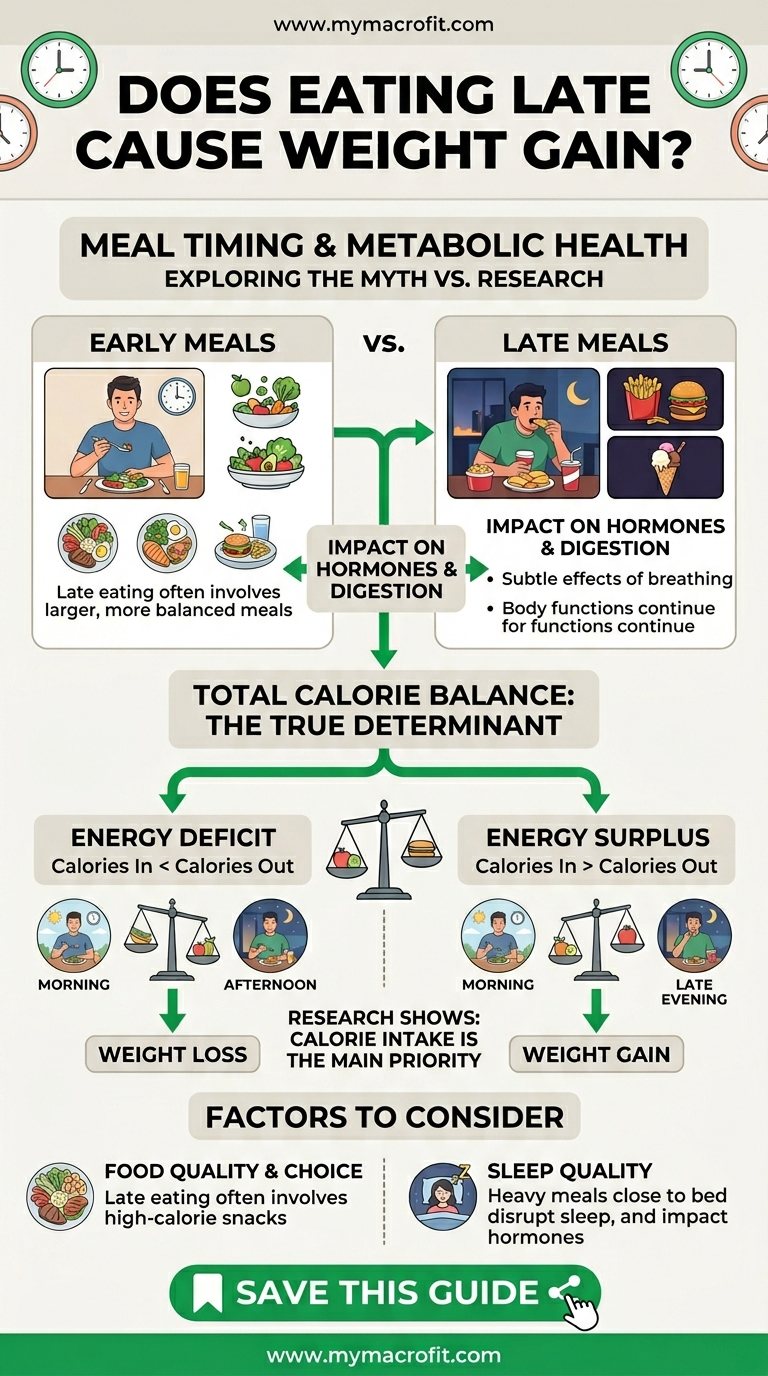
The Core Answer: Calories Over 24 Hours, Not the Clock
Body fat accumulation is determined by your calorie balance across the full day, not by whether those calories were consumed at 7pm or midnight.
If your total daily intake is 1,600 kcal (and your TDEE is 2,000 kcal), you are in a deficit regardless of when you ate. If your total daily intake is 2,800 kcal, you are in a surplus regardless of how you distributed those calories.
Multiple controlled studies confirm this: when total daily calories are equated, meal timing does not produce significantly different weight outcomes.
Why Late-Night Eating Is Associated With Weight Gain (Correlation ≠ Causation)
Despite this, observational studies do show an association between eating late and higher body weight. The mechanisms are behavioural, not metabolic:
Additional calories, not redistributed calories: For most people, late-night eating adds calories to a day's total rather than replacing earlier calories. A person who eats dinner at 7pm and then eats again at 10pm is typically consuming more total calories, not fewer earlier.
Food choice at night: Late-night food choices tend to be calorie-dense, ultra-processed, and easy to overeat, crisps, chocolate, cereals, toast with butter. These foods aren't inherently fattening at night, but they're easy to consume in large quantities mindlessly.
Distracted eating: Late-night eating typically happens while watching TV, on a phone, or winding down. Distracted eating consistently increases intake by ~20% compared to mindful eating.
Tiredness impairs food regulation: Ghrelin (hunger hormone) rises in the evening, and self-control is depleted after a full day of decisions. This combination makes portion control harder late at night.
The behaviour pattern associated with late-night eating causes weight gain, not the timing itself.
When Meal Timing Does Legitimately Matter
While overall calorie balance is primary, there are two contexts where timing has genuine relevance:
1. Circadian Rhythm and Metabolic Efficiency
The body's metabolic processes are partially synchronised to the day/night cycle (circadian rhythm). Insulin sensitivity is higher earlier in the day, meaning the same carbohydrate load produces a lower blood glucose response in the morning than in the evening.
Studies on cardiometabolic health (not just weight) suggest eating more calories earlier in the day and fewer late in the day may modestly improve blood glucose control and cardiovascular risk markers, even at the same total calorie intake.
What this means practically: If you have two otherwise equal meal distribution options, front-loading slightly more calories to earlier in the day is mildly preferable for metabolic health. But this is a modest effect, not a binary rule.
2. Eating Within a Time Window
Time-restricted eating (TRE), where all food is consumed within a 8-12 hour window, has modest evidence for metabolic benefits. A 10-hour eating window (e.g., 8am-6pm) aligns food intake more closely with circadian clock signals.
Some studies show TRE improves blood glucose, blood pressure, and lipids even without significant calorie restriction. The weight loss benefit is largely explained by naturally eating less within the window.
3. Workout Nutrition Timing
For those who train: consuming protein and carbohydrates around training sessions (within 1-2 hours pre/post workout) improves muscle protein synthesis and recovery. This is real, evidence-based timing that matters. See our pre-workout nutrition guide.
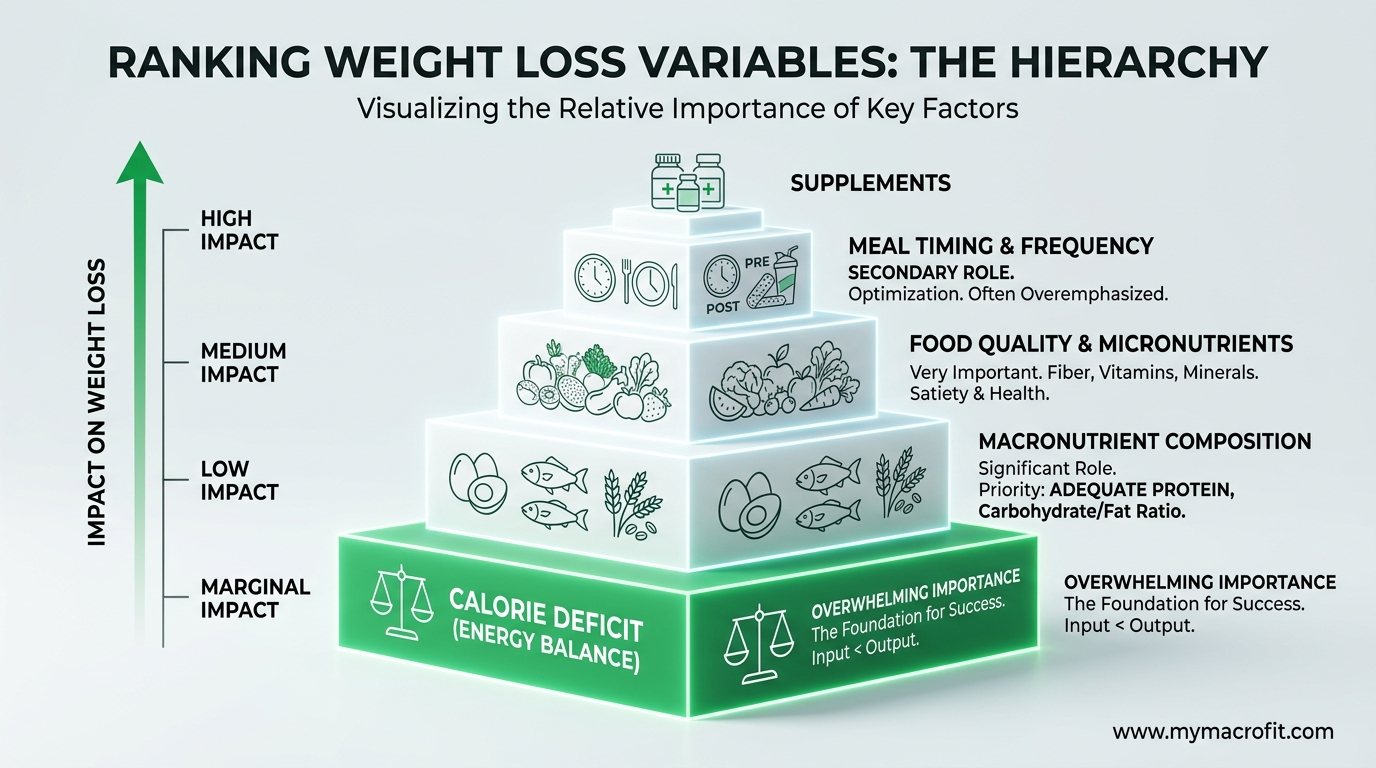
The Late-Night Eating Trap: Why It Happens
Many people eat well all day and then overeat at night, a pattern sometimes called "night eating syndrome" in its more severe form.
Common causes:
- Under-eating during the day (large lunch skip or restrictive breakfast) → intense evening hunger
- Using food to manage stress, boredom, or anxiety in the evening
- Social or habitual eating patterns (TV snacking as a wind-down ritual)
- Low protein during the day → insufficient satiety → evening hunger
Fixes that work:
Eat adequate protein at breakfast and lunch. The most common reason for extreme evening hunger is under-fuelling earlier in the day. 30-40g protein at breakfast and lunch dramatically reduces evening appetite.
Don't skip meals. If dinner is your first substantial meal of the day, you've created a cortisol-driven hunger response that makes controlled late-night eating very difficult.
Plan your evening snack. If you know you'll want something at 9pm, plan and log it in advance. Planned eating is far easier to control than reactive eating.
Close the kitchen. A physical habit of "the kitchen closes at 9pm" works for many people, more effective than relying on willpower.
Practical Guidance
If you're losing weight: Focus on total daily calories. Eat at whatever times work for your life. Meal timing is not the variable that's holding you back.
If you keep going over your calorie target late at night: Address the cause (under-eating during the day, evening stress eating) rather than trying to enforce a rigid cutoff time through willpower alone.
For general health: Front-loading slightly more calories to daytime hours is mildly beneficial for metabolic health, but the evidence doesn't justify making this the primary diet rule.
The Bottom Line
Eating at night does not directly cause weight gain. A calorie surplus causes weight gain, and late-night eating is behaviorally associated with calorie surplus, not causally linked to fat storage through the timing itself.
If late-night eating is disrupting your calorie control, address the reason, which is almost always under-fuelling during the day or stress-driven eating rather than a fundamental metabolic problem with eating after dark.
Save & share on Pinterest
Click any card to pin it — or share with someone who needs it.
Does Eating Late at Night Cause Weight Gain?
The evidence behind late-night eating and weight gain, what the research actually shows, what matter…
The evidence behind late-night eating and weight gain, what the research actuall…
Read the full guide: Does Eating Late at Night Cause Weight Gain?
Free fitness tools
Does Eating Late at Night Cause Weight Gain? — use our free calculators for instant personalised res…
Pinterest opens in a new tab. You can edit the description before saving.
Frequently Asked Questions
Does eating before bed cause weight gain?+
Why do people say you shouldn't eat after 8pm?+
Does intermittent fasting work because of meal timing or calorie restriction?+
Is it bad to eat a late dinner if I work shifts or eat late for cultural reasons?+
Why do I gain weight when I snack at night, then?+
About the Author

I'm a registered health coach and pre/postnatal specialist. I look at the whole person, your sleep, your stress, your hormones, because the number on the scale is only ever part of the story.
View full profile →