Glute Training Guide: Best Exercises and the Nutrition for Results

BSc Kinesiology · CPT
Glute training is one of the most popular training goals, and also one of the most commonly done incorrectly. Many women train glutes for months without seeing meaningful change because of insufficient load, inadequate frequency, or nutrition that doesn't support muscle growth.
This guide covers the anatomy, exercises, programming, and nutrition required for real glute development.
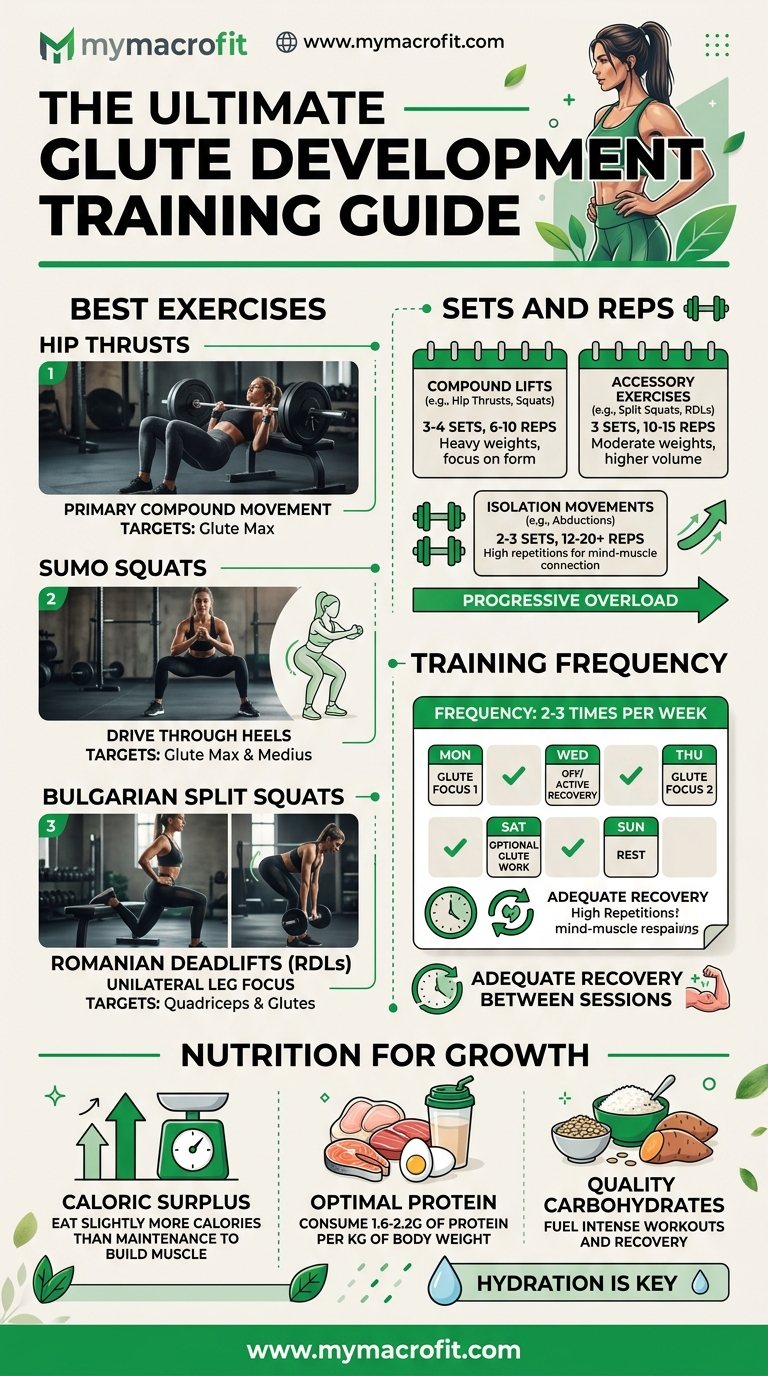
Glute Anatomy: Why It Matters for Exercise Selection
The glutes comprise three muscles with different functions:
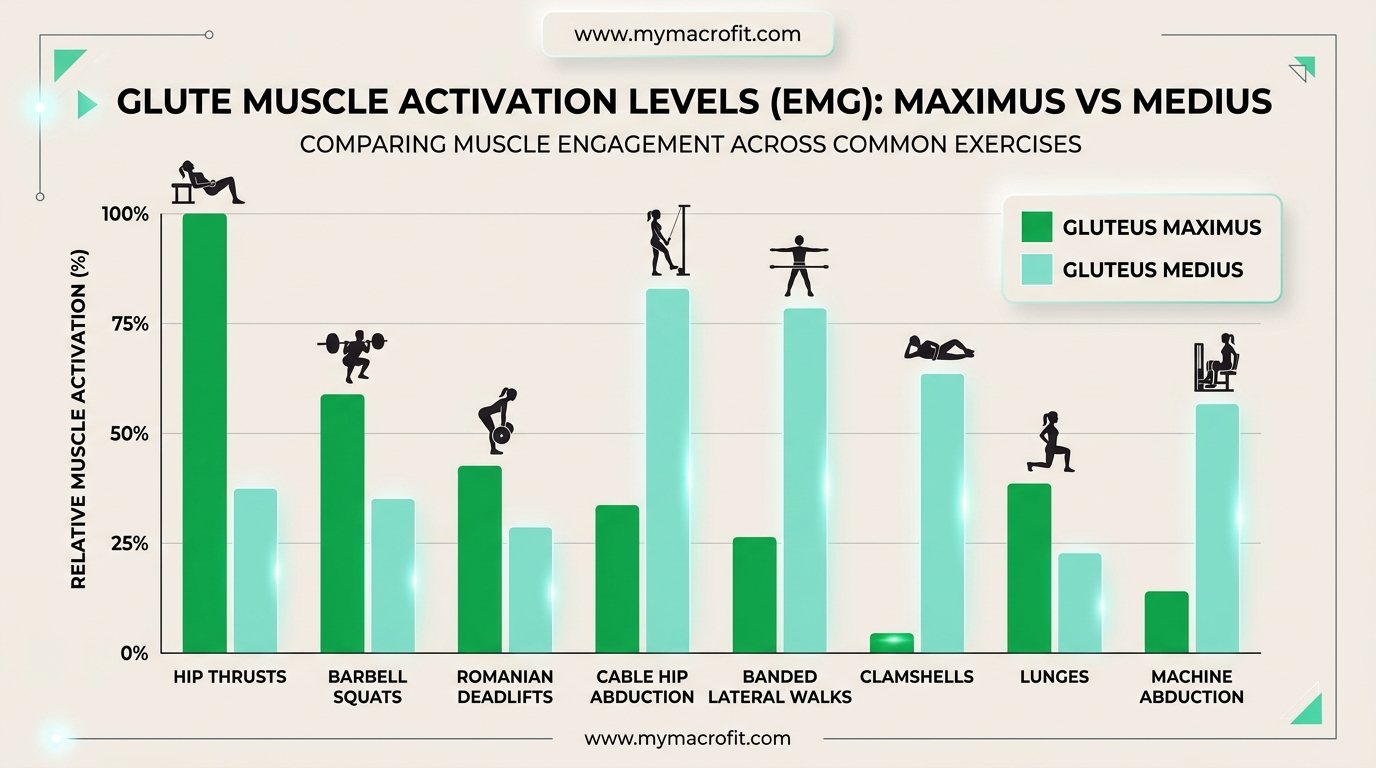
Gluteus maximus (largest): Hip extension (moving the thigh backwards), external rotation. Primary function in: hip thrusts, squats (deep), Romanian deadlifts, step-ups.
Gluteus medius (upper/side): Hip abduction (moving leg out to the side), pelvic stabilisation during walking and single-leg movements. Primary function in: lateral band walks, hip abductions, single-leg exercises.
Gluteus minimus (smallest, underneath medius): Hip abduction and internal rotation. Activated alongside gluteus medius.
The implication: A complete glute training programme must include both hip extension movements (for gluteus maximus growth) AND abduction movements (for gluteus medius/minimus development). Training only squats and hip thrusts leaves the upper and outer glutes underdeveloped.
The Best Glute Exercises (By Evidence and Effect)
Tier 1: Highest Glute Activation, Maximum Growth Stimulus
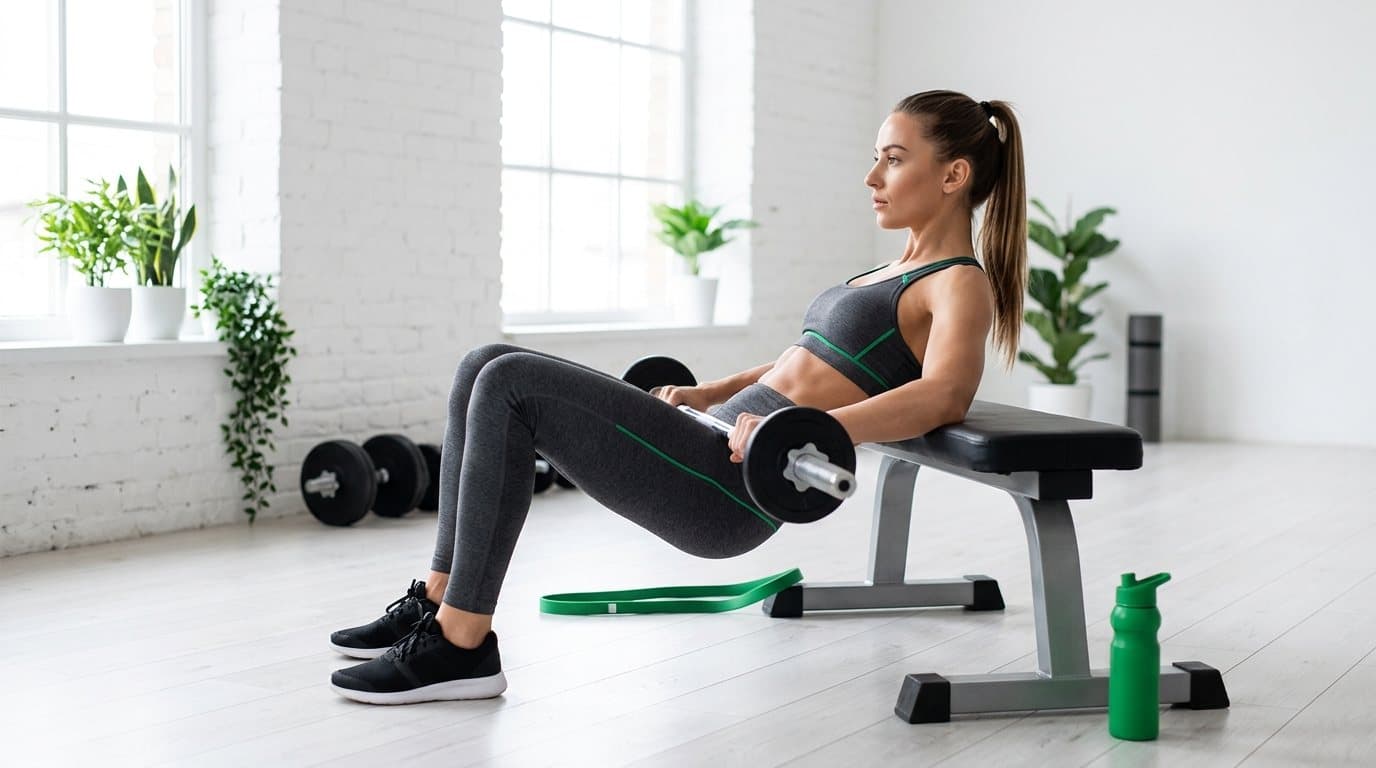
Hip thrust (barbell or machine): Consistently shows the highest gluteus maximus activation of any exercise. Allows progressive loading to heavy weights in a mechanically advantageous position. The primary glute-building exercise.
Romanian Deadlift (RDL): Hip hinge with a strong glute stretch under load. Excellent for the lower gluteus maximus and creates a high mechanical tension stimulus throughout the range.
Bulgarian split squat: High unilateral glute loading, significant training stimulus. Difficult to load progressively but extremely effective.
Sumo or wide-stance squat: Greater hip involvement than narrow-stance squats. Good complement to hip thrusts.
Tier 2: Strong Glute Activation, Important Complements
Conventional barbell squat (parallel depth): Good glute activation when reaching full depth (hip crease below knee). Less glute-specific than hip thrusts but excellent compound movement.
Step-ups: High single-leg glute loading. Practical, controllable, and effective.
Cable pull-through or band hip hinge: Teaches hip hinge pattern, strong posterior chain activation.
Tier 3: Gluteus Medius Focus (Upper/Outer Glutes)
Hip abduction machine or cable: Direct isolation of gluteus medius. Often neglected but essential for complete development.
Banded lateral walks: Activation focus, good warm-up exercise and as accessory work.
Single-leg glute bridge: Glute medius activation during hip stabilisation.
Clamshells (with resistance band): Isolated gluteus medius work.
Programming Glute Training
Frequency
Glutes are a large, resilient muscle group that responds well to frequency. Recommended:
Beginners (0-6 months): 2 sessions/week targeting glutes directly, as part of full-body training
Intermediate: 2-3 sessions/week, with at least 48 hours between sessions
Advanced: 3-4 sessions/week with appropriate periodisation
Volume
Research on glute hypertrophy suggests:
- Minimum effective volume: 10 direct sets per week
- Optimal range for most people: 15-20 sets per week
- Maximum recoverable volume: 20-25+ sets (for advanced trainees)
A set = one working set taken close to failure (2-3 reps in reserve)
Progressive Overload
The most important principle. If you're using the same weight for the same reps after 4 weeks, the stimulus for growth has stopped. Progress through:
- Increasing weight
- Increasing reps at the same weight
- Increasing sets
- Reducing rest time
A Practical Weekly Template
Glute-focused day (lower body A):
- Barbell hip thrust: 4 × 8-12
- Romanian deadlift: 3 × 8-12
- Bulgarian split squat: 3 × 10-12 per leg
- Hip abduction machine: 3 × 15-20
- Banded lateral walks: 2 × 20 steps each direction
Full body day with glute emphasis:
- Squat (full depth): 4 × 6-10
- Step-up (weighted): 3 × 10-12 per leg
- Cable pull-through: 3 × 12-15
- Clamshells with band: 3 × 20
Nutrition for Glute Growth
Without the right nutrition, glute training produces far less result.
Protein: 2g/kg bodyweight
Muscle protein synthesis, the process that builds new muscle, requires adequate amino acid supply. 2g/kg provides the substrate for glute growth. Distribute across 3-4 meals of 35-50g each.
Use our Macro Calculator to set your complete macronutrient targets.
Calories: Maintenance or Slight Surplus
Beginners (body recomposition possible): Calorie maintenance with high protein allows simultaneous fat loss and muscle gain.
Intermediate and advanced: A slight surplus (100-200 kcal/day above maintenance) accelerates muscle building rate. This doesn't mean eating everything in sight, a controlled surplus maximises muscle gain while minimising fat gain.
In a deficit: Glute growth is limited when in a deficit for experienced trainees. Prioritise protein (2-2.2g/kg) and resistance training stimulus to preserve what you have while losing fat.
Carbohydrates for Training Performance
Glute training is glycolytic, it uses muscle glycogen. Adequate carbohydrate intake (particularly around training) supports the training quality required for progressive overload.
Pre-workout: 30-60g carbohydrates 1-2 hours before training (oats, banana, rice) Post-workout: carbohydrates + protein within 2 hours to support glycogen replenishment and muscle protein synthesis
Creatine: Optional but Effective
Creatine monohydrate (3-5g/day) supports strength performance during high-intensity resistance training, allowing you to train heavier for more reps. This translates directly to better progressive overload, the mechanism of glute growth. Evidence across 500+ studies consistently shows benefit. See our creatine guide for women.
The Mind-Muscle Connection
A significant factor in glute growth that's often overlooked: consciously contracting the glute during exercises.
Research shows people who focus their attention on feeling the target muscle contract during training produce greater muscle activation than those who focus only on moving the weight.
Practical technique: During hip thrusts and squats, actively think about squeezing the glute at the top of the movement. Warm up with lighter weight specifically focusing on feeling glute activation before adding heavy loads.
The Bottom Line
Glute training that produces visible results requires: the right exercise selection (hip thrusts and RDLs for gluteus maximus; hip abduction exercises for gluteus medius), sufficient volume (15-20 sets/week), progressive overload, adequate protein (2g/kg), and appropriate calorie intake.
The most common reason glutes don't grow: training with the same weights for the same reps week after week without progressive challenge. Keep a training log. Make the numbers go up. Eat enough protein.
Save & share on Pinterest
Click any card to pin it — or share with someone who needs it.
Glute Training Guide: Best Exercises and the Nutrition for Results
The exercises that actually build glutes, how to structure a training programme, and the nutrition r…
The exercises that actually build glutes, how to structure a training programme,…
Read the full guide: Glute Training Guide: Best Exercises and the Nutrition for Results
Try the free Macro Calculator
Glute Training Guide: Best Exercises and the Nutrition for Results — use our free calculators for in…
Pinterest opens in a new tab. You can edit the description before saving.
Ready to get your numbers?
Free calculator, instant results, no signup required.
Frequently Asked Questions
How long does it take to build noticeable glutes?+
Can you grow glutes in a calorie deficit?+
Why won't my glutes grow despite training them?+
What are the best exercises to build glutes?+
How often should I train glutes to see results?+
About the Author

I'm a kinesiologist and personal trainer. I've spent eight years helping women lose fat and get stronger without handing their whole life over to a diet.
View full profile →