
How to Maintain Your Weight After Losing It

BSc Kinesiology · CPT
Losing weight is difficult. Keeping it off is harder. Studies consistently show that 50-80% of people regain most of the weight they lost within 2-5 years. This isn't a willpower failure, it's the result of specific biological mechanisms that work against long-term maintenance.
Understanding these mechanisms, and the habits that successfully counteract them, is the key to making your weight loss permanent.
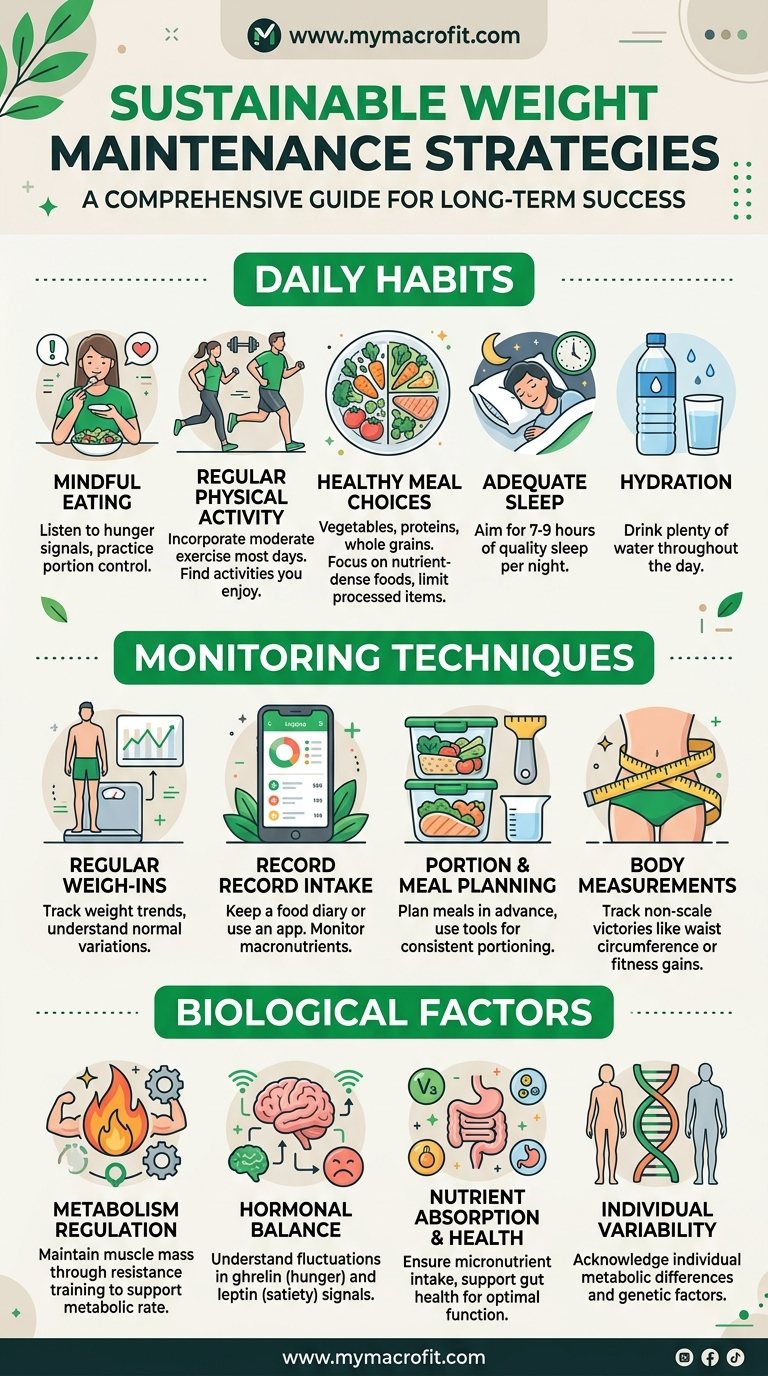
Why Weight Regain Is Biologically Driven
Before covering maintenance habits, it's important to understand why your body actively works against maintaining weight loss:
Reduced metabolic rate: After significant weight loss, the body burns fewer calories than expected for its new size, typically 100-300 kcal/day less than a weight-matched person who never dieted. This persists for years.
Hormonal changes: Leptin (satiety hormone) drops sharply with fat loss and doesn't fully normalise even after the body has stabilised at a lower weight. Ghrelin (hunger hormone) remains elevated. The net effect is increased hunger and reduced satisfaction from food, often for 12+ months after reaching goal weight.
Reduced NEAT: Non-exercise movement drops during and after dieting. The body is physically more efficient at lower weights, using less energy for the same activity.
These are physiological facts, not excuses. Successful long-term maintainers overcome these forces with specific, consistent behaviours, not superior willpower.
What Successful Long-Term Maintainers Do Differently
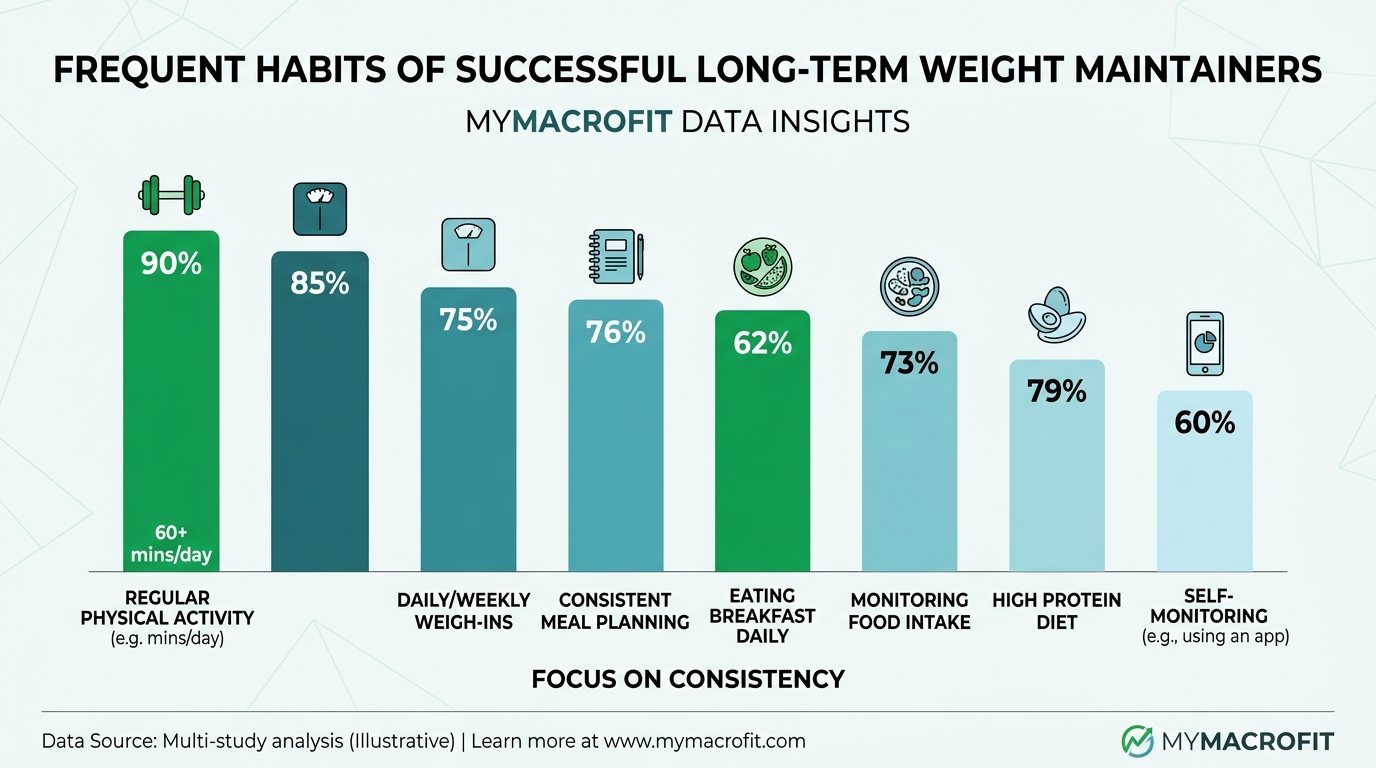
Research from the National Weight Control Registry (10,000+ people who maintained 13kg+ loss for 5+ years) consistently identifies these habits:
1. They Continue Weighing Themselves
Frequency: 75% of successful maintainers weigh themselves at least weekly. Many weigh daily.
The mechanism: Catching a 1-2kg upward trend early is far easier to address than a 5-7kg gain. Regular weighing creates an early warning system, before habits have significantly deteriorated.
Practical approach: Weigh at the same time each morning, after bathroom, before eating. Record the weekly average. Set a personal threshold (typically 2-3kg above goal weight) that triggers immediate habit review.
2. They Continue Tracking, Or Use a Monitoring Method
After reaching maintenance, most successful long-term maintainers either continue tracking (at lower frequency, perhaps 3-4 days per week) or use a consistent monitoring method like regular progress photos and measurements.
Tracking at maintenance isn't obsession, it's the tool that catches creep before it becomes regain.
3. They Maintain a High Protein Intake
Protein matters even more for maintenance than for weight loss:
- Preserves muscle mass (which maintains metabolic rate)
- Provides greater satiety per calorie than carbs or fat
- Has a high thermic effect (25-30% of calories burned in digestion)
Target: Continue at 1.8-2g/kg bodyweight. This is one habit that should not relax after reaching goal weight.
4. They Don't Stop Resistance Training
Muscle mass is the most important variable for long-term metabolic rate. Every kilogram of muscle added or preserved requires approximately 13 kcal/day just to maintain.
Stopping resistance training after reaching goal weight accelerates both muscle loss and metabolic rate decline, exactly the conditions that lead to regain.
Minimum: 2-3 resistance training sessions per week, maintained indefinitely.
5. They Exercise Regularly (Including Cardio)
The National Weight Control Registry finding most people ignore: successful maintainers exercise significantly more than the general population, approximately 60-90 minutes of moderate activity per day on average.
This doesn't mean everyone needs an hour of gym time daily. Walking counts. The takeaway is that maintenance requires more calorie expenditure than most people expect because metabolic rate is suppressed post-weight-loss.
6. They Eat Breakfast
A counterintuitive but consistent finding from NWCR: 78% of successful long-term maintainers eat breakfast daily. The mechanism likely involves preventing mid-morning hunger that leads to larger compensatory eating later.
7. They Limit Screen Time During Eating
Distracted eating consistently increases calorie intake by ~20% across multiple studies. Eating while watching TV or using a phone disconnects from satiety signals. Maintainers tend to eat mindfully at a table without screens.
Setting Your Maintenance Calories
Start with your recalculated TDEE. Use our TDEE Calculator at your new, lower weight.
Adjust based on weekly weight trend:
- If weekly average is consistently rising: reduce by 100-150 kcal
- If weekly average is consistent: stay
- If weekly average is falling more than desired: add 100-150 kcal
The "maintenance" calorie number is different for everyone and changes over time. Your weekly weight average tells you whether you've found the right intake, not a calculator.
The Reverse Dieting Approach
Moving directly from a calorie deficit to full maintenance calories can cause water weight gain (glycogen refilling) and psychological difficulty with increased food volume. Many people find reverse dieting more comfortable:
Increase calories by 50-100 kcal per week over 4-8 weeks until reaching maintenance. This gradual approach:
- Minimises psychological discomfort from a sudden increase
- Allows metabolic rate to adapt upward incrementally
- Reduces the water weight "shock" of going from deficit to surplus
See our reverse dieting guide for the complete protocol.
The First Year: The Critical Period
The first 6-12 months after reaching goal weight are statistically the highest-risk period for significant regain. During this period:
- Maintain all tracking and monitoring habits (don't relax because you "succeeded")
- Keep up resistance training consistently
- Weigh weekly without exception
- Address a 1-2kg gain immediately, not after it becomes 5kg
After 2+ years of maintaining the same weight, the behaviours become more habitual and require less conscious effort. The goal is to reach that point.
The Bottom Line
Long-term weight maintenance requires active management, at least for the first 1-2 years. The most powerful habits are: regular self-weighing, continued protein focus, maintained resistance training, and consistent movement.
The biology works against you. The habits work back in your favour, but only if you maintain them.
Save & share on Pinterest
Click any card to pin it — or share with someone who needs it.
How to Maintain Your Weight After Losing It
Why most people regain weight after losing it, and the evidence-based habits that separate successfu…
Why most people regain weight after losing it, and the evidence-based habits tha…
Read the full guide: How to Maintain Your Weight After Losing It
Try the free TDEE Calculator
How to Maintain Your Weight After Losing It — use our free calculators for instant personalised resu…
Pinterest opens in a new tab. You can edit the description before saving.
Ready to get your numbers?
Free calculator, instant results, no signup required.
Frequently Asked Questions
Why do most people regain weight after losing it?+
How many calories can I eat to maintain my new weight?+
How long does it take before weight maintenance becomes automatic?+
What habits do people who keep weight off long-term have in common?+
How do I stop slowly regaining the weight I lost?+
About the Author

I'm a kinesiologist and personal trainer. I've spent eight years helping women lose fat and get stronger without handing their whole life over to a diet.
View full profile →