
What Results Should You Expect From Intermittent Fasting?

CN · Metabolic Health Coach
Intermittent fasting is one of the most Googled dietary interventions globally, partly because of dramatic "before and after" content that creates unrealistic expectations. This guide presents what the research, and honest clinical experience, shows most people actually achieve.
Why IF Results Vary So Much
Before we look at timelines, the fundamental reason results vary:
Intermittent fasting is not calorie magic. Every study showing IF produces weight loss has one thing in common: participants are in a calorie deficit. IF works primarily because:
- A compressed eating window naturally reduces total calorie intake for most people
- Fasting-induced appetite suppression reduces hunger in the eating window
- The structured approach reduces mindless snacking
For people who respond to fasting with larger compensatory meals, IF will not produce a calorie deficit and will not produce meaningful weight loss. This is why results vary, individual responses to appetite and hunger regulation differ significantly.
The Realistic IF Results Timeline
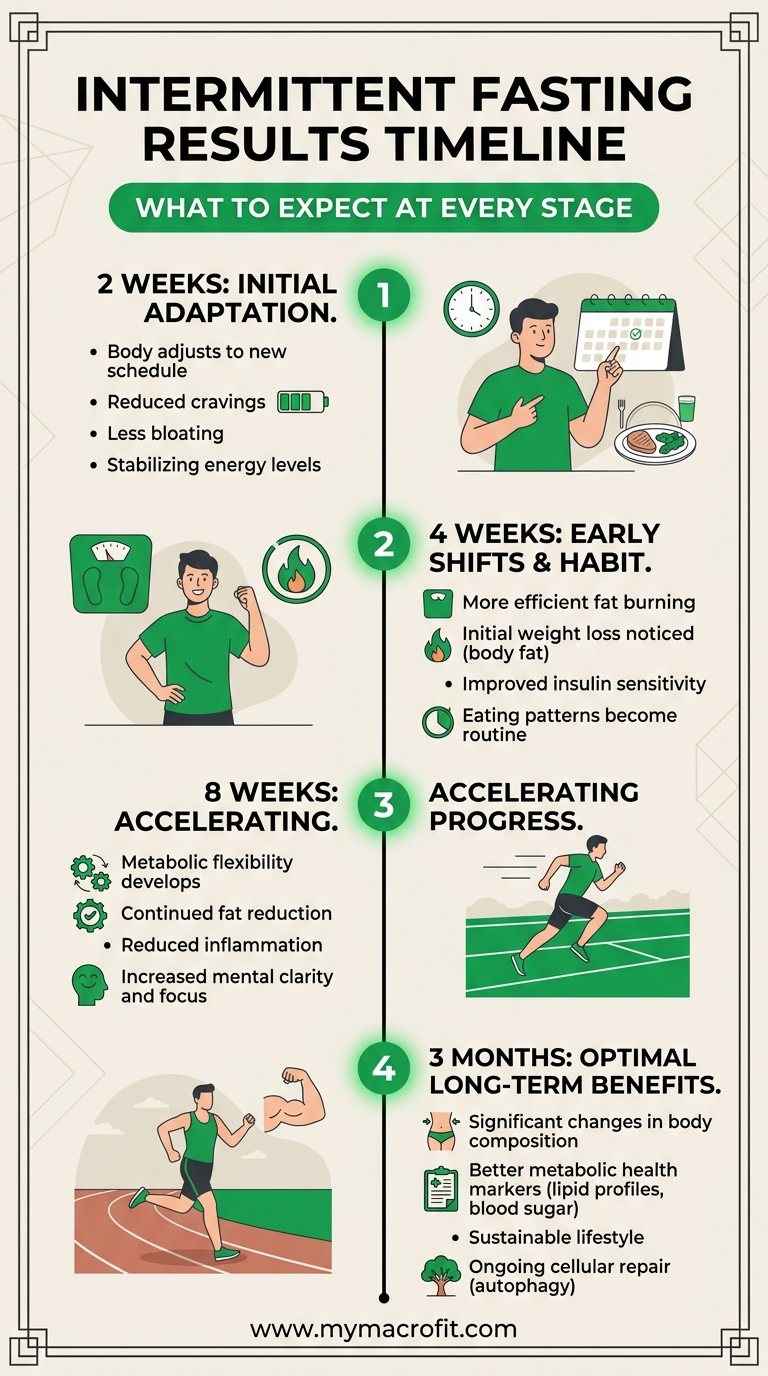
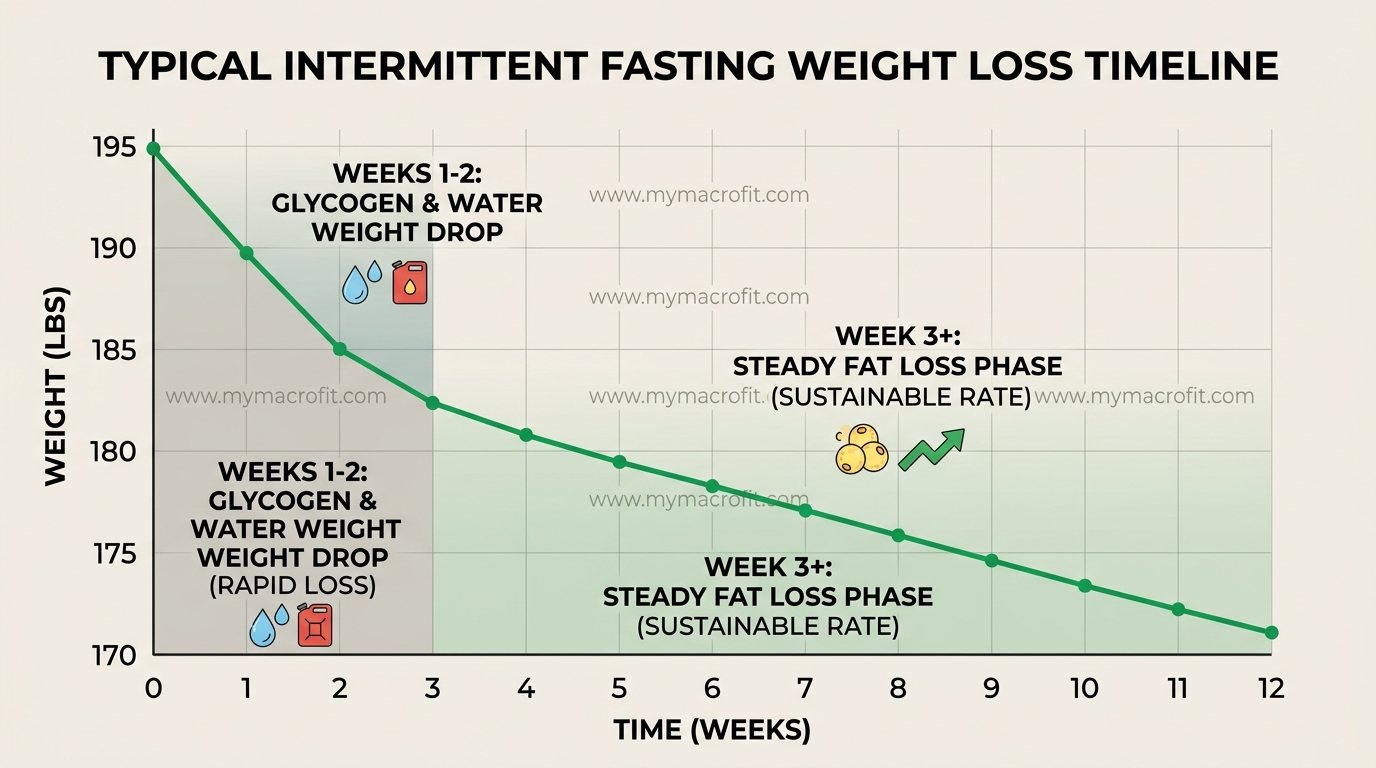
Week 1-2: The Glycogen Drop
What you'll see: Rapid scale weight loss, typically 2-5kg in the first two weeks.
What it actually is: Almost entirely water and glycogen. When you extend your fasting period, liver and muscle glycogen depletes faster. Each gram of glycogen is stored with approximately 3-4g of water. Depleting 300-400g of glycogen can reduce scale weight by 1-2kg from water alone, before adding the actual calorie deficit.
Reality check: This is not fat loss. Don't use week 1-2 weight loss as your baseline expectation. Actual fat tissue loss is occurring, but it's masked by the larger glycogen/water shift.
Week 3-4: The Real Results Begin
What you'll see: Weight loss slowing to 0.5-1kg/week. Energy is steadier. Morning hunger in the fasting period has largely subsided.
What's happening physiologically:
- Glycogen depletion has stabilised, you're no longer losing extra water weight
- Fat oxidation is contributing more significantly to energy during fasting periods
- Insulin sensitivity has improved slightly (measurable after 3-4 weeks)
- Eating habits in the window are becoming more automatic
Typical total loss at 4 weeks: 3-6kg (combining the glycogen/water drop and actual fat loss). For those who compensated with larger meals, 1-2kg is more realistic.
Week 5-8: Steady Progress or Adaptation
What you'll see: Continued 0.25-0.75kg/week loss for those maintaining the deficit. Some people notice a plateau.
Plateau reasons at this stage:
- Metabolic adaptation: After significant weight loss, TDEE decreases (you're lighter and your body is metabolically adapted). A calorie target set at week 1 may no longer create a deficit by week 6.
- Compensatory eating: The novelty of IF wears off, and the eating window expands with larger or more frequent meals.
- Accurate calorie recalculation needed: If plateau hits, recalculate your deficit with a Calorie Deficit Calculator.
Typical total loss at 8 weeks: 4-8kg for those who maintained the approach. Those who compensated may see 2-4kg.
Month 3: Sustainable Progress or Reassessment
What you'll see: At 3 months, the most motivated practitioners have typically lost 6-10kg. The majority have lost 3-6kg. Some have not lost significantly.
The honest breakdown:
| Group | Typical 3-month result | Why |
|---|---|---|
| Strong IF responders | 8-12kg total | Eating window reliably reduces calories; protein maintained |
| Moderate responders | 4-7kg | Some compensation but net deficit maintained |
| Minimal responders | 0-3kg | Compensatory eating negating the fasting window |
| Negative responders | Weight gain | Fasting triggers overeating; total calories increased |
Non-Scale Results That Matter
Weight is not the only, or even best, measure of IF outcomes. Research consistently shows:
Blood glucose: Fasting glucose typically decreases 5-10% after 8-12 weeks on IF, particularly in people with elevated baseline glucose. The extended low-insulin periods improve insulin sensitivity.
Triglycerides: Often the most dramatic improvement, triglycerides can drop 20-30% in people with elevated levels after 8-12 weeks.
Eating habits: Many people report IF improves their relationship with food, fewer impulsive eating episodes, more deliberate meal planning, reduced mindless snacking.
Mental clarity: Anecdotally strong, though hard to measure. Many IF practitioners report improved focus in the morning fasting hours. This is partly ketone-mediated (brain prefers ketones slightly over glucose), partly psychological (no post-breakfast blood sugar dip).
Who Gets the Best IF Results
Strong responders tend to:
- Be naturally good at delaying meals (not driven by clock-based hunger)
- Eat satisfying protein-rich meals in their window (naturally suppressing further hunger)
- Find the structure of a defined eating window helpful rather than restrictive
- Have slightly elevated insulin or blood glucose at baseline (more to improve)
Weak responders or non-responders tend to:
- Experience intensified hunger and food preoccupation during fasting periods
- Compensate in the eating window with larger, more calorie-dense meals
- Have no appetite regulation improvement from fasting (continue eating similar calories)
- Have disordered eating tendencies where fasting/restriction triggers binge-type eating
Setting Realistic Expectations
At 4 weeks: 3-5kg scale loss (2-4kg of which is real fat), adapted eating schedule, moderate metabolic improvements.
At 3 months: 6-10kg for motivated, consistent practitioners who eat appropriate protein in their window.
At 6 months: 8-15kg is achievable, but requires recalibrating calorie targets as weight changes. The maintenance challenge intensifies as the novelty of IF fades.
If not losing weight after 4 weeks: Track calories for one week without changing behaviour. Most people discover they're eating more in the window than they estimated.
The Bottom Line
Intermittent fasting produces results roughly proportional to the calorie deficit it creates, not the length of the fast. Most people lose 0.5-1kg/week in actual fat after the initial glycogen drop. Non-scale benefits (blood glucose, triglycerides, eating structure) are often more reliable than scale results. The people who get the best results from IF are those whose appetite is reliably suppressed by fasting, not those who compensate with larger eating window meals. If you're not sure what calorie target to set, use our Calorie Deficit Calculator.
Save & share on Pinterest
Click any card to pin it — or share with someone who needs it.
What Results Should You Expect From Intermittent Fasting?
Honest, research-backed expectations for intermittent fasting results, what most people experience a…
Honest, research-backed expectations for intermittent fasting results, what most…
Read the full guide: What Results Should You Expect From Intermittent Fasting?
Try the free Calorie Deficit Calculator
What Results Should You Expect From Intermittent Fasting? — use our free calculators for instant per…
Pinterest opens in a new tab. You can edit the description before saving.
Ready to get your numbers?
Free calculator, instant results, no signup required.
Frequently Asked Questions
How much weight can you lose with intermittent fasting?+
Does intermittent fasting work for everyone?+
What happens to your body after 1 month of intermittent fasting?+
Why am I not losing weight with intermittent fasting?+
Is intermittent fasting better than just counting calories?+
Will I lose muscle doing intermittent fasting?+
About the Author

I'm a certified nutritionist and metabolic health coach. I went deep on keto and metabolism after reversing my own insulin resistance, and I'd rather give you the actual numbers than a hand-wave.
View full profile →