OMAD Diet: One Meal a Day, Results, Risks, and Who It Suits

CN · Metabolic Health Coach
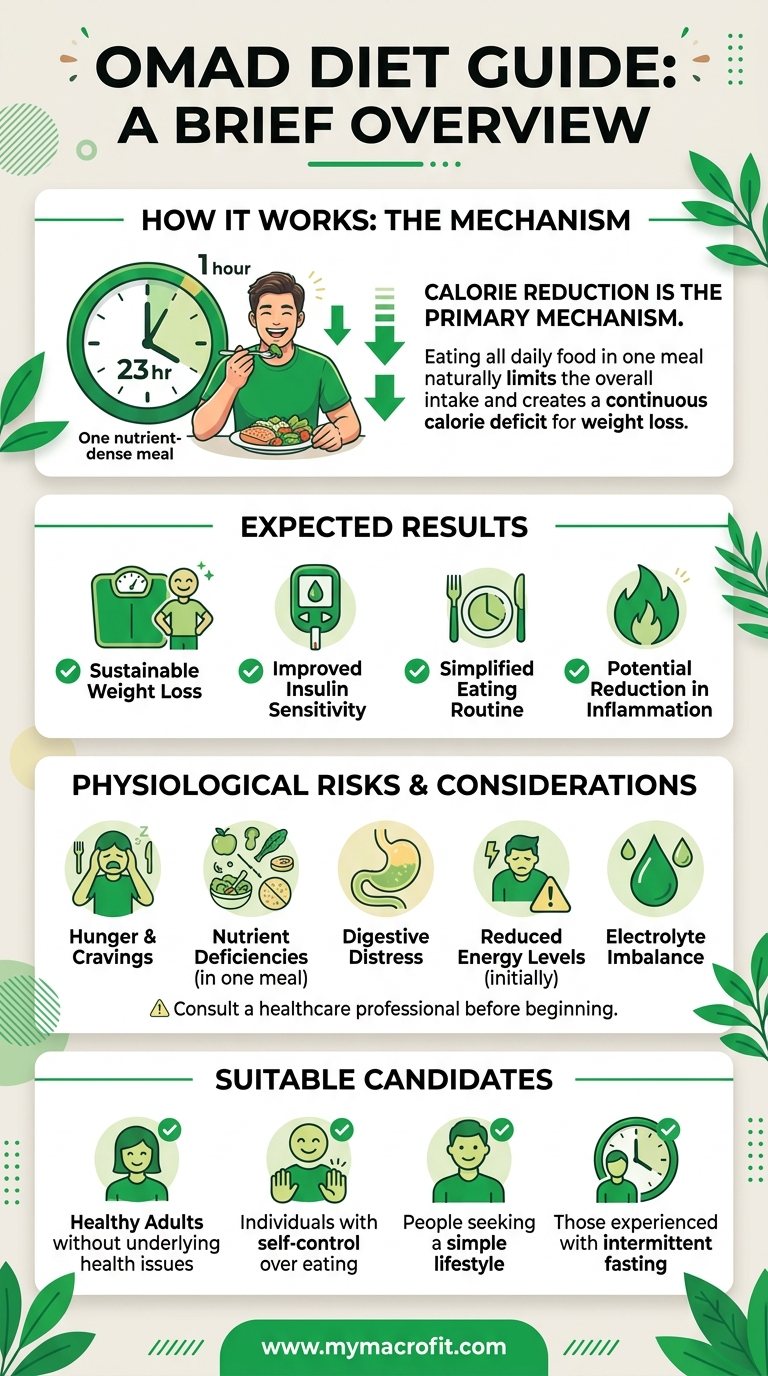
OMAD is the most extreme mainstream dietary approach, 23 hours fasting, 1 hour eating. It has genuine adherents reporting significant results, and genuine physiological risks that aren't always honestly presented. Both deserve a clear-eyed assessment.
How OMAD Produces Weight Loss
Primary mechanism: calorie restriction by default.
Most people eating one meal per day find it physically impossible to consume their full maintenance calories in one sitting, even eating very calorie-dense foods. The restriction to one meal creates a natural calorie deficit of 30-50% for most people, driving rapid weight loss.
Secondary mechanisms:
- Insulin is low for 22-23 hours/day, maximising fat oxidation window
- Growth hormone reaches very high levels after 18-23 hours of fasting
- Autophagy is significantly activated with 20+ hour fasts
- Glycogen is thoroughly depleted, forcing reliance on fat and ketones
What OMAD doesn't do: Create some magic metabolic state beyond these mechanisms. The fasting itself doesn't burn more fat than an equivalent calorie deficit achieved through other methods, the calorie reduction is doing most of the work.
Typical OMAD Results
Week 1: Very rapid weight loss, often 3-5kg in 7 days. This is predominantly water/glycogen loss, not fat. The body rapidly depletes glycogen (which holds 3-4× its weight in water) when fasting most of the day.
Weeks 2-8: Actual fat loss begins, typically 0.5-1kg/week depending on the calorie content of the daily meal. Some people compensate with very large meals and see slower loss.
The common problem: The extreme restriction of OMAD creates a significant "permission" mentality around the one meal, leading people to eat calorie-dense foods in large quantities, negating the deficit. A 3,000 kcal OMAD meal for someone with a 2,000 kcal maintenance requirement actually creates a surplus.
Protein Challenge: The Most Important OMAD Risk
Consuming adequate protein (1.6-2g/kg bodyweight) in one sitting is physiologically challenging and counterproductive:
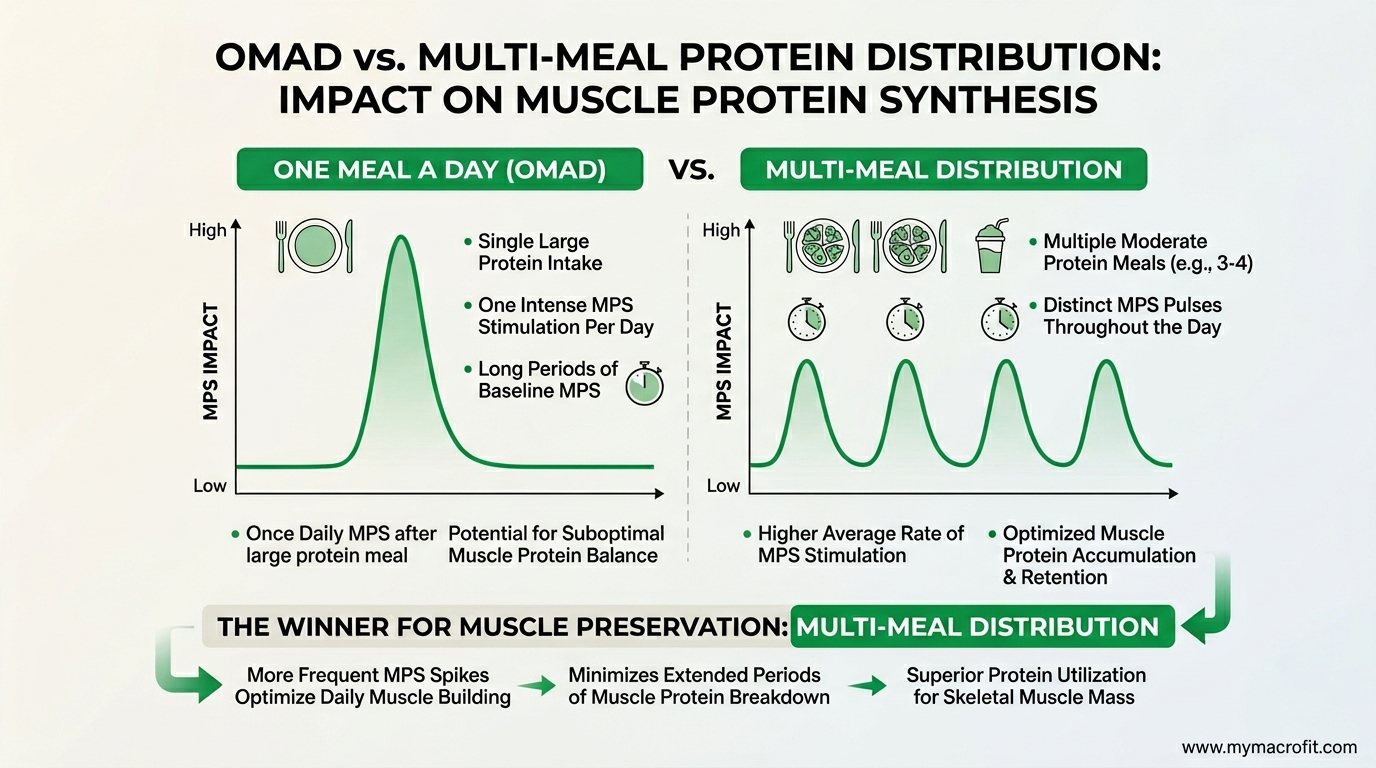
The absorption ceiling: Muscle protein synthesis (MPS) from a single meal is maximised at approximately 40-50g protein. Additional protein above this in one sitting doesn't further increase MPS, it's metabolised for energy.
The muscle loss risk: OMAD typically produces more muscle loss than comparable calorie deficits spread across multiple meals. The extended fasting period (23 hours) with only one protein pulse means muscles go without amino acids for most of the day, increasing net muscle protein catabolism.
For a 75kg person targeting 150g protein: Consuming 150g protein in one meal is possible but produces very different muscle outcomes than 3 × 50g meals. The overnight and daytime hours without amino acids mean net muscle protein balance is negative for most of the day.
Nutritional Completeness in One Meal
Fitting a full day's micronutrient requirements in a single meal is challenging:
What's typically missing: Calcium (hard to meet in one meal without dairy), fibre (difficult to eat 30g fibre in one sitting without significant discomfort), iron, zinc, various B vitamins.
Practical OMAD meal for nutritional density:
- Protein: 150-200g lean meat/fish (30-40g protein)
- Eggs (2-3, 12-18g protein)
- Large mixed salad with diverse vegetables
- Legumes (lentils, chickpeas), but this adds significant carbohydrates
- Nuts or seeds
- Dairy
Even carefully designed, one meal rarely meets all nutritional requirements without supplementation.
Who OMAD May Suit
Genuinely not hungry in the morning: Some people have minimal morning appetite, OMAD formalises what they naturally do and adds discipline to the eating period.
Extreme schedule constraints: Some professions or lifestyles genuinely limit eating opportunities. OMAD provides structure.
Short-term use (4-8 weeks): As a kickstart for rapid initial weight loss before transitioning to a more sustainable protocol. The rapid early loss can provide psychological momentum.
Those without significant muscle mass concerns: People primarily focused on fat loss without performance goals.
Who OMAD Does NOT Suit
- Athletes and regular strength trainers (muscle loss from inadequate protein distribution)
- Anyone with a history of disordered eating or restriction
- Pregnant or breastfeeding women
- Diabetics
- Growing adolescents
- Anyone with high physical performance demands
- People who struggle with binge eating (extreme restriction commonly precedes binge episodes)
A Better Alternative for Most People
For most people wanting the benefits of time-restricted eating, appetite control, insulin reduction, fat oxidation, without the nutritional compromise of OMAD:
16:8 or 18:6 with careful protein distribution across 2-3 meals provides:
- 16-18 hours of fasting benefits (significant GH elevation, autophagy activation)
- 2-3 protein doses supporting muscle protein synthesis
- Nutritional completeness more achievable
- More sustainable long-term
Calculate your TDEE with our TDEE Calculator to set calorie targets that work regardless of eating window approach.
The Bottom Line
OMAD produces rapid initial weight loss primarily through severe calorie restriction. The physiological risks, particularly muscle loss from inadequate protein distribution and nutritional incompleteness, make it less suitable than less extreme IF protocols for most people. Short-term use (4-8 weeks) with careful meal planning may have a role; long-term OMAD is rarely appropriate for anyone with muscle preservation or performance goals.
Save & share on Pinterest
Click any card to pin it — or share with someone who needs it.
OMAD Diet: One Meal a Day, Results, Risks, and Who It Suits
The evidence on OMAD (One Meal a Day), how it works, the real-world results, the physiological risks…
The evidence on OMAD (One Meal a Day), how it works, the real-world results, the…
Read the full guide: OMAD Diet: One Meal a Day, Results, Risks, and Who It Suits
Try the free TDEE Calculator
OMAD Diet: One Meal a Day, Results, Risks, and Who It Suits — use our free calculators for instant p…
Pinterest opens in a new tab. You can edit the description before saving.
Ready to get your numbers?
Free calculator, instant results, no signup required.
Frequently Asked Questions
What is OMAD and how does it work?+
How much weight can you lose on OMAD?+
Is OMAD safe?+
Can you get enough protein and nutrients in one meal?+
Will I lose muscle on OMAD?+
Is OMAD better than 16:8 for weight loss?+
About the Author

I'm a certified nutritionist and metabolic health coach. I went deep on keto and metabolism after reversing my own insulin resistance, and I'd rather give you the actual numbers than a hand-wave.
View full profile →