Low Calorie High Volume Foods: The Complete List

BSc Kinesiology · CPT
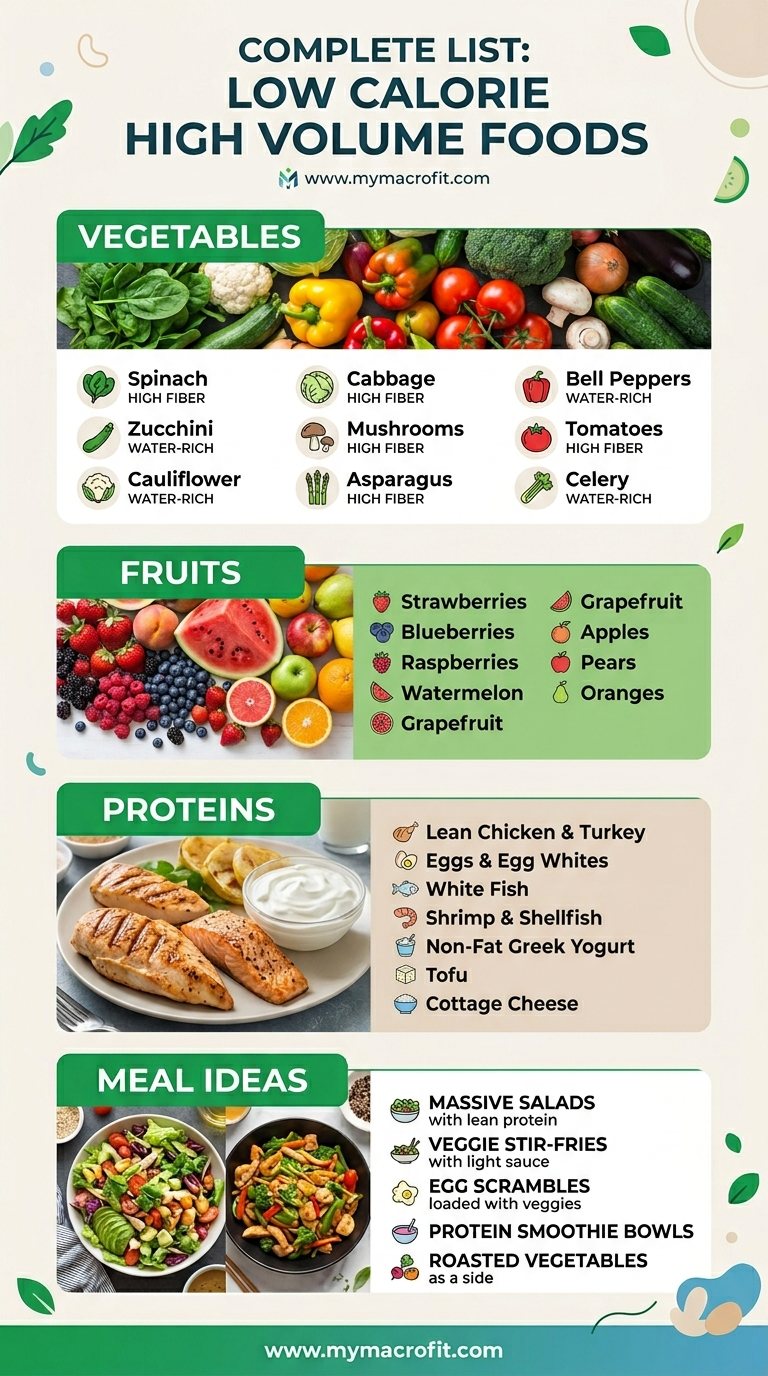
One of the most practical fat loss strategies isn't about eating less, it's about eating differently. Low-calorie, high-volume foods let you maintain or even increase your food volume while consuming significantly fewer calories.
This guide covers the complete list by category, with practical ways to use each group to feel full on a calorie-controlled diet.
Why Volume Eating Works
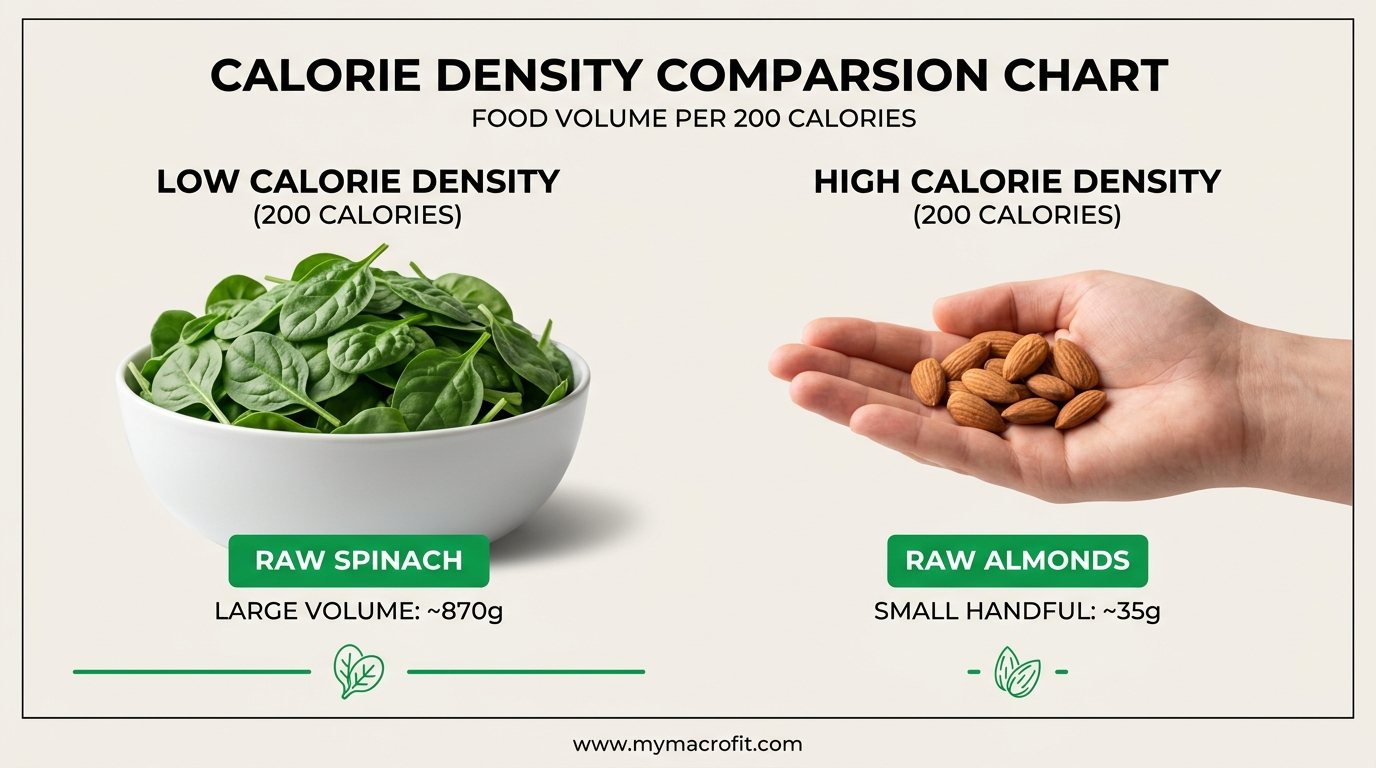
The stomach registers fullness through stretch receptors, it responds to physical volume, not just calories. When you eat a large volume of food, these receptors signal the brain to reduce hunger, regardless of how many calories that volume contains.
Research consistently shows that people eat a fairly consistent weight of food per day (approximately 1-2kg for most adults). Shifting toward lower-calorie-density foods lets you eat the same weight for far fewer calories.
Example: 400g of salad with vegetables = ~80 kcal. 400g of pasta with sauce = ~560 kcal. Both provide similar physical volume in the stomach, but the salad costs 480 kcal less.
Calorie Density Guide
| Category | Calories per 100g | Strategy |
|---|---|---|
| Leafy greens | 10-25 kcal | Fill half your plate |
| Non-starchy vegetables | 20-50 kcal | Unlimited addition to meals |
| Fresh fruits (high water) | 30-60 kcal | Snacks and desserts |
| Lean protein (white fish, egg whites) | 80-110 kcal | Protein source with high satiety |
| Legumes (cooked) | 80-130 kcal | High fibre + protein combination |
| Whole grains (cooked) | 120-180 kcal | Moderate portions |
| Lean poultry | 120-165 kcal | Primary protein source |
| Nuts and seeds | 550-650 kcal | Minimal portions only |
| Oils and fats | 700-900 kcal | Measure carefully |
The Complete List by Category
Vegetables (10-50 kcal per 100g)
The lowest calorie density foods on earth:
| Food | Calories per 100g | Notes |
|---|---|---|
| Cucumber | 15 kcal | 96% water, excellent bulk for salads |
| Lettuce / mixed leaves | 14-17 kcal | Volume base for any meal |
| Celery | 14 kcal | Almost no calories, crunchy, filling |
| Courgette/zucchini | 17 kcal | Versatile, spiralise as pasta substitute |
| Radishes | 16 kcal | High crunch, low calories |
| Spinach | 23 kcal | Wilts significantly, massive uncooked volume |
| Kale | 35 kcal | Nutrient-dense, fills a bowl |
| Broccoli | 34 kcal | Excellent roasted or steamed |
| Cauliflower | 25 kcal | Substitute for rice, mash |
| Mushrooms | 22 kcal | High umami, increases meal satisfaction |
| Tomatoes | 18 kcal | Versatile, raw, cooked, in sauces |
| Bell peppers | 31 kcal | Sweet, high volume, excellent raw |
| Asparagus | 20 kcal | Elegant, filling side |
| Green beans | 31 kcal | Low density, high fibre |
| Cabbage | 25 kcal | Excellent sautéed or in soups |
How to use: Build every meal around a large vegetable base. A 200g portion of roasted broccoli and courgette is only 100 kcal and physically fills a large portion of a plate.
Fruits (40-90 kcal per 100g)
High-water fruits provide sweetness and volume at low calorie cost:
| Food | Calories per 100g | Notes |
|---|---|---|
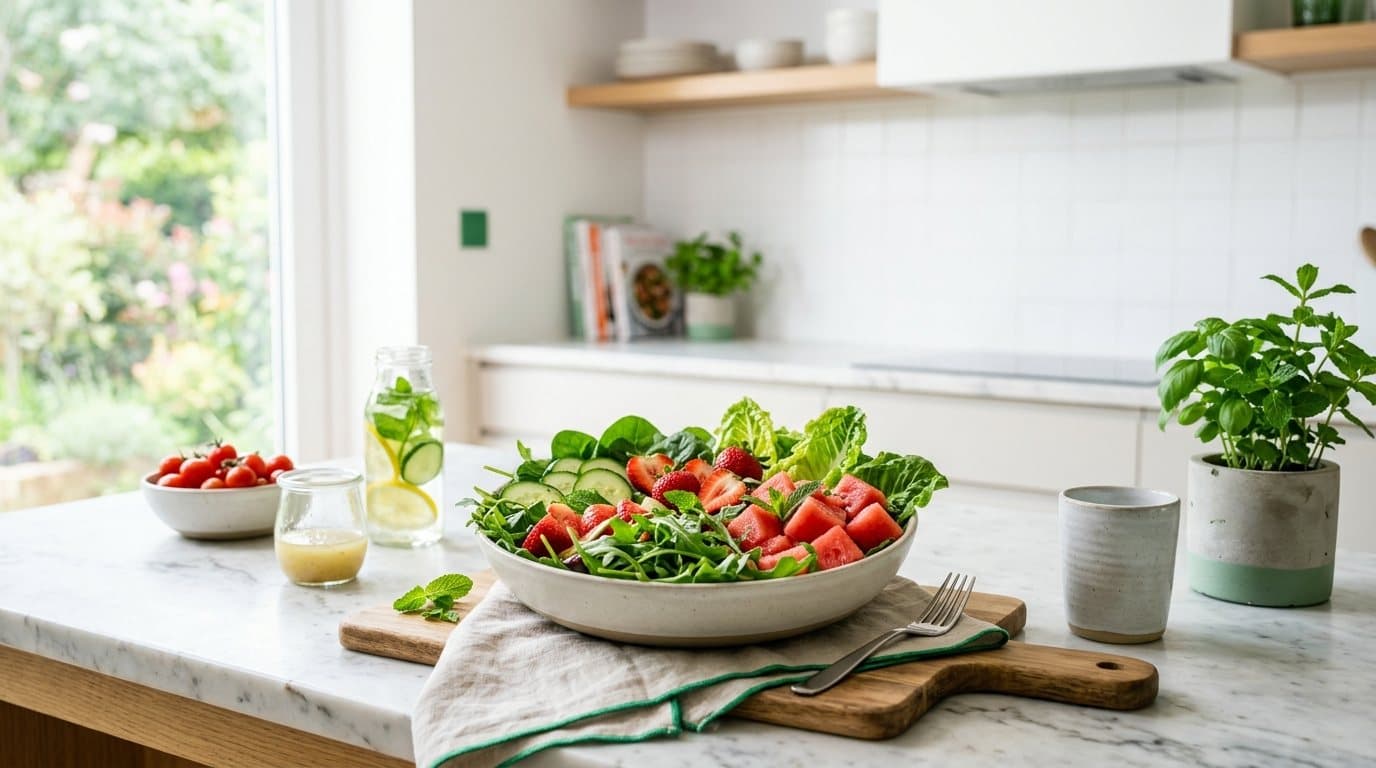
| Watermelon | 30 kcal | 92% water, extremely low density |
| Strawberries | 32 kcal | Sweet, high volume per serving |
| Raspberries | 52 kcal | High fibre, satisfying |
| Blueberries | 57 kcal | Antioxidant-rich, moderate density |
| Peach / nectarine | 40-45 kcal | Filling with high water content |
| Melon (cantaloupe) | 34 kcal | Excellent breakfast addition |
| Grapefruit | 42 kcal | Some evidence for satiety effect |
High-sugar fruits to moderate (still healthy but denser): Bananas (90 kcal/100g), grapes (67 kcal/100g), mangoes (60 kcal/100g), not excluded, but eat alongside lower-density foods.
High-Protein, Low-Calorie Sources
Protein is the most satiating macronutrient, it reduces hunger through hormonal mechanisms beyond just volume. These combine high satiety with relatively low calorie density:
| Food | Calories per 100g | Protein per 100g |
|---|---|---|
| Egg whites | 52 kcal | 11g |
| Non-fat Greek yogurt | 59 kcal | 10g |
| Cottage cheese (low-fat) | 98 kcal | 11g |
| White fish (cod, haddock) | 82-90 kcal | 18-20g |
| Prawns/shrimp | 85 kcal | 18g |
| Chicken breast (skinless) | 165 kcal | 31g |
| Turkey breast | 135 kcal | 29g |
| Quark | 68 kcal | 12g |
| Silken tofu | 55 kcal | 5g |
How to use: Anchor every meal with a protein source from this list. The combination of protein satiety + vegetable volume = meals that keep you full for 3-5 hours.
Filling Whole Foods at Moderate Calorie Density
These aren't "low calorie" but are highly filling relative to their calories:
| Food | Calories per 100g | Why filling |
|---|---|---|
| Oats (cooked) | 71 kcal | Beta-glucan fibre, very filling |
| Lentils (cooked) | 116 kcal | High protein + fibre combination |
| Chickpeas (cooked) | 164 kcal | Very filling, moderate density |
| Sweet potato | 86 kcal | Resistant starch, high satiety |
| Brown rice (cooked) | 111 kcal | More filling than white rice |
| Quinoa (cooked) | 120 kcal | Complete protein, fibre-rich |
Special High-Volume Low-Calorie Tools
| Food | Calories | Notes |
|---|---|---|
| Shirataki noodles | 9 kcal/100g | Almost zero calories, excellent pasta substitute |
| Broth-based soup | 20-40 kcal/cup | Volume + warmth = strong satiety |
| Rice cakes | 392 kcal/100g (low per piece: ~30 kcal) | High volume per calorie when used as crackers |
| Popcorn (air-popped) | 387 kcal/100g (large volume per 100g) | High volume, low density by serving |
How to Build Volume-Eating Meals
The Volume Plate Template
- 50% of plate: Non-starchy vegetables (10-50 kcal/100g)
- 25% of plate: Lean protein (80-165 kcal/100g)
- 25% of plate: Complex carbohydrate or legume
Example meal (500 kcal, very filling):
- 200g roasted courgette and broccoli = 100 kcal
- 150g chicken breast = 250 kcal
- 100g sweet potato = 86 kcal
- Hot sauce, lemon, herbs to season = 5 kcal
- Total: ~441 kcal. Substantial, satisfying meal.
Compare to: 1 large bowl of pasta with cream sauce = ~800-1,000 kcal for the same physical volume.
Volume-Eating Snacks
- 200g strawberries + 150g non-fat Greek yogurt = 120 kcal, 15g protein
- 100g cucumber + 30g hummus = 90 kcal
- Broth-based soup (large cup) + 2 rice cakes = 80 kcal
- 150g watermelon = 45 kcal
- Air-popped popcorn (30g) = 116 kcal, large serving bowl
Volume-Eating Breakfasts
- 40g oats cooked with water + 200g strawberries = 200 kcal, very filling
- 3-egg omelette with spinach and mushrooms = 250 kcal, 22g protein, large plate
- 200g non-fat Greek yogurt + 100g blueberries + 1 tsp honey = 180 kcal, 20g protein
Pairing Volume Eating With a Calorie Deficit
Volume eating makes a calorie deficit much more bearable, you're not shrinking portions, you're replacing calorie-dense foods with volume-efficient ones.
Use our Calorie Deficit Calculator to establish your target calorie intake, then apply volume eating to comfortably hit that target without constant hunger.
The Bottom Line
Low-calorie, high-volume foods work through a simple mechanism: they let you eat the same physical quantity of food for dramatically fewer calories. Vegetables, high-water fruits, lean proteins, and broth-based soups are the foundation.
Applying volume eating, building meals around a large vegetable base with lean protein and moderate carbohydrates, is one of the most sustainable fat loss strategies available. It doesn't require hunger, willpower, or tiny portions.
Save & share on Pinterest
Click any card to pin it — or share with someone who needs it.
Low Calorie High Volume Foods: The Complete List
The complete list of low-calorie, high-volume foods, categorised by food type with calorie density, …
The complete list of low-calorie, high-volume foods, categorised by food type wi…
Read the full guide: Low Calorie High Volume Foods: The Complete List
Try the free Calorie Deficit Calculator
Low Calorie High Volume Foods: The Complete List — use our free calculators for instant personalised…
Pinterest opens in a new tab. You can edit the description before saving.
Ready to get your numbers?
Free calculator, instant results, no signup required.
Frequently Asked Questions
What does calorie density mean?+
Does volume eating work for weight loss?+
What are the best low-calorie foods to feel full?+
About the Author

I'm a kinesiologist and personal trainer. I've spent eight years helping women lose fat and get stronger without handing their whole life over to a diet.
View full profile →