
Low Carb vs Keto: What's the Difference?

CN · Metabolic Health Coach
Low carb and keto are often used interchangeably, but they're distinct approaches with different mechanisms, different food lists, and different suitability for different people.
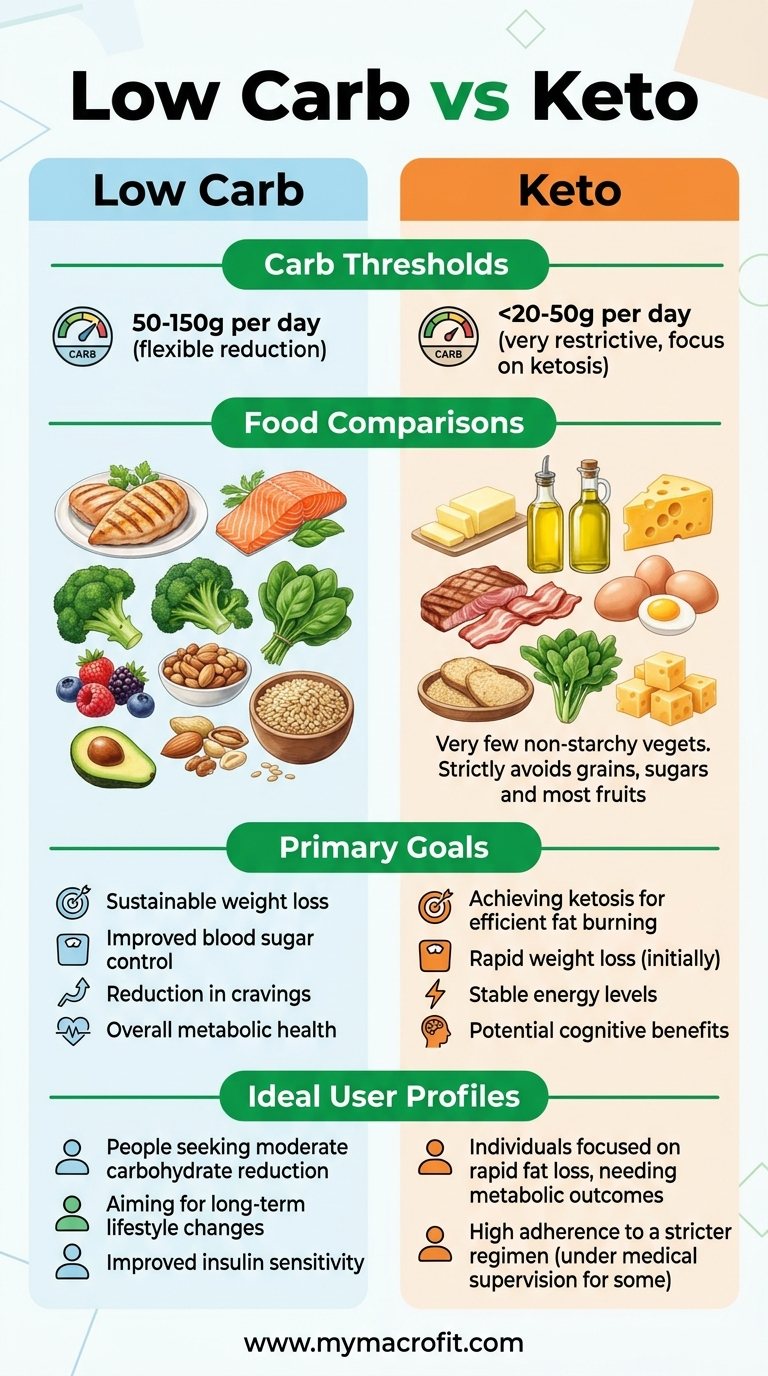
The Carbohydrate Thresholds
| Category | Daily carb intake | Typical ketosis? |
|---|---|---|
| Standard Western diet | 250-350g/day | No |
| Moderate low-carb | 100-150g/day | No |
| Low-carb | 50-100g/day | Borderline for some |
| Strict low-carb | 50-70g/day | Possibly, for some people |
| Ketogenic | Under 20-50g net carbs | Yes |
The dividing line for ketosis is approximately 50g net carbs/day for most people, though individual variation exists (very active people with high glycogen turnover may maintain ketosis slightly above this threshold).
Physiological Differences
Low-carb (50-150g/day):
- Blood glucose is modestly lower and more stable
- Insulin secretion is reduced but not at keto levels
- Fat oxidation increases significantly vs. standard diet
- Ketone production: minimal to moderate (ketones as supplemental fuel, not primary)
- Appetite reduction: meaningful but not as dramatic as full ketosis
- Most people retain enough metabolic flexibility to use both glucose and fat
Ketogenic (under 50g/day):
- Glucose availability is severely limited
- Insulin at very low levels
- Liver produces ketones at high rate, ketones become primary fuel for brain and most tissues
- Fat oxidation is maximised
- Appetite suppression is dramatic (ketone-mediated ghrelin suppression)
- "Keto adaptation" required: 3-6 weeks for the body to maximally upregulate fat-oxidising enzymes
Food Comparison
| Food | Low-carb (50-100g/day) | Keto (under 50g/day) |
|---|---|---|
| Berries (100g) | ✅ | ✅ (small portion) |
| Apple | ✅ | ❌ (25g net carbs) |
| Legumes | ✅ small portions | ❌ (too high) |
| Sweet potato (100g) | ✅ | ❌ (18g net carbs) |
| Oats (40g dry) | ✅ | ❌ (24g net carbs) |
| Greek yogurt (200g) | ✅ | ✅ (8g net carbs if fitting) |
| Quinoa (100g cooked) | ✅ | ❌ (18g net carbs) |
| Broccoli (200g) | ✅ | ✅ (6g net carbs) |
| Dark chocolate (30g) | ✅ | ✅ (if 85%+, ~8g net carbs) |
Low-carb allows significantly more variety and nutritional breadth, particularly legumes (a major prebiotic fibre source) and diverse fruits that keto eliminates.
Weight Loss: Which Is Better?
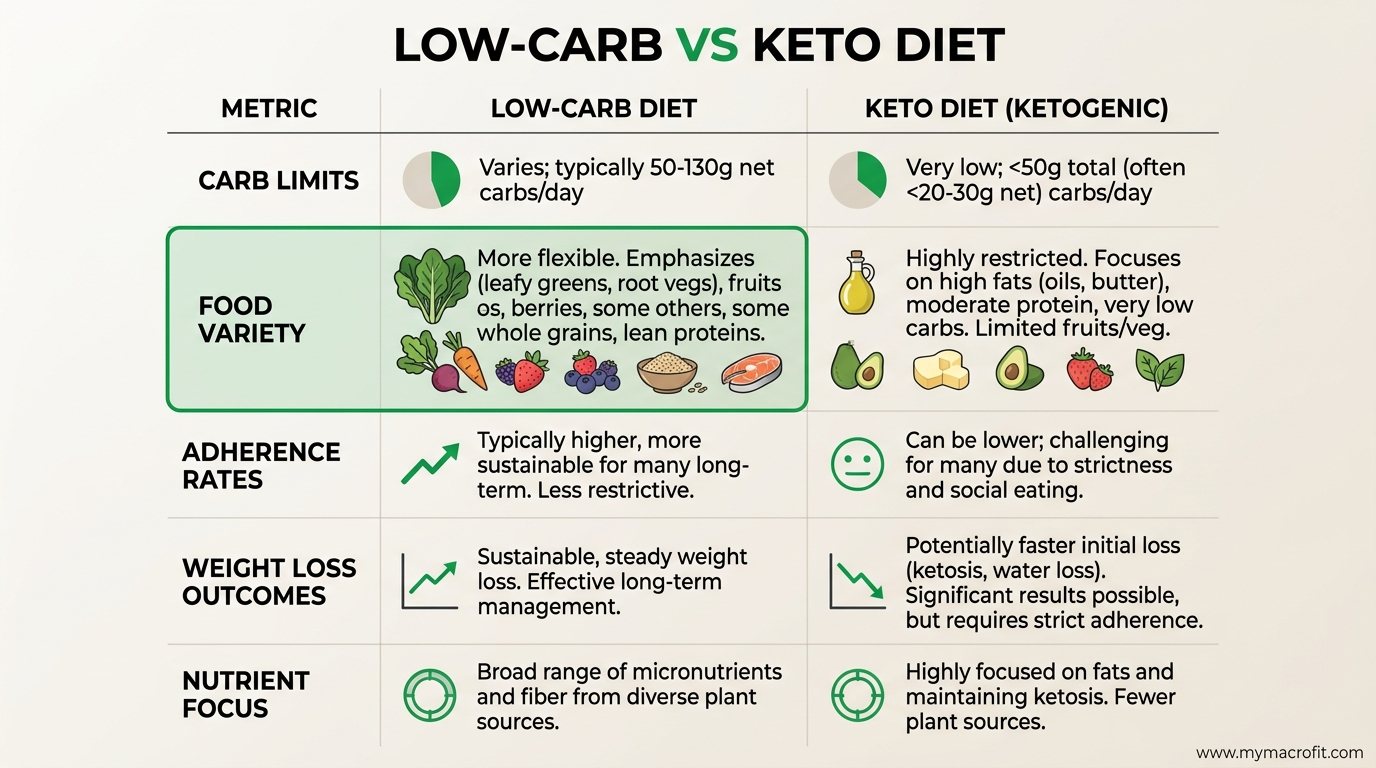
Short term (under 3 months): Keto typically produces faster initial weight loss, partly from larger glycogen/water depletion, partly from stronger appetite suppression.
Medium term (6-12 months): Multiple meta-analyses show comparable weight loss between low-carb and keto when adherence is equivalent. The earlier keto advantage often reverses as dietary flexibility erodes adherence.
Long term (12-24 months): Adherence is the dominant variable. Low-carb at 50-100g/day is sustained by more people long-term than strict keto. Studies consistently show that the best diet is the one you can actually maintain.
For blood glucose management (type 2 diabetes): Both low-carb and keto substantially improve glucose control. Keto produces more dramatic acute changes; low-carb is more sustainable for long-term management.
Who Is Each Suited For?
Low-carb is suitable for:
- Anyone wanting to reduce refined carbohydrates, improve blood glucose, and support fat loss
- People who want a sustainable long-term dietary pattern
- Those who exercise regularly and need some glycogen availability
- Anyone who values food variety and social flexibility
- Type 2 diabetics (with medical oversight)
Keto is potentially appropriate for:
- People specifically seeking the strong appetite suppression of ketosis
- Those who have struggled with hunger on other dietary approaches
- Individuals pursuing keto for neurological applications (epilepsy, certain neurological conditions)
- Short-term rapid fat loss phases (4-12 weeks) before returning to low-carb maintenance
- Those willing to accept significant dietary restriction for the specific benefits
Keto is NOT appropriate for:
- Pregnant or breastfeeding women
- Type 1 diabetics without close medical supervision
- People with kidney disease (high protein + ketosis can stress kidneys)
- Anyone with a history of eating disorders (extreme restriction is high risk)
Use our Keto Macro Calculator if you're planning a keto approach, it calculates your specific carb, protein, and fat targets.
The Bottom Line
Low-carb and keto are distinct points on a spectrum of carbohydrate restriction. Low-carb (50-100g/day) reduces blood glucose and supports fat loss while retaining nutritional variety and adherence. Keto (under 50g net carbs) produces stronger appetite suppression and ketosis but requires significantly greater restriction and typically produces comparable long-term outcomes only if maintained.
The most effective approach is the one you can sustain consistently for months and years.
Save & share on Pinterest
Click any card to pin it — or share with someone who needs it.
Low Carb vs Keto: What's the Difference?
The difference between low-carb and ketogenic diets, the carb thresholds, what each achieves, and ho…
The difference between low-carb and ketogenic diets, the carb thresholds, what e…
Read the full guide: Low Carb vs Keto: What's the Difference?
Try the free Keto Macro Calculator
Low Carb vs Keto: What's the Difference? — use our free calculators for instant personalised results…
Pinterest opens in a new tab. You can edit the description before saving.
Ready to get your numbers?
Free calculator, instant results, no signup required.
Frequently Asked Questions
What is the difference between low carb and keto?+
Which is easier, low carb or keto?+
Can you lose weight on low carb without being in ketosis?+
Should I start with low carb or jump straight to keto?+
Do I need to test for ketosis, and how?+
Is keto or low carb better for managing blood sugar?+
About the Author

I'm a certified nutritionist and metabolic health coach. I went deep on keto and metabolism after reversing my own insulin resistance, and I'd rather give you the actual numbers than a hand-wave.
View full profile →