
Metabolic Adaptation: Why Your Diet Stops Working

CN · Metabolic Health Coach
You started your diet successfully, lost weight for the first 8 weeks, and then progress slowed dramatically despite eating the same amount. You might have even tried eating less, and still nothing. This is metabolic adaptation, and understanding it is essential for anyone engaged in prolonged calorie restriction.
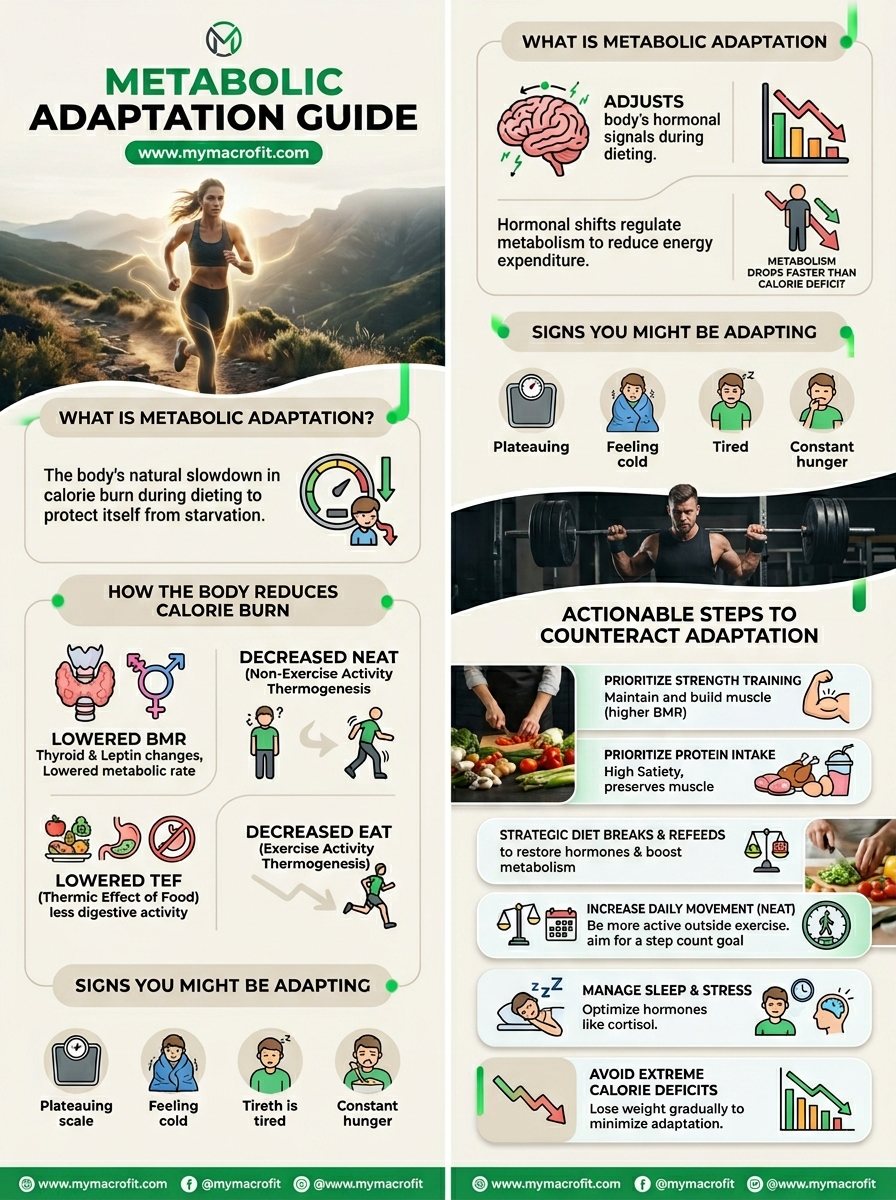
The Body's Anti-Starvation Mechanisms
From an evolutionary perspective, the body interprets a sustained calorie deficit as a potential starvation situation, and activates multiple protective responses to conserve energy:
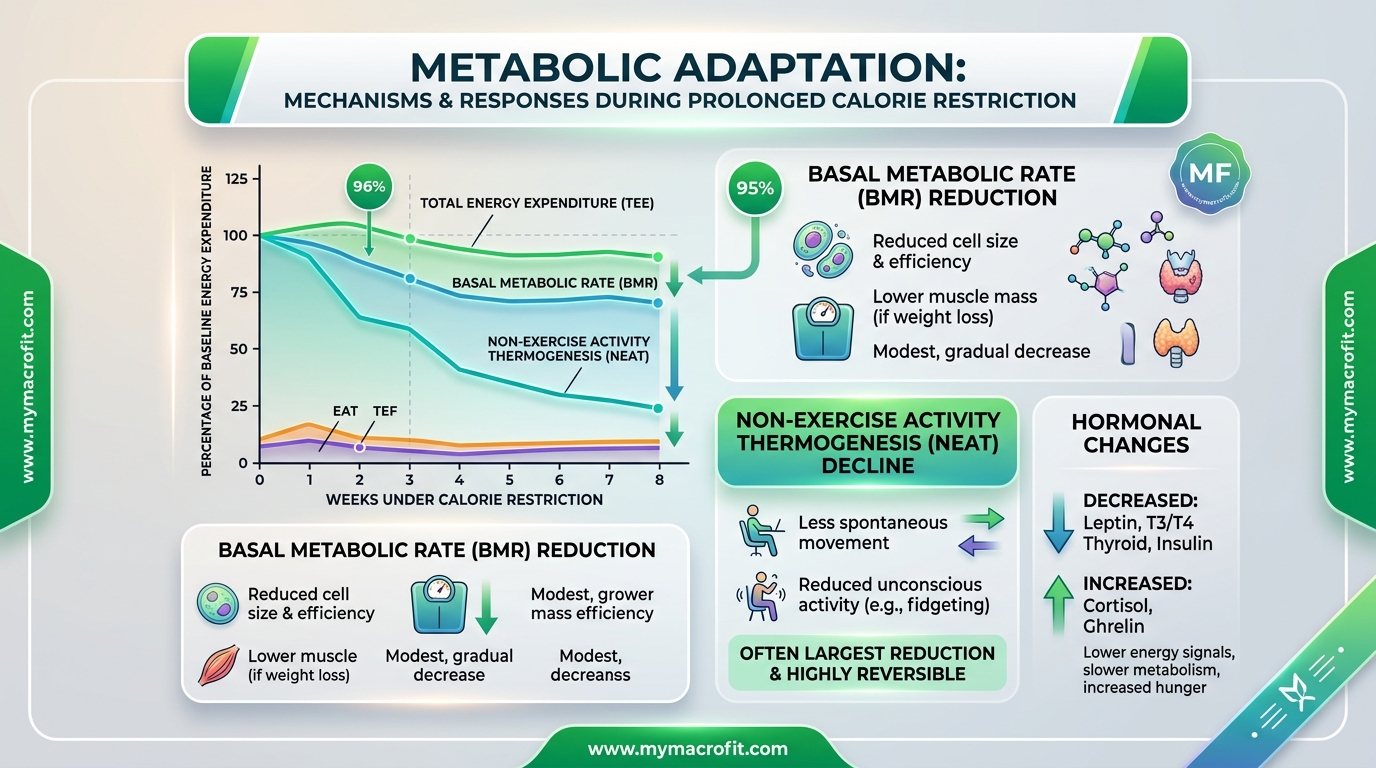
Reduced basal metabolic rate (BMR): The body becomes more efficient, requiring fewer calories to maintain basic functions. Mitochondria become more efficient; cellular energy expenditure decreases.
Reduced NEAT (Non-Exercise Activity Thermogenesis): People unconsciously move less when in a prolonged deficit, fidgeting less, sitting more, moving at slower speeds, taking fewer spontaneous steps. This can reduce daily expenditure by 100-200+ kcal without any conscious decision.
Reduced thermic effect of food: Processing fewer calories means fewer calories burned in digestion.
Improved exercise efficiency: The body learns to perform the same exercise at lower calorie cost through neuromuscular adaptation. Running the same route burns fewer calories after 8 weeks than it did at the start.
Hormonal changes: Lower leptin (metabolism-supporting hormone), reduced T3 (active thyroid hormone), elevated ghrelin (hunger hormone). These changes simultaneously reduce calorie burn and increase appetite, a double hit.
The combined effect: a body that has lost, say, 8kg may be burning 200-400 kcal/day fewer calories than expected for its new size, not just because it weighs less, but because it's actively down-regulating expenditure.
How to Identify If You're Adapted
Signs that metabolic adaptation may be significant:
- Weight loss stalled for 3+ weeks despite reported calorie compliance
- Resting heart rate lower than normal (higher metabolic efficiency)
- Feeling consistently cold (thyroid-related metabolic suppression)
- Significant fatigue despite adequate sleep
- Markedly reduced motivation for spontaneous movement
The diagnostic test: If you increase calories to what should be maintenance for your body weight and don't gain weight (or gain only modestly), metabolic adaptation is present, your actual calorie needs are lower than calculated.
Strategies to Counteract Metabolic Adaptation
1. Diet Breaks (The Most Evidence-Based Approach)
A diet break, 1-2 weeks eating at calculated maintenance calories, partially reverses metabolic adaptation:
- Leptin levels recover (partially restoring metabolic rate)
- T3 thyroid hormone recovers (improving metabolic efficiency)
- NEAT returns to higher levels (unconscious movement increases)
- Cortisol decreases (reducing cortisol-driven muscle catabolism)
The MATADOR study (University of Queensland) demonstrated that "intermittent dieting", alternating 2 weeks deficit with 2 weeks maintenance, produced greater fat loss and better muscle preservation over 30 weeks than continuous restriction, even though total weeks in a deficit were the same.
Practical protocol: After every 8-12 weeks of continuous deficit, take a 2-week break at maintenance. Expect 0.5-1kg scale increase from glycogen and water (not fat). This is temporary.
2. Recalculate TDEE at Current Weight
TDEE calculators are based on standard equations. After significant weight loss (5%+ of bodyweight), your actual TDEE may be 200-400 kcal lower than a fresh calculation suggests, due to metabolic adaptation.
Recalculate using our TDEE Calculator at current bodyweight, then validate against actual weight trend. If the calculator says 2,000 kcal is maintenance but you're not losing at 1,600 kcal, work backward from your actual data.
3. Increase Protein
Protein has a 25-30% thermic effect, it costs more calories to digest. Higher protein intake partly offsets reduced metabolic rate. Additionally, protein preserves muscle mass during a deficit, preventing the muscle loss that further reduces resting metabolic rate.
Target: 2-2.2g/kg bodyweight throughout the diet.
4. Resistance Training
Resistance training maintains or increases muscle mass, the metabolically active tissue that drives resting metabolic rate. People who lose weight through diet alone lose proportionally more muscle (and experience greater metabolic adaptation) than those who include resistance training.
The resistance training signal, "keep this muscle, it's being used", is the most effective single tool for maintaining resting metabolic rate during a deficit.
5. Protect NEAT Deliberately
NEAT reduction is unconscious, you have to actively counter it:
- Set a daily step minimum (8,000-10,000 steps)
- Stand at a desk rather than sit
- Take walking meetings, stairs, active commuting
How Long Does Adaptation Persist?
After ending a diet (returning to maintenance):
- NEAT: Recovers relatively quickly (days to weeks)
- Leptin: Recovers over weeks to months at maintenance
- T3 thyroid hormone: Recovers over weeks with adequate carbohydrate intake
- BMR: Partially recovers over months at maintenance; full recovery may take longer for large weight losses
This is why reverse dieting, gradually increasing calories rather than abruptly returning to full maintenance, is recommended after prolonged diets. It gives these systems time to upregulate as calorie intake increases.
The Realistic Magnitude
For most recreational dieters (not extreme cases):
- Metabolic adaptation of 100-200 kcal/day is typical after 8-16 weeks of dieting
- This is meaningful but not catastrophic, it means your original 500 kcal deficit has become a 300 kcal deficit
- The plateau feels more dramatic than the biology explains, often complicated by calorie creep
True severe metabolic adaptation (300+ kcal/day suppression) is less common than fitness culture suggests, and is often confused with calorie creep or TDEE overestimation.
The Bottom Line
Metabolic adaptation is real, measurable, and predictable. After 8-12 weeks of continuous deficit, a planned 2-week diet break at maintenance is the most evidence-based tool for counteracting it. Maintaining resistance training and protein intake throughout limits the degree of adaptation by preserving muscle mass.
The diet plateau isn't your body "broken", it's your body doing exactly what evolution designed it to do.
Save & share on Pinterest
Click any card to pin it — or share with someone who needs it.
Metabolic Adaptation: Why Your Diet Stops Working
The science of metabolic adaptation, how the body reduces calorie burn in response to dieting, and w…
The science of metabolic adaptation, how the body reduces calorie burn in respon…
Read the full guide: Metabolic Adaptation: Why Your Diet Stops Working
Try the free TDEE Calculator
Metabolic Adaptation: Why Your Diet Stops Working — use our free calculators for instant personalise…
Pinterest opens in a new tab. You can edit the description before saving.
Ready to get your numbers?
Free calculator, instant results, no signup required.
Frequently Asked Questions
What is metabolic adaptation?+
Is metabolic adaptation permanent?+
How much does metabolism slow down during a diet?+
Is 'starvation mode' real, and will eating too little stop weight loss completely?+
How can I minimise metabolic adaptation while dieting?+
Should I do a diet break or reverse diet to recover my metabolism?+
About the Author

I'm a certified nutritionist and metabolic health coach. I went deep on keto and metabolism after reversing my own insulin resistance, and I'd rather give you the actual numbers than a hand-wave.
View full profile →