Strength Training for Women: The Complete Beginner's Guide

BSc Kinesiology · CPT
Strength training is arguably the single most impactful physical health intervention available to women, improving body composition, bone density, metabolic health, hormonal balance, and mental health simultaneously. Yet many women avoid it due to gym intimidation, fear of getting bulky, or simply not knowing where to start.
This guide provides everything you need to begin.
Why Strength Training Is Especially Important for Women
The case for women specifically:
Bone density: Women lose bone density faster than men in later life, particularly post-menopause. Strength training is the most effective lifestyle intervention for building and maintaining bone density, more so than calcium supplementation or even walking. Starting in your 20s and 30s builds a higher peak bone mass; continuing through menopause and beyond preserves it.
Muscle mass and metabolic rate: Each kilogram of muscle burns approximately 13 kcal/day at rest. Women who maintain muscle mass through strength training have higher metabolic rates, making weight management easier throughout life, particularly important as TDEE naturally declines with age.
Insulin sensitivity: Resistance training significantly improves insulin sensitivity, relevant for PCOS management, blood glucose regulation, and reducing type 2 diabetes risk.
Hormonal health: Resistance training supports sex hormone balance, reduces cortisol through improved stress resilience, and supports progesterone production through luteal phase support (via improved body composition and hormonal signalling).
Mental health: Strength training has comparable evidence to aerobic exercise and moderate pharmacological intervention for depression and anxiety.
The Biggest Beginner Myths
Myth: Heavy weights will make you bulky. Women's hormonal environment simply doesn't support large muscle mass. The women with significant muscle mass you may have seen in fitness media are either professional bodybuilders who've trained specifically for years, or are using performance-enhancing compounds. Recreational strength training produces a toned, defined physique, not bulk.
Myth: Cardio is better for weight loss. Strength training preserves and builds the muscle that maintains metabolic rate during and after a fat loss phase. Women who lose weight through cardio alone lose proportionally more muscle alongside fat, resulting in a "smaller, softer" physique rather than the defined result most women want.
Myth: You need to be fit before starting strength training. You start wherever you are. Every exercise can be modified. Every weight starts where it starts and increases over time.
The Beginner Programme
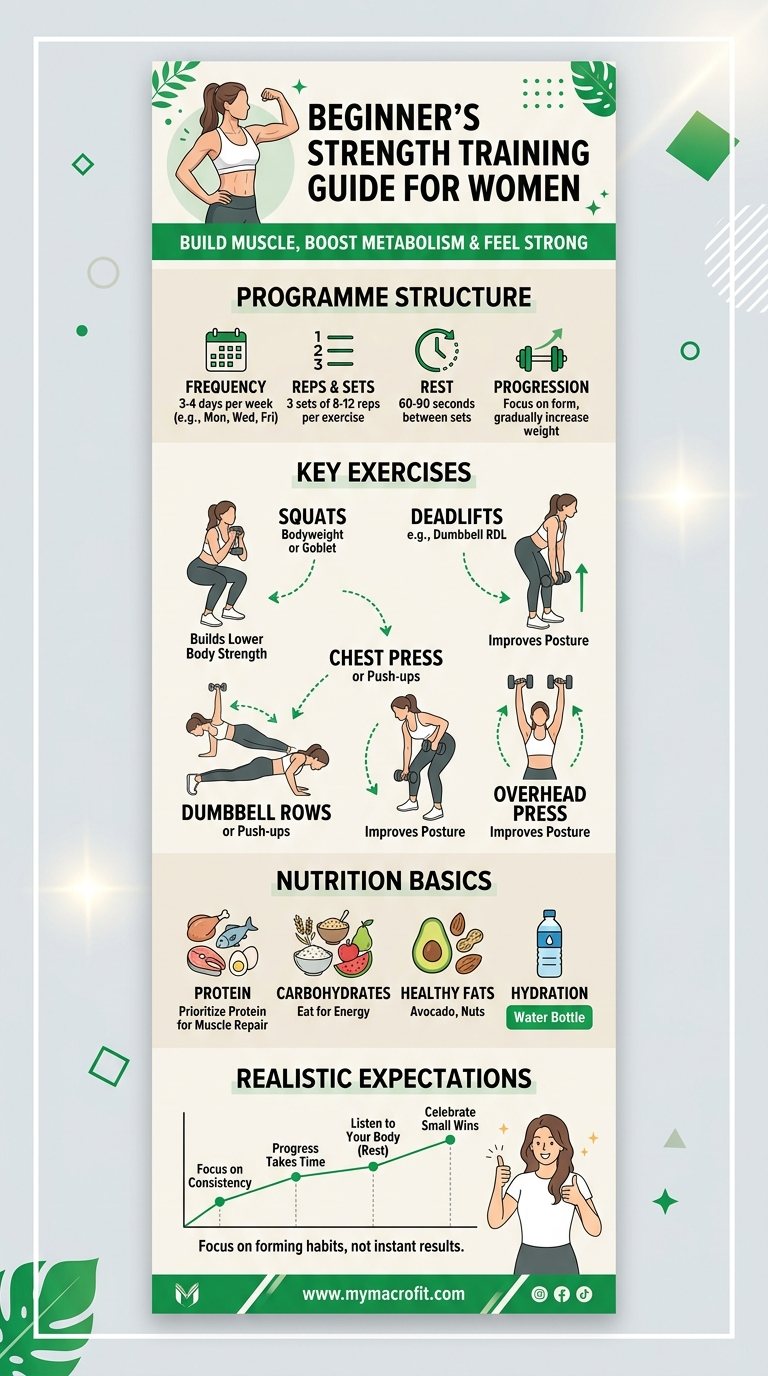
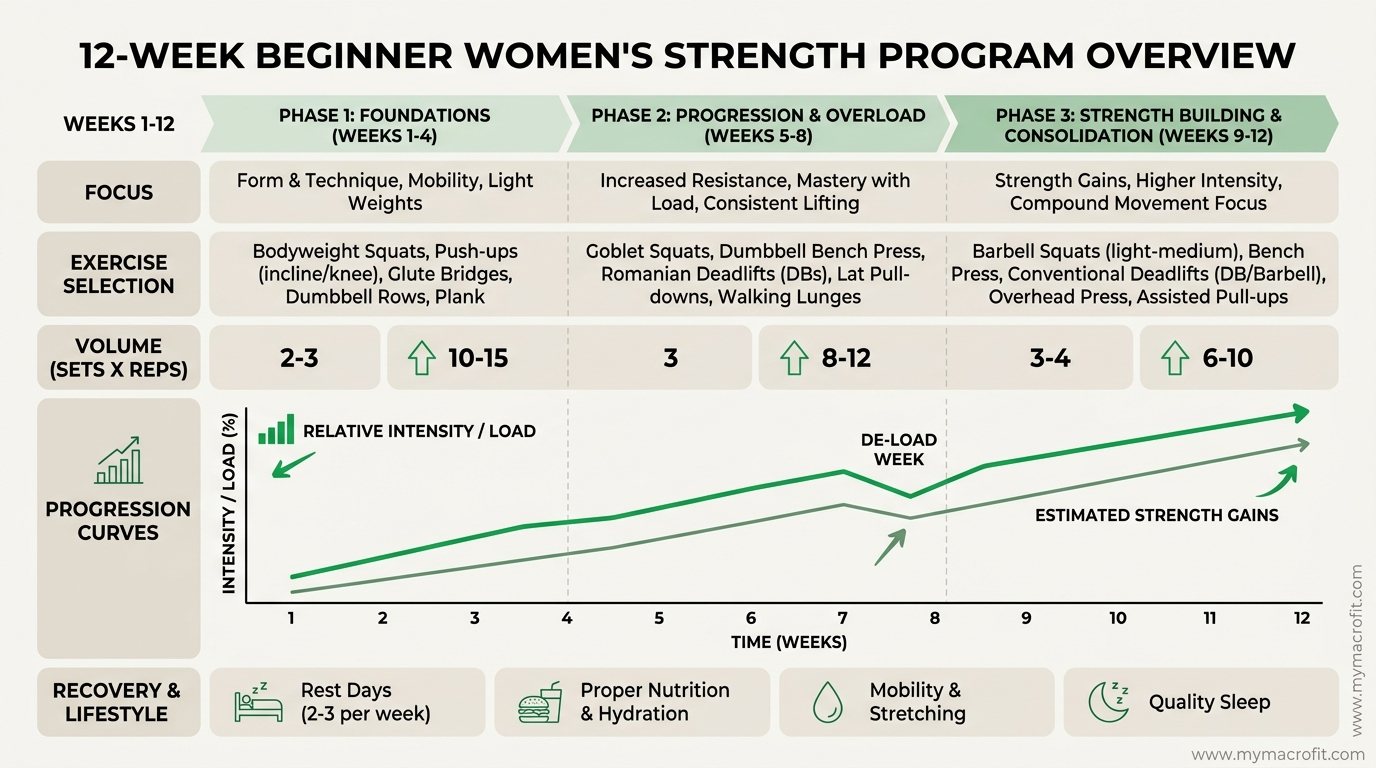
A 3-day full-body programme is optimal for beginners. All sessions are the same structure:
Warm-Up (5-10 minutes)
- Hip circles: 10 each direction
- Bodyweight squats: 15 reps
- Glute bridges: 15 reps
- Shoulder rotations: 10 each arm
- Leg swings front/back: 10 each leg
The Programme (3 × week, non-consecutive days)
Session structure:
1. Squat pattern (lower body push):
- Goblet squat or barbell back squat
- 3 sets × 8-12 reps
- Beginner modification: Bodyweight squat → goblet squat with light dumbbell → barbell
2. Hip hinge (posterior chain):
- Romanian deadlift (dumbbells or barbell)
- 3 sets × 8-12 reps
- Beginner modification: Dumbbell RDL → barbell RDL
3. Upper body push:
- Dumbbell shoulder press or chest press
- 3 sets × 8-12 reps
- Beginner modification: Seated dumbbell press
4. Upper body pull:
- Lat pulldown or assisted pull-up or dumbbell row
- 3 sets × 8-12 reps
- Beginner modification: Seated cable row or dumbbell bent-over row
5. Hip extension accessory:
- Glute bridge or hip thrust (bodyweight → barbell)
- 3 sets × 12-15 reps
6. Core:
- Dead bug or plank
- 3 sets × 30-45 seconds
Total session time: 45-55 minutes
Progressive Overload Guide
When you can complete the top of the rep range (12 reps) for all 3 sets with good form, increase the weight by the smallest available increment (usually 1.25-2.5kg per side for bars; next dumbbell up).
Track your weights. Write every session in a notebook or app. Progress is the mechanism, it's not optional.
How to Choose Starting Weights
The most common beginner mistake: using weights that are too light for comfort rather than appropriately challenging.
A working weight should feel challenging for the last 2-3 reps of each set. If you complete 12 reps and could easily do 6 more, the weight is too light.
Starting suggestions for women with no training history:
- Goblet squat: 8-12kg dumbbell
- Romanian deadlift: 10-15kg dumbbells or 20kg barbell
- Shoulder press: 5-8kg dumbbells
- Row: 8-12kg dumbbell or moderate cable stack
These will feel light at first, and should for the first 1-2 sessions while you learn form. Increase quickly once technique is confident.
Nutrition for Beginner Strength Training
Protein
Muscle building requires adequate protein. Without it, the training stimulus doesn't translate to muscle growth.
Target: 1.8-2g/kg bodyweight daily
For a 65kg woman: 117-130g/day. This is likely significantly more than most beginner women currently eat.
Practical protein distribution:
- Breakfast: 30g (3 eggs + Greek yogurt, or protein shake)
- Lunch: 35g (chicken breast, tuna, or legumes + cottage cheese)
- Dinner: 40g (150g salmon, chicken, or other lean protein)
- Snack: 15-20g (Greek yogurt, cottage cheese, protein bar)
Calories
For body recomposition (losing fat and gaining muscle simultaneously, particularly achievable for beginners): calorie maintenance with high protein.
For muscle gain focus: slight surplus of 100-200 kcal/day above TDEE.
Use our TDEE Calculator to establish your maintenance baseline.
Timing
Eat a protein-containing meal within 2 hours post-workout. This doesn't need to be a protein shake immediately after, a meal with 35-50g protein within the window supports muscle protein synthesis.
What to Expect in the First 12 Weeks
Weeks 1-3: Learning the movements. Some soreness (DOMS) is normal. Strength gains are primarily neurological, your nervous system learns the patterns.
Weeks 4-8: Strength increasing notably, you'll likely be using significantly heavier weights than week 1. This is when it becomes motivating.
Weeks 8-12: Visible body composition changes. Clothes fitting differently around the waist and arms. Progress photos show clear changes. Strength numbers are significantly higher than starting point.
What the scale does: Often doesn't change dramatically, particularly for women simultaneously losing fat. Measure progress in strength numbers, waist circumference, and photos, not just scale weight.
Getting Comfortable in the Gym
The first session is the hardest: The discomfort of not knowing what you're doing fades completely within 3-4 sessions as the routine becomes familiar.
Start at quieter times: Gyms are typically less busy in the mid-morning or early afternoon on weekdays.
Use machines initially if barbells feel intimidating: Leg press, lat pulldown, chest press, and cable rows provide similar muscle stimulus with more intuitive setup.
Consider 1-2 personal training sessions: Not to follow a PT programme, but specifically to learn the form on squats, deadlifts, and hip thrusts. Correct technique from the start prevents injury and maximises results.
The Bottom Line
Strength training is the most valuable physical health investment women can make. The myths about getting bulky are false. The benefits, body composition, bone density, metabolic health, hormonal balance, mental health, are all evidence-based and significant.
Start with 3 full-body sessions per week. Master the compound movements. Eat 2g/kg protein. Progress the weights every session or two.
The first 12 weeks deliver the largest visible changes of your entire strength training journey, take advantage of them.
Save & share on Pinterest
Click any card to pin it — or share with someone who needs it.
Strength Training for Women: The Complete Beginner's Guide
Everything a woman needs to start strength training, dispelling myths, the best beginner programme, …
Everything a woman needs to start strength training, dispelling myths, the best …
Read the full guide: Strength Training for Women: The Complete Beginner's Guide
Try the free TDEE Calculator
Strength Training for Women: The Complete Beginner's Guide — use our free calculators for instant pe…
Pinterest opens in a new tab. You can edit the description before saving.
Ready to get your numbers?
Free calculator, instant results, no signup required.
Frequently Asked Questions
Will lifting weights make women bulky?+
How many days per week should a beginner woman lift weights?+
What results can a woman expect from 3 months of strength training?+
About the Author
I'm a kinesiologist and personal trainer. I've spent eight years helping women lose fat and get stronger without handing their whole life over to a diet.
View full profile →