
How Much Weight Can You Lose in 4 Weeks? (Realistic Targets)
Founder, MyMacroFit
The first question most people ask when starting a diet is "how much can I lose in a month?" The honest answer is more nuanced than most diet advice admits, and understanding the difference between water weight and fat loss saves enormous frustration.
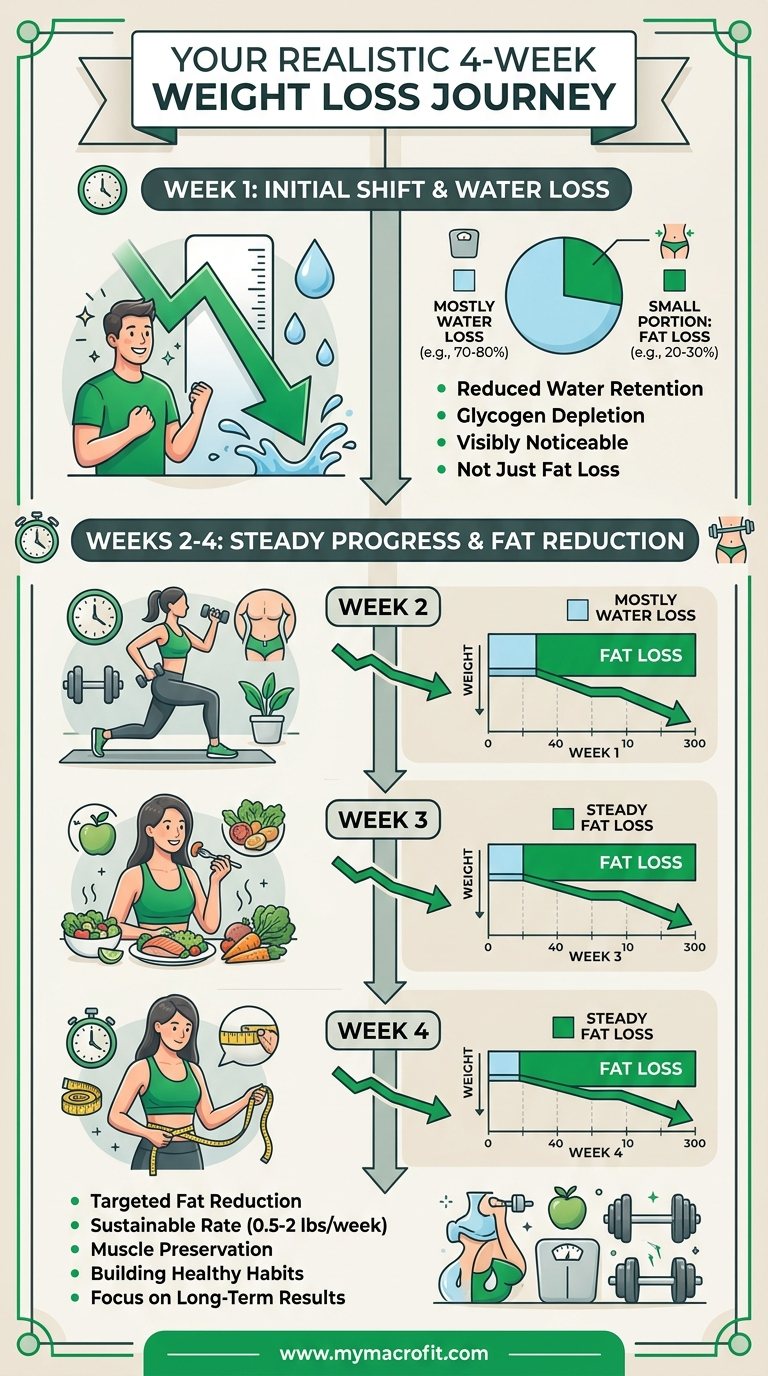
What Can Realistically Happen in 4 Weeks
Week 1: 1.5-3kg scale drop (mostly water and glycogen, minimal fat) Weeks 2-4: 0.4-0.7kg/week actual fat loss = 1.2-2.1kg additional
Total 4-week scale change: 2.7-5kg Of which actual fat loss: 1.5-3kg Of which water/glycogen: 1-2kg
This is the honest breakdown most diet programmes don't explain, and it's why many people feel disappointed at the end of week 2 ("I only lost 0.5kg this week") when in reality week 2 is precisely on target.
Setting Up Your 4-Week Plan
Step 1: Calculate your TDEE using our Calorie Deficit Calculator
Step 2: Set your daily calorie target at TDEE − 500 to − 700 kcal
Step 3: Set protein at 1.8-2g/kg bodyweight
Step 4: Structure your week:
- 3 resistance training sessions
- 2 moderate cardio sessions (30-40 min)
- Meal prep on Sunday
Maximising Results in 4 Weeks
The non-negotiables for maximum 4-week progress:
Eliminate alcohol entirely. Even "moderate" drinking (3-4 drinks/week) can add 400-800 empty calories to a week, equivalent to eliminating a day's worth of deficit.
Track everything for 4 weeks. The most common reason 4-week results disappoint is inaccurate estimation. People consistently underestimate intake by 20-30%.
Hit protein every day. Low protein in a deficit = muscle loss alongside fat loss = smaller, softer result despite similar scale change.
Prioritise sleep. Poor sleep (under 6 hours) increases ghrelin and reduces willpower, making dietary adherence much harder and potentially stalling results independently.
Drink water before meals. 400-500ml before each of 3 daily meals = 300-450 kcal/day natural reduction (see our non-tracking strategies guide).
The 4-Week Check-In
At 4 weeks, take stock:
If weight has dropped 2.5-5kg: You're on track. Continue with the same approach.
If weight has dropped under 2kg despite adherence: Check for calorie creep (re-measure all portions), check TDEE calculation (may need adjustment upward for activity), consider adding 1-2 cardio sessions.
If weight has dropped over 5kg: Ensure you're eating enough protein. Scale drop this large in 4 weeks includes significant muscle loss, add a resistance training session and increase protein to upper end of range.
The Week-by-Week Picture
Because the first week flatters you and the second week scares you, it helps to see the whole month laid out. Here's a realistic shape for someone in a steady deficit:
| Week | Typical scale change | Mostly |
|---|---|---|
| Week 1 | 1.5-3kg down | Water & glycogen |
| Week 2 | 0.4-0.7kg down | Fat (feels slow, is on target) |
| Week 3 | 0.4-0.7kg down | Fat |
| Week 4 | 0.4-0.7kg down | Fat |
Look at the gap between week 1 and week 2. That cliff isn't your diet failing, it's the water drop finishing and the real, slower fat loss taking over. People quit at that exact moment every single time, convinced it stopped working, when week 2 is precisely what success looks like.
Why Week 2 Breaks People
I want to hammer this because it's where most 4-week attempts die. Week 1, the scale plummets and you feel unstoppable. Week 2, it barely moves, and your brain screams that the diet's broken. So you crash your calories harder, or you give up.
Neither is the answer. The slowdown was always coming, because you can only lose actual fat at roughly half a kilo a week no matter how perfect you are. Knowing that in advance is the difference between riding out week 2 calmly and rage-quitting on day 10. Expect the cliff, recognise it for what it is, and keep doing exactly what you were doing.
The Bottom Line
In 4 weeks with a consistent 500-700 kcal deficit, adequate protein, and resistance training: expect 2.5-4.5kg total scale change, of which 1.5-2.5kg is actual fat loss. The rest is water and glycogen.
Set expectations accurately, track your intake, hit protein, and don't panic when week 2 shows less than week 1.
Use our Calorie Deficit Calculator to calculate your specific 4-week setup.
Save & share on Pinterest
Click any card to pin it — or share with someone who needs it.
How Much Weight Can You Lose in 4 Weeks? (Realistic Targets)
What you can realistically expect to lose in 4 weeks, the difference between fat loss and total weig…
What you can realistically expect to lose in 4 weeks, the difference between fat…
Read the full guide: How Much Weight Can You Lose in 4 Weeks? (Realistic Targets)
Try the free Calorie Deficit Calculator
How Much Weight Can You Lose in 4 Weeks? (Realistic Targets) — use our free calculators for instant …
Pinterest opens in a new tab. You can edit the description before saving.
Ready to get your numbers?
Free calculator, instant results, no signup required.
Frequently Asked Questions
How much weight can you realistically lose in 4 weeks?+
Is it safe to lose 5kg in 4 weeks?+
Why did I lose 3kg in the first week but almost nothing in week 2?+
Can you lose belly fat specifically in 4 weeks?+
Should I weigh myself every day during a 4-week plan?+
What happens after the 4 weeks are up?+
About the Author
I'm the founder of MyMacroFit. I'm not a coach or a dietitian. I'm someone who wanted to lose weight, worked it out the hard way, and built the tools I wish I'd had.
View full profile →