Body Recomposition: Can You Really Build Muscle and Lose Fat at the Same Time?

BSc Kinesiology · CPT
It's the holy grail of fitness goals: get leaner and more muscular at the same time, no bulking, no cutting, just steadily better. For years the internet insisted it was impossible, you had to pick fat loss or muscle gain, never both. The truth is more nuanced. Body recomposition is real, it works well for certain people, and the reason most folks think it failed is that they were watching the wrong number the whole time.
What recomposition actually is
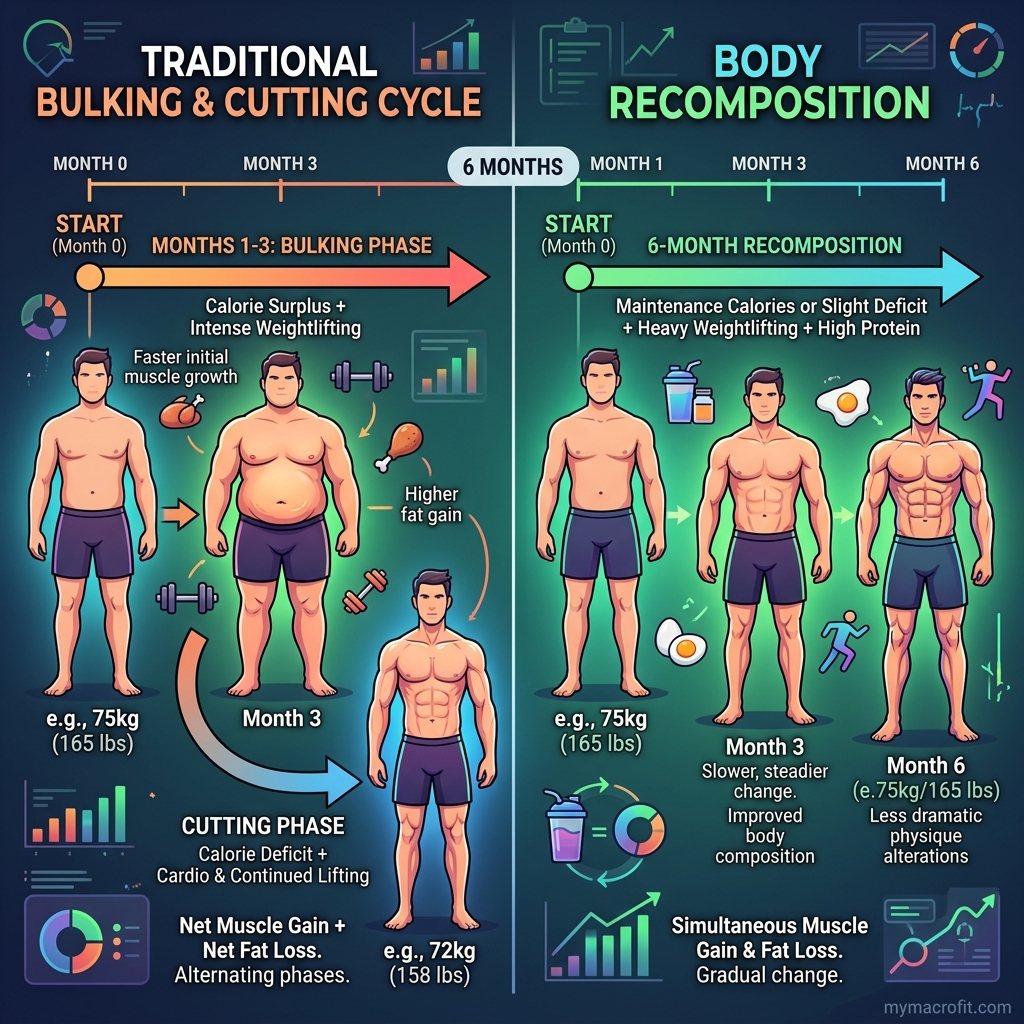
Body recomposition, "recomp", means changing the ratio of muscle to fat in your body without necessarily changing your weight. You lose fat and build muscle simultaneously, so the scale might barely move while your body looks and performs noticeably better.
The reason it sounds impossible is that fat loss needs a calorie deficit and muscle gain traditionally needs a surplus, opposite conditions. Recomp threads that needle by running at roughly maintenance calories and letting your body fund muscle growth partly from its own fat stores. Whether your body can pull that off depends almost entirely on who you are.
Who recomp works best for
Recomposition is dramatically easier for some people than others. You're a strong candidate if you're:
- A beginner in your first year of resistance training, "newbie gains" let your body build muscle rapidly even without a surplus.
- Returning after a long break, "muscle memory" lets you regain lost muscle quickly.
- Carrying higher body fat, more stored energy on hand to fund muscle growth.
- Coming off poor nutrition, simply eating enough protein and training properly unlocks fast change.
If, on the other hand, you're a lean, experienced lifter who's already trained hard for years, simultaneous recomp slows to a crawl. For you, alternating dedicated muscle-gain and fat-loss phases usually beats trying to do both at once. Be honest about which group you're in, it sets realistic expectations.
The two non-negotiables
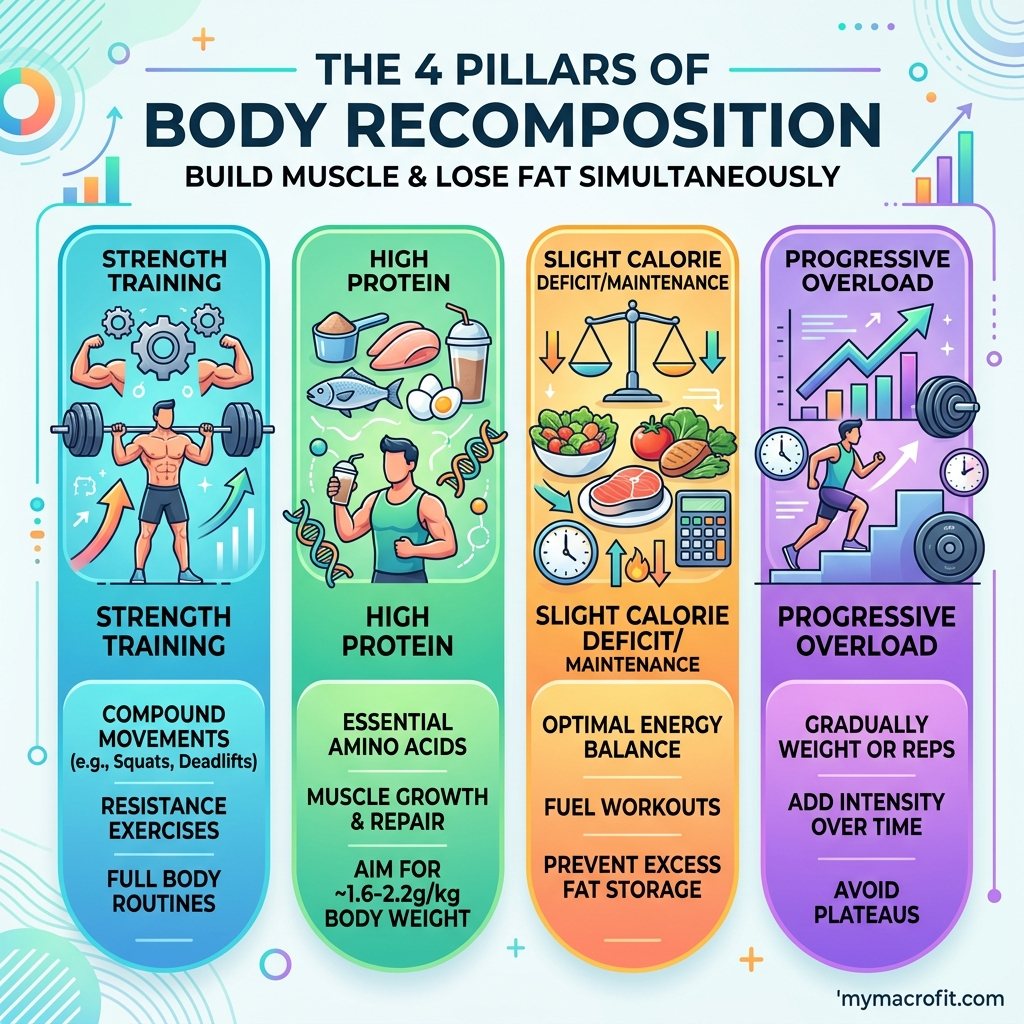
Whoever you are, recomposition stands on two pillars, and neither is optional.
1. High protein. Aim for the top of the range, around 2.0-2.2g per kg of bodyweight. During a recomp, protein works two jobs at once: building new muscle and defending existing muscle from being burned for energy in the slight deficit. Nothing else in your nutrition matters as much.
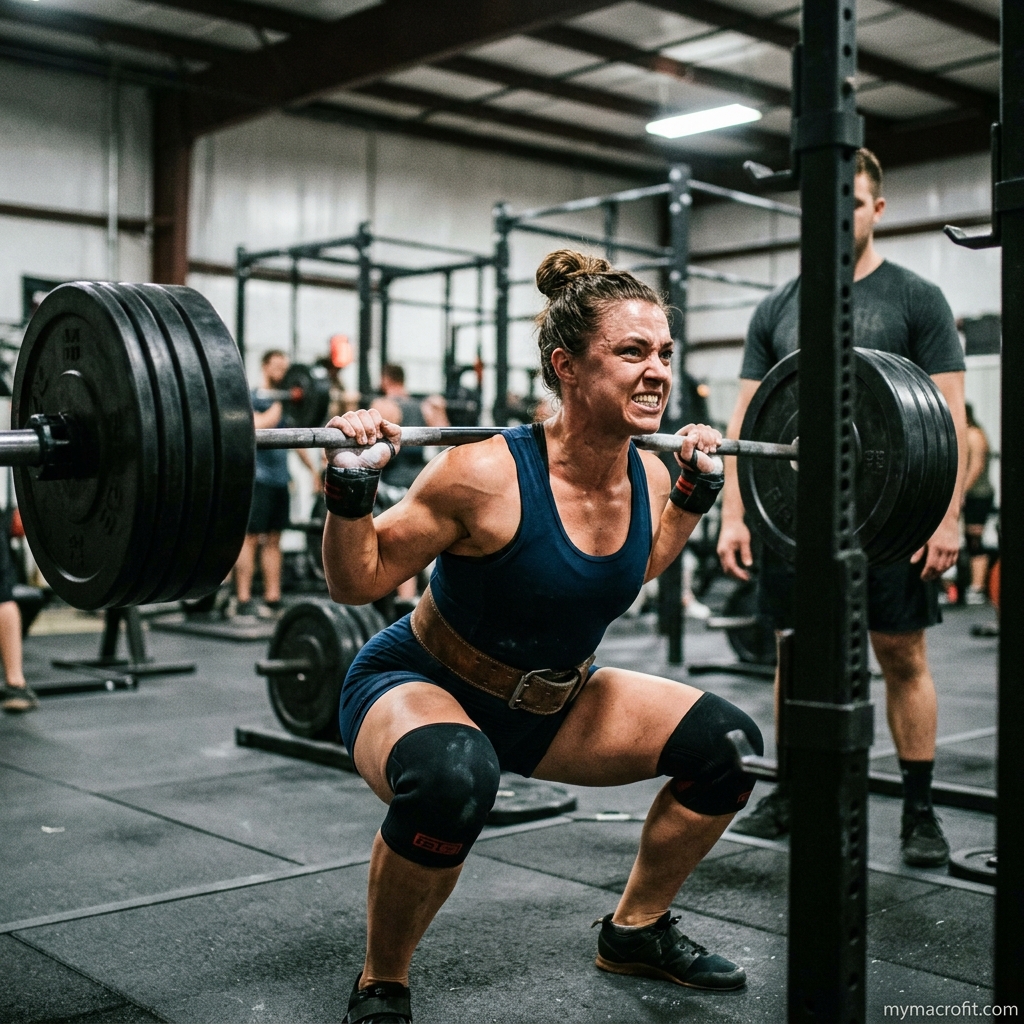
2. Progressive resistance training. Lifting weights with steadily increasing demand is the signal that tells your body to build muscle rather than simply lose weight. Without it, a maintenance-calorie diet just keeps you the same. The progression, adding reps or weight over time, is what drives the muscle side of the equation.
Set your calorie and protein targets with the Macro Calculator; aim for maintenance or a small deficit, and treat the protein number as a floor you always hit.
Get your recomp numbers.
The free Macro Calculator gives you a maintenance calorie target and a high-protein split, the exact setup recomposition needs.
Calculate My Macros →Throw away the scale
Here's the part that trips everyone up. During a successful recomp, the scale is the least useful tool you own. If you lose 0.3kg of fat and gain 0.3kg of muscle in a month, the scale reads zero, and you conclude, wrongly, that nothing's happening. Meanwhile your waist is smaller, your arms are fuller, and your lifts are climbing.
Measure recomposition the way it actually shows up:
- Progress photos in the same lighting and pose, monthly.
- Waist (and hip) measurements, fat loss shows here even when weight doesn't move.
- Strength numbers in your training log, rising lifts are muscle being built.
- How clothes fit, the most honest everyday signal of body-composition change.
If you only track bodyweight, recomp will look like failure even as it succeeds. That single mistake is why so many people "give up" on something that was quietly working.
What a recomp month actually looks like on paper
To set expectations, here's a realistic month for a good recomp candidate, say a returning beginner at 75kg eating around maintenance with protein high:
| Measure | Month start | Month end |
|---|---|---|
| Bodyweight | 75.0kg | 74.8kg |
| Waist | 86cm | 84.5cm |
| Squat (5 reps) | 60kg | 67.5kg |
| Mirror | Softer | Firmer, more defined |
Look at the weight row, basically unchanged, while every other row improved. A scale-only tracker would call this a failed month and quit. In reality, fat came off (waist down), muscle went on (lifts up), and the body looks better. This is exactly why recomp demands you measure with photos, the tape, and your training log, the scale is the one tool that hides the very thing you're achieving.
A simple weekly checklist
Recomp is slow, so the way to stay sane is to stop judging it daily and instead make sure the inputs are right each week. If you can tick these off, the result is taking care of itself in the background:
- Hit your protein (around 2.0-2.2g/kg) most days, this is the non-negotiable.
- Progress your lifts, add a rep or a little weight somewhere this week versus last.
- Stay near maintenance calories, not crashing, not surplus.
- Take a monthly photo and waist measurement, your real progress report.
- Sleep enough to recover, since muscle is built in recovery, not just in the gym.
Tick those weekly and stop asking the scale for permission to feel like it's working. It is.
Patience is the price
Recomposition is slower than picking one goal, because you're asking your body to do two opposing things at once. There's no avoiding that trade-off, the reward for the slower pace is that you never have to "bulk up" and then diet it off, and you stay lean and capable throughout. Judge it over months. Hold your protein high, keep progressing your lifts, eat around maintenance, and ignore the scale. Do that consistently and you'll look in the mirror one day and realise the impossible goal happened while you weren't weighing yourself.
Save & share on Pinterest
Click any card to pin it — or share with someone who needs it.
Body Recomposition: Can You Really Build Muscle and Lose Fat at the Same Time?
Building muscle while losing fat sounds too good to be true, but for the right person it's real. Her…
Building muscle while losing fat sounds too good to be true, but for the right p…
Read the full guide: Body Recomposition: Can You Really Build Muscle and Lose Fat at the Same Time?
Try the free Macro Calculator
Body Recomposition: Can You Really Build Muscle and Lose Fat at the Same Time? — use our free calcul…
Pinterest opens in a new tab. You can edit the description before saving.
Ready to get your numbers?
Free calculator, instant results, no signup required.
Frequently Asked Questions
Can you build muscle and lose fat at the same time?+
Do you need a calorie deficit or surplus to recomp?+
How much protein do you need for body recomposition?+
How long does body recomposition take?+
Why isn't the scale moving during a recomp?+
Should I recomp or just bulk and cut in separate phases?+
Do I need supplements to recomp, like creatine or fat burners?+
About the Author

I'm a kinesiologist and personal trainer. I've spent eight years helping women lose fat and get stronger without handing their whole life over to a diet.
View full profile →