How to Build Muscle as a Beginner (The Only Guide You Need)

BSc Kinesiology · CPT
Building muscle as a beginner is one of the most straightforward endeavours in fitness, and also one of the most commonly overcomplicated. The basic requirements are simple: consistent resistance training, adequate protein, sufficient calories, and adequate sleep. Everything else is optimisation.
How Muscle Growth Works
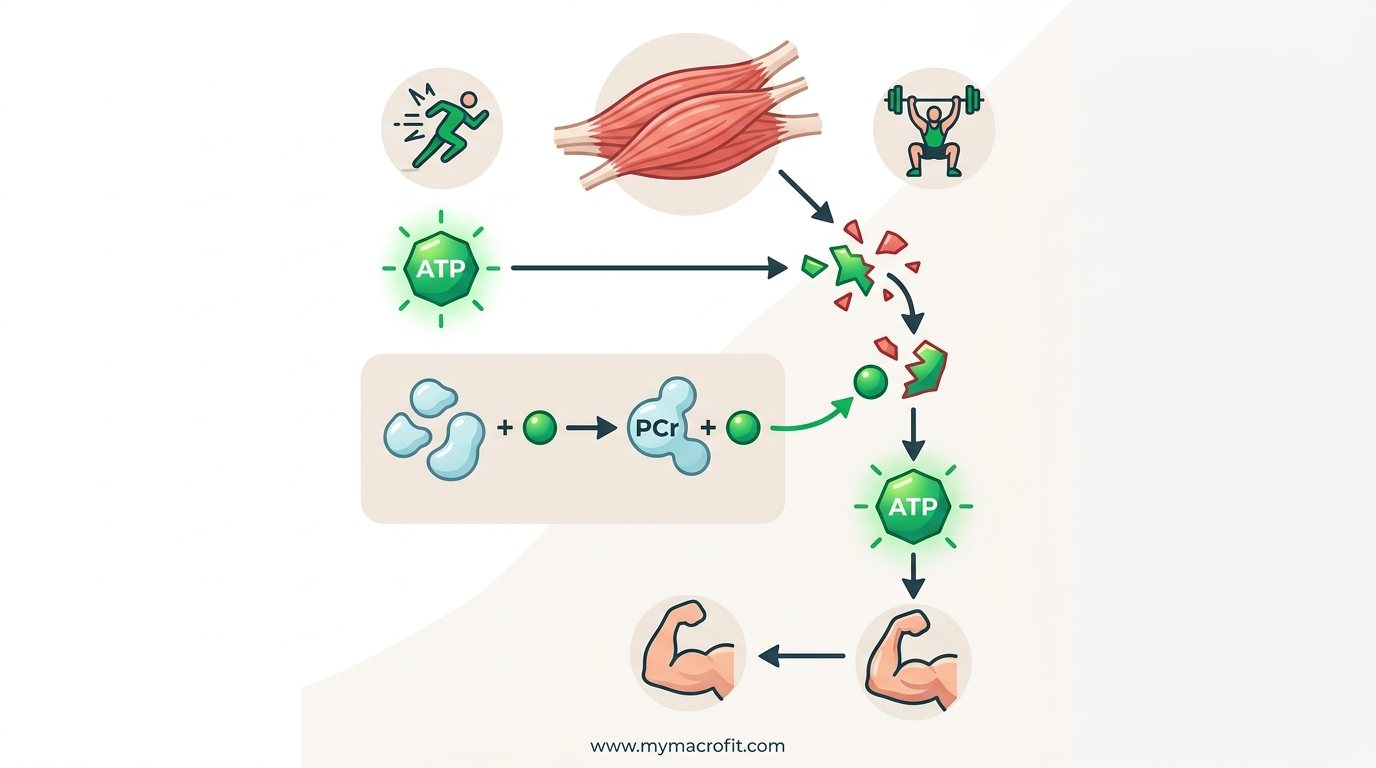
Muscle hypertrophy (growth) occurs through a specific process:
- Mechanical tension: Lifting a weight creates tension in muscle fibres
- Metabolic stress: High-rep sets and shorter rest periods create a metabolic environment that signals growth
- Muscle damage: Micro-tears in muscle fibres during eccentric (lowering) phase
- Repair and growth: With adequate protein and rest, the body repairs the damage and adds slightly more muscle, a process called muscle protein synthesis (MPS)
The key stimulus: Progressive overload, progressively increasing the demand on muscles over time. Without progressive overload, muscles have no reason to grow beyond their current size.
The Beginner Advantage: Newbie Gains
In the first 6 months of consistent training, several factors converge for unusually rapid progress:
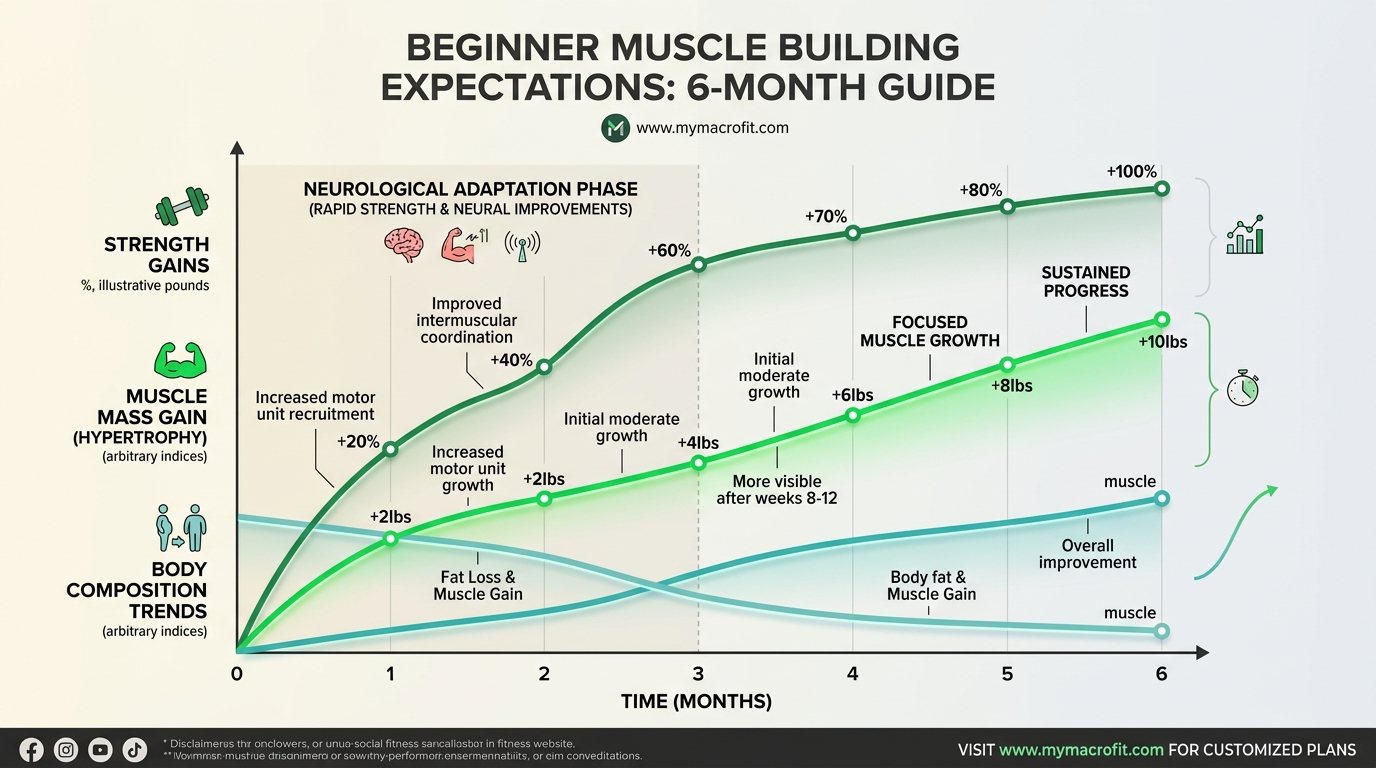
Neurological adaptation: In the first 4-8 weeks, strength gains come primarily from improved neuromuscular coordination, your nervous system learns to recruit more motor units and fire them more efficiently. This produces rapid strength improvement before significant muscle mass is added.
Untapped muscle protein synthesis capacity: Untrained muscle responds strongly to any resistance training stimulus. The MPS response is maximal, every session is a powerful signal. This response blunts progressively as you become more trained.
Simultaneous fat loss and muscle gain: Body recomposition is most achievable here. Beginners can gain 1-2kg of muscle per month while also losing fat, a combination that becomes increasingly difficult with more training experience.
The Programme: 3 Days/Week Full Body
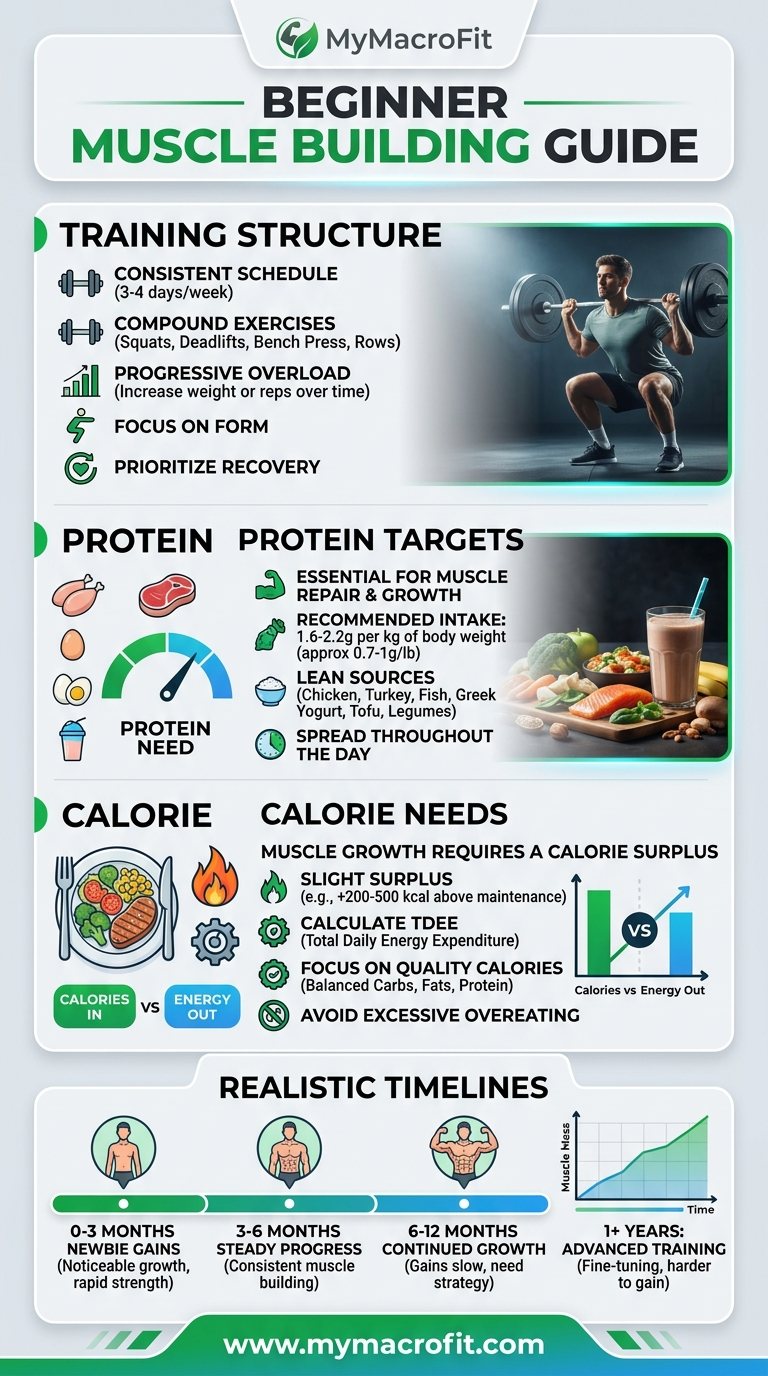
Every beginner programme should be built around compound movements, exercises that work multiple muscle groups simultaneously, allowing the most efficient stimulus per session.
Core exercises to master:
| Movement pattern | Exercise | Muscles |
|---|---|---|
| Squat | Barbell back squat or goblet squat | Quads, glutes, core |
| Hip hinge | Romanian deadlift or conventional deadlift | Hamstrings, glutes, back |
| Horizontal push | Bench press or dumbbell press | Chest, shoulders, triceps |
| Horizontal pull | Barbell row or dumbbell row | Upper back, biceps |
| Vertical push | Overhead press | Shoulders, triceps |
| Vertical pull | Lat pulldown or pull-up | Lats, biceps |
| Hip extension | Hip thrust | Glutes |
Session structure (3x/week):
- 3-4 compound movements
- 3 sets each
- 8-12 reps per set
- 2-3 minutes rest between sets
- Total session time: 45-60 minutes
Week 1-4: Focus entirely on technique. Use lighter weights. Master the movement patterns.
Week 5 onwards: Begin progressive overload, when you can complete 12 reps on all 3 sets, increase weight by the smallest increment available.
Nutrition for Muscle Building
Protein: 2g/kg bodyweight
The most important dietary variable. Muscle protein synthesis requires amino acid availability. Without adequate protein, the training signal cannot produce muscle growth.
For a 75kg beginner: 150g protein/day, distributed across 3-4 meals of 35-40g each.
Protein distribution matters: Eating 150g protein in one meal is far less effective than spreading it across the day. Each meal provides a MPS "pulse", more pulses = more total synthesis.
Calories: Maintenance for Recomposition, Small Surplus for Faster Gains
Body recomposition (fat loss + muscle gain): Calorie maintenance with high protein. This works well for beginners and produces the visually dramatic "toned" result most people want.
Muscle gain focus (lean bulk): 100-200 kcal above TDEE. This maximises muscle gain rate while minimising fat gain. More than 200 kcal surplus adds body fat faster than muscle.
Use our Macro Calculator to set your specific targets.
Carbohydrates: Fuel Your Sessions
Resistance training burns glycogen. Adequate carbohydrates (at minimum, 3-4g/kg bodyweight for training days) support training intensity and recovery. Cutting carbohydrates too aggressively while training impairs glycogen availability and reduces training quality.
Sleep: Non-Negotiable
Growth hormone, the primary repair and growth signal, is released predominantly during deep sleep. Inadequate sleep (under 7 hours) reduces GH output, increases cortisol (which breaks down muscle), and reduces MPS response to training.
Minimum: 7-9 hours per night. Prioritise sleep equal to nutrition and training.
Realistic Expectations: 6-Month Timeline
Month 1: Strength increases rapidly (neuromuscular adaptation). Little visible muscle change. Learning movement patterns.
Month 2: Visible muscle development begins. Clothes fitting differently. Strength continuing to improve.
Month 3: Noticeable body composition change, less fat, more muscle definition. Significant strength gains.
Months 4-6: Continued visible progress. Most people gain 3-6kg of lean muscle in first 6 months with optimal nutrition and training. Body composition dramatically improved even if scale weight changed little.
What the scale does: Often doesn't move dramatically, muscle gain offsets some fat loss. Track progress with:
- Progress photos (monthly)
- Waist and arm measurements (monthly)
- Strength numbers (every session)
- How clothes fit
Common Beginner Mistakes
Using weights that are too light: If you're not challenged in the last 2-3 reps, the weight isn't heavy enough to stimulate growth.
No progressive overload: Using the same weights for the same reps week after week. Progress requires progressive challenge.
Inconsistency: 2 weeks training, 2 weeks off. Muscle development requires consistent, sustained stimulus over months.
Insufficient protein: Training hard but eating 80-100g protein when target is 150g+ will significantly limit results.
Too much programme switching: Beginners frequently change programmes every 3-4 weeks. Consistent application of any sensible programme for 6 months outperforms frequent changes.
The Bottom Line
Beginner muscle building requires: consistent full-body training 3x/week with progressive overload, 2g/kg protein daily distributed across meals, adequate calories, and 7-9 hours sleep. Everything else is secondary to these fundamentals applied consistently for 6 months.
The beginner phase is the best opportunity for rapid transformation, commit to the basics and you'll be unrecognisable in 6 months.
Save & share on Pinterest
Click any card to pin it — or share with someone who needs it.
How to Build Muscle as a Beginner (The Only Guide You Need)
The complete beginner's guide to building muscle, the programme, nutrition, recovery, and realistic …
The complete beginner's guide to building muscle, the programme, nutrition, reco…
Read the full guide: How to Build Muscle as a Beginner (The Only Guide You Need)
Try the free Macro Calculator
How to Build Muscle as a Beginner (The Only Guide You Need) — use our free calculators for instant p…
Pinterest opens in a new tab. You can edit the description before saving.
Ready to get your numbers?
Free calculator, instant results, no signup required.
Frequently Asked Questions
How fast can a beginner build muscle?+
Do beginners need a calorie surplus to build muscle?+
How many days per week should a beginner lift to build muscle?+
How much protein does a beginner need to build muscle?+
What are the most common mistakes beginners make when building muscle?+
About the Author

I'm a kinesiologist and personal trainer. I've spent eight years helping women lose fat and get stronger without handing their whole life over to a diet.
View full profile →