Compound vs Isolation Exercises: What to Prioritise and When

BSc Kinesiology · CPT
The compound vs. isolation debate is one of the most discussed in strength training. The answer isn't an absolute "one or the other", both serve purposes, and understanding when to prioritise each makes your programme significantly more effective.
Compound Exercises: Definition and Benefits
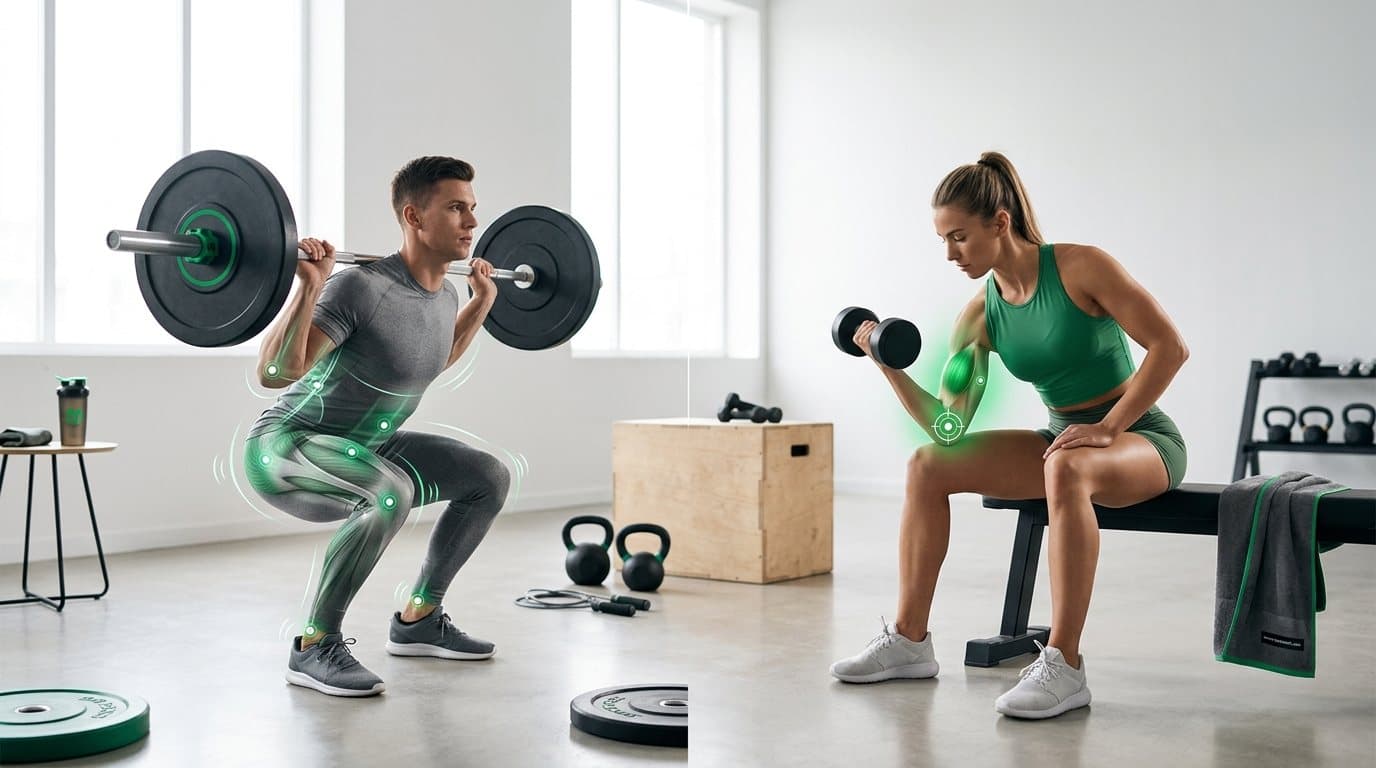
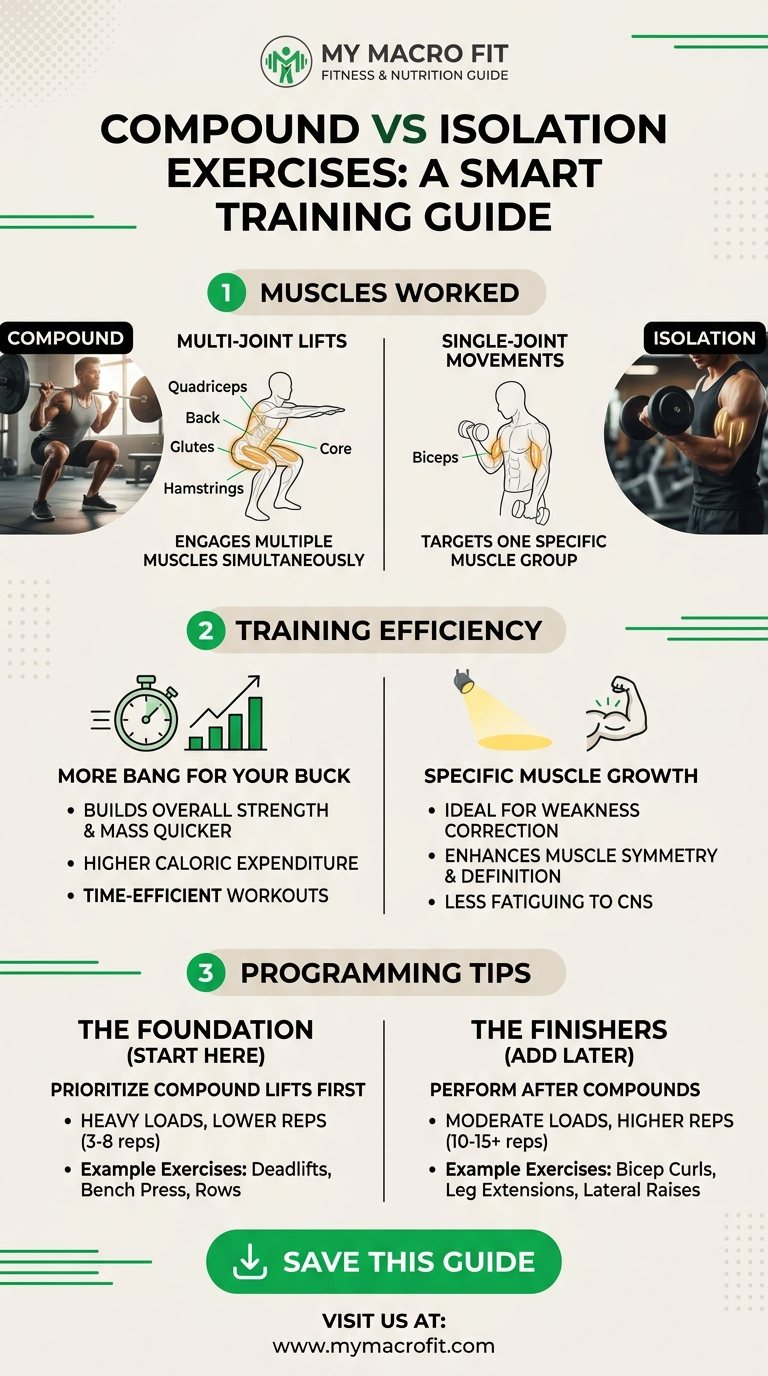
Compound exercises involve movement at two or more joints and engage multiple muscle groups simultaneously.
Examples: Squat (knee and hip joints), deadlift (hip and knee), bench press (shoulder, elbow, wrist), pull-up (shoulder and elbow), overhead press (shoulder and elbow), rowing movements.
Advantages:
Greater total muscle activation: A back squat activates quadriceps, hamstrings, glutes, core, and upper back simultaneously, one exercise, multiple muscle groups. Training efficiency is dramatically higher than equivalent isolation work.
Higher hormonal response: Heavy compound movements produce significantly greater acute testosterone and growth hormone release than isolation exercises, an anabolic environment that benefits all muscle growth, not just the target muscles.
Functional strength transfer: Compound strength translates to real-world physical capability. The pattern of squatting, hinging, and pressing is directly applied in daily movement.
Progressive loading potential: Barbell compound movements allow the most significant total load, you can deadlift 150kg; you can't do an equivalent hamstring curl. This large absolute load creates the most significant adaptation stimulus.
Time efficiency: Three sets of squats achieve what multiple isolation exercises would take twice as long to accomplish.
Isolation Exercises: Definition and Benefits
Isolation exercises involve a single joint movement targeting a specific muscle or muscle group.
Examples: Bicep curl (elbow only), leg extension (knee only), lateral raise (shoulder joint only), calf raise (ankle only), tricep pushdown.
Advantages:
Targeted hypertrophy: When a specific muscle is underdeveloped relative to the rest (a "lagging" body part), isolation work provides direct stimulus that compound exercises might not sufficiently target.
Lower central nervous system (CNS) fatigue: Heavy compound work is neurologically demanding. Isolation exercises can add volume to specific muscles without the systemic fatigue of additional compound sets.
Reduced injury risk for rehabilitation: After injury, isolation exercises allow targeted muscle maintenance or development without loading joints that aren't ready for compound movement.
Addressing weak links: If a specific muscle is limiting performance in a compound (weak glutes limiting the squat, weak lats limiting the deadlift), direct isolation work can address the bottleneck.
Mind-muscle connection development: Isolation exercises improve awareness of specific muscles, developing the ability to consciously activate them, which enhances compound exercise performance.
The Practical Framework: Compounds First, Isolation to Complement
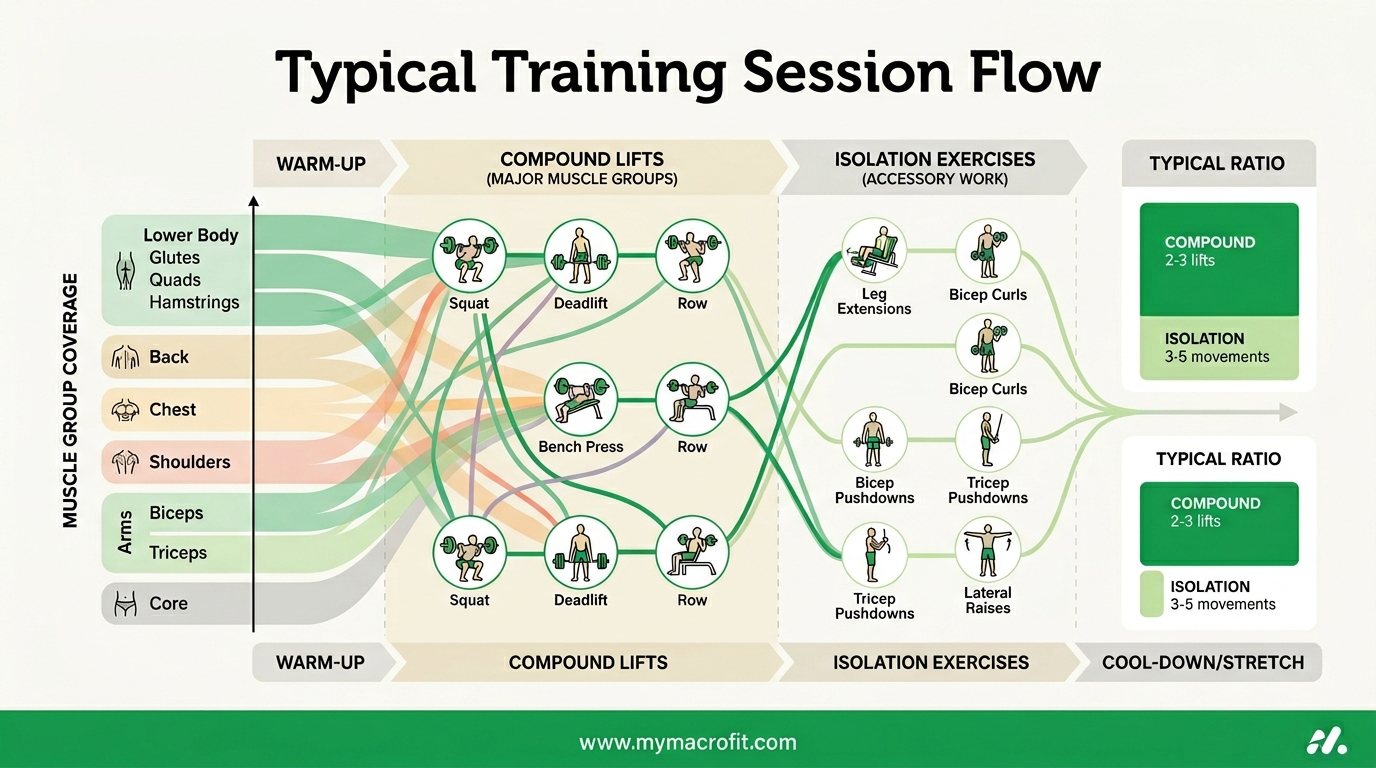
The most effective training structure for most goals:
Foundation (60-70% of training volume): Compound movements
- These form the core of every session
- Progressive overload applied here drives the majority of strength and muscle gains
- Select 3-4 compounds per session based on movement patterns
Accessories (30-40% of training volume): Isolation work
- Complete after compound work when the primary stimulus has been delivered
- Used to address specific muscles, add volume to lagging areas, or complete the session with lighter work
Example Programme Structure
Day 1: Upper Body
- Bench press: 4×6-8 (compound, primary push)
- Barbell row: 4×6-8 (compound, primary pull)
- Overhead press: 3×8-10 (compound, secondary push)
- Lat pulldown: 3×10-12 (compound, secondary pull)
- Bicep curl: 3×12-15 (isolation, accessory)
- Tricep pushdown: 3×12-15 (isolation, accessory)
- Rear delt fly: 3×15 (isolation, accessory)
Day 2: Lower Body
- Back squat: 4×6-8 (compound, primary)
- Romanian deadlift: 4×8-10 (compound, primary)
- Bulgarian split squat: 3×10-12 (compound, secondary)
- Leg curl: 3×12-15 (isolation, accessory)
- Calf raise: 4×15-20 (isolation, accessory)
- Hip abduction: 3×15-20 (isolation, accessory)
Specific Situations: When Isolation Takes Priority
Rehabilitation: Rebuilding a specific muscle after injury without loading the surrounding complex.
Lagging muscles: If biceps are significantly underdeveloped compared to overall physique, adding 2-3 dedicated isolation sets per session accelerates specific development.
Late-stage competition prep: Bodybuilders increase isolation work as competition approaches to target specific muscle definition.
High injury risk from compounds: Some people have mobility restrictions that make heavy barbell squats or deadlifts high-risk. Machine alternatives and isolation work can achieve similar development with lower joint risk.
The Bottom Line
Compound exercises are the foundation of effective training, providing the most stimulus, the best progressive loading potential, and the greatest efficiency. Isolation exercises are valuable accessories that target specific muscles, add volume without excessive fatigue, and address individual development needs.
Build your programme around compound movements. Add isolation exercises as accessories after the compounds are complete. This structure serves virtually every training goal from beginner to advanced.
Save & share on Pinterest
Click any card to pin it — or share with someone who needs it.
Compound vs Isolation Exercises: What to Prioritise and When
The difference between compound and isolation exercises, which builds more muscle and strength, and …
The difference between compound and isolation exercises, which builds more muscl…
Read the full guide: Compound vs Isolation Exercises: What to Prioritise and When
Free fitness tools
Compound vs Isolation Exercises: What to Prioritise and When — use our free calculators for instant …
Pinterest opens in a new tab. You can edit the description before saving.
Frequently Asked Questions
Should beginners do compound or isolation exercises?+
Do isolation exercises build more muscle than compound exercises?+
Can you build a good physique with only compound exercises?+
How should I structure compounds and isolations in a single workout?+
How many isolation exercises do I actually need?+
About the Author

I'm a kinesiologist and personal trainer. I've spent eight years helping women lose fat and get stronger without handing their whole life over to a diet.
View full profile →