How to Lose 20kg: Timeline, Expectations, and the Plan
Founder, MyMacroFit
Twenty kilograms is a life-changing transformation. It's also a 7-12 month project that requires a fundamentally different approach than a 5kg cut. The mistakes people make with large weight loss goals, too aggressive, too rigid, no strategy for plateaus, are what turn a realistic goal into years of start-stop frustration.
This guide gives you the honest timeline, the phased approach, and the expectation management that makes 20kg actually achievable.
The Honest Timeline
| Pace | Weekly loss | Weeks to 20kg | Months |
|---|---|---|---|
| Conservative | 0.3-0.4kg/week | 50-67 weeks | 12-16 months |
| Moderate (recommended) | 0.5-0.7kg/week | 29-40 weeks | 7-10 months |
| Aggressive | 0.7-1.0kg/week | 20-29 weeks | 5-7 months |
| Extreme (not recommended) | 1.0kg+/week | Under 20 weeks | Under 5 months |
Recommended target: 0.5-0.7kg/week from a sustainable deficit. This preserves muscle, manages hunger better, and produces results that last.
Important caveat: Most people lose weight non-linearly. The first 2-3 weeks show faster loss (water weight), weeks 4-16 show steady fat loss, then plateaus appear. Total realistic duration including plateaus: 9-14 months for most people losing 20kg.
The Phased Approach: Why You Can't Just "Diet" for 10 Months
Attempting to maintain the same aggressive deficit for 10 straight months fails because:
- TDEE decreases as you lose weight, a 20kg lighter body burns 150-200 fewer calories daily at rest
- Metabolic adaptation reduces calorie burn further (beyond just bodyweight change)
- Hormonal adaptation (lower leptin, higher ghrelin) makes hunger harder to manage
- Diet fatigue, sustained restriction creates psychological pressure that leads to abandonment
The solution: phase your approach
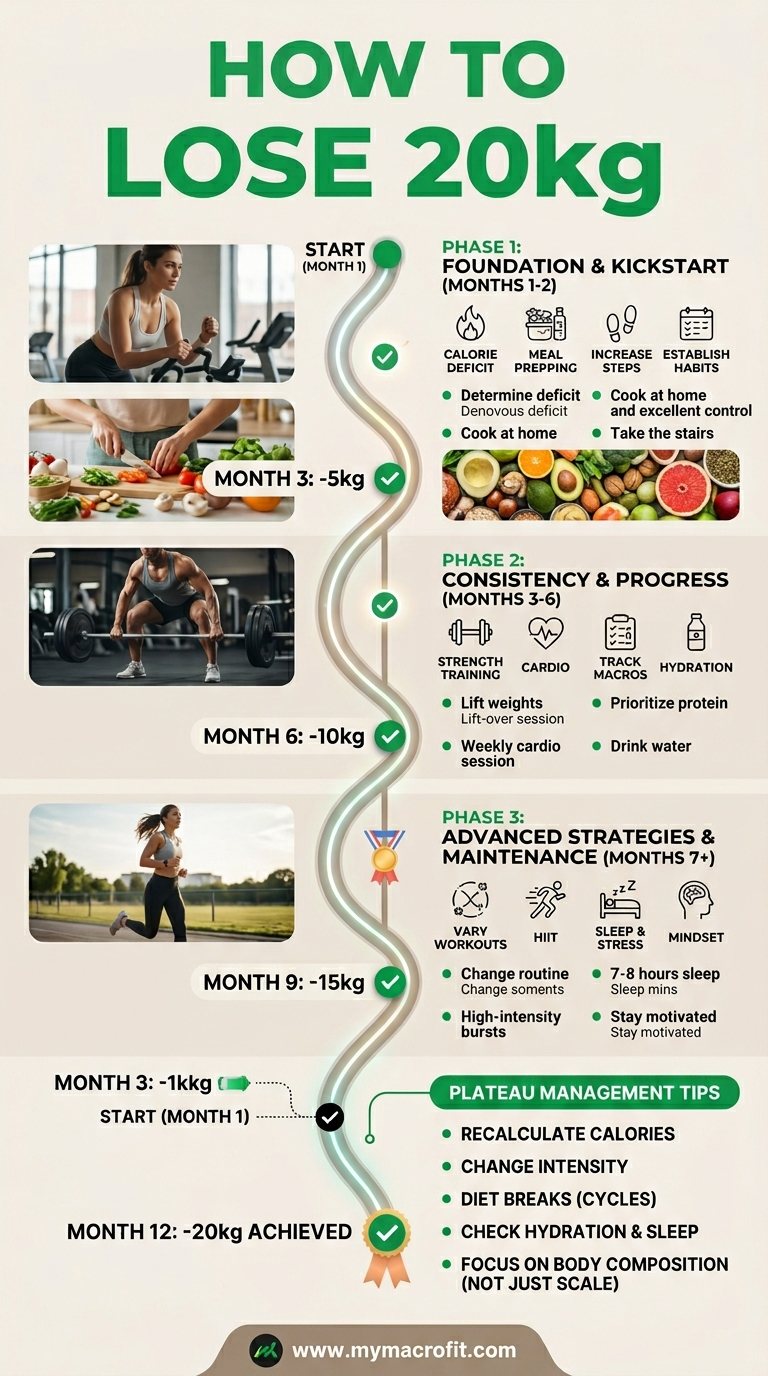
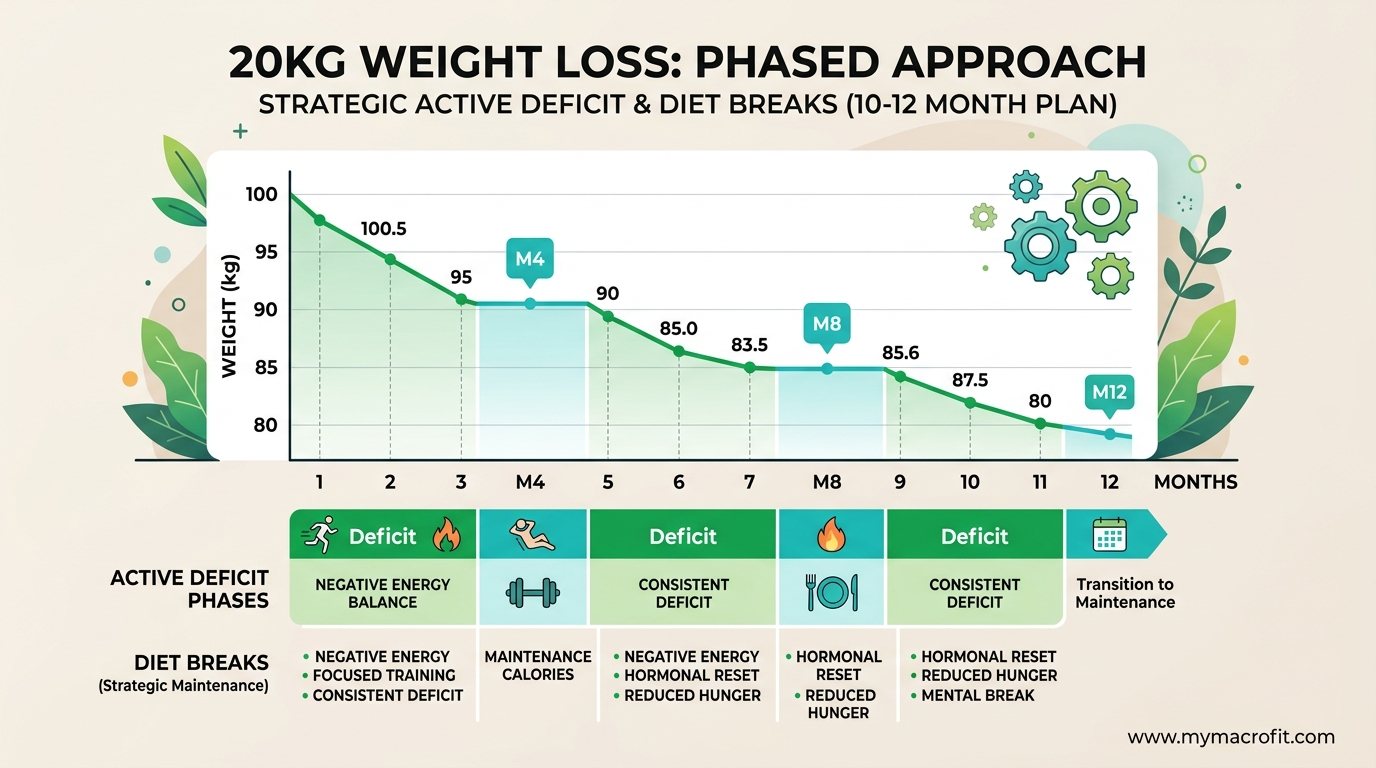
Phase 1 (Months 1-3): Active Deficit
Goal: 7-9kg fat loss Setup: TDEE − 500-600 kcal/day + high protein + resistance training Protein: 1.8-2.2g/kg bodyweight (adjust downward as weight drops) Training: 3 strength sessions + 2 cardio sessions/week
Recalculate TDEE at month 3 (you're lighter, TDEE has dropped).
Phase 2 (Month 3, Diet Break): 2 Weeks at Maintenance
Increase calories back to current TDEE for 2 weeks. This is called a diet break, not a cheat period, but a deliberate maintenance phase.
Why: Research shows 2-week diet breaks during extended weight loss reduce metabolic adaptation, restore leptin toward baseline, reduce muscle loss, and improve long-term adherence. This is a strategy, not a weakness.
Continue training throughout the diet break.
Phase 3 (Months 4-7): Active Deficit (Phase 2)
Goal: Additional 7-9kg loss Setup: Recalculated TDEE (lower than Phase 1) − 500 kcal/day Adjust protein: Recalculate for new bodyweight
Diet break again at month 7.
Phase 4 (Months 8-12): Final Phase + Maintenance Transition
Goal: Final 3-5kg + transition to maintenance Setup: Smaller deficit (−300-400 kcal) as you approach goal weight, slower loss is appropriate as you get closer Transition: Gradually increase calories to new maintenance in the final 4-6 weeks
Managing the Inevitable Plateaus
Every person losing 20kg will hit plateaus, periods of 2-4+ weeks where the scale doesn't move despite adherence. Plateaus are normal and have specific causes:
Cause 1: TDEE has dropped but deficit hasn't been recalculated Solution: Recalculate TDEE at current weight and re-establish a new deficit.
Cause 2: Unconscious calorie creep Solution: Return to precise food tracking for 1-2 weeks. Research consistently shows that people underestimate intake by 20-30% when not tracking.
Cause 3: Water retention masking fat loss Solution: Zoom out, look at 4-week trends, not weekly scales. The scale can fluctuate 1-2kg around your trend line from water, hormones, and food volume.
Cause 4: Metabolic adaptation Solution: A 2-week diet break (see above) followed by resuming the deficit often breaks a prolonged plateau.
What not to do: Cut calories drastically when hitting a plateau. This accelerates muscle loss, worsens adaptation, and increases rebound risk.
Calorie and Protein Setup
Use our Calorie Deficit Calculator to get your personalised Phase 1 starting numbers.
Example for a 90kg woman, moderately active:
- TDEE: ~2,200 kcal
- Phase 1 deficit target: 1,600-1,700 kcal/day
- Protein: 90kg × 2g = 180g/day
- After 10kg loss (80kg): recalculate, TDEE drops to ~2,050 kcal; new target ~1,500-1,600 kcal/day
Training: Why It Matters More Than Most People Think
For a 20kg goal, training is not optional, it's the mechanism that determines whether the lost weight is mostly fat or a mix of fat and muscle.
Without resistance training: You lose fat AND muscle. At 20kg lost, you're smaller but have a proportionally lower resting metabolism, making maintenance harder.
With resistance training: You preserve or build muscle while losing fat. At 20kg lost, you have a higher fat-free mass proportion, better resting metabolism, and a physically different (more defined) physique.
Minimum training target: 3 resistance training sessions per week. Add 2-3 cardio sessions for calorie burn and cardiovascular health.
See our Strength Training for Weight Loss guide for the specific programme.
The Psychological Framework
Twenty kilograms over 10+ months is a long time to maintain a consistent behaviour. The people who succeed:
Track weekly, not daily. Daily weigh-ins are data; weekly averages are signal. Don't react to daily fluctuations.
Plan for imperfect periods. Holidays, illness, stressful work periods, these happen. The goal is to return to the plan faster, not to maintain perfection throughout.
Celebrate non-scale victories. Clothes that fit, energy improvements, strength gains, better sleep, these are progress even when the scale is stubborn.
Don't moralize food. No food is "bad" or makes you "bad." A day over target doesn't undo a week of adherence.
The Bottom Line
Losing 20kg is a 7-12 month project done correctly. The key variables: a sustainable deficit (not extreme restriction), adequate protein (1.8-2.2g/kg, recalculated as you lose weight), resistance training to preserve muscle, and a phased approach with diet breaks to manage metabolic adaptation.
Expect plateaus. Plan diet breaks. Recalculate regularly. Stay consistent without requiring perfection. Twenty kilograms is achievable, it just requires a longer runway than most people initially expect.
Save & share on Pinterest
Click any card to pin it — or share with someone who needs it.
How to Lose 20kg: Timeline, Expectations, and the Plan
A realistic guide to losing 20kg, how long it takes, why the approach must change as you progress, m…
A realistic guide to losing 20kg, how long it takes, why the approach must chang…
Read the full guide: How to Lose 20kg: Timeline, Expectations, and the Plan
Try the free Calorie Deficit Calculator
How to Lose 20kg: Timeline, Expectations, and the Plan — use our free calculators for instant person…
Pinterest opens in a new tab. You can edit the description before saving.
Ready to get your numbers?
Free calculator, instant results, no signup required.
Frequently Asked Questions
How long does it take to lose 20kg?+
Can I lose 20kg in 3 months?+
Why does weight loss slow down after the first month?+
Should I recalculate my calories as I lose weight on the way to 20kg?+
How do I stay motivated for the many months it takes to lose 20kg?+
Will I have loose skin after losing 20kg?+
About the Author
I'm the founder of MyMacroFit. I'm not a coach or a dietitian. I'm someone who wanted to lose weight, worked it out the hard way, and built the tools I wish I'd had.
View full profile →