
The Complete Keto & Low Carb Guide

CN · Metabolic Health Coach
Low-carb and ketogenic diets have been among the most debated nutrition approaches for decades, first dismissed as dangerous fad diets, then vindicated by accumulating evidence, now more nuanced than either camp allows.
This guide covers everything: the biochemistry of ketosis, the honest evidence on fat loss, who benefits most, the practical setup, common mistakes, and how low carb compares to keto.
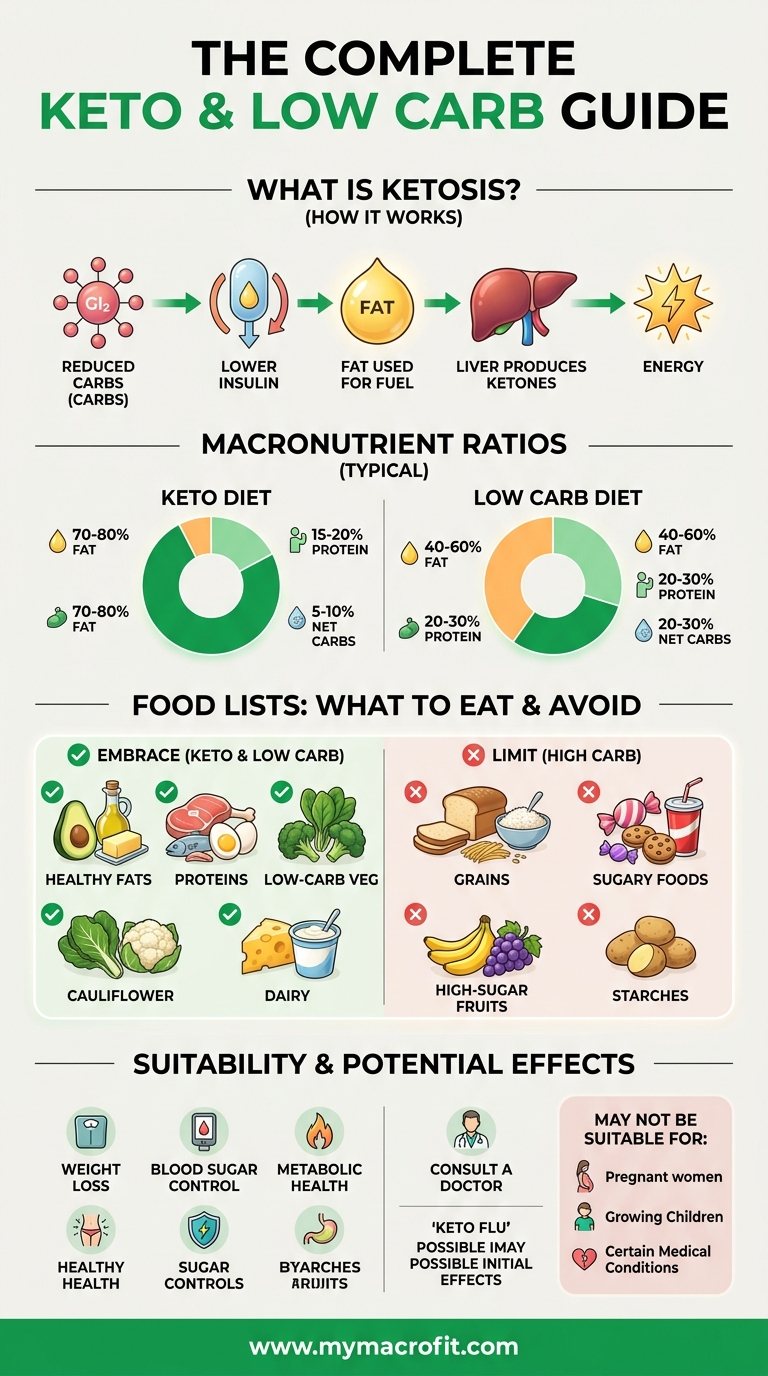
The Spectrum: Low Carb vs. Keto
"Low carb" and "keto" are often used interchangeably, but they're distinct approaches:
| Approach | Carb intake | Goal | Notes |
|---|---|---|---|
| Moderate low carb | 100-150g/day | General health, reduced insulin spikes | Most people can sustain this indefinitely |
| Low carb | 50-100g/day | Fat loss, blood sugar management | Does not necessarily produce ketosis |
| Ketogenic | 20-50g/day net | Ketosis, therapeutic use, rapid fat loss | Strict, requires precise tracking |
| Very low carb | Under 20g/day net | Deep ketosis | Typical medical keto protocol |
Most people who "do keto" are actually doing low carb. True ketosis requires sustained carb restriction below 50g/day, maintained over days to weeks.
How Ketosis Works: The Biochemistry
Under normal conditions, your body runs primarily on glucose derived from carbohydrates. When carb intake drops sufficiently and glycogen stores are depleted (typically 24-48 hours of restriction), the liver begins breaking down fatty acids to produce ketone bodies, specifically:
- Beta-hydroxybutyrate (BHB): The primary circulating ketone
- Acetoacetate: The precursor to BHB
- Acetone: Exhaled (the "keto breath" some people notice)
Ketone bodies can be used as fuel by most tissues, including the brain, challenging the old myth that the brain "requires" glucose. The brain actually functions well on ketones, and many people report improved mental clarity once fully adapted.
Metabolic adaptation period: The transition from glucose to fat metabolism takes approximately 2-6 weeks. During this period, performance may be reduced, and "keto flu" symptoms are common. After full adaptation, most people find energy levels normalise.
The Evidence on Fat Loss
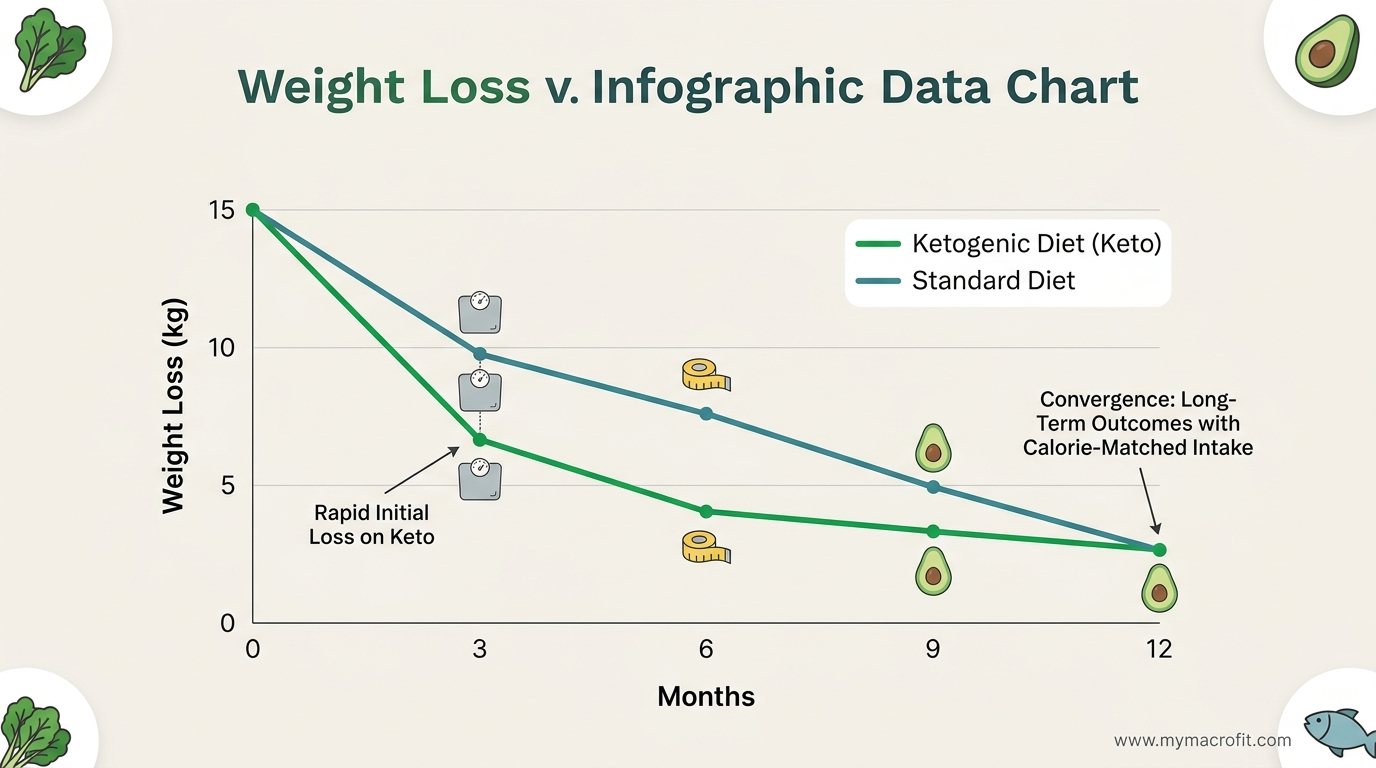
Short-term (0-3 months): Keto advantage
Studies consistently show faster weight loss with keto in the first 3 months. The mechanisms:
- Rapid glycogen depletion: Each gram of glycogen is stored with ~3g water. Depleting ~400g glycogen releases ~1.2kg water weight within days.
- Appetite suppression: Ketones suppress ghrelin (hunger hormone). High protein intake on keto is independently satiating.
- Calorie reduction without explicit counting: Many people naturally eat less on keto because food choices are limited and protein is high.
Long-term (6-24 months): Equivalence with adequate protein and calories
When studies equate calories and protein between keto and non-keto groups, weight loss outcomes converge at 6-12 months. The 2020 Bazzano meta-analysis of 13 RCTs found keto produced modestly superior fat loss, but the difference was clinically small (~1-2kg) and likely explained by residual calorie and protein differences.
The honest conclusion: Keto is not metabolically magical. It works through appetite suppression, often-higher protein intake, and reduced calorie consumption from limited food choices. For people who find it sustainable, these mechanisms are real and effective.
Benefits of Keto Beyond Weight Loss
Blood Sugar Management
This is where keto has the strongest non-weight evidence. Reducing carbohydrates directly reduces glucose spikes. Multiple RCTs show keto significantly improves:
- Fasting glucose and insulin
- HbA1c in type 2 diabetics
- Insulin resistance (HOMA-IR)
For people with type 2 diabetes or prediabetes, keto is one of the most effective dietary interventions available, under medical supervision, as medication adjustments are often required.
Cardiovascular Markers (Mixed)
The picture is genuinely mixed:
Generally improves:
- Triglycerides (often dramatically)
- HDL cholesterol
- Blood pressure (often)
- Fasting insulin
Variable:
- LDL cholesterol: Increases in some individuals (particularly with high saturated fat intake), decreases in others. The particle size change (small dense LDL to large fluffy LDL) with keto may be more important than the raw number, and large particle LDL is less atherogenic.
If you have cardiovascular disease or family history, lipid monitoring before and after keto is essential.
Neurological Conditions
The ketogenic diet originated as a clinical treatment for drug-resistant epilepsy in the 1920s and remains a standard treatment today. Emerging evidence also supports keto for:
- Migraines (reduction in frequency in several RCTs)
- ADHD (early, limited evidence)
- Neurodegenerative disease prevention (largely mechanistic, limited clinical evidence)
Cognitive Performance
Many consistent keto practitioners report improved mental clarity, reduced brain fog, and more stable energy without the glucose-crash cycle. This is biologically plausible given that ketones are a more stable fuel source than glucose, but robust clinical evidence is limited.
Who Benefits Most from Keto
Strong candidates:
- Type 2 diabetics or people with insulin resistance
- People with metabolic syndrome
- Those who experience significant hunger on moderate-carb diets
- People who find carb restriction easier to adhere to than calorie counting
- Epilepsy (medical supervision required)
Less ideal candidates:
- Competitive endurance athletes (reduced glycolytic capacity)
- Strength athletes in high-volume training phases
- People with a history of disordered eating (the restrictiveness can be triggering)
- Pregnant women (insufficient evidence for safety)
- People with certain genetic lipid disorders
Setting Up a Ketogenic Diet
Macros
The standard ketogenic macro split:
- Fat: 65-75% of calories
- Protein: 20-25% of calories
- Carbohydrates: 5-10% of calories (maximum 20-50g net carbs)
Use our Keto Macro Calculator to calculate exact grams based on your weight, height, and goals.
Important note on protein: Higher protein keto (30% protein) is increasingly supported by evidence and reduces muscle loss risk. Don't be afraid of protein on keto, it has minimal impact on ketosis for most people.
The Keto Food List
Eat freely:
- All meat and fish
- Eggs
- All non-starchy vegetables (leafy greens, broccoli, cauliflower, courgette, asparagus, peppers)
- Avocado
- Olive oil, butter, coconut oil
Eat in moderation:
- Cheese and full-fat dairy
- Nuts and seeds (watch portions, macadamia and pecans are lowest carb)
- Berries (small portions, raspberries and blackberries lowest carb)
Avoid:
- All grains, pasta, bread, rice
- Potatoes and root vegetables
- Most fruit
- Legumes
- Sugar in all forms
- Most alcohol (beer is particularly high; dry wine and spirits in moderation)
Managing the Keto Flu
Keto flu symptoms (fatigue, headache, brain fog, nausea, irritability) occur in the first 2-7 days as the body adjusts and electrolytes shift.
The cause: As glycogen depletes, the kidneys excrete sodium more aggressively, taking potassium and magnesium with it. This electrolyte loss drives most keto flu symptoms.
The fix: Supplement sodium, potassium, and magnesium explicitly in the first 2-4 weeks.
- Sodium: 2,000-3,000mg extra per day (bone broth, salt food liberally, electrolyte supplements)
- Potassium: 2,000-3,500mg per day (avocado, leafy greens, electrolyte supplements)
- Magnesium: 300-400mg per day (magnesium glycinate supplement)
Low Carb vs. Keto: Which Is Right for You?
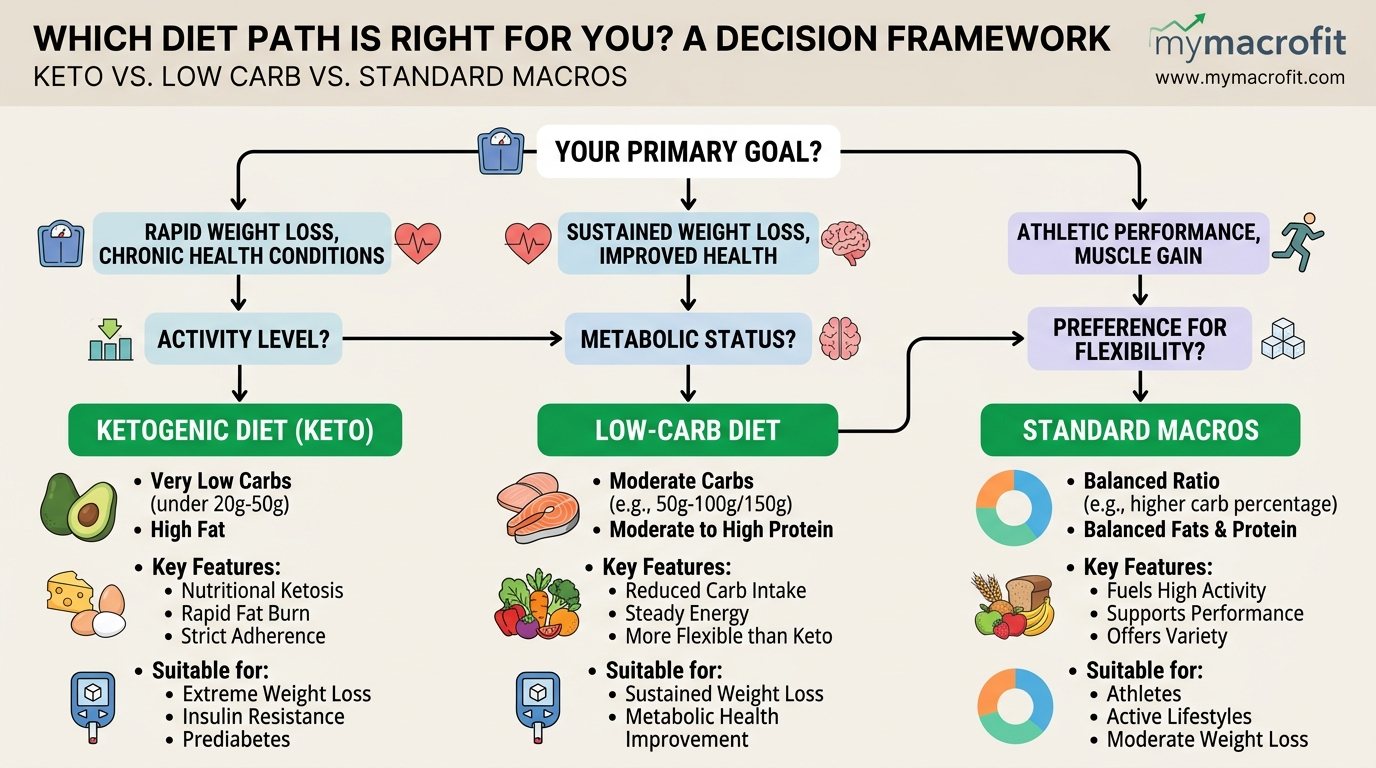
For most people, moderate low carb (100-150g carbs/day) offers the practical benefits of carb reduction without the strict constraints of full ketosis:
- Easier to maintain social eating
- No need for precise carb counting
- Better performance for training
- Fewer electrolyte issues
- More food variety (legumes, some fruit, sweet potato)
Full keto (under 50g carbs/day) is most valuable for people with specific metabolic conditions, those who find appetite control easiest with ketosis, or those doing therapeutic keto for epilepsy.
Consider this decision framework:
- Do you have insulin resistance, type 2 diabetes, or significant hunger on moderate carbs? → Try strict keto (under 50g)
- Do you want carb restriction benefits without strict ketosis? → Try low carb (50-100g)
- Are you currently eating 300g+ carbs and want to reduce gradually? → Start at 150g and reduce by 25g/week
Common Keto Mistakes
1. Not eating enough protein Many keto resources overcorrect on protein, worrying about gluconeogenesis (protein converting to glucose). For most people, even high protein intake (2g/kg) does not meaningfully disrupt ketosis. Low protein on keto leads to muscle loss.
2. Eating too much saturated fat without monitoring lipids Keto works excellently with olive oil, avocado, and oily fish. It's less ideal when dominated by processed cheese, bacon, and butter. Monitor LDL if you have cardiovascular risk factors.
3. Ignoring fibre and vegetable intake Low-carb vegetables are unlimited on keto. Neglecting them reduces fibre, gut microbiome diversity, and micronutrients. Fill half your plate with leafy greens, broccoli, and courgette at every meal.
4. Relying on keto "treats" and processed keto products The keto food industry has produced an array of sweetened, processed products marketed as keto-friendly. These don't represent healthy eating, just low-carb junk food.
5. Expecting immediate performance Keto-adapted endurance performance takes 3-6 months of consistent adaptation. The first 2-6 weeks often show performance decline. Don't judge keto's effect on training until you're fully adapted.
The Bottom Line
Keto is a legitimate, evidence-based dietary approach for fat loss and metabolic health, particularly for people with insulin resistance, type 2 diabetes, or those who find appetite control easier with carb restriction. It is not superior to other approaches for everyone.
Start with the Keto Macro Calculator to set your personal macros, stock your kitchen with the food list above, and commit to at least 8-12 weeks to get past the adaptation phase before evaluating results.
For a complete 7-day beginner keto meal plan, see our Keto Meal Plan for Beginners.
Sources
- Effects of low-carbohydrate diets on weight and cardiovascular risk factors, Batch et al., Nutrients, 2020
- Ketogenic diet in type 2 diabetes, Westman et al., JMIR Diabetes, 2018
- Low-carbohydrate diets for overweight and obesity, Hession et al., Obesity Reviews, 2009
Save & share on Pinterest
Click any card to pin it — or share with someone who needs it.
The Complete Keto & Low Carb Guide
Everything you need to know about keto and low carb diets, how they work, the evidence on fat loss, …
Everything you need to know about keto and low carb diets, how they work, the ev…
Read the full guide: The Complete Keto & Low Carb Guide
Try the free Keto Macro Calculator
The Complete Keto & Low Carb Guide — use our free calculators for instant personalised results. No s…
Pinterest opens in a new tab. You can edit the description before saving.
Ready to get your numbers?
Free calculator, instant results, no signup required.
Frequently Asked Questions
Is keto better for weight loss than a regular diet?+
What can you eat on a keto diet?+
How long does it take to get into ketosis?+
Is keto safe long term?+
About the Author

I'm a certified nutritionist and metabolic health coach. I went deep on keto and metabolism after reversing my own insulin resistance, and I'd rather give you the actual numbers than a hand-wave.
View full profile →