How to Lose Fat Without Losing Muscle

BSc Kinesiology · CPT
The goal of most people isn't just to lose weight, it's to lose fat while looking more toned and defined. That requires maintaining (or building) muscle while losing fat. This is body recomposition, and it's what separates a successful cut from a smaller, softer version of your starting physique.
The good news: the research on muscle preservation during fat loss is clear and actionable.
Why Muscle Loss During Dieting Happens
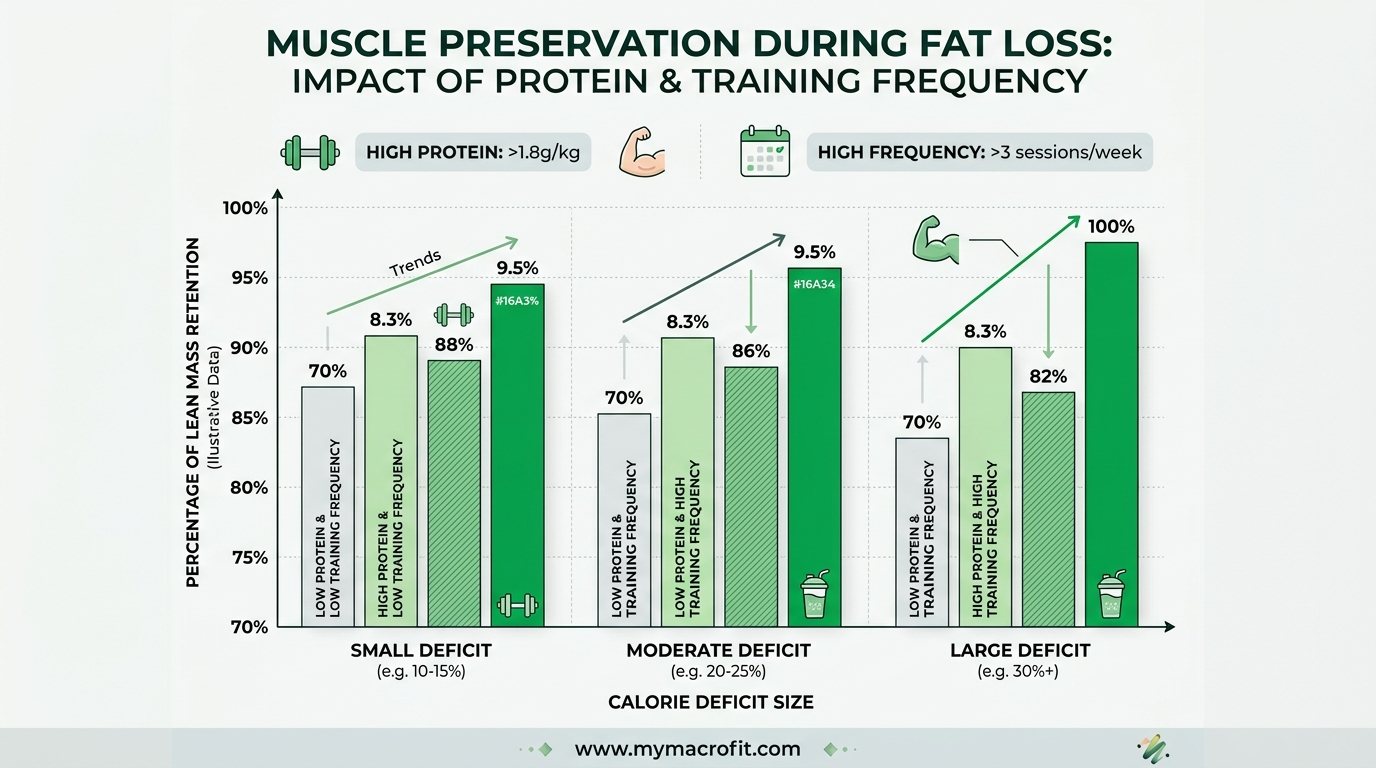
When in a calorie deficit, the body breaks down multiple tissues for energy, including fat AND muscle protein. The proportion of each is influenced by:
Protein availability: If amino acids from dietary protein aren't sufficient to maintain muscle protein balance, the body catabolises muscle protein for energy and gluconeogenesis. Higher dietary protein dramatically reduces this.
Training stimulus: Resistance training signals muscles to preserve themselves despite energy deficit, it's a direct "keep this" signal to muscle tissue. Without it, muscle loss accelerates.
Deficit magnitude: A larger deficit increases the proportion of energy coming from non-fat sources, including lean tissue.
Body fat percentage: Leaner individuals (less fat available) experience more muscle loss at a given deficit size, fat stores are more readily mobilised when they're abundant.
The Four Pillars of Muscle Preservation
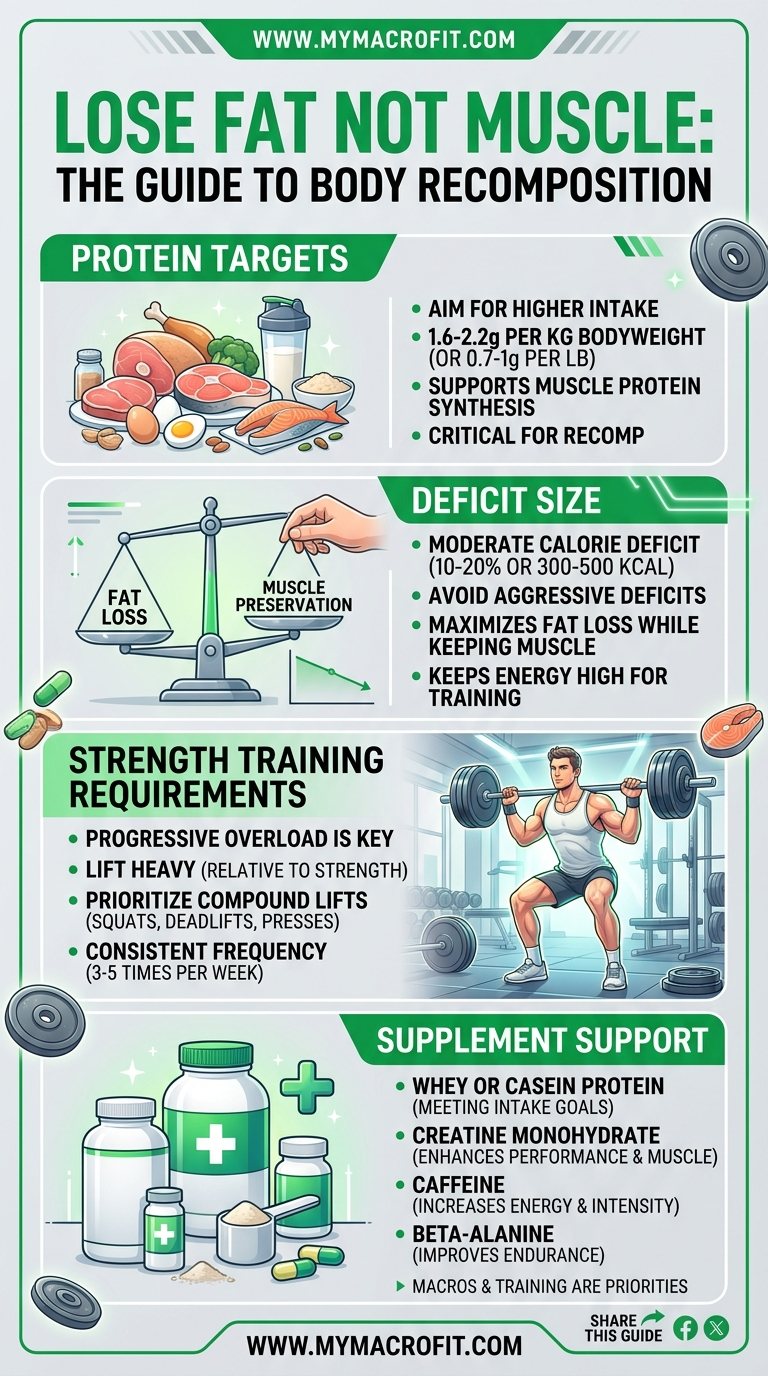
1. Protein: 2-2.2g per kg bodyweight
The most important dietary variable. During a deficit, your protein requirement is actually higher than during maintenance, because some dietary amino acids are used for energy rather than muscle synthesis.
Target: 2-2.2g per kg bodyweight (bodyweight, not lean mass, simpler to calculate)
For a 70kg person: 140-154g protein/day. For a 90kg person: 180-198g/day.
Distribute protein across 3-4 meals of 35-50g each. Research shows that muscle protein synthesis is maximised per meal at approximately 40g protein, the remaining protein still contributes to total daily balance.
2. Resistance Training: The Essential Signal
Every single time you perform resistance training, you send a muscle-preservation signal. This is the most powerful thing you can do to prevent muscle loss during a deficit, more important than any supplement.
Minimum training frequency: 3 full-body sessions per week
Critical principle: Maintain your training intensity and volume. The mistake many people make when dieting is reducing the weight they lift because they have less energy. This removes the stimulus for muscle preservation. Keep lifting heavy (adjust volume slightly if energy is low, not intensity).
Progressive overload: Even in a deficit, keep aiming to maintain or slightly progress on key lifts. This is a powerful signal that muscle is needed.
3. Deficit Size: 0.5-0.7kg/week Maximum
Aggressive deficits (1kg+/week) rapidly deplete both fat and muscle. More moderate deficits allow a higher proportion of the weight lost to come from fat.
Use the Calorie Deficit Calculator to set a deficit of 300-500 kcal/day from your TDEE.
Exception: Very overweight individuals can sustain slightly larger deficits (600-800 kcal) with less proportional muscle loss because abundant fat stores are more readily mobilised.
4. Creatine: The Only Supplement With Meaningful Evidence
Among all supplements for muscle preservation during a deficit, creatine monohydrate has the most evidence. Studies combining creatine supplementation with resistance training during calorie restriction show significantly greater lean mass preservation compared to training alone.
Dose: 3-5g daily. Continue without interruption during a cutting phase.
The Role of Cardio
Cardio is not the enemy of muscle, excessive cardio without adequate fuel is. The principles:
Moderate cardio (2-3 sessions, 30-40 min, moderate intensity): No meaningful impact on muscle when protein is adequate and resistance training is maintained.
High-volume cardio (5+ sessions/week) without adequate calories: Creates a cortisol environment that promotes muscle catabolism. This is the combination that earns cardio a bad reputation for muscle preservation.
Post-workout cardio: Do cardio after strength training when doing both in the same session, this ensures glycogen is available for the resistance training stimulus that matters most for muscle preservation.
Sleep: The Underestimated Variable
Growth hormone (GH) peaks during deep sleep, it's the primary repair signal for muscle tissue. Inadequate sleep (under 7 hours) reduces GH output and increases cortisol, both of which worsen muscle preservation during a deficit.
A study by Nedeltcheva et al. showed that people in a deficit sleeping 5.5 hours lost significantly more lean mass and less fat than those sleeping 8.5 hours, on the same diet. Sleep quality is a direct variable in body composition outcomes.
Minimum target: 7-9 hours consistently. See our improving sleep quality through nutrition guide.
What a Muscle-Preserving Cut Looks Like
Daily targets for a 75kg woman:
- Calories: TDEE − 400-500 kcal (approximately 1,600-1,800 kcal depending on activity)
- Protein: 150g/day
- Training: 3 strength sessions + 2 cardio sessions per week
- Sleep: 7-9 hours
- Creatine: 5g daily
Expected outcome over 12 weeks:
- Scale loss: 4-6kg
- Fat loss: 4.5-6.5kg
- Lean mass change: ±0kg (preserved or slightly increased with adequate stimulus)
This is body recomposition, the physique looks dramatically different at the same bodyweight compared to losing weight without the above protocol.
For a complete strength training programme for fat loss, see our dedicated guide.
The Bottom Line
Losing fat without muscle loss requires three non-negotiables: adequate protein (2-2.2g/kg), resistance training 3+ days/week, and a moderate deficit (300-500 kcal/day). Sleep quality and creatine provide meaningful additional support.
The physique difference between losing weight correctly versus incorrectly is dramatic, and it determines whether the weight you lost stays off long-term.
Save & share on Pinterest
Click any card to pin it — or share with someone who needs it.
How to Lose Fat Without Losing Muscle
The evidence-based guide to preserving muscle during a calorie deficit, optimal protein intake, trai…
The evidence-based guide to preserving muscle during a calorie deficit, optimal …
Read the full guide: How to Lose Fat Without Losing Muscle
Try the free Calorie Deficit Calculator
How to Lose Fat Without Losing Muscle — use our free calculators for instant personalised results. N…
Pinterest opens in a new tab. You can edit the description before saving.
Ready to get your numbers?
Free calculator, instant results, no signup required.
Frequently Asked Questions
How much protein do I need to preserve muscle while losing fat?+
Does cardio cause muscle loss?+
How fast should I lose weight to preserve muscle?+
How do I know if I'm losing fat or muscle?+
Should I do cardio or weights to lose fat without losing muscle?+
About the Author

I'm a kinesiologist and personal trainer. I've spent eight years helping women lose fat and get stronger without handing their whole life over to a diet.
View full profile →