How to Lose Weight Without Counting Calories

BSc Kinesiology · CPT
Calorie counting is the most reliable method for creating a specific deficit, but it's not the only way to lose weight, and for many people it creates an exhausting, obsessive relationship with food that isn't sustainable.
The good news: several evidence-based strategies naturally reduce calorie intake without counting. The key is understanding why they work.
Why Non-Tracking Approaches Work
Calorie restriction produces weight loss. Non-tracking approaches work because they reduce calorie intake through satiety and food quality rules, not through explicit measurement.
The goal of every strategy below is to increase the feeling of fullness per calorie consumed, getting your body to feel satisfied on fewer calories than it was previously eating.
Strategy 1: The Protein Rule
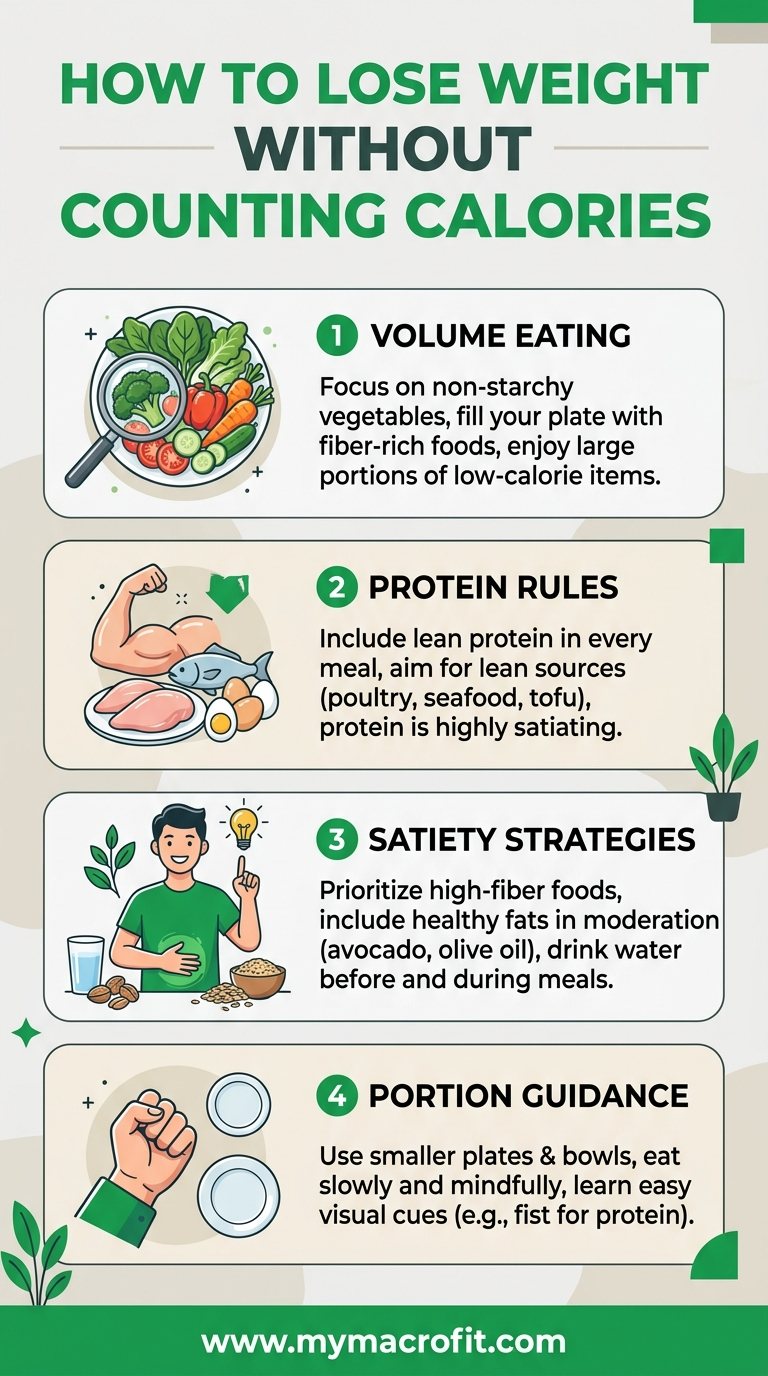
The single most impactful non-tracking change: Prioritise 30-40g of protein at every meal.
Why it works: Protein is the most satiating macronutrient. It suppresses ghrelin (hunger hormone) more effectively than carbs or fat, has the highest thermic effect (25-30% of calories burned in digestion), and signals satiety through multiple hormonal pathways.
Studies consistently show that people who increase protein intake spontaneously reduce total calorie consumption, without tracking.
Simple rule: Every meal has a protein source as its anchor.
- Breakfast: eggs, Greek yogurt, cottage cheese
- Lunch: chicken, fish, tuna, tofu
- Dinner: any lean protein source
For a complete protein foods list with protein content by food.
Strategy 2: The Plate Rule
Fill plates using this non-negotiable structure:
- Half plate: non-starchy vegetables (spinach, broccoli, courgette, salad)
- Quarter plate: protein source
- Quarter plate: complex carbohydrates
Why it works: Non-starchy vegetables have very low calorie density (~30-50 kcal per 100g) but high volume and fibre. A half-plate of vegetables at lunch and dinner adds roughly 200-300g of food for 80-120 kcal, this physical volume occupies stomach space and triggers stretch receptors, signalling fullness.
The same plate rule applied consistently produces a natural calorie reduction of 300-400 kcal/day in most people.
Strategy 3: The Ultra-Processed Food Limit
Ultra-processed foods are engineered to be hyper-palatable, salt, sugar, fat, and texture are calibrated to override normal satiety signals and encourage overconsumption.
The most impactful single food rule: Eat ultra-processed foods as less than 20% of your diet by meal frequency.
Why it works: A 2019 RCT (Hall et al.), the only true controlled human study of ultra-processed vs. whole food diet, found people eating an ultra-processed diet consumed 500 kcal/day MORE than when eating whole foods matched for energy density, and gained weight, while the whole food group lost weight, without any explicit restriction.
This is the strongest evidence that food quality affects calorie intake beyond just calorie density.
Practical: Most meals and snacks should be minimally processed whole foods. Ultra-processed foods (crisps, biscuits, ready meals, fast food) are not forbidden, just not the default.
Strategy 4: The Slow Eating Protocol
Satiety signals from the gut take approximately 20 minutes to reach the brain. Fast eating bypasses this mechanism, you can consume 500+ calories before your brain registers satisfaction.
Evidence: Studies consistently show that slower eating reduces meal calorie intake by 10-15% without any conscious effort.
Practical rules:
- Put your fork down between bites
- Chew each mouthful thoroughly
- No screens during meals (distracted eating increases intake ~20%)
- Eat sitting at a table, not standing or on the move
Strategy 5: Liquid Calories, The Overlooked Source
Liquid calories don't suppress appetite proportionally to their calorie content. Drinking 200 kcal of juice produces far less satiety than eating 200 kcal of chicken.
Common liquid calorie sources that derail non-tracking weight loss:
- Alcohol (7 kcal/g, often 300-800 kcal per evening)
- Fruit juice (150-200 kcal per glass)
- Barista-style coffees (lattes, frappuccinos: 200-500 kcal each)
- Smoothies (home-made can easily reach 400-600 kcal)
Rule: Drink water, black coffee, or unsweetened tea. Everything else counts, whether or not you're tracking.
Strategy 6: The Water Pre-Load
Drinking 400-500ml of water 20-30 minutes before a meal significantly reduces meal calorie intake in multiple RCTs (by approximately 100-150 kcal per meal).
The mechanism is simple: water occupies volume in the stomach, reducing the physical space available for food before fullness is signalled.
This single habit, applied consistently at 2-3 meals daily, produces a 200-450 kcal/day natural deficit without any other change.
When Non-Tracking Works (and When It Doesn't)
Works well for:
- People who find tracking obsessive or anxiety-inducing
- People with a relatively straightforward dietary pattern
- Those who are overweight and making mostly poor food quality choices
- Maintenance after reaching a goal weight
Works less well for:
- People very close to their goal weight (smaller deficit needed, less margin for imprecision)
- People with metabolic conditions affecting hunger signals (insulin resistance, PCOS)
- People who have been dieting for years and have calibrated their hunger signals poorly
- Those who want maximum speed or specific targets
The evidence-based hybrid: Track precisely for 2-4 weeks to build genuine awareness of calorie and protein content in your regular foods. Then use intuitive eating informed by that knowledge. This is the most effective long-term approach.
Assessing Progress Without Tracking
Without counting calories, you need another method to assess whether you're in a deficit:
Weekly weight average: Weigh daily, calculate weekly average, compare week to week. Downward trend = deficit. Stable for 3+ weeks = not in a sufficient deficit.
Clothes fit: Useful secondary signal, scales miss body composition changes.
Energy and hunger levels: Persistent extreme hunger suggests the deficit is too large. Minimal hunger despite food-quality changes suggests you may not be in a deficit.
Use our TDEE Calculator to understand your baseline calorie needs, even if you're not tracking, knowing your TDEE helps you understand the scale of change your dietary habits need to create.
The Bottom Line
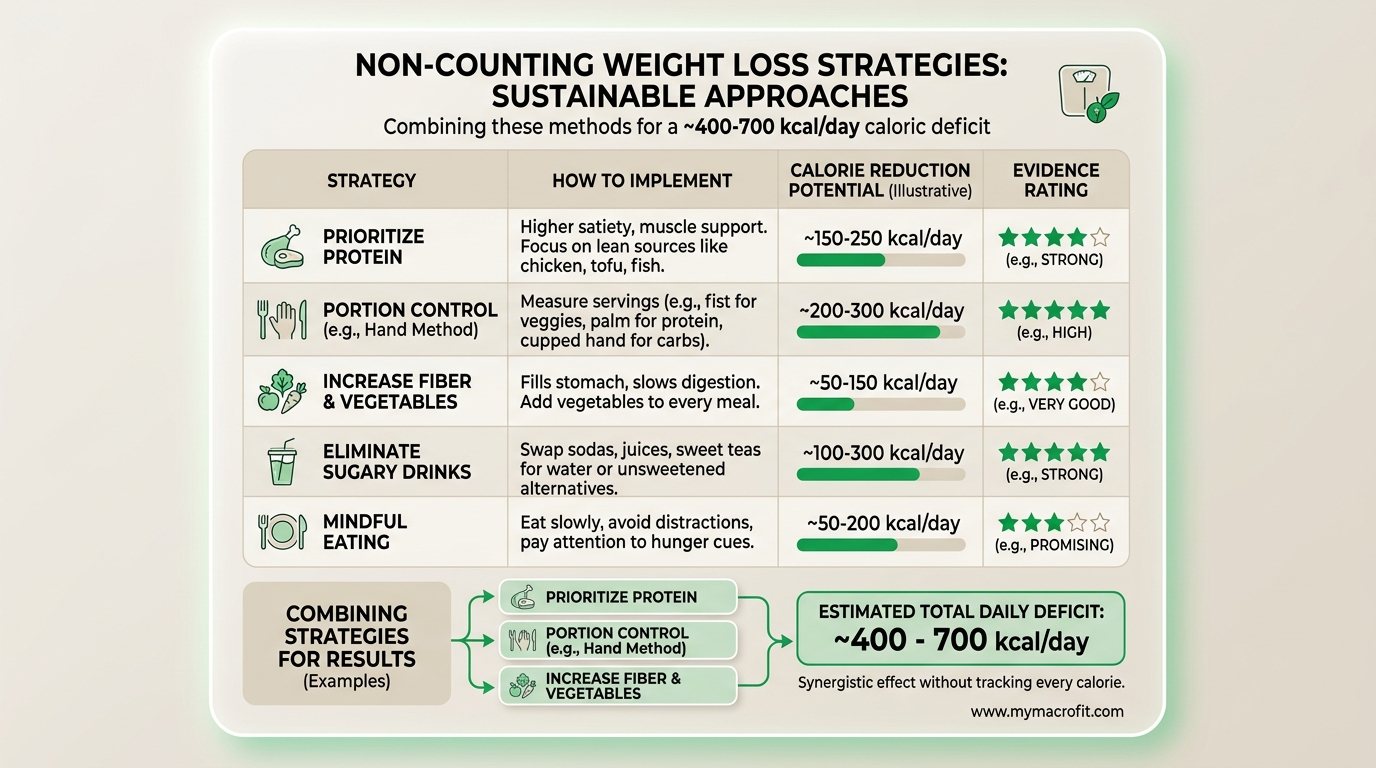
You can absolutely lose weight without counting calories, using protein priority, volume eating, food quality rules, slow eating, and liquid calorie awareness. These strategies produce a natural 400-700 kcal/day deficit for most people starting from a typical Western diet.
If weight loss stalls after 3 weeks of applying these strategies consistently, short-term tracking (2 weeks) will reveal where the hidden calories are coming from. Non-tracking doesn't mean ignoring feedback, it means using weight trend as your signal rather than a daily calorie log.
Save & share on Pinterest
Click any card to pin it — or share with someone who needs it.
How to Lose Weight Without Counting Calories
Practical strategies to lose weight without calorie counting, volume eating, food quality rules, sat…
Practical strategies to lose weight without calorie counting, volume eating, foo…
Read the full guide: How to Lose Weight Without Counting Calories
Try the free TDEE Calculator
How to Lose Weight Without Counting Calories — use our free calculators for instant personalised res…
Pinterest opens in a new tab. You can edit the description before saving.
Ready to get your numbers?
Free calculator, instant results, no signup required.
Frequently Asked Questions
Can you lose weight without counting calories?+
What are the best strategies to eat less without feeling hungry?+
How do I know if I'm in a calorie deficit without tracking?+
Is it better to count calories or eat intuitively for weight loss?+
What should I do if I stop losing weight without tracking?+
About the Author

I'm a kinesiologist and personal trainer. I've spent eight years helping women lose fat and get stronger without handing their whole life over to a diet.
View full profile →