Net Carbs vs Total Carbs: What's the Difference?

CN · Metabolic Health Coach
Net carbs appear on keto-friendly food products, low-carb meal plans, and fitness apps. But what does the number actually mean, how is it calculated, and does it matter for your goals?
Total Carbohydrates: What the Label Shows
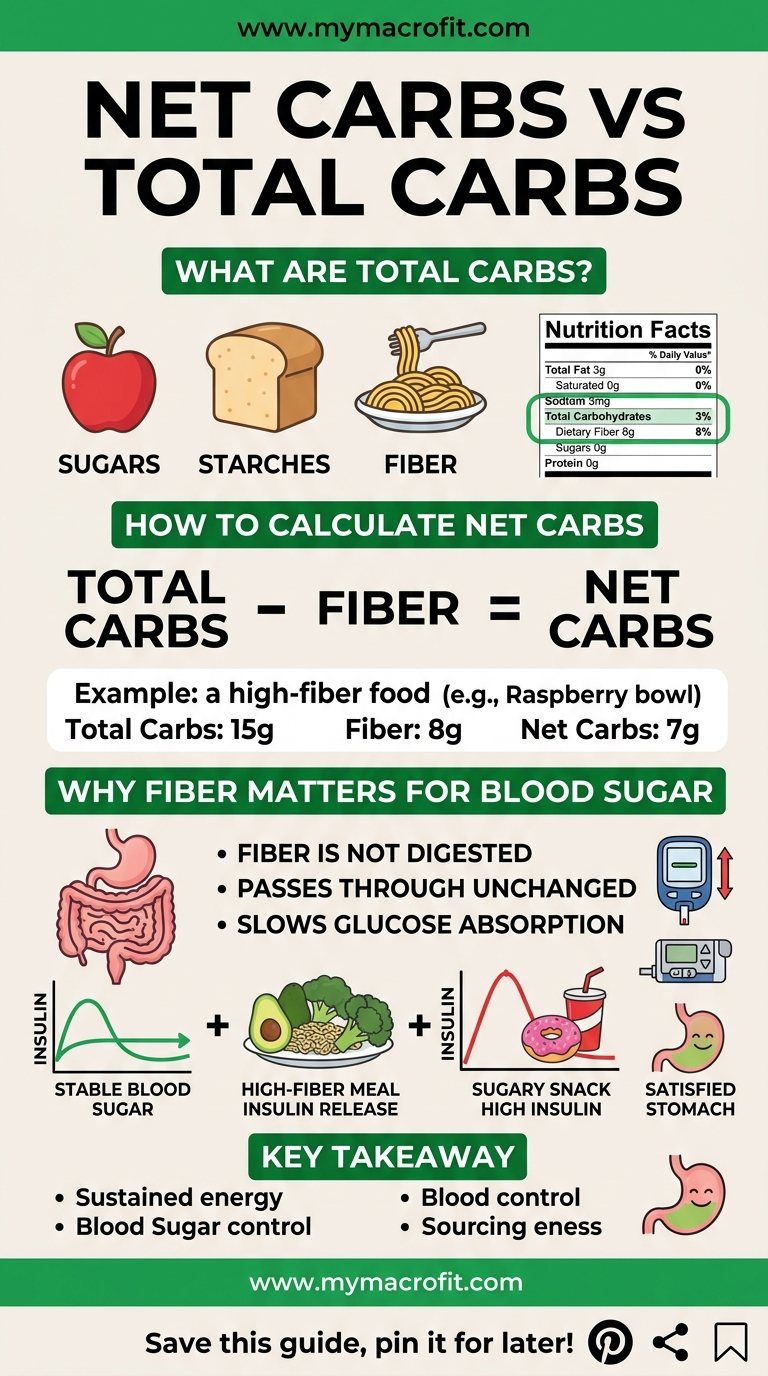
The total carbohydrates figure on a UK food label includes everything classified as a carbohydrate:
- Digestible starches
- Sugars (both naturally occurring and added)
- Dietary fibre
- Sugar alcohols (if present)
All of these are counted in the total carbohydrate figure.
What Are Net Carbs?
Net carbs subtract the carbohydrate components that don't significantly raise blood glucose:
Net Carbs = Total Carbohydrates − Dietary Fibre
(Some calculations also subtract sugar alcohols, depending on the type)
Why fibre is subtracted:
Dietary fibre cannot be digested and absorbed by human small intestinal enzymes. It passes to the large intestine where gut bacteria ferment it. This fermentation produces short-chain fatty acids, but it doesn't produce glucose, doesn't trigger significant insulin release, and doesn't affect ketosis.
Because fibre doesn't raise blood glucose, it's considered a "non-impact" carbohydrate, hence its subtraction to arrive at net carbs.
Example:
An avocado has:
- Total carbohydrates: 9g
- Dietary fibre: 7g
- Net carbs: 2g
Despite being a 9g total carb food, it has minimal blood glucose impact.
Sugar Alcohols: The More Complex Subtraction
Sugar alcohols (polyols) are partially digested carbohydrates used as low-calorie sweeteners. They appear in many "keto-friendly" products:
| Sugar alcohol | Blood glucose impact | Subtract fully? |
|---|---|---|
| Erythritol | Very minimal (zero for most) | Yes, usually fully subtracted |
| Xylitol | Moderate (about 50%) | Partially, subtract 50% |
| Maltitol | Significant (similar to table sugar) | No, don't subtract |
| Sorbitol | Moderate (about 50%) | Partially |
The keto trap: Many "keto" products use maltitol and subtract it entirely in their net carb calculation, but maltitol raises blood glucose significantly and can impair ketosis. Check which sugar alcohols are used in labelled "net carb" products.
How to Calculate Net Carbs
From a UK food label:
UK labels show "Carbohydrates" and "of which fibre" separately. Net carbs = Carbohydrates − Fibre.
Wait, UK labels already separate fibre from total carbohydrates in many cases. The "Carbohydrates" figure on UK nutrition labels typically does NOT include fibre (unlike US labels where fibre is included in total carbohydrates).
UK label reading:
- UK total carbohydrates figure ≈ already excludes fibre in most labelling formats
- Check whether fibre is listed under carbohydrates or separately
The concept of "net carbs" was developed primarily in the US where fibre IS included in total carbohydrate counts on labels. For UK readers: the carbohydrate figure on most labels is close to what Americans would call "net carbs."
When Net Carbs Actually Matter
Ketogenic Dieting
The primary context where net carbs vs. total carbs is a practical daily decision. Keto aims for 20-50g net carbs to maintain ketosis. Counting total carbs would make eating adequate vegetables nearly impossible.
Use our Keto Macro Calculator to set your specific carb threshold.
Example comparison:
- 200g broccoli: 6g total carbs, 3g fibre → 3g net carbs ✅
- 200g broccoli counted as 6g total: would rapidly exceed a 20g total carb limit without room for much else
Blood Glucose Management
For people with type 2 diabetes or insulin resistance, net carbs (i.e., the carbs that actually raise blood glucose) are more clinically relevant than total carbs. High-fibre foods that have the same total carbs as low-fibre foods produce very different glycaemic responses.
General Health (Not Keto)
For most people not following a ketogenic diet, tracking net carbs isn't necessary. Focus instead on:
- Total fibre intake (30g/day target, most people are under 20g)
- Quality of carbohydrates (whole grains, legumes, vegetables vs. refined carbohydrates)
- Total carbohydrate amount in the context of overall calorie balance
Practical Examples
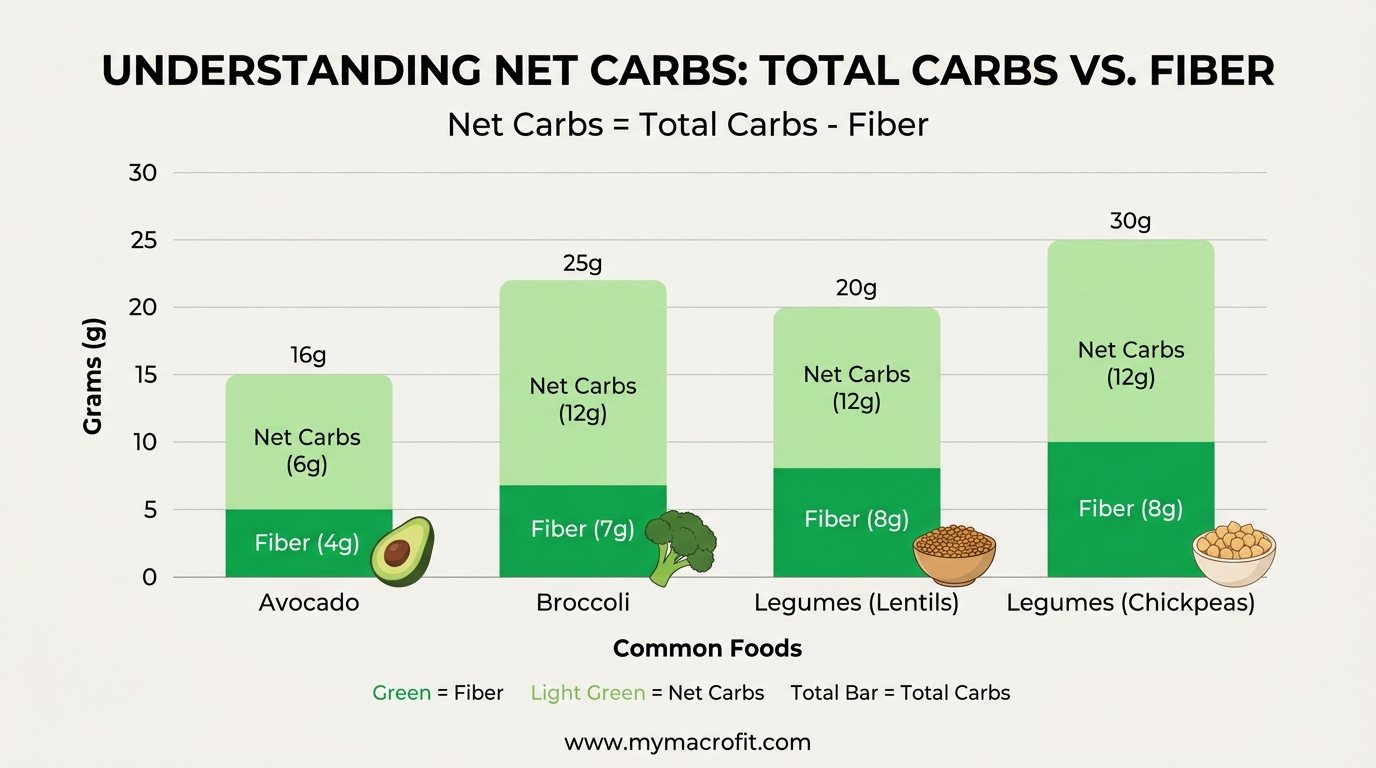
| Food (100g) | Total carbs | Fibre | Net carbs |
|---|---|---|---|
| Avocado | 9g | 7g | 2g |
| Broccoli | 7g | 3g | 4g |
| Lentils (cooked) | 20g | 8g | 12g |
| Oats (dry) | 66g | 10g | 56g |
| Chickpeas (cooked) | 27g | 8g | 19g |
| White bread | 49g | 2g | 47g |
| Berries (mixed) | 14g | 5g | 9g |
This illustrates why legumes and vegetables are favoured in low-carb approaches, their high fibre dramatically reduces net carb impact.
The Bottom Line
Net carbs = total carbohydrates minus dietary fibre (and sometimes certain sugar alcohols). This matters most for ketogenic dieting and blood glucose management. For general healthy eating, focus on total fibre intake (30g/day) and carbohydrate quality rather than tracking net carbs specifically.
Save & share on Pinterest
Click any card to pin it — or share with someone who needs it.
Net Carbs vs Total Carbs: What's the Difference?
The difference between total carbohydrates and net carbs, how to calculate net carbs, and when net c…
The difference between total carbohydrates and net carbs, how to calculate net c…
Read the full guide: Net Carbs vs Total Carbs: What's the Difference?
Try the free Keto Macro Calculator
Net Carbs vs Total Carbs: What's the Difference? — use our free calculators for instant personalised…
Pinterest opens in a new tab. You can edit the description before saving.
Ready to get your numbers?
Free calculator, instant results, no signup required.
Frequently Asked Questions
What are net carbs?+
Do you count total carbs or net carbs on keto?+
Do net carbs matter if you're not doing keto?+
Are sugar alcohols really 'free' carbs you can subtract?+
Should I count net carbs or total carbs to lose weight?+
Does fibre really have no calories or blood-sugar effect?+
About the Author

I'm a certified nutritionist and metabolic health coach. I went deep on keto and metabolism after reversing my own insulin resistance, and I'd rather give you the actual numbers than a hand-wave.
View full profile →